The Ethical Marketing Campaign for Addiction Treatment (EMCAT) was founded by a coalition of dedicated individuals united by a commitment to enhance standards
Share your Experience of Getting Addiction Support
If you called a helpline or were guided towards a rehab, we’d like to hear about your experience.
Were you given options? Did something feel unclear? Did it work for you?
You can share anonymously.
All experiences - good or bad - are welcome.
Link to our website in comments section
Share your Experience of Getting Addiction Support
If you called a helpline or were guided towards a rehab, we’d like to hear about your experience.
Were you given options? Did something feel unclear? Did it work for you?
You can share anonymously.
All experiences - good or bad - are welcome.
Link to our website in comments section
Boom in ketamine clinics and at home delivery sparks safety concerns
by American Society of Anaesthesiologists
The American Society of Anesthesiologists called on policymakers to address the fast-growing problem of home delivery of ketamine and the lack of physician oversight in ketamine clinics. In guidance updated this month, ASA emphasised that ketamine used for non-anesthetic purposes should meet the same safety standards as other anesthetic drugs.
EMCAT Seeks People Affected by Patient Brokering
EMCAT is calling on anyone who believes they may have been affected by patient brokering or unethical addiction treatment marketing practices to come forward.
Patient brokering occurs when individuals or organisations receive hidden referral fees for directing people into addiction treatment services - often without the patient’s knowledge. These practices can mislead vulnerable people seeking help and prioritise profit over appropriate care.
Despite growing awareness and investigations into the issue, patient brokering continues to affect people in the UK addiction treatment sector.
If you believe you were referred into treatment through misleading advice, deceptive marketing, or undisclosed financial arrangements, EMCAT would like to hear from you.
Details in the comment section.
Share your Experience of Getting Addiction Support
If you called a helpline or were guided towards a rehab, we’d like to hear about your experience.
Were you given options? Did something feel unclear? Did it work for you?
You can share anonymously.
All experiences - good or bad - are welcome.
Link to our website in comments section
AI, Addiction Treatment, and Ethics: Innovation at a Crossroads in the UK
Back in February 2026, the UK government put £20 million behind its Addiction Healthcare Goals programme. They want to shake up drug and alcohol treatment - a big promise, really - by bringing in AI, mobile apps, wearables, and virtual care.
The goal? Cut harm, save lives, and help more people build a life in recovery. It’s a big moment. Addiction services in the UK have struggled for years - never enough money, plenty of stigma. Now, with this cash, the sector becomes a testing ground for tech. But don’t be fooled into thinking you can just throw AI at the problem and walk away. The real challenge is figuring out how you use the technology, who gets to be in charge, and how you make sure it actually supports people, not just numbers on a screen. Because recovery isn’t just about data or algorithms - it’s built on trust, empathy, and real human connection.
Technology can help people heal, find support, and regain control of their lives - if we use it wisely. Mismanaged, it just adds to the struggles they already face. Let’s use it right.
https://t.co/4AJl8LF3KL
ASA bans weight loss jab discount code posts for Voy, Zava, MedExpress and UK Meds Direct
Men
The UK advertising watchdog has banned a series of social media posts that shared discount codes and referral links for online pharmacies and prescribers selling prescription-only weight-loss injections, including Wegovy and Mounjaro.
BBC investigation finds Voy and MedExpress finds weight loss jabs sold without full checks.
A BBC investigation found it was possible to order weight-loss injections from Voy and MedExpress using inaccurate details and an out-of-date photo, with no further verification.
We’re thrilled to welcome Rosalie Weetman to the EMCAT Advisory Board!
A Derbyshire public health expert, Rosalie brings decades of experience in addiction, mental health, and community wellbeing. Since 2014, she’s led the Inclusion Health portfolio at Derbyshire County Council, covering everything from trauma-informed care to substance use support.
Her career spans national and local probation work, CEO leadership at a regional drug and alcohol charity, advisory roles with the Health & Social Care Committee, and three terms on the Advisory Council on the Misuse of Drugs. She’s also consulted on drug and alcohol programs across the UK and internationally.
Rosalie’s focus on evidence-based care and ethical practice aligns perfectly with EMCAT’s mission: shining a light on misleading marketing in addiction treatment and raising standards for the people who need help most.
We’re excited for the insight and expertise she brings to the board!
https://t.co/8cqVHTxxgv
AI chatbots could help people trapped in the “iron triangle” of risky drinking.
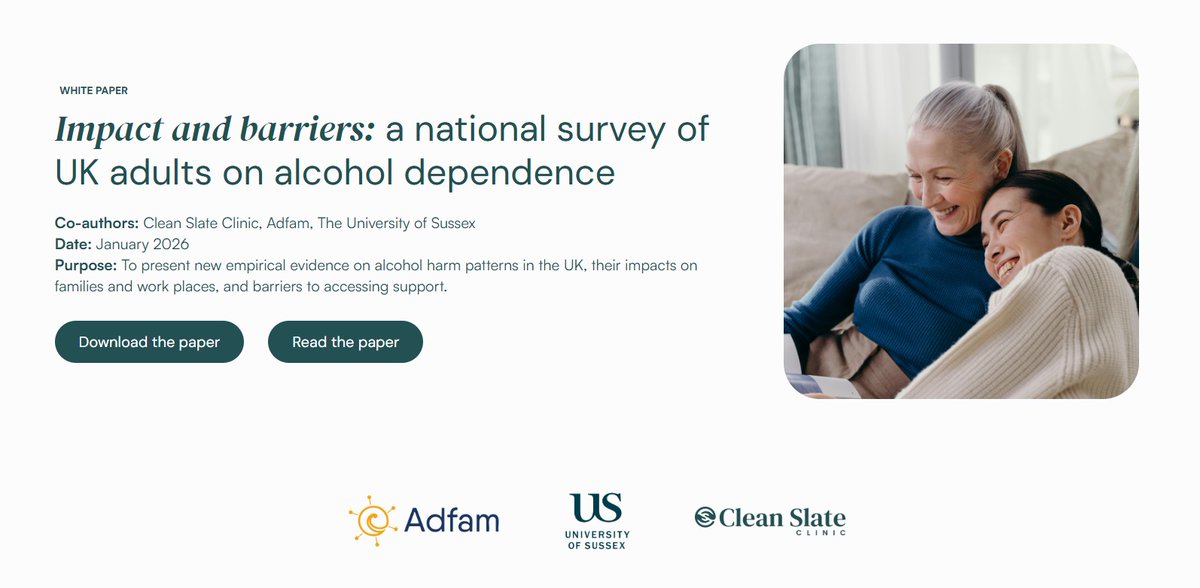
A new report by alcohol charity Adfam, the University of Sussex, and social enterprise Clean Slate Clinic reveals that cost, stigma and poor access are preventing employed people in the UK from seeking support for alcohol misuse.
https://t.co/QxrjBO9jRo
A recent white paper from Clean Slate Clinic, Adfam and the University of Sussex reveals stark realities: despite the scale of alcohol dependence in the UK, too many people are left without meaningful support. Stigma, lack of awareness, long waiting lists and under-resourced services are blocking access to help - and the human cost isn’t just personal, it’s social, economic and systemic.
https://t.co/Q1gi3pKCYf
When “Help” Websites Get Data Protection Wrong: An EMCAT Review
People looking for addiction treatment are among the most vulnerable users online. Yet many of the websites they turn to fail basic standards of transparency, consent, and data protection. What we found raises serious concerns about ethics, legality, and trust in parts of the sector.
In reviewing a number of patient-brokerage and home-detox referral websites, EMCAT identified recurring problems including outdated or inaccurate privacy policies, unclear or misleading identification of the data controller, reliance on implied “consent” in a healthcare context, and cookie and tracking practices that fall short of UK GDPR standards.
These issues matter because addiction treatment enquiries frequently involve sensitive health data and moments of acute vulnerability. Transparency and lawful data handling are not technicalities here - they are ethical fundamentals.
EMCAT has previously worked with the Information Commissioner’s Office on data-protection concerns in this sector, and this review forms part of our ongoing effort to raise standards and protect patients and families at the point of first contact.
https://t.co/lfAipPMSbN
When searching for addiction treatment online, not every site that looks like a rehab actually provides care. Some “ghost rehabs” pose as clinics but operate no facility, employ no clinical staff, and simply pass enquiries to third-party providers for a commission fee - sometimes without making this clear. Others may create fake listings or keep websites active long after a clinic has closed.
These practices can mislead vulnerable people making critical medical and financial decisions. Always ask whether a service runs its own rehab, how referrals are funded, and verify that any clinic is registered with the relevant regulator. In addiction treatment, clarity isn’t just a detail - it’s a safeguard.
https://t.co/X2Z9EvOnL6
@ASA_UK@CAP_UK@ICOnews@CareQualityComm
We’re excited to have Dr David McLaughlan, join the EMCAT Advisory Board!
David’s one of the UK’s top addiction psychiatrists, with more than ten years working right on the front lines. Right now, he’s the Academic Secretary for the Royal College of Psychiatrists’ Faculty of Addictions and the UK Clinical Director at Clean Slate Clinic.
He’s won awards, he’s been in the media, and he’s a real advocate for addiction care that’s ethical, evidence-based, and open to everyone.
We’re looking forward to his insights as we push EMCAT’s mission forward.
Welcome aboard, David!
https://t.co/iN0zqwsS3e
📊 How does the UK stack up on residential addiction treatment? 🇬🇧
In the UK, only a tiny percentage of people in drug and alcohol treatment enter residential care - around 2% - because the system prioritises community and outpatient support. Meanwhile, other countries like Italy have a much stronger tradition of inpatient care, with 10–20% of people in treatment getting residential help, and places like the US and Australia sit somewhere in between.
🔹 What does this mean?
➡️ The UK’s approach focuses on wide-reach, community-based services - but that can leave those with severe and complex needs with limited access to intensive residential support.
📘 Dive into the full picture and see how policy shapes treatment options here 👇
https://t.co/yjcFCupRx8
#AddictionTreatment #ResidentialRehab #PublicHealth #UKPolicy #DrugAlcoholSupport
@DHSCgovuk@AshleyDalton_MP