Can your Creedal God do any of this?
- Love us (in any meaningful sense of the term)
- Honor our agency
- Mourn with those that mourn
- Seek our exaltation (not mere obedience)
1. God loves us because God wills our good only and never wills bad to come to us. No other person (or persons) love us in that way
2. God honors our agency, God does not make us do thinks like marionettes
3. Due to the incarnation, God became man. And as such, mourned and suffered
4. To quote Athanasius from his work On the Incarnation, God became man so that man can become God. And Athanasius was a hardline Nicene Christian, and was exiled 5 times at least for it.
@ThoughtfulSaint Starting with the apostolic proclamation of Jesus necessitates an invisible, immutable, impassible, infinite, eternal, transcendent, etc. God lol
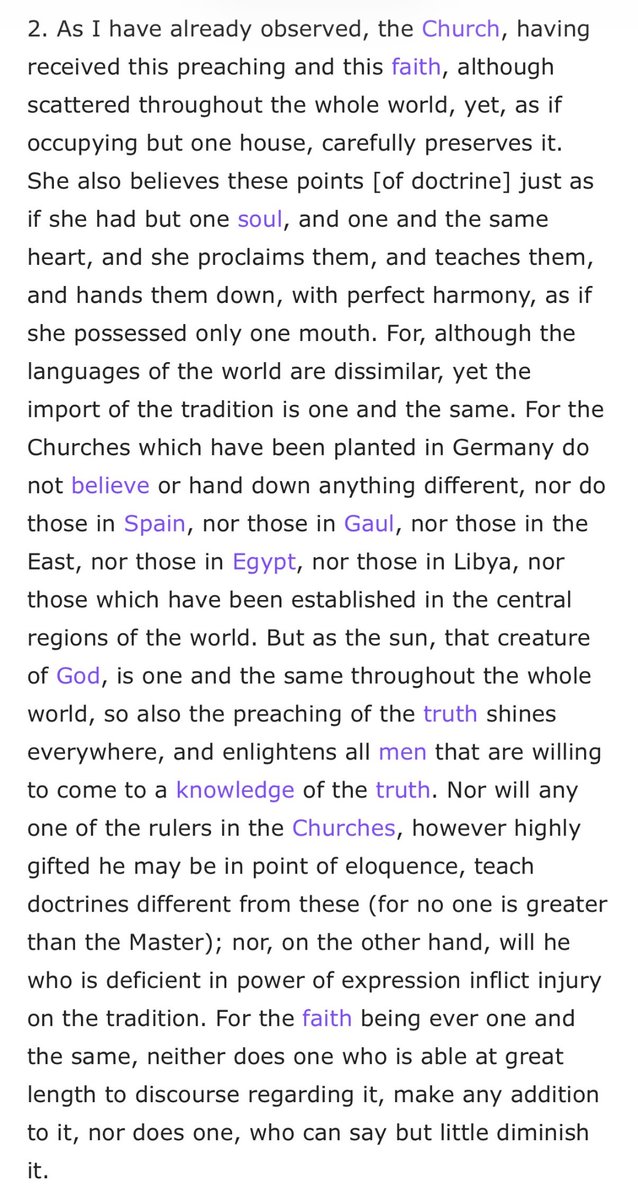
@LukeFHan Depends on what you mean. The standard is the rule of faith: the apostolic proclamation received and handed down. History doesn't replace that standard, it just lets us examine whether that claim is true.
@AaronRHolloway1@Lets_Talk_HC@CapturingChrist I think the issue is that the theology you're calling Greek shows up in OT, Jesus, Paul, Justin and Irenaeus, etc. (e.g. God is incorporeal). Unmoved Mover is just aristotelian language applied to the biblical God. Not adopted wholesale (ex. Aristotle's god cant die for sins)
@LukeFHan Right so the question isn't "is there a standard" but "Which one?" We operate with different rules. Christianity with the rule of faith received and passed down from apostles; LDS with prophets/revelation. The former is public/historical/checkable. The latter isn't.
@AaronRHolloway1@Lets_Talk_HC@CapturingChrist Well even if that were the case (I don’t think so) that concession totally voids Jacob’s argument in the video about some apostasy happening beginning with the church fathers
@AaronRHolloway1@Lets_Talk_HC@CapturingChrist Example: NT was written in Greek. The NT authors quote from Greek Septuagint. The fathers used Greek vocab (ousia, physis, hypostasis) but they didn't leave the content of those terms untouched. Other doctrines were contrary to Greek thought (e.g. creation ex nihilo)
@AaronRHolloway1@Lets_Talk_HC@CapturingChrist I was being cheeky with the metaphor (bc tweet) so it’s not super precise, but essentially yes my argument would be that Christianity put on some Greek socks. Same Christian feet, just maybe red socks instead of blue.
@AaronRHolloway1@Lets_Talk_HC@CapturingChrist Haha nice. But concepts aren’t ingredients! And mixture isn’t what Wilken is arguing. He’s arguing that instead of Christianity being the husk for Hellenism, some Greek words/concepts became the husk for Christianity. That’s different—a difference that’s no small potatoes!
According to Irenaeus in AH 3.20.1, humans should never assume two things:
(1) that the incorruptibility which surrounds him is his own by nature,
(2) nor, by not holding the truth, should boast with empty superciliousness, as if he were by nature like to God.
NEW: Artemis II Commander Reid Wiseman reflects on being MOVED to tears by the Christian cross after returning to Earth from the historic expedition:
"When I got back on the on the ship — I'm not really a religious person — but there was just no other avenue for me to explain anything or to experience anything."
"So I asked for the chaplain on the Navy ship to just come visit us for a minute, and when that man walked in, I'd never met him before in my life. But I saw the cross on his collar, and I just broke down in tears."
"It's very hard to fully grasp what we just went through."
@manmotion@John_Stone_@ThoughtfulSaint Still not addressing the critique. Regardless, what you've shown isn't that the Bible doesn't teach creation ex nihilo, only that your methodology can't see it. Those are two diff claims