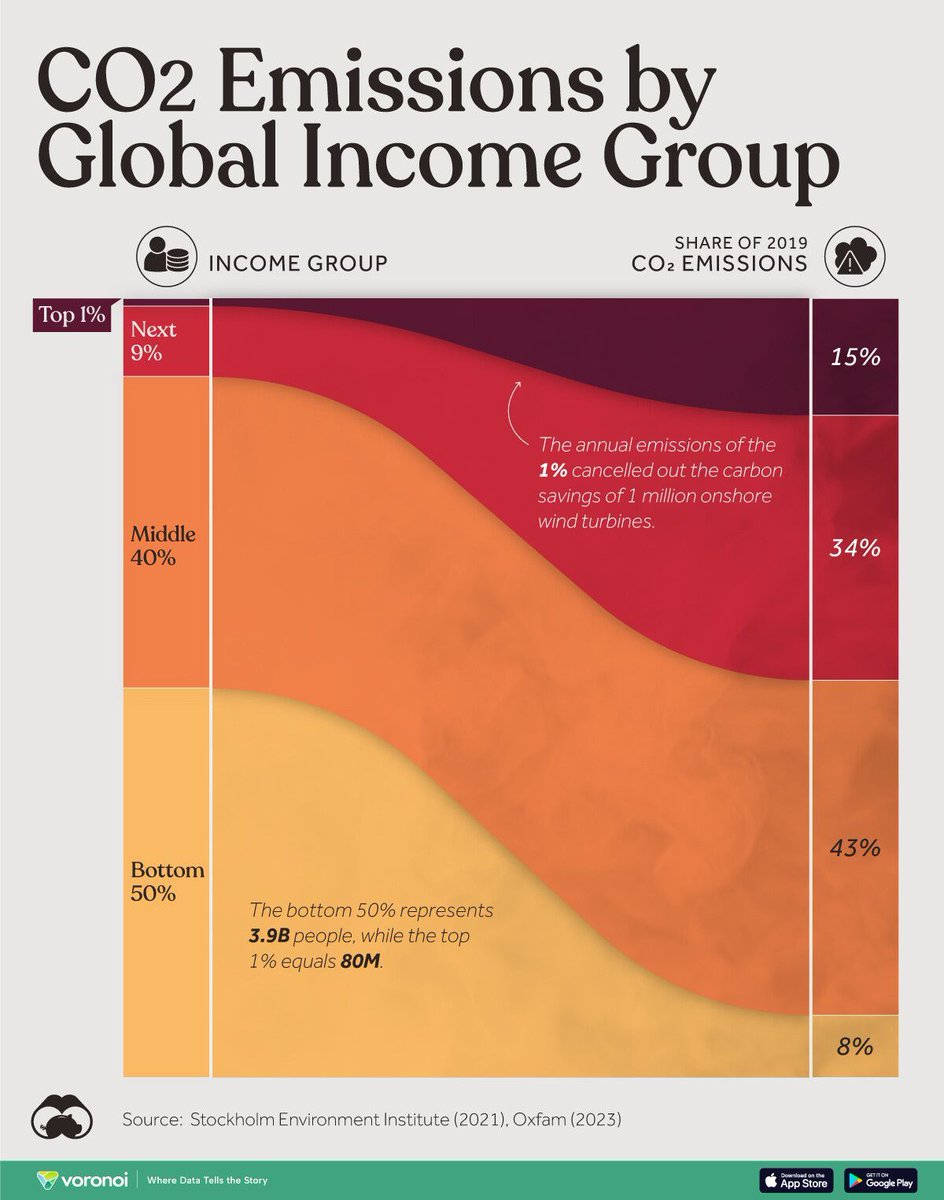
The richest 1% are responsible for the same quantity of planet-wrecking greenhouse gases as two-thirds of humanity.
These are not natural facts. They are the result of humanity’s choices.
We can, and must, decide to do things differently.
4 ways the #climate crisis could be coming for your income: @wef highlights SEI's #CarbonInequality findings in this new article, with a data illustration by @VisualCap.
Read more ⤵️
https://t.co/ARu8L7CWCG
cc @Emi_Ghosh @NazNishu
Check out the new @FAOInvest and @SEIResearch report on investment trends in agricultural #water by int’l financing institutions + emerging areas for investment and innovations to improve water productivity and efficiency. https://t.co/POfESIUd3a
A more equal distribution of limited resources and #ecological space are necessary for a better future.
Read more from SEI's @naznishu and @Emi_Ghosh in their research supporting #Stockholm50 earlier this month: https://t.co/qiqUbbKyqS
News 🚨:
The 6-3 #SCOTUS ruling in West Virginia v. EPA, the most significant climate case in a decade, delivers a blow to President Joe Biden’s efforts to tackle planet-warming emissions and make electricity generation carbon-free by 2035.
https://t.co/VudJEspktS
Feeling truly depressed after the #RoeVWade ruling. That 5 people took away the human rights of millions. That millions no longer have full autonomy over their own body and make decisions to preserve their physical and mental health. So scared about what they’ll take away next.
insane how the only notable change since Sandy Hook is that kids are now formally trained to hide, barricade doors, fight, or run for their lives. that was the solution. to literally put the responsibility on them to figure it out and wish them luck.
The bottom line is climate action needs money. But we need to make sure the solutions are well thought out, context-specific and actively involve local communities in decisions. Otherwise, we risk locking-in solutions that reproduce existing inequalities. https://t.co/brrcWtC3C4
Eight takeaways from #IPCC#ClimateReport on mitigation:
Energy
Investment & finance gaps
Equity
Dietary shifts
Industry impacts
Transportation
Carbon dioxide removal
Finance geopolitics
cc @cleoverk @dr_olsson@Miquel_SEI@KarthaSivan@Emi_Ghosh
Read: https://t.co/THF15TVCdo
Do you want to help drive an equitable transition to a sustainable future?
SEI US is recruiting a social scientist with expertise in #inequality, #ClimateChange and #SustainableDevelopment in Somerville, MA.
Interested? Learn more and apply by 18 April! https://t.co/Z3CrKnxKRa
"The total emissions of the richest 10 percent alone are set to exceed the 1.5°C-aligned level in 2030, regardless of what the other 90 percent do" - study from @SEIresearch and @IEEP_eu
This is one of the many reasons why we need climate justice. #COP26
https://t.co/IuyQaXozTx
Climate change isn’t a future problem, it’s a problem *now*. Millions displaced due to climate events in the last 6 months alone. But of course those with the power to do something about it are the least affected by it.
Tracking these increases in radiative forcing — less & less energy escaping to space — not only reinforces the scientific conclusion that humans are driving climate change, it may enable monitoring the impact of emissions policies and refining model projections of future change.
“Since several of the Provinces seem to be fine with humanity’s extinction as long as it doesn’t hurt our GDP, the task has fallen to the federal government”...so much 🤦🏾♀️
So honoured to be included in the February issue of @OneEarth_CP. Read my piece on the importance of collecting disaggregated data and increasing inclusiveness in decision-making processes to help close the environmental inequality gap.
When it comes to implementing sustainable solutions, ‘fairness’ is often a secondary consideration. This month One Earth discusses aspects of the inequality gap & pathways toward sustainable & just futures. https://t.co/QILOsfyb3o Featuring powerful cover art from @CollinSekajugo
BREAKING: fossil fuel production must decrease by 6% per year to limit catastrophic warming.
Instead, countries are planning increases. Policymakers must act now to close the #ProductionGap.
Read the report by @SEIresearch@IISD_news@ODIdev@UNEP@e3g: https://t.co/epsdOKx0g0
What are the links between environmental problems and issues of #gender, #poverty and social #inequality? Find out in this video with SEI researcher Emily Ghosh --> https://t.co/rcN2BKCWVl