Financial headlines are reporting Notice 2026-62 as a total shutdown of Section 351 ETF conversions.
That is not what the documents say.
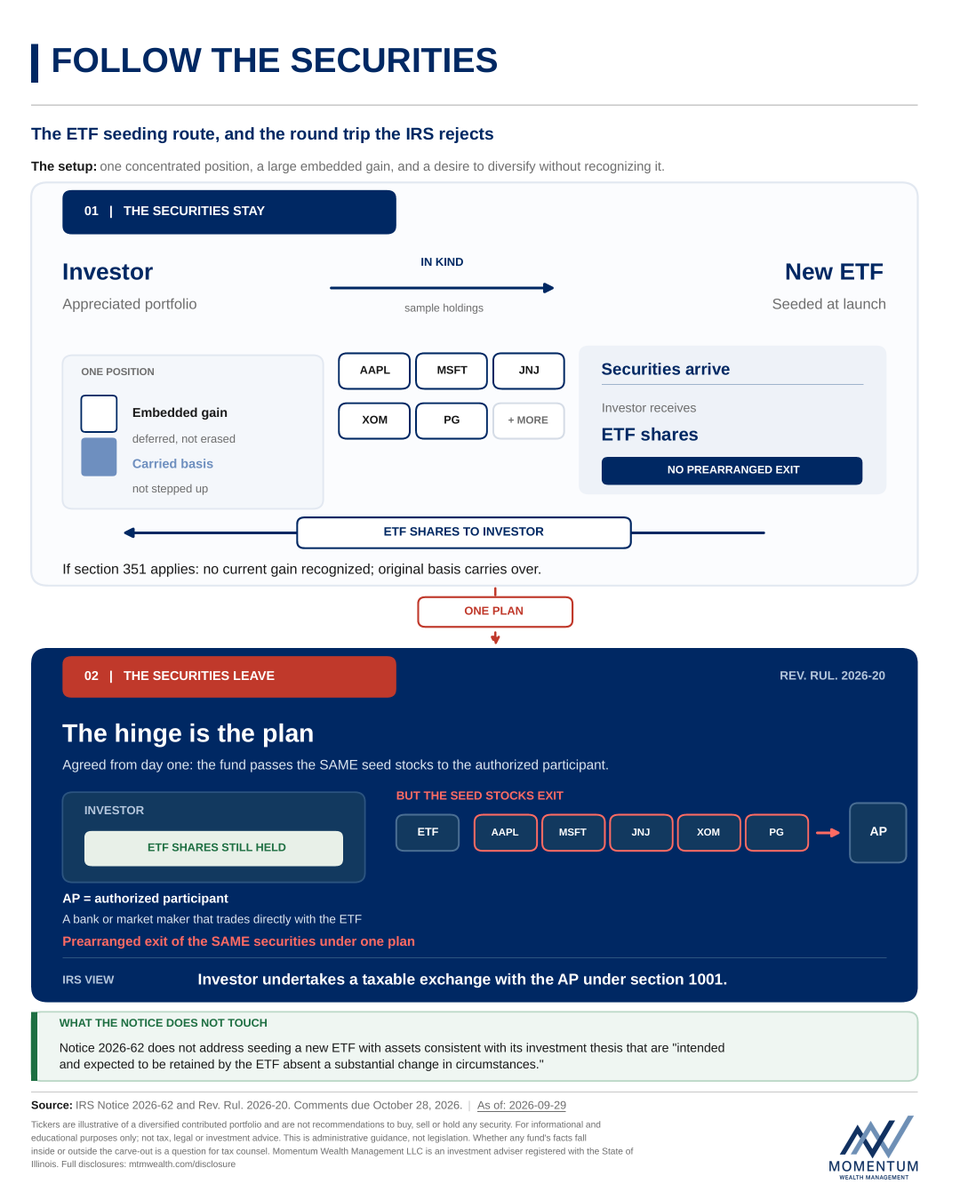
The premise behind a Section 351 exchange remains intact: You have a concentrated stock position with substantial embedded gains. You contribute an eligible basket into a newly formed ETF. Section 351 defers the gain and carries your cost basis into the fund shares.
Nothing in Monday’s release repealed Section 351.
What the IRS struck down in Rev. Rul. 2026-20 is an orchestrated round trip:
• An investor contributes appreciated stock into a new ETF.
• The ETF issues shares to an Authorized Participant (AP).
• Pursuant to the same prearranged plan, the ETF redeems the AP out using the investor's original stock.
• The appreciated stock exits the fund without recognized gain.
The IRS applied longstanding step-transaction doctrine: they collapsed the steps and ruled it a direct, taxable exchange between the investor and the AP under Section 1001.
Now look at what Notice 2026-62 explicitly carved out:
The IRS stated it expresses no view on Section 351 seedings where the assets match the ETF's investment thesis and are "intended and expected to be retained by the ETF absent a substantial change in circumstances."
Retained. That is the operative standard.
If an ETF is structured to actually hold the underlying securities, the statutory foundation holds. If the vehicle is used as a temporary conduit to flush low-basis shares to an AP under a prearranged exit, the IRS treats it as a sale.
Public comments run through October 28. Read the primary administrative guidance, not the headlines.
Disclosures: Momentum Wealth Management LLC ("MWM") is an investment adviser registered with the State of Illinois. This material is for informational and educational purposes only and does not constitute personalized investment, legal, or tax advice, a recommendation, or an offer or solicitation. Past performance is not indicative of future results. Investing involves risk, including possible loss of principal. Implementation decisions should be made in coordination with your CPA and estate planning attorney. Full disclosures: https://t.co/VAZ0Xmujwo.
The most misunderstood dynamic in asset allocation today:
Investors buy Big Tech equity for growth, then buy corporate bond funds for safety, unwittingly lending money to the exact same companies to finance their capex buildout.
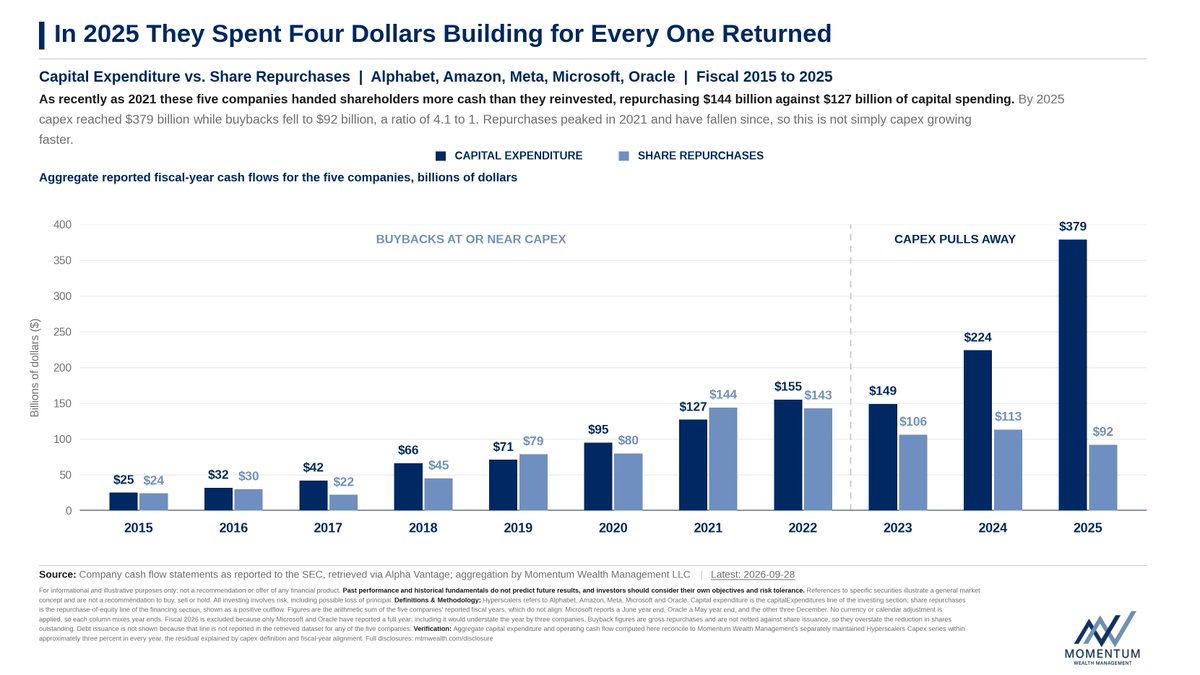
Capex vs. Share Repurchases across Alphabet, Amazon, Meta, Microsoft, and Oracle (2015–2025):
• 2021: $127B Capex | $144B Buybacks (Buybacks exceeded Capex)
• 2025: $379B Capex | $92B Buybacks (4.1 to 1 ratio)
• Buybacks have fallen 36% from their 2021 peak
In 2025, hyperscalers spent $4 building physical infrastructure for every $1 returned to shareholders.
When cash is diverted from retiring shares into power grids and data centers, these companies tap the debt market to fund the gap.
So in a typical "balanced" portfolio:
1.) Your stock fund owns their equity at 30x+ earnings.
2.) Your bond fund owns their debt to pay for the chips.
Holding the equity and lending to the debtor isn't multi-asset diversification, it's a two-sided bet on the same balance sheets.
Real portfolio resilience requires structural alternatives and uncorrelated yield that deliver zero beta to both public equities and corporate bond markets.
Disclosures: Momentum Wealth Management LLC ("MWM") is an investment adviser registered with the State of Illinois. This material is for informational and educational purposes only and does not constitute personalized investment, legal, or tax advice, a recommendation, or an offer or solicitation. Past performance is not indicative of future results. Investing involves risk, including possible loss of principal. Implementation decisions should be made in coordination with your CPA and estate planning attorney. Full disclosures: https://t.co/VAZ0XmuRlW.
This isn't a directional market call. It’s an anatomy of why market timing is so difficult across different time horizons.
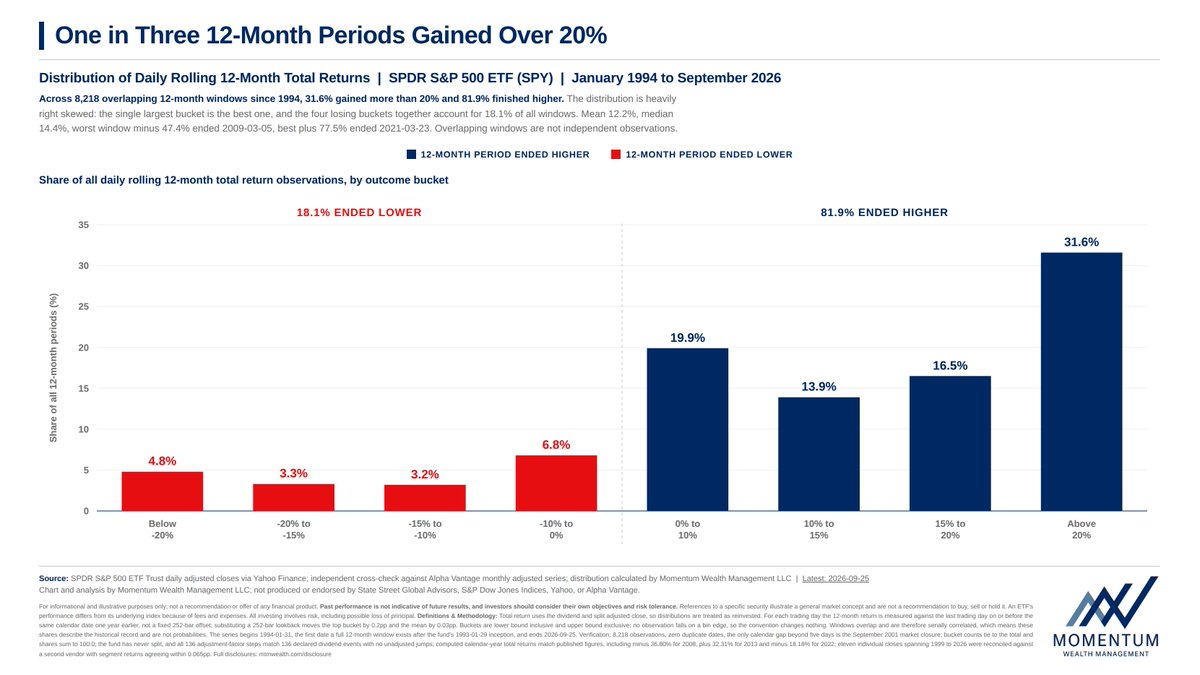
Evaluating 8,218 daily rolling 12-month S&P 500 returns since 1994:
• 12-month periods ended higher 81.9% of the time (18.1% ended lower)
• Gains above +20% occurred in 31.6% of all windows, nearly 1 in 3
• The historical mean return is 12.2%, but returns landed in the "normal" 10–15% range just 13.9% of the time
• Severe drops worse than -20% occurred 4.8% of the time
The market almost never delivers an "average" year. It behaves like an asymmetric barbell.
The dilemma for investors is horizon mismatch:
1.) Short-term: Noise and volatility shake investors out.
2.) Intermediate-term: Outcomes are extreme, ranging from -47.4% (2009) to +77.5% (2021).
3.) Long-term: Missing the +20% right tail permanently impairs compounding.
Because the sharpest rallies usually explode straight out of severe drawdowns, de-risking in a downturn guarantees you miss the recovery.
You don't manage wealth by predicting the next 12-month bucket. You manage it by structuring balance-sheet liquidity so you never become a forced seller at the bottom.
Disclosures: Momentum Wealth Management LLC ("MWM") is an investment adviser registered with the State of Illinois. This material is for informational and educational purposes only and does not constitute personalized investment, legal, or tax advice, a recommendation, or an offer or solicitation. Past performance is not indicative of future results. Investing involves risk, including possible loss of principal. Implementation decisions should be made in coordination with your CPA and estate planning attorney. Full disclosures: https://t.co/VAZ0Xmujwo.
Investors think buying international stocks diversifies away U.S. mega-cap concentration.
The index plumbing proves the exact opposite.
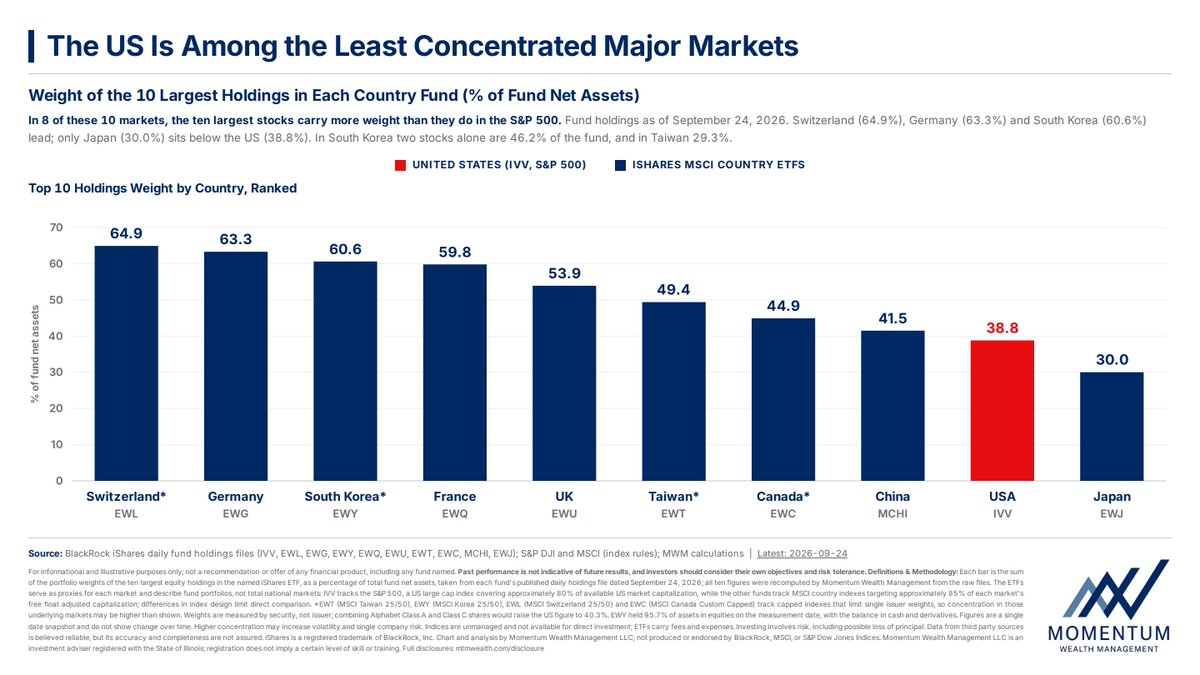
In 8 of the 10 largest equity markets, the top 10 stocks carry more weight than they do in the S&P 500.
Weight of the 10 largest holdings across major country funds:
• Switzerland: 64.9%
• Germany: 63.3%
• South Korea: 60.6% (2 stocks alone = 46.2%)
• France: 59.8%
• United Kingdom: 53.9%
• Taiwan: 49.4%
• Canada: 44.9%
• China: 41.5%
• United States: 38.8%
• Japan: 30.0%
Everyone complains that the S&P 500 is top-heavy at 39%.
Outside of Japan, the U.S. is actually among the least concentrated major markets in the developed world.
Foreign indices have been structural oligopolies for decades:
Switzerland is dominated by three defensive giants.
France is concentrated in luxury conglomerates and energy.
South Korea and Taiwan are single-sector tech hardware bets.
When allocators buy foreign country ETFs to escape U.S. tech, they aren't reducing single-stock risk. They are swapping dynamic cash-flow compounders for concentrated exposure to legacy industries and domestic banks.
Geographic diversification is vanity if you don't audit the index plumbing underneath.
Disclosures: Momentum Wealth Management LLC ("MWM") is an investment adviser registered with the State of Illinois. This material is for informational and educational purposes only and does not constitute personalized investment, legal, or tax advice, a recommendation, or an offer or solicitation. Past performance is not indicative of future results. Investing involves risk, including possible loss of principal. Implementation decisions should be made in coordination with your CPA and estate planning attorney. Full disclosures: https://t.co/VAZ0XmuRlW.
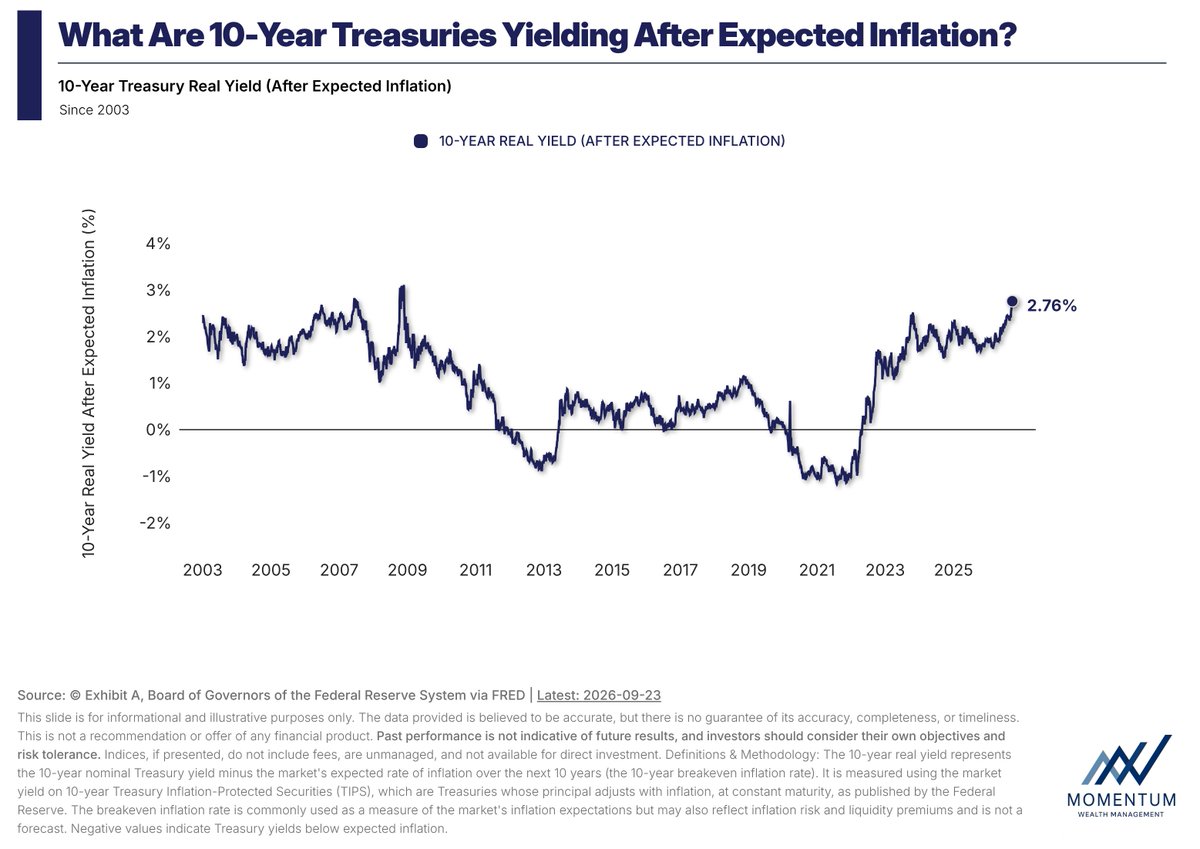
The most important chart in macro today isn’t the S&P 500. It’s the 10-year Treasury real yield.
As of September 23, the 10-year real yield hit 2.76%, the highest level since 2008.
Between 2010 and 2021, real yields hovered near zero and plunged as low as -1.0%. A decade of financial repression forced allocators out the risk curve just to beat inflation.
That dynamic has completely reversed.
Today, you can lock in 2.8% above expected inflation in risk-free sovereign paper. That resets the cost of capital across the entire global balance sheet:
1.) The Cash Trap: Parking in 5% floating money markets feels safe until the Fed cuts and yields evaporate. Intermediate duration locks in multi-year real purchasing power today.
2.) The Hurdle Rate Shock: When risk-free sovereign debt yields 2.8% real, every asset class must clear a higher bar. Speculative multiples compress; generic index beta faces a real benchmark competitor.
3.) Selective Equity Alpha: In a high-real-yield regime, multiple expansion is dead. Equities must deliver real earnings growth and high ROIC to justify their risk premium.
Pairing high-quality duration with non-correlated alternatives and pricing-power equities is how you win in this regime.
A 2.8% real risk-free hurdle rate separates disciplined wealth architects from passive asset gatherers.
Disclosures: Momentum Wealth Management LLC ("MWM") is an investment adviser registered with the State of Illinois. This material is for informational and educational purposes only and does not constitute personalized investment, legal, or tax advice, a recommendation, or an offer or solicitation. Past performance is not indicative of future results. Investing involves risk, including possible loss of principal. Implementation decisions should be made in coordination with your CPA and estate planning attorney. Full disclosures: https://t.co/VAZ0Xmujwo.
Consensus treats private markets access as the ultimate status symbol. Today, access is commoditized. Anyone can buy an alts fund.
The real bottleneck is governance.
Institutional survey data shows alternatives now average 36% of endowment and foundation portfolios, eclipsing public U.S. equities at 27%.
Meanwhile, committee bandwidth and internal staff are completely flat.
Nonprofit boards and family offices do not have an asset allocation problem. They have an operational plumbing problem:
1.) Unfunded capital calls colliding with mandatory 5% annual spending policies.
2.) The denominator effect artificially inflating alts weights during public drawdowns.
3.) Volunteer trustees with 3-year term limits panicking over standard private equity J-curves.
4.) Managing aggregate portfolio risk when a third of the assets report on a 90-day lag.
Writing the commitment check is easy. Managing liquidity, capital calls, and board alignment for the next 10 years is the real work.
Before adding more illiquidity, boards must ask: do we have the governance capacity to handle what we already own?
Disclosures: Momentum Wealth Management LLC ("MWM") is an investment adviser registered with the State of Illinois. This material is for informational and educational purposes only and does not constitute personalized investment, legal, or tax advice, a recommendation, or an offer or solicitation. Past performance is not indicative of future results. Investing involves risk, including possible loss of principal. Implementation decisions should be made in coordination with your CPA and estate planning attorney.
Consensus assumes the top 1% got rich exclusively on Silicon Valley tech grants and Wall Street bonuses.
The IRS tax data shows otherwise.
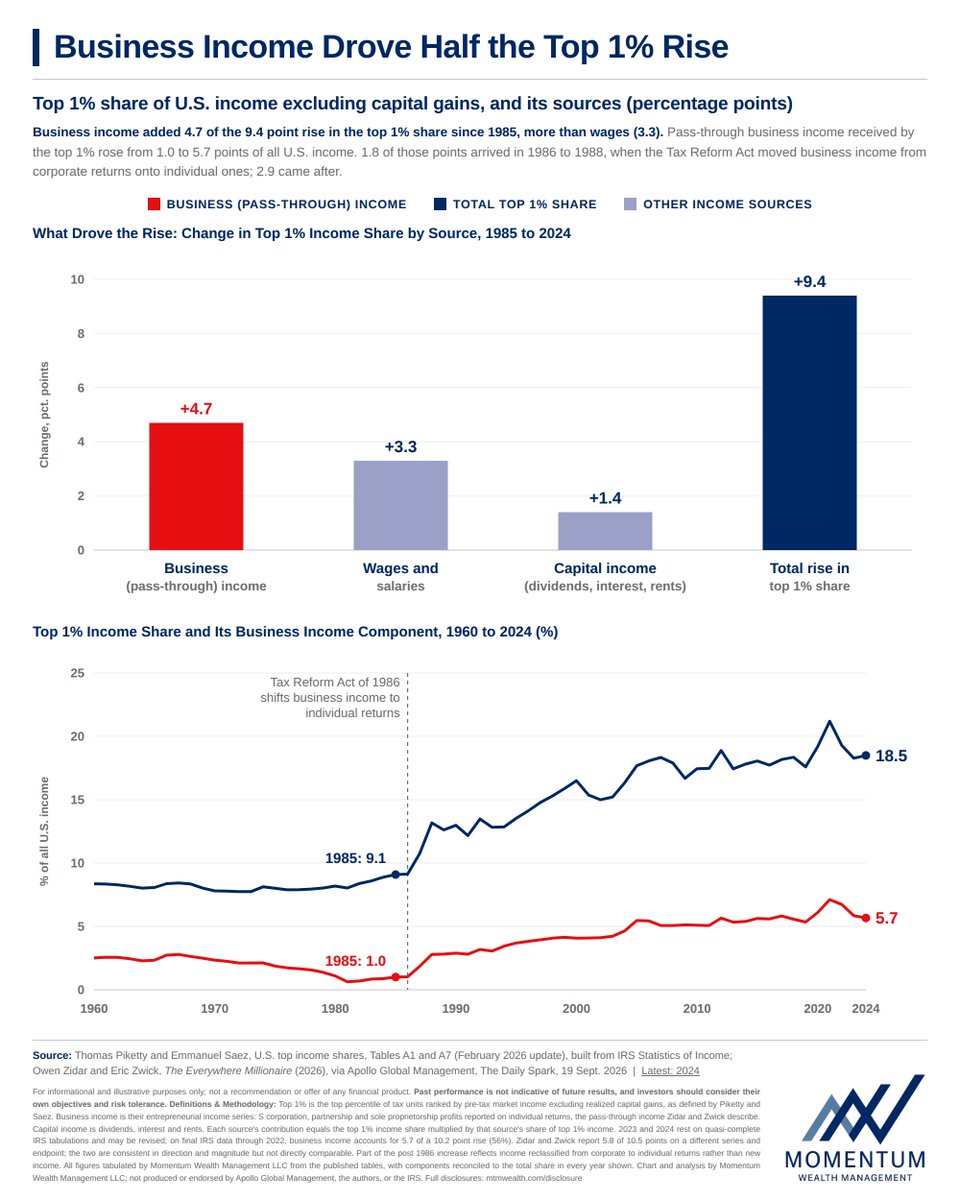
We tabulated Piketty-Saez top income data from 1985 to 2024. The top 1% income share rose 9.4 percentage points (9.1% to 18.5%).
Here is the source breakdown:
• Pass-through business income: +4.7 points
• Wages & salaries (including executive pay/bonuses): +3.3 points
• Capital income: +1.4 points
Business income drove more of the rise than corporate wages and finance bonuses combined.
The nuance: 1.8 of those 4.7 points arrived between 1986 and 1988, when TRA86 shifted existing profits from C-corps onto 1040s via S-corps and LLCs. But the remaining 2.9 points compounded organically over the decades that followed.
Independent research by Zidar & Zwick (relayed by Apollo) confirms it: pass-through income drove over half the expansion.
The cohort driving this isn't tech founders. It is roughly 3M middle-market business owners with an average net worth near $25M (contractors, dealerships, medical groups).
Their wealth requires a completely different playbook:
1.) Entity tax structuring (PTET) to blunt top-bracket 1040 drag.
2.) Liquid portfolios built as non-correlated ballast against business risk.
3.) Pre-transaction estate transfers executed years before an exit.
Real wealth creation in America is private and operational. Manage the business plumbing, not just public equities.
Disclosures: Momentum Wealth Management LLC ("MWM") is an investment adviser registered with the State of Illinois. This material is for informational and educational purposes only and does not constitute personalized investment, legal, or tax advice, a recommendation, or an offer or solicitation. Past performance is not indicative of future results. Investing involves risk, including possible loss of principal. Implementation decisions should be made in coordination with your CPA and estate planning attorney. Full disclosures: https://t.co/VAZ0Xmujwo.
Quite the humiliating headline for Morgan Stanley this week, and one that should terrify any firm handling sensitive documents.
A senior MD accidentally emailed an internal pipeline of over 100 confidential cross-border IPOs and M&A transactions to outside clients instead of a generic market overview. He scrambled to hit Outlook "recall," which obviously did nothing once the email left their server, and now the unencrypted deal list is circulating across social media.
Morgan Stanley has the balance sheet and institutional weight to absorb the regulatory blowback and reputational damage. But imagine you aren't Morgan Stanley. If an independent wealth advisory, an RIA, or an emerging fund misfires material non-public deal terms or client records like that? The firm evaporates overnight.
We see this exact exposure everywhere in financial services:
▪︎On the wealth management side, you’re handling tax returns, trust agreements, estate structures, and private financials for individuals, multi-generational families, entrepreneurs, and foundations.
▪︎On the venture side, you’re coordinating data rooms, sensitive cap tables, and confidential terms with GPs, LPs, and founders.
Human error is inevitable. People mis-click attachments and autocomplete the wrong recipient every single day. The real failure is relying on perimeter security, gateway scanners, or an Outlook "recall" button to save you. The moment an unencrypted file crosses outside your network boundary, you have zero control.
Most leaders assume there isn’t a real technical fix once an email leaves the building. But protection shouldn't live on the email pipe, it has to live directly inside the document at the data layer.
This is why we implement https://t.co/wWuEMCAMwz across our enterprise.
Because protection travels inside the file itself:
1.) Instant Cryptographic Revocation: If someone attaches the wrong file, you don't send an embarrassing follow-up begging the recipient to delete it. You kill the encryption key. The document instantly turns into useless, unreadable ciphertext on their screen, even if it was already delivered, opened, or forwarded.
2.) Access Control & Geotargeting: You control who can view, restrict raw copying or downloading, and enforce location-level boundaries.
3.) True Auditability: You know exactly who opened what, where, and when, giving compliance definitive proof instead of guessing the blast radius.
Perimeter DLP protects the mailbox, but data-layer encryption protects the actual asset. Until financial institutions protect the file itself, every firm is just one accidental keystroke away from the front page of Bloomberg.
https://t.co/IMVaLljFrB
Retirement anxiety is rarely about net worth. It is almost always about cash-flow plumbing.
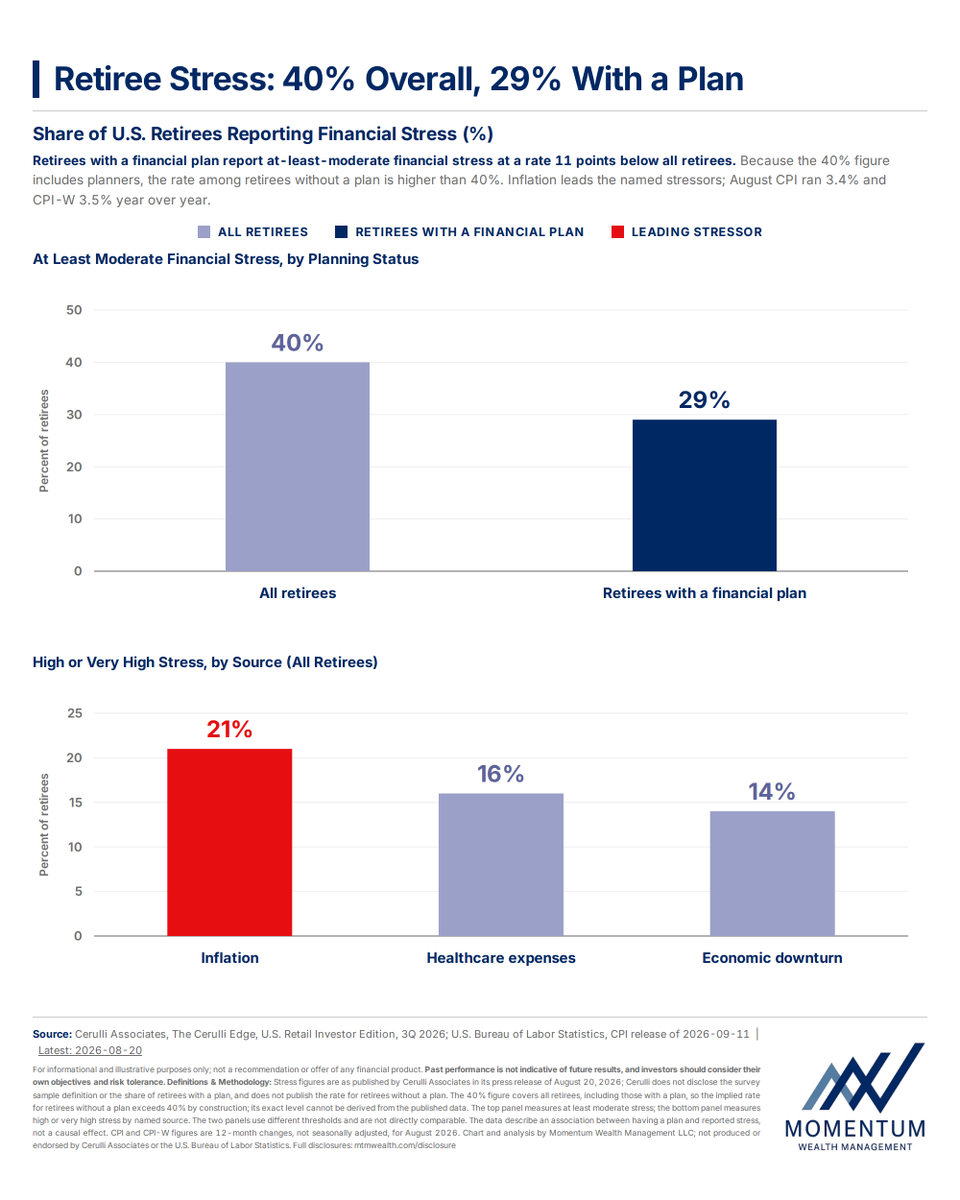
Cerulli survey data shows 40% of all retirees report moderate-to-severe financial stress.
For retirees with a documented wealth plan, that drops to 29%. (Since the 40% includes planners, the unguided cohort is even higher).
Look at what actually drives the anxiety:
1.) Inflation: 21% (August CPI at 3.4%)
2.) Healthcare costs: 16% (Medicare Part B rose 9.7% this year)
3.) Economic downturn: 14%
Market drawdowns rank last. The real fear is non-discretionary purchasing power getting eaten alive.
When investors lack a cash-flow framework, every market dip feels like a threat to their lifestyle. They panic-sell risk assets at the bottom to fund next month's cash needs, crystallizing sequence-of-returns risk.
Proper portfolio architecture solves this mechanically:
• Ring-fence 2–3 years of distributions in contractual yield and short-duration cash proxies.
• Let equity beta compound uninhibited without lifestyle liquidation drag.
• Deploy real assets and private credit to outpace non-discretionary cost inflation.
You can't control inflation prints or equity pullbacks. But with an asset-liability matching framework, market volatility never forces you to liquidate capital at the wrong time.
A plan isn't a static document. It’s liquidity insurance for your balance sheet.
Disclosures: Momentum Wealth Management LLC ("MWM") is an investment adviser registered with the State of Illinois. This material is for informational and educational purposes only and does not constitute personalized investment, legal, or tax advice, a recommendation, or an offer or solicitation. Past performance is not indicative of future results. Investing involves risk, including possible loss of principal. Implementation decisions should be made in coordination with your CPA and estate planning attorney. Full disclosures: https://t.co/VAZ0Xmujwo.
The industry spends all its time warning investors not to panic-sell stocks.
Meanwhile, investors completely butchered their bond portfolios.
DALBAR’s 2026 QAIB report shows a staggering behavioral disconnect in 2025:
• S&P 500: +17.88% | Avg Equity Investor: +17.16% (Gap: -0.72%)
• Bloomberg Agg: +7.30% | Avg Bond Investor: +2.41% (Gap: -4.89%)
Equity investors held the line. Bond investors threw away two-thirds of their return in what is supposed to be the safest corner of the balance sheet.
Why?
Rate volatility turned conservative allocators into terrible market timers:
1.) Sitting in short-term T-bills and cash traps, missing duration rallies.
2.) Panic-selling pooled bond funds at yield peaks.
3.) Trying to trade Fed rate-cut tea leaves instead of holding duration for structural ballast.
The real behavioral damage isn't happening in volatile growth stocks. It’s happening when allocators treat fixed income like a trading vehicle rather than a contractual cash-flow asset.
Discipline belongs in the bond book just as much as the equity book.
Disclosures: Momentum Wealth Management LLC ("MWM") is an investment adviser registered with the State of Illinois. This material is for informational and educational purposes only and does not constitute personalized investment, legal, or tax advice, a recommendation, or an offer or solicitation. Past performance is not indicative of future results. Investing involves risk, including possible loss of principal. Implementation decisions should be made in coordination with your CPA and estate planning attorney.
@levie ...The progress Box is making with agents on unstructured documents is huge, especially seeing the gains on due diligence and clinical files.
In financial services, the barrier to letting agents run on live documents isn't reasoning; it's raw NPI. The model doesn't need to see unencrypted account numbers or private transaction records to catch pricing errors. In our firm, we pair workflows with Confidencial (spun out of SRI International through DARPA) to selectively tokenize sensitive fields at the data layer. The agent gets all the reasoning context it needs, but the underlying records stay sealed.
Natural fit for what you're building with Box AI Studio; more than happy to introduce you to Karim and the Confidencial team if you want to take a look at that data layer.
Headline valuation on a term sheet is vanity. Net wire at closing is reality.
Founders routinely celebrate an enterprise value on an LOI, only to watch deal terms gut the actual proceeds:
• Asset vs. stock structure triggering ordinary income tax recapture
• Aggressive working capital pegs draining post-close cash
• 10–15% held back in indemnity escrow for 12–24 months
• Rollover equity subordinated in the buyer’s debt-heavy capital stack
• Contingent earnouts tied to operational targets they no longer control
Two identical $30M headline bids can result in wildly different after-tax net wealth.
The critical trap is timing. Most entrepreneurs wait until they have an offer before assembling their tax, wealth, and estate team.
At that point, the window has closed. The moment an LOI is signed, the assignment-of-income doctrine locks down your ability to execute pre-liquidity trust transfers, state tax arbitrage, or structural wealth transfers.
Selling a business isn't a closing date. It’s a 12-month pre-close tax architecture and a disciplined 90-day post-close liquidity plan.
Negotiate the structure before you fall in love with the headline number.
Disclosures: Momentum Wealth Management LLC ("MWM") is an investment adviser registered with the State of Illinois. This material is for informational and educational purposes only and does not constitute personalized investment, legal, or tax advice, a recommendation, or an offer or solicitation. Past performance is not indicative of future results. Investing involves risk, including possible loss of principal. Implementation decisions should be made in coordination with your CPA and estate planning attorney.
Headline valuation on a term sheet is vanity. Net wire at closing is reality.
Founders routinely celebrate an enterprise value on an LOI, only to watch deal terms gut the actual proceeds:
• Asset vs. stock structure triggering ordinary income tax recapture
• Aggressive working capital pegs draining post-close cash
• 10–15% held back in indemnity escrow for 12–24 months
• Rollover equity subordinated in the buyer’s debt-heavy capital stack
• Contingent earnouts tied to operational targets they no longer control
Two identical $30M headline bids can result in wildly different after-tax net wealth.
The critical trap is timing. Most entrepreneurs wait until they have an offer before assembling their tax, wealth, and estate team.
At that point, the window has closed. The moment an LOI is signed, the assignment-of-income doctrine locks down your ability to execute pre-liquidity trust transfers, state tax arbitrage, or structural wealth transfers.
Selling a business isn't a closing date. It’s a 12-month pre-close tax architecture and a disciplined 90-day post-close liquidity plan.
Negotiate the structure before you fall in love with the headline number.
Disclosures: Momentum Wealth Management LLC ("MWM") is an investment adviser registered with the State of Illinois. This material is for informational and educational purposes only and does not constitute personalized investment, legal, or tax advice, a recommendation, or an offer or solicitation. Past performance is not indicative of future results. Investing involves risk, including possible loss of principal. Implementation decisions should be made in coordination with your CPA and estate planning attorney.
The 60/40 portfolio is built on a mechanical assumption that died four years ago.
The tape shows it clearly:
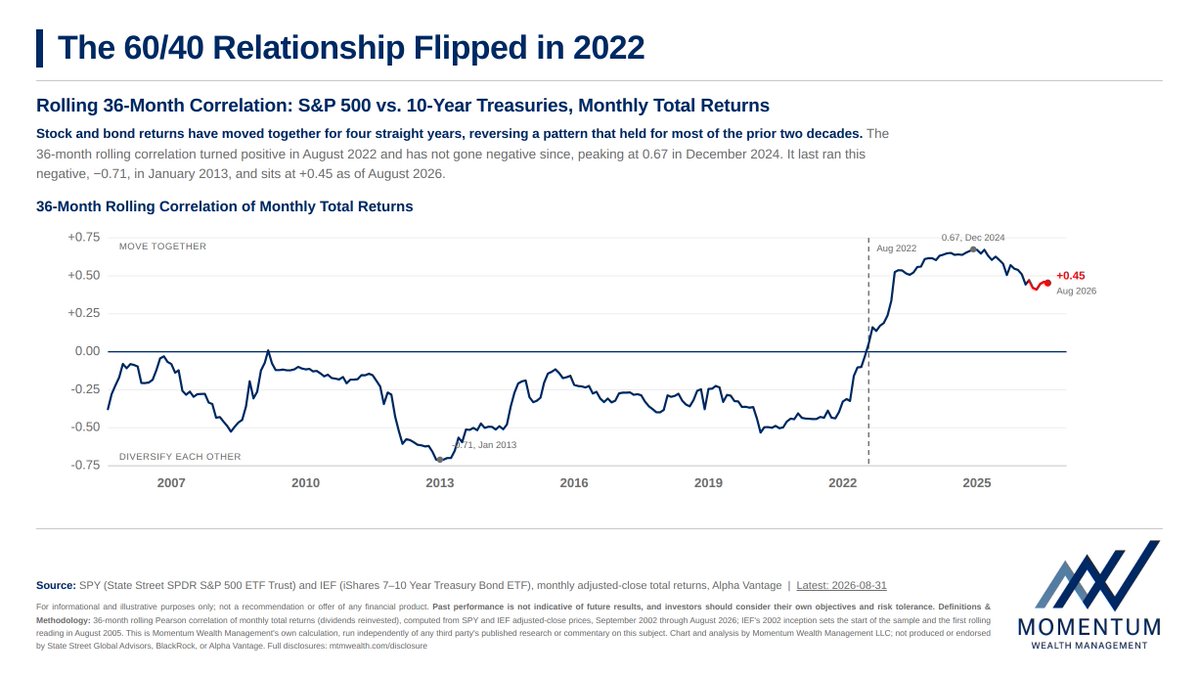
• 2005–2022: Negative stock-bond correlation (troughing at −0.71 in 2013)
• August 2022: Correlation flipped positive
• December 2024: Peaked at +0.67
• August 2026: Still positive at +0.45
We tabulated the 36-month rolling total-return correlation between SPY and IEF. For four straight years, stocks and bonds have moved in the exact same direction.
Bonds aren't hedging equities anymore. In an inflation-volatile regime, duration acts as an amplifier, not a shock absorber.
AQR’s 50-year research corroborated the same reality: during inflation shocks, stocks and bonds sell off together.
If your fixed income drops at the same time as your equity book, holding two assets isn't diversification. It's just two different ways of being long the same macro risk.
A modern balance sheet needs an authentic third leg:
1.) Trend-following (managed futures) that can sit short public markets.
2.) Real assets that monetize input cost shocks.
3.) Private credit insulated from public duration swings.
Alternatives aren't a speculative satellite sleeve. In this regime, non-correlation is the only real defense on the board.
Disclosures: Momentum Wealth Management LLC ("MWM") is an investment adviser registered with the State of Illinois. This material is for informational and educational purposes only and does not constitute personalized investment, legal, or tax advice, a recommendation, or an offer or solicitation. Past performance is not indicative of future results. Investing involves risk, including possible loss of principal. Alternative investments involve specific risks including illiquidity, leverage, and complex tax structures. Implementation decisions should be made in coordination with your CPA and estate planning attorney. Full disclosures: https://t.co/VAZ0Xmujwo.
Headline index returns hide the real mechanics underneath.
The S&P 500 is up 11.8% on price this year. Yet 202 of the 490 companies that started the year in the index are negative.
That is 41.2% of the index trading in the red during an up tape.
A decade of constituent data shows this isn’t an anomaly:
• 2019: Index +28.9% | 8.1% down (31 stocks)
• 2020: Index +16.3% | 38.4% down
• 2021: Index +26.9% | 11.3% down
• 2023: Index +24.2% | 34.5% down
• 2024: Index +23.3% | 32.5% down
• 2025: Index +16.4% | 37.7% down
• 2026 YTD: Index +11.8% | 41.2% down
The historical average of declining stocks in positive years is 25.3%.
When you buy a commingled ETF in a taxable account, you hold one cost basis. When 40% of the basket pulls back, the fund absorbs those losses internally. You get zero tax benefit.
Direct indexing captures that structural asymmetry:
1.) Own the underlying constituents directly in an SMA or Custom Index.
2.) Capture broad market beta on the advancing names.
3.) Harvest losses systematically on the 41% that decline.
4.) Reallocate into sector proxies to stay fully invested without wash-sale violations.
Those harvested losses do not expire. You bank them to offset capital gains across your broader balance sheet, private equity, real estate, or concentrated stock.
Generating after-tax alpha purely off constituent dispersion, without taking active stock-picking risk, is one of the few true structural edges left in liquid equities.
When market dispersion is this wide, holding the underlying constituents is simply a more tax-aware way to own the index.
Disclosures: Momentum Wealth Management LLC ("MWM") is an investment adviser registered with the State of Illinois. This material is for informational and educational purposes only and does not constitute personalized investment, legal, or tax advice, a recommendation, or an offer or solicitation. Past performance is not indicative of future results. Investing involves risk, including possible loss of principal. Implementation decisions should be made in coordination with your CPA and estate planning attorney. Full disclosures: https://t.co/VAZ0Xmujwo.
Founders and executives create wealth through concentration, but they preserve it through architecture.
Per the Journal of Financial Planning, 15% of high-net-worth investors hold at least 10% of their net worth in a single stock. For founders and C-suite executives, that concentration routinely crosses 50%.
The trap is tax paralysis: selling triggers an immediate 25% to 35% haircut across combined federal capital gains, state income tax, and the Net Investment Income Tax.
Holding unhedged single-stock exposure, however, leaves the balance sheet exposed to permanent capital impairment. Individual equities can easily suffer 50%+ drawdowns even during secular bull markets.
Institutional allocators solve this through a coordinated 3-part framework:
1. Exchange Funds (IRC Section 721):
Contribute concentrated shares into a private partnership pool with zero upfront tax liability. After a mandatory 7-year holding period, you receive a diversified equity basket with carryover basis. If held through estate transition, the deferred gain is eliminated via the Section 1014 basis step-up.
2. Direct Indexing "Tax Budgets":
Construct a custom completion portfolio around the concentrated holding. The engine dynamically harvests capital losses across individual constituents to systematically offset scheduled, multi-year sales of the position, unwinding single-stock risk with minimal net tax drag.
3. Cashless Collars:
When lock-ups, blackout periods, or executive restrictions limit selling, purchase downside puts funded entirely by selling upside calls. Structured within IRC Section 1259 rules, you establish an absolute valuation floor with zero out-of-pocket cash outlay and no constructive sale.
Never let tax aversion turn an equity concentration into a balance-sheet impairment.
Sources: Journal of Financial Planning, IRC Sections 721, 1014, 1259. Analysis by Momentum Wealth Management.
Disclosures: Momentum Wealth Management LLC ("MWM") is an investment adviser registered with the State of Illinois. This material is for informational and educational purposes only and does not constitute personalized investment, legal, or tax advice, an offer, or a solicitation. Past performance does not guarantee future results. Investing involves risk, including possible loss of principal. Implementation decisions should be made in coordination with your CPA and estate planning attorney.
Consensus assumes Fed rate hikes immediately kill equity markets.
History shows that's amateur macro.
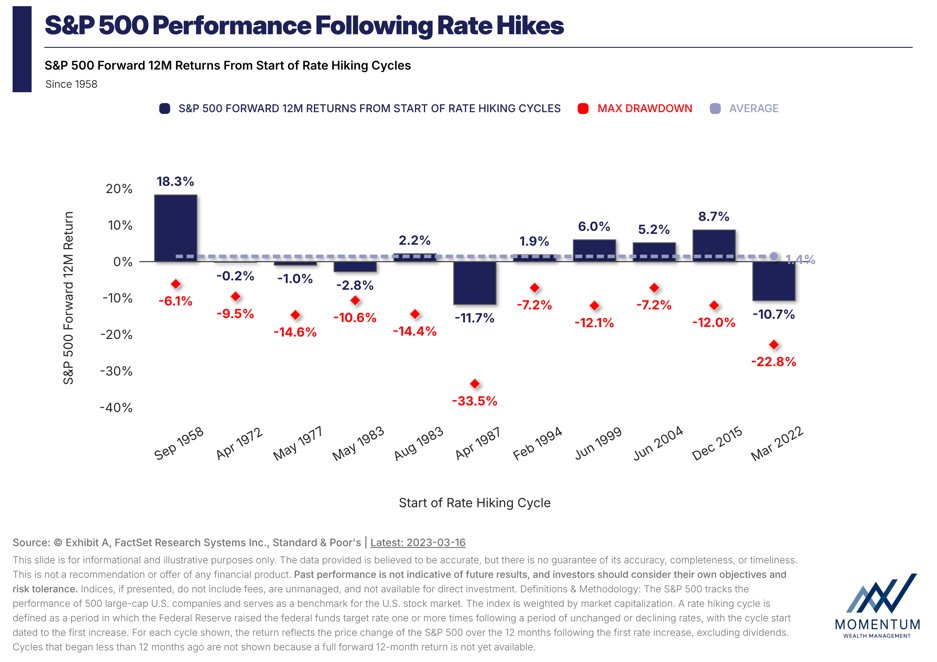
Looking at every Fed hiking cycle since 1958:
▪ 12-Month Forward Average Return: +1.4% across 11 cycles
▪ 6 out of 11 cycles finished positive (1958: +18.3%, 2015: +8.7%, 1999: +6.0%)
▪ Negative cycles only occurred when hikes hit an already exhausted earnings cycle (1987: -11.7%, 2022: -10.7%)
Rates don't break markets in isolation. Liquidity withdrawal into slowing corporate earnings does.
The catch? Intra-year volatility is guaranteed.
Every single hiking cycle since 1958 saw meaningful drawdowns, ranging from -6.1% to -33.5%. Even during the best forward-12M years, the market endured double-digit pullbacks (-12.1% in 1999, -12.0% in 2015) while adjusting to the new discount rate.
The playbook isn't guessing the terminal rate:
1.) Own pricing power and high ROIC balance sheets that don't depend on cheap leverage.
2.) Maintain dedicated cash reserves so you never become a forced seller during intra-cycle drawdowns.
3.) Anchor the portfolio with real contractual yields and non-correlated alts.
Architecture beats rate forecasting every time.
Source: FactSet, S&P Global, Exhibit A. Analysis by Momentum Wealth Management.
Disclosures: Momentum Wealth Management LLC ("MWM") is an investment adviser registered with the State of Illinois. This material is for informational and educational purposes only and does not constitute personalized investment, legal, or tax advice, an offer, or a solicitation. Past performance does not guarantee future results. Investing involves risk, including possible loss of principal. Implementation decisions should be made in coordination with your CPA and estate planning attorney. Full disclosures: https://t.co/VAZ0Xmujwo.
A mandatory tax bill is coming due for pre-2027 Opportunity Zone investors.
Per IRC Section 1400Z-2 and IRS Notice 2026-40, all capital gains deferred into a legacy QOF must be recognized on the 2026 return, with December 31, 2026, as the inclusion date.
It applies whether the fund has distributed liquidity or not.
The key balance-sheet mechanics allocators need to know:
The FMV Valuation Cap:
▪ Taxable gain is calculated on the lesser of the deferred gain or the fund's FMV on December 31, 2026.
▪ For underperforming, unencumbered funds, a year-end appraisal can permanently reduce the recognized gain with no recapture.
▪ The Catch: For leveraged real estate partnerships, Treasury Regulations factor in debt relief, which can dilute the benefit of a lower FMV.
Estate & Wealth Planning Reality:
▪ Deferred gains are Income in Respect of a Decedent (IRD). Heirs get zero basis step-up on the deferred gain; they inherit the 2026 tax liability.
▪ Gifting a QOF interest accelerates the gain immediately; transfers to revocable grantor trusts do not.
▪ Legacy gains cannot be rolled over into new "QOZ 2.0" vehicles.
The Action Item:
This is a phantom tax event. Coordinate proactive loss harvesting across public equity portfolios and adjust Q4 estimated payments with your CPA before December 31.
Sources: IRC Section 1400Z-2, IRS Notice 2026-40, Treasury Regulations. Analysis by Momentum Wealth Management.
Disclosures: Momentum Wealth Management LLC ("MWM") is an investment adviser registered with the State of Illinois. This material is for informational and educational purposes only and does not constitute personalized investment, legal, or tax advice, an offer, or a solicitation. Past performance does not guarantee future results. Investing involves risk, including possible loss of principal. Implementation decisions should be made in coordination with your CPA and estate planning attorney.
The Fed just hiked 25 bps to 3.75%–4.00%, its first-rate hike since 2023.
Markets closed mixed (Dow down 90 pts, Nasdaq +0.5%) because futures had already priced 92% of the move. But looking under the hood of today's SEP release and Chair Warsh's presser, the macro tape just underwent a quiet regime change:
The Unanimous Shift:
▪ 12–0 vote. July's three hawkish dissenters carried the entire committee without a single dissent.
▪ Median dots revised up to 4.1% for both 2026 and 2027 (up from 3.8% and 3.6% in June).
▪ 12 of 18 officials pencil in another hike before year-end; 4 sit higher.
▪ 17 of 18 participants see inflation risks weighted strictly to the upside.
The Inflation & Curve Dynamic:
▪ Headline CPI sticky at 3.4% forced the Fed's hand. Warsh confirmed they had to "remove a dose of accommodation" with inflation too high for too long.
▪ The front end now migrates toward 4% to meet a long end that moved months ago (10Y 4.95%, 30Y at 5.31%).
The Portfolio Implication:
Earning 4% in cash feels safe during a mixed session, but it masks compounding reinvestment risk as the curve shifts.
The easing cycle isn't paused; it’s reversed. Institutional balance sheets require deliberate duration laddering and non-correlated assets that do not price off Fed accommodation.
Sources: Federal Reserve (FOMC Statement, SEP), BLS, CME FedWatch. Analysis by Momentum Wealth Management.
Disclosures: Momentum Wealth Management LLC ("MWM") is an investment adviser registered with the State of Illinois. This material is for informational and educational purposes only and does not constitute personalized investment, legal, or tax advice, an offer, or a solicitation. Past performance does not guarantee future results. Investing involves risk, including possible loss of principal. Implementation decisions should be made in coordination with your CPA and estate planning attorney.