Assistant Professor @Stanford in Biomedical Data Science and (by courtesy) CS. Trustworthy, deployable ML for healthcare. Prev @HarvardMed @mit_hst @MIT_CSAIL.
Early bird registration for #CHIL2026 is open!
Join us June 28–30, 2026 at Seattle Children’s Research Institute for keynotes, research talks, posters, roundtables, the Doctoral Symposium, and more.
Use code EARLYBIRD26 through May 31.
Register: https://t.co/0jTn4YOIpW
The Health AI Builders Unconference is back! 🙌
Join us on June 28th in Seattle, WA for a full day of exploring entrepreneurship in health AI. Join the waitlist: https://t.co/hCT1cDevCR
#CHIL2026#HealthAI#Entrepreneurship#AIinHealthcare
June is going to be a busy month for Seattle 👀
CHIL, FIFA, and… 🥁
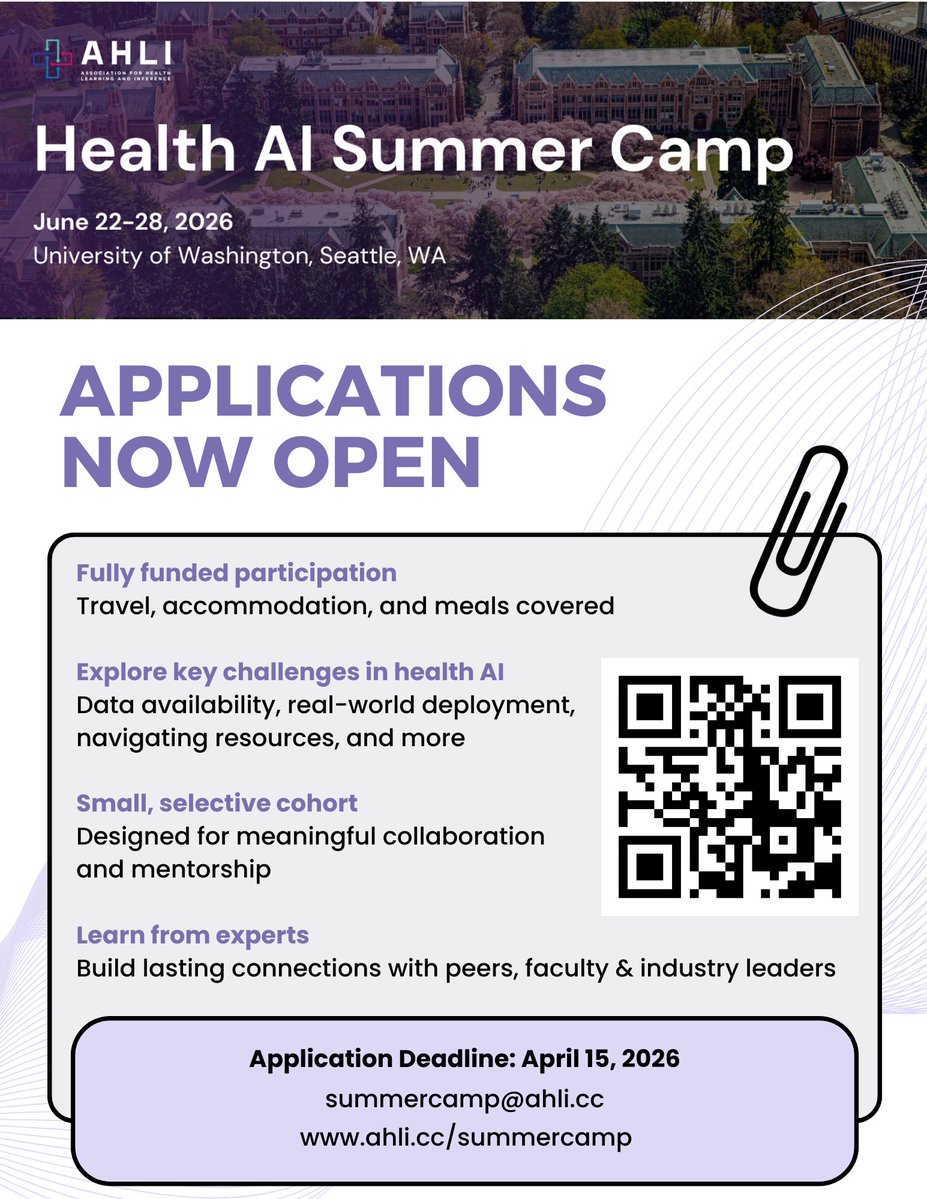
AHLI’s inaugural Health AI Summer Camp
📍 University of Washington
📅 June 22–28, 2026
Fully funded for accepted participants.
⏳Apply by April 15 (limited spots): https://t.co/Xk8Ua8fG6C
The CHIL 2026 Doctoral Symposium is back! Apply by March 13th 📅
https://t.co/7VrDzore8s
Last year, we welcomed 28 outstanding PhD researchers for mentorship and lightning talks in health AI.
Watch 3 participant talks from 2025 👇 (see 2:48:43)
https://t.co/QElgXnRWDW
Help us shape the conversation at CHIL 2026! We invite suggestions for Research Roundtable topics about controversial or open questions in machine learning for healthcare. Drop your suggestions here: https://t.co/Evo7SRcW4j
Happy Holidays from AHLI! But first, a quick reminder:
📣 CHIL 2026 is coming to Seattle, June 28-30th.
📝 Submission site is now open!
⏰ Deadline: Feb 4, 2026
🤝 Sponsorship opportunities available
🌎 Request an invitation letter for visa applications
https://t.co/DEutUucFZr
Looking forward to @SymposiumML4H! The Alsentzer Lab just turned 1, & we’re celebrating with 4 papers on longitudinal EHR QA eval, LLMs for rare disease diagnosis, prior-chat bias in LLMs, & inference-time merging of general+clinical models.
We’re recruiting postdocs-Let’s chat!
✨I'm on the research scientist and postdoc job market! I'll be graduating from my PhD this academic year with a thesis that focuses on reinforcement learning and healthcare. ✨
I'll also be presenting some new work at ML4H (https://t.co/cnuuixyhyd) which focuses on building synthetic datasets for off-policy evaluation in healthcare.
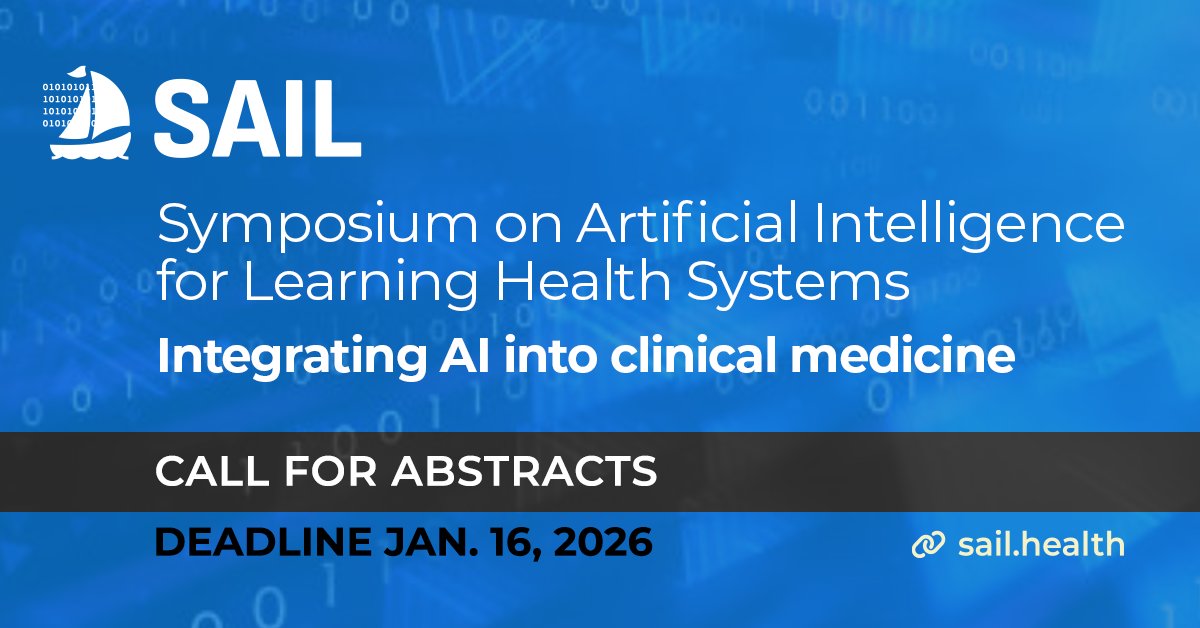
CALL FOR ABSTRACTS | SAIL 2026 on May 5–8 in Río Grande, Puerto Rico! In-person attendance limited to those with accepted work. Apply by 1/16/26. Oral presentation invitations & @NEJM_AI-sponsored travel awards go to the top abstract submissions. #SAILhealth26 - https://t.co/qYEVM7PdR1
IFF you: @stanford student
Want: Publish your study in NEJM AI
Free: November 18th at noon PST
DO: contact me at [email protected]
Me: Buy you coffee/refreshment while you pitch the study.
📣 Announcing the 7th Annual Conference on Health, Inference, and Learning (CHIL) happening June 28-30, 2026 in Seattle, WA!
👉 Call for Papers is up at https://t.co/8Pp68WYlLV...
⏳ Submit by February 4, 2026
Super excited that our work with TIMER has been published in npj Digital Medicine! We explore the role of temporal bias in both clinician and synthetically generated data-- showing current benchmarks don't evaluate models across the full input context of a patient's record.
I am on the job market this year! My research advances methods for reliable machine learning from real-world data, with a focus on healthcare. Happy to chat if this is of interest to you or your department/team.
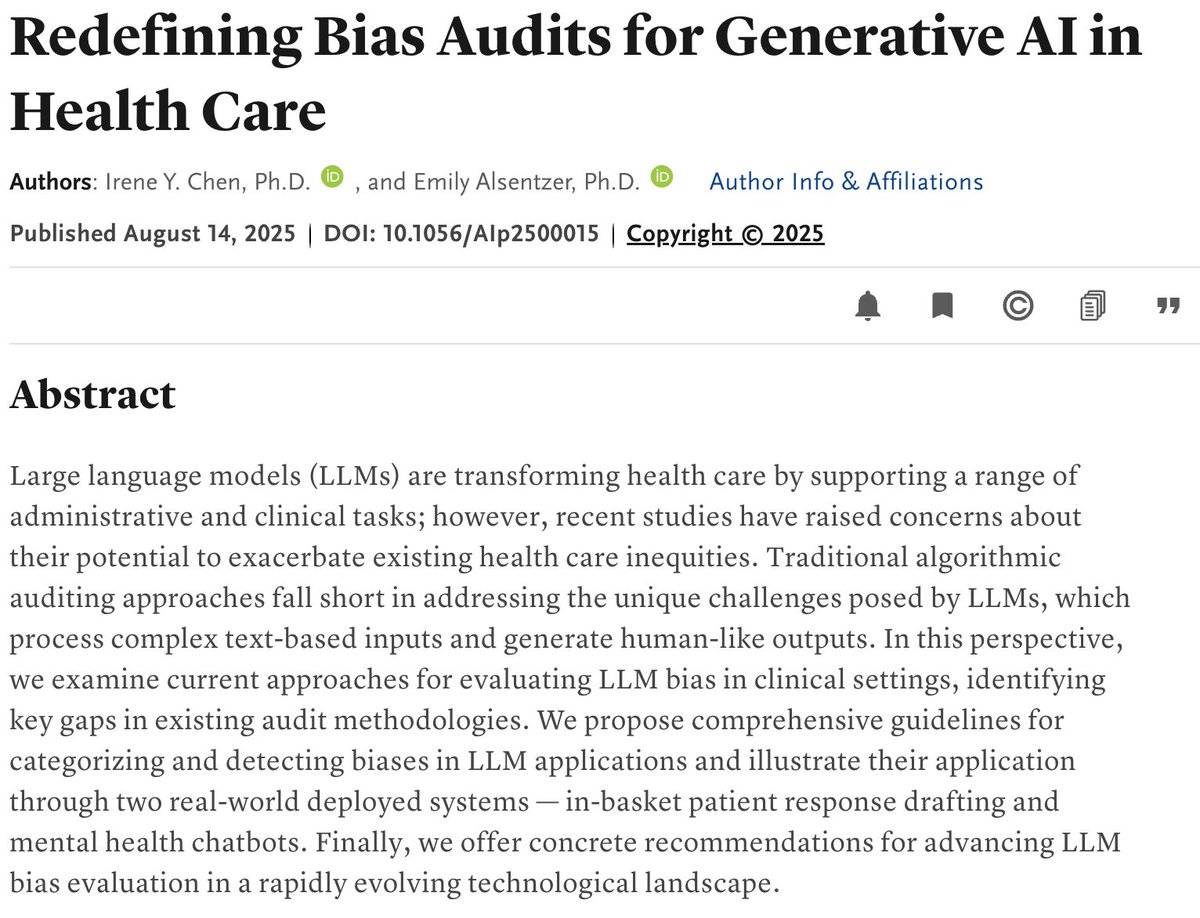
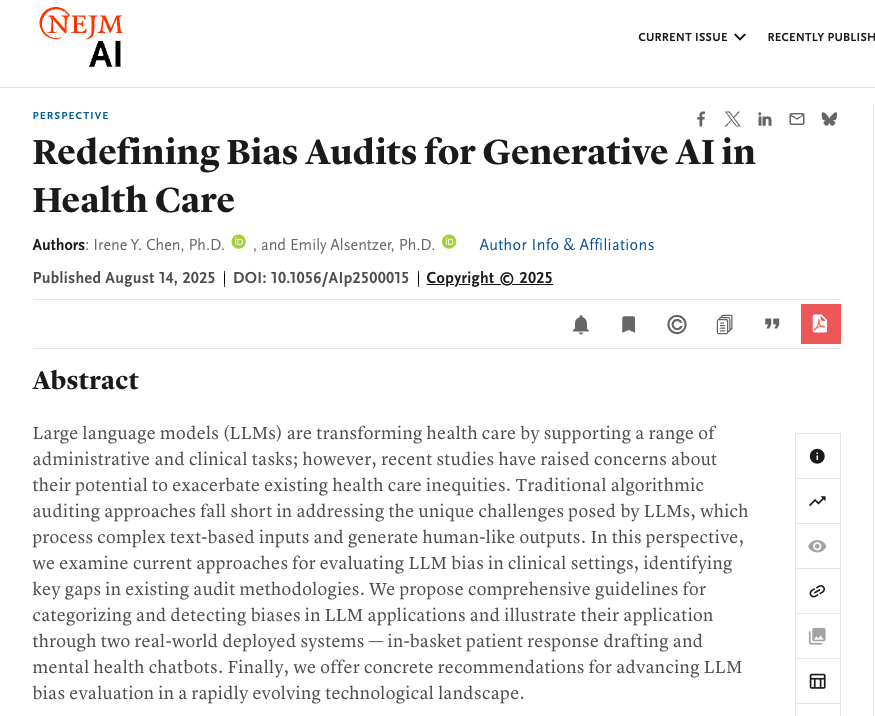
Traditional ML fairness audits don't work in the LLM era, eg medical LLMs may have eq treatment rec rates across groups (seemingly good!) but differ in empathetic vs dismissive phrasing (bad!). Also what do "groups" even mean now?
New NEJM AI piece w @Emily_Alsentzer out today
We show how to apply these guidelines to two deployed use cases:
• Drafting replies to patient messages
• Mental health chatbots
Full paper: https://t.co/e7ITPatMzL
Had a great time collaborating with the incredible @irenetrampoline on this!
🚨 LLMs are rapidly entering the clinic - ambient documentation tools are now deployed at most major hospital systems, and Epic alone has dozens of LLM applications in development.
Yet we lack systematic ways to evaluate these *already deployed models* for bias.
🧵
We need:
• Clearer ways to define at-risk groups (e.g., looking beyond explicit demographics to groups inferred from input text)
• More comprehensive metrics (e.g., factuality, thoroughness, tone, tailoring to context, and stigmatization)