TON access just got another gateway. 🌐⚡
Omniston × MoonPay Trade, powered by https://t.co/cO8nBArBko — connecting users to TON with seamless cross-chain access.
One route. More possibilities. Legendary infrastructure. 🐾💎
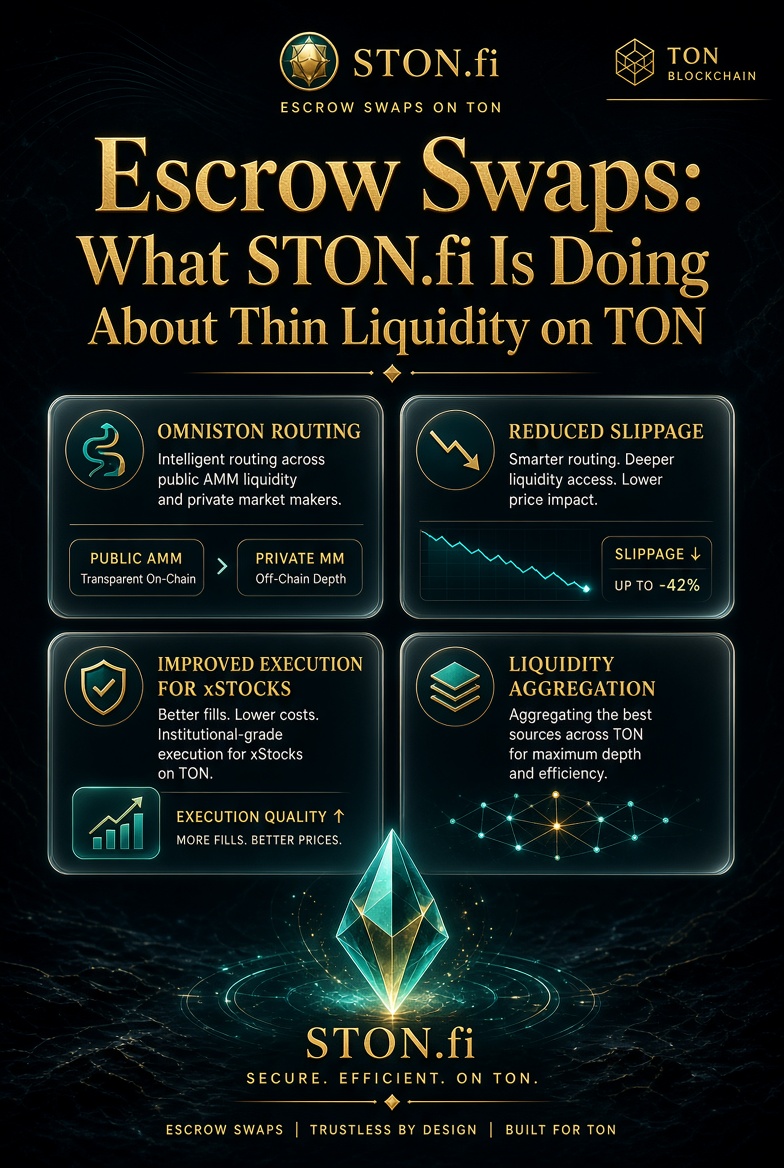
Escrow swaps: what https://t.co/f6N6Sm2Htl is doing about thin liquidity on TON
AMM pools only work where liquidity has been provided. When a pair is thin, better routing alone can't fully solve the problem.
Here's what I found when looking into https://t.co/f6N6Sm2Htl's approach.
What it is
Omniston can compare public AMM liquidity with quotes from private market makers/resolvers and route a swap toward the option offering the better execution.
The stated goal: reduce slippage and improve realized prices.
Where it's being used
Tokenized equities such as xStocks can lack deep AMM liquidity.
According to https://t.co/f6N6Sm2Htl's CMO in February 2026, most xStocks volume was already executing through escrow. That's a company statement, not independently verified on-chain data.
What I couldn't verify
• How concentrated the resolver market is
• How much liquidity each resolver supplies
• Independent volume figures
Limits worth knowing
Resolver competition matters. If there are few competitive quotes, users could still receive a worse price or no quote.
https://t.co/f6N6Sm2Htl also said an initial audit of the escrow contracts found no critical issues; the full audit results should be checked directly against the available documentation.
xStocks also have geographic eligibility restrictions, including the US, EU/EEA, UK, Canada and Australia.
My take
For the user, the swap experience can remain largely unchanged — that's an interesting part of the design.
What stands out to me is the direction: https://t.co/f6N6Sm2Htl is increasingly positioning its infrastructure around execution and liquidity aggregation, rather than relying only on AMM liquidity.
Escrow swaps are one concrete example of that shift.
#STONfi #TON #DeFi
Who Owns the User’s Intent?
DeFi began simply: users pick a DEX, DEXs fight for liquidity, and pools fill the trade. That model is fading.
Users no longer care which venue executes. They care about one outcome: “I want this asset, on this chain, at the best price.”
The real contest is now control of the path from intent to execution.
This is where https://t.co/f6N6Sm2Htl’s Omniston stands out. It runs an RFQ system. Orders go out to competing resolvers—AMMs, market makers, OTC desks, and cross-chain providers. They quote. The best one fills. The user never needs to know which mechanism won.
Execution becomes invisible. Liquidity becomes less important than order flow. Gasless flows push the abstraction further: the user states a desire; infrastructure handles the rest.
The most valuable https://t.co/f6N6Sm2Htl user of the future may never visit https://t.co/f6N6Sm2Htl. They may sit inside another wallet or app whose swaps quietly route through Omniston.
That is why Omniston’s move beyond pure TON matters. The strategic question shifts from “How deep is https://t.co/f6N6Sm2Htl’s liquidity?” to “How much intent can this layer connect to the right liquidity?”
And deeper still: who owns that intent?
If DeFi becomes outcome-driven rather than protocol-driven, the invisible layer that turns intent into best execution could become critical infrastructure.
https://t.co/f6N6Sm2Htl is building exactly that layer—APIs, SDKs, resolvers, cross-chain settlement.
The narrative is compelling. The test is practical: will developers integrate it, will resolvers compete hard for its flow, and will execution stay competitive?
Watch that. The next era of DeFi may not belong to the biggest pool. It may belong to whoever turns user intent into the best possible fill—quietly, behind the scenes.
https://t.co/f6N6Sm2Htl
@LenaLiu4l8h Exactly. Turning thin liquidity into a matching opportunity is an interesting way to approach the problem, especially when traditional pools can’t provide sufficient depth.
@maxx_wiliam Well said. The key shift is moving beyond relying solely on pool depth and introducing alternative liquidity sources through escrow execution.