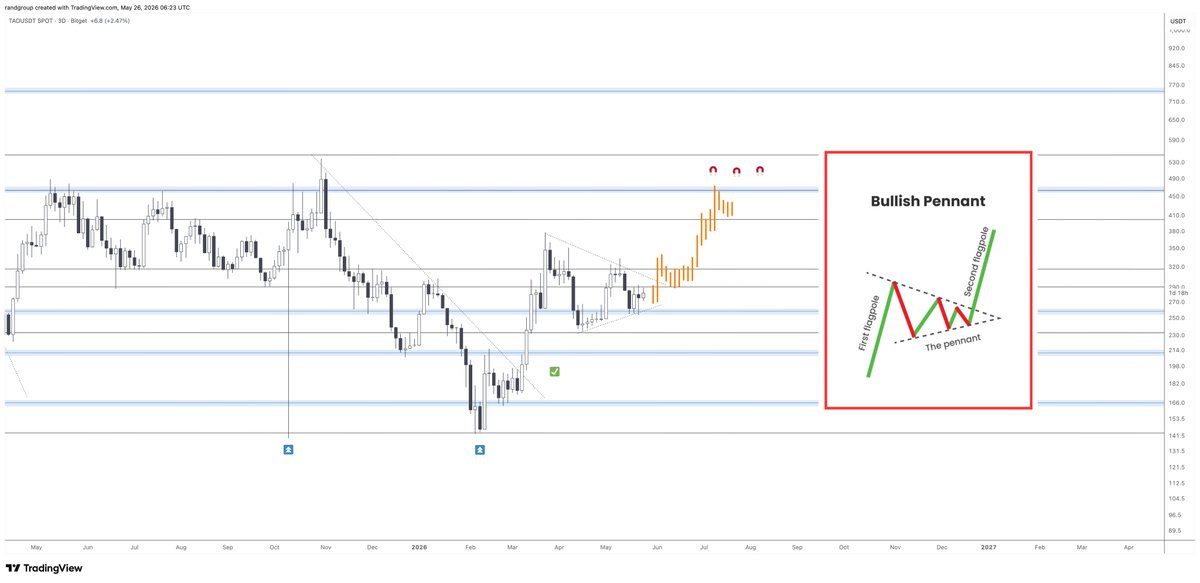
The final wizz Ta
Chart wont be valid anymore once we break below 55 k #btc
I refuse to believe that we will go to 45 k or lower. So here are my thoughts for Q3 /Q4 2026
Summer range between 74/60 k
Saylor has one more chance to unload his bags at 100 k.
What do you think?
Barry Silbert bought Bitcoin at $7.
He built Grayscale from nothing.
He turned DCG into a 300-company crypto empire.
Now he's saying $TAO is his Bitcoin moment.
Here's what he said that most people missed:
"For Bitcoin OGs, we are circa 2012 to 2013 right now."
At a $1.5 billion market cap.
He's not guessing. He's pattern matching to the only playbook that turned a $7 bet into the largest crypto asset manager in the world.
The fair launch comparison hit different.
No VC round. No team allocation. No foundation getting rich before you.
Just a white paper turned into code, launched into the world.
Exactly like Bitcoin.
Same 21 million supply cap.
Same halving cycle.
Same organic community that had to earn their way in.
Then he explained the subnet flywheel.
88 subnets. Each one solving a different problem. Each one with its own token.
But every single subnet token trades in and out of TAO.
So when any subnet wins, TAO wins.
He called it something I had to read twice.
"There is no other project in crypto with the same dynamic."
On Ethereum and Solana, ecosystem tokens create zero value for the base layer.
On Bittensor, every subnet success flows directly back to TAO.
Then came the boldest statement.
Right now $500 million in TAO emissions are up for grabs annually as incentives for compute, data, and model providers.
As TAO price rises, that becomes $1 billion. $5 billion. $10 billion.
At $10 billion in annual incentives, you've built the most powerful intelligence coordination network in human history.
His mission with Yuma is simple.
Find the Coinbase of Bittensor.
Find the Chain Analysis of Bittensor.
Find the BitGo of Bittensor.
Infrastructure first. Same playbook. Different era.
His boldest prediction?
Bittensor could be a better version of Bitcoin.
Instead of spending $10 to $12 billion a year to secure a ledger, imagine spending that same amount to incentivie a global network of people solving the world's hardest problems.
Same economics. Bigger mission.
The people who read the docs always buy before the people who read the price.