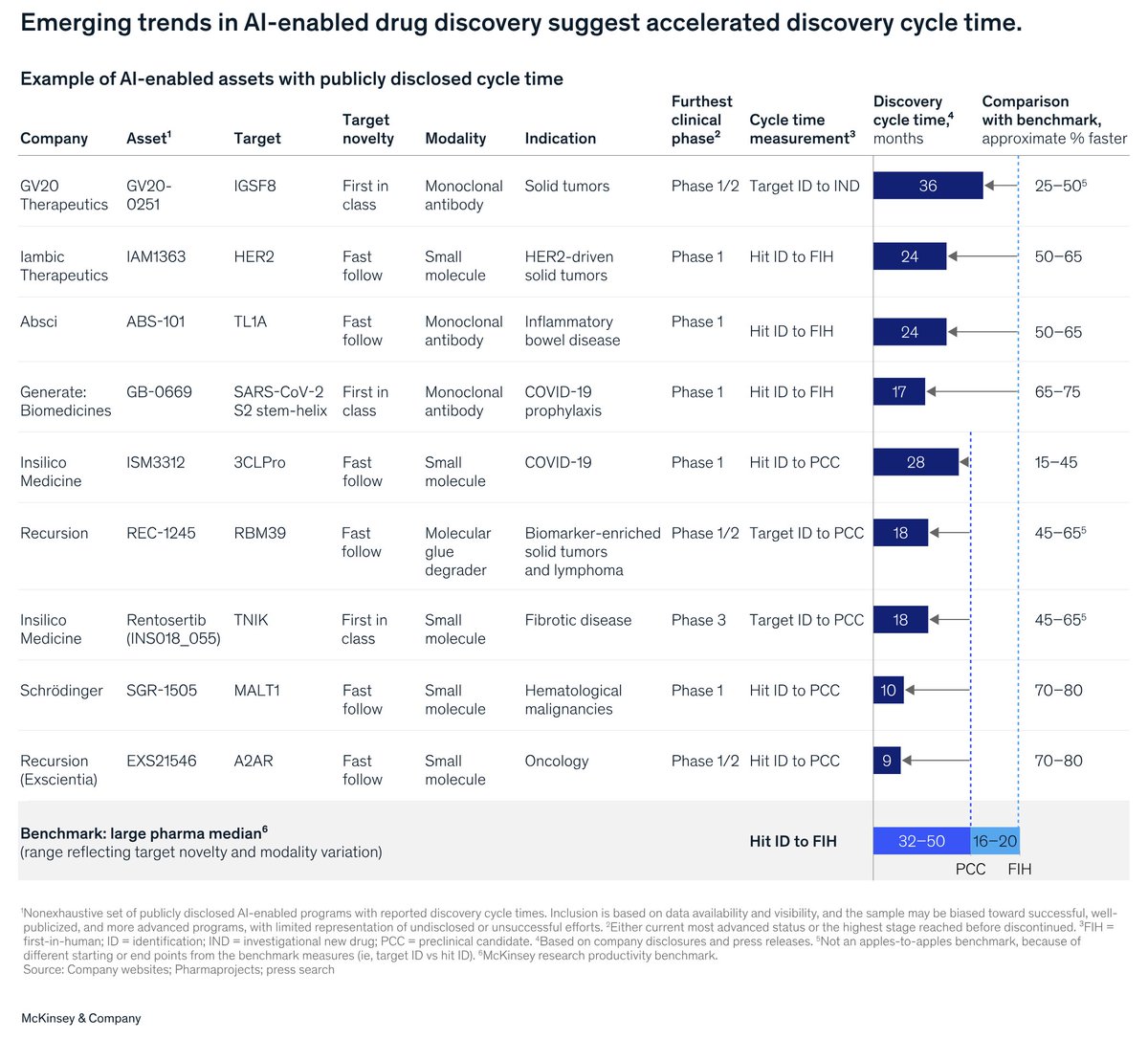
Is AI actually speeding up drug discovery?
According to new McKinsey research, there are early signs that it is: all of these candidates were AI-enabled, with discovery time cut by ~15-80%.
(Incredibly bullish)
Yes I built it for myself, it started with a calorie tracker, kinda messy but nice:
https://t.co/FeWxZkJUiG
I log my food in Telegram to get calories and protein data
My workouts and sleep from WHOOP
My weight from my scale
Indoor air quality, temperature, humidity for bedroom is also tracked from Xiaomi to Home Assistant to there
Steps and other health data from Apple Health is auto exported every hour with Health Auto Export app on iOS which POST's to my server
My travels from @nomadscom's API and sauna use from @wip's API
That lets me find correlations between lots of things and see what is good for me and what is bad for me
Health is personal and everyone's body is different so this helps me make good more healthy decisions
New paper @Nature: Semaglutide recapitulates many of the benefits of caloric restriction in female mice & extends lifespan by almost 100 days. Males not yet tested for lifespan
Below: Red traces = mouse movement
I en tid när Israel anklagas för att styra världen och döda barn är det också värt att berätta vad israel faktiskt egentligen gör för människor världen över. Deras forskning är på väg att rädda livet på miljoner människor världen över nu.
Jag har typ 1-diabetes och för första gången känns det faktiskt möjligt att drömma om ett liv utan diabetes. Fullt frisk blir jag kanske aldrig, men israeliska forskare vid Technion har utvecklat ett sätt att skydda nya insulinproducerande betaceller från immunförsvaret.
Tanken är i princip att plantera in nya celler som känner av blodsockret och gör insulin åt kroppen igen, samtidigt som de skyddas från attacken som orsakar typ 1-diabetes. De har tydligen hittat sätt som äntligen fungerar
Det här är fortfarande forskning, inte en färdig behandling. Men vi pratar potentiellt inte om bot om 300 år, utan kanske någon gång under 2030- eller 2040-talet om forskningen fortsätter gå framåt och klarar säkerhetskraven.
Och med AI ovanpå biotekniken kan utvecklingen dessutom gå fortare än vi är vana vid.
För oss med typ 1-diabetes börjar ordet ”bot” åtminstone kännas lite mindre science fiction.
Och om israeliska och judiska forskare en dag är med och botar min diabetes så kommer jag åka till Israel direkt och buga inför alla heliga platser och människor för att visa min tacksamhet för all framtid.
https://t.co/lcdfiLd1w2
DXA kan överskatta muskelförlust vid viktnedgång – en del av minskningen kan vara fett i/kring muskeln snarare än faktisk muskelvävnad. MR visar betydligt mindre muskelförlust.
https://t.co/Z7WjDrl08e
The big news in biotech is that the EU just approved a cochlear implant for eyesight.
Age-related macular degeneration affects ~200m people globally, and the "PRIMA" lens turns light into signals your surviving retinal cells send to the brain, restoring the ability to see again!
Physical activity may help protect the aging brain for nearly a decade.
Older adults with a higher VO₂ peak had larger cortical brain volumes and better memory years after a 5-year exercise intervention, regardless of whether they had been assigned to high-intensity, moderate-intensity training, or standard physical activity guidelines.
The group following the guidelines also experienced the least hippocampal volume loss, even four years after the intervention ended. High-intensity training was not superior for preserving hippocampal volume in this study, which I found genuinely surprising.
This does not mean HIIT harms the brain. Entering older age with strong cardiorespiratory fitness, and continuing to stay active, may matter more for long-term brain health than following any one specific training intensity/exercise prescription.
Bananas contain PPO, which may reduce flavanol absorption when blended with berries. Still healthy—just consider eating them separately. Small study: https://t.co/sSw16QpfHp
I'm a cardiologist. Everyone is sharing this study as a skin story. They're burying the part that matters.
Scientists took the aorta of a 75-year-old donor, applied a single engineered enzyme, and stripped away more than 70% of the molecular damage — bringing it down to the levels you'd see in a 30-year-old artery.
Published five days ago in Nature Communications. Revel Pharmaceuticals, with Calico and the University of Colorado.
Here's what they erased.
Sugar reacts with proteins in your body the same way heat browns bread — slowly, over a lifetime. It leaves behind a residue called CML, the most abundant advanced glycation end product in aging tissue. It welds itself onto collagen and elastin in your skin, your eye lens, and your arterial walls.
Two things follow. Your arteries stiffen. And CML latches onto a receptor called RAGE, which drives chronic inflammation — the exact fire I've been writing about for months as the engine of heart disease.
Since the 1980s this damage was considered permanent. Your body has no enzyme to remove it. Every existing approach only slows new damage from forming. Nothing touched what was already there.
So they built an enzyme that doesn't exist in nature. They screened 45,000 protein structures, then ran five rounds of directed evolution across more than 500 million variants until they had CMLase — a molecular lawnmower that oxidizes the CML off the protein and restores the original, healthy lysine underneath.
Not patched. Reversed.
Over 70% cleared from elderly arterial tissue. Over 55% from elderly skin — below the levels found in 31-year-old skin. 45-78% in lens proteins. The CEO said they expected 20% and were floored.
Arterial stiffness drives systolic hypertension, heart failure, and stroke, and I have no drug that reverses it. I can slow the process. I cannot undo it. This paper says undoing it may be possible.
The caveats are real and I won't skip them. This was done on donated tissue in a dish, not in a living person. No functional data yet — we don't know if that artery got measurably more elastic. Delivering a large enzyme deep into human tissue is a hard, unsolved problem. Clinical trials are years away.
But something considered permanent for forty years just came off human tissue.
We spent a century learning to slow aging. Someone finally figured out how to erase it.
Thank you @theallinpod@friedberg@chamath@pesottas
This is *huge* news.
For a long time, the only way to lower your cholesterol that was effective, cheap, and easy was to take statins.
But for some patients, that wasn't enough, so they had to add on PCSK9 inhibitors, via injection.
Now, we have an oral version!
Myostatin inhibitors will be bigger than any GLP-1
I just analyzed results from 4 recent Phase 2+ trials:
+ Bimagrumab (Lilly)
+ Trevogrumab & Garetosmab (Regeneron)
+ Apitegromab (Scholar Rock)
+ Enobosarm (Veru)
The results are insane
We're entering the Era of Enhancement:
The cholesterol wars are over.
LDL won.
New guidelines. Four landmark trials. An oral PCSK9 inhibitor that matches injectables. And data proving we should be treating patients we currently aren't.
Here's everything clinicians need to know. 🧵