A street can look ordinary and still hold a complex interaction.
Where is attention focused? What is partially hidden? Who might move next?
Reading the road means looking beyond what is directly in front of us.
#PedestrianSafetyMonth
Good judgment behind the wheel is built mile by mile.
For National #TeenDriverSafetyWeek, help new drivers build safe habits early: phones away, seat belts on, speed down and eyes on the road.
Autonomy will not scale through technology alone. It requires operators, cities, insurers and infrastructure providers to build a shared understanding of real-world performance.
Thanks to @driverlessguy_ for the recap of the incredible conversations our team took part in.
🚦🤖 Our Austin Urban Autonomy Summit recap is live!
Our latest article brings together perspectives from operators, infrastructure providers, insurers and city leadership across three panels at the summit, presented by @EmpiricEarth.
🧵 (1/5)
AI is creating new forms of risk faster than insurers can define, measure or price them.
@TechstrongAI examines the growing coverage and accountability gaps, with perspective from Empiric Earth President Jen Vescio on the evidence Physical AI will require: https://t.co/ZjAZxVXRJa
Construction can move a walkway. A delivery vehicle can block a sightline. Rain can change how quickly someone crosses.
The road is never a fixed environment. Safe movement depends on understanding what is happening now.
#PedestrianSafetyMonth
Last night, we welcomed Women in Automotive Technology (WAT) to our Sunnyvale office for a conversation on AI architectures in automotive systems.
Thank you to our own Tahmida Mahmud, the panelists, and everyone who joined us for an evening of conversation and networking.
#WomenAutoTech #AutomotiveTechnology #AI
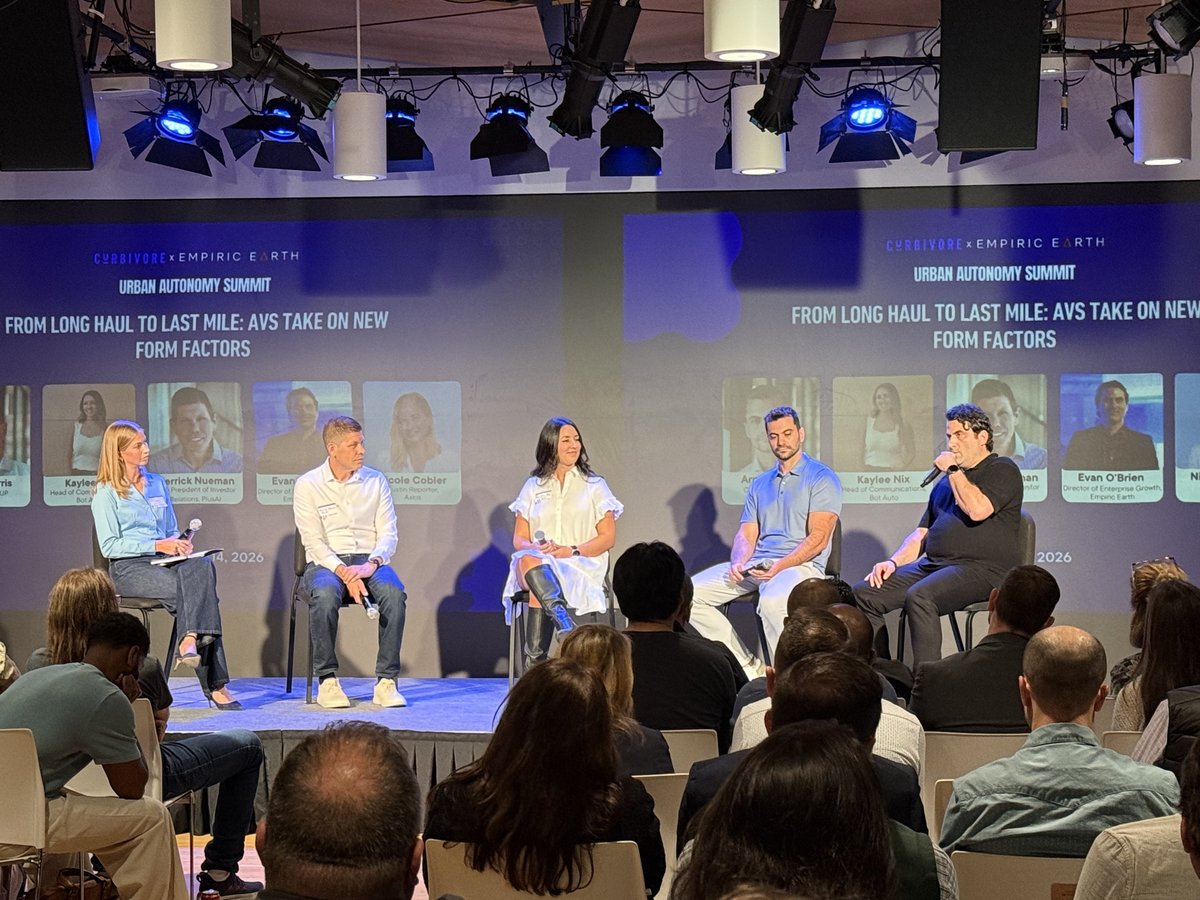
A huge shoutout to our Director of Enterprise Growth, Evan O’Brien, who took the stage today at the Urban Autonomy Summit.
In a room full of people who decide how AVs show up on our streets, Evan highlighted the importance of Empiric Earth’s role in enabling AV deployment at scale.
We’re only three hours away from welcoming Women in Automotive Technology to our Sunnyvale office.
There’s still time to join us for the panel and an evening of networking with women from across the automotive technology community.
RSVP: https://t.co/clb2qAEUnX
#WomenAutoTech #AutomotiveTechnology #AI
Tesla built its view of the physical world through a fleet operating at enormous scale. Most Physical AI companies will not have that advantage. And they shouldn't need it.
Real-world experience can become shared infrastructure, giving more machines the benefit of situations they have not encountered themselves.
Efficient compute plus diverse driving data is what makes Physical AI safe at scale. World models built on this data demonstrate zero shot generalization and handle situations they've never been trained on.
This is why we built @EmpiricEarth and why we are the only company that can offer access to the real world at a scale that Tesla has been seeing for over a decade.
National Truck Driver Appreciation Week recognizes the skill behind every safe mile.
Across 423 million miles, the safest vehicles drove farther, braked more smoothly, and remained among the safest over time – even after accounting for where and when they drove.
Explore the data behind The Safest Million Miles at https://t.co/YBNEuBwEoi
#NTDAW26 #ThankATrucker
Can one world model support autonomy across cars, trucks, aircraft, and fleets?
Next week, our Chief R&D Officer joins AI leaders from Waymo, Archer Aviation, and Motive to explore what transfers between machines – and what doesn’t.
Learn more at https://t.co/aykISRYUKI
@naturewill An important step toward machines that can carry experience into new tasks. As these systems move into the world, a current record of the conditions they encounter will help show where that knowledge transfers and where new experience is still needed.
@nuro@Uber@LucidMotors Real-world streets do more than validate an AI driver. They expose changing conditions and edge cases that a closed test cannot fully reproduce. Capturing those moments is how one deployment can help improve the next.
People don’t move like lane markings.
They pause, change direction, and respond to what’s around them. Technology operating in the physical world must learn to recognize that movement in context.
#PedestrianSafetyMonth
Exciting news 🎉
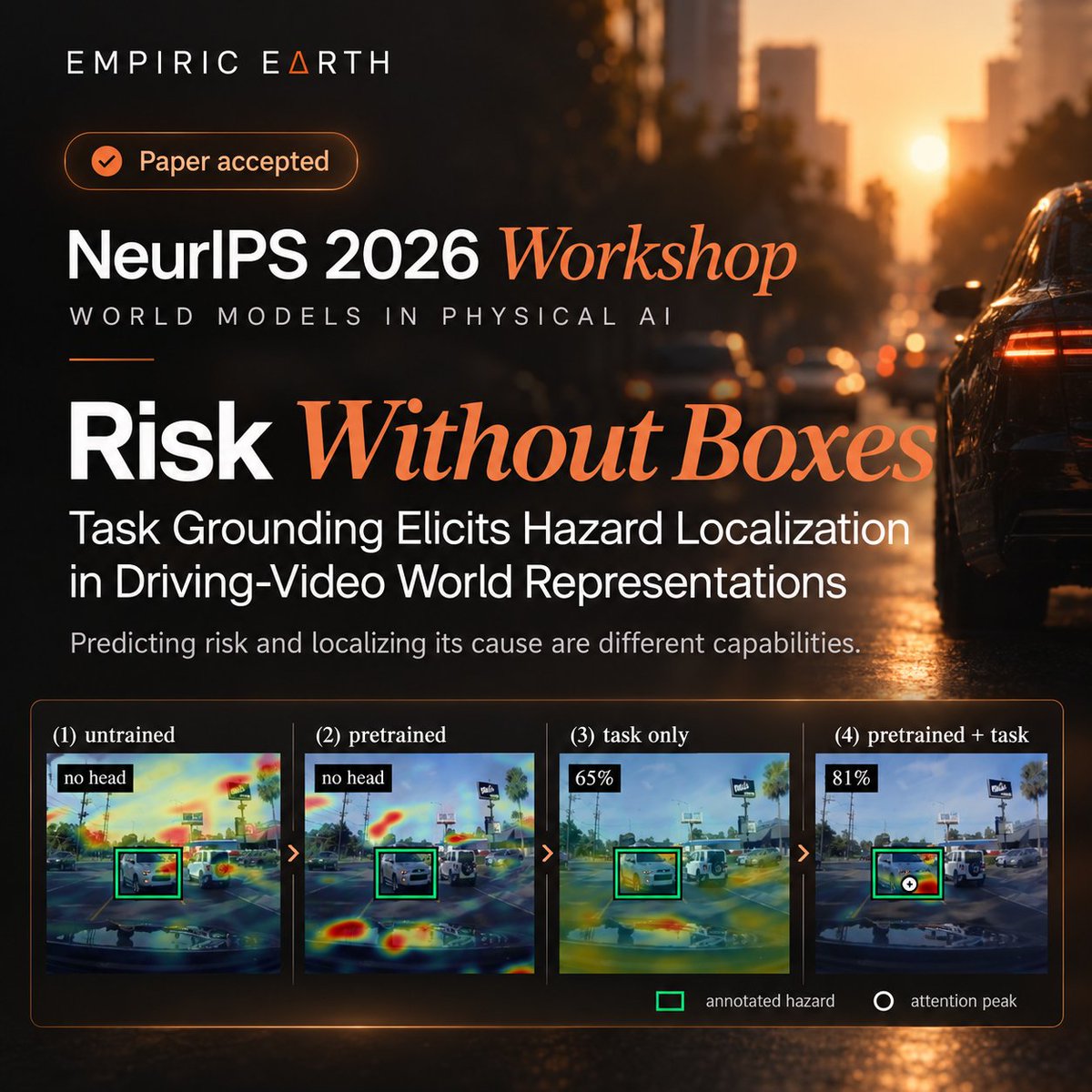
Our paper “Risk Without Boxes” has been accepted to World Models in Physical AI Workshop @ NeurIPS 2026!
We show risk prediction and hazard localization are different capabilities and that self-supervised learning + supervised distillation can achieve both.
New Empiric Earth President, Jen Vescio, explains the trust challenge facing Physical AI, the gap between breakthrough tech and commercial scale, and the work she wants to help lead.
Read why she joined Empiric Earth at https://t.co/D7qRuccAtO
Empiric Earth has named Jen Vescio President.
A board member since April and former @Uber Chief Business Development Officer, Jen will lead corporate strategy and commercialization across product, partnerships, sales, and marketing. https://t.co/44ELdBU3Ja
A pedestrian stepping out from behind a parked vehicle. A driver beginning a turn. A signal about to change.
Road safety often comes down to reading moments like these early enough to respond. Better awareness begins with seeing the full context.
#PedestrianSafetyMonth
@huaviduc753@vangrid_io Physical AI needs more than large volumes of data. It needs a record of where that data came from, what conditions shaped it, and how privacy was protected. Without that context, it becomes much harder to know what a model has actually learned.