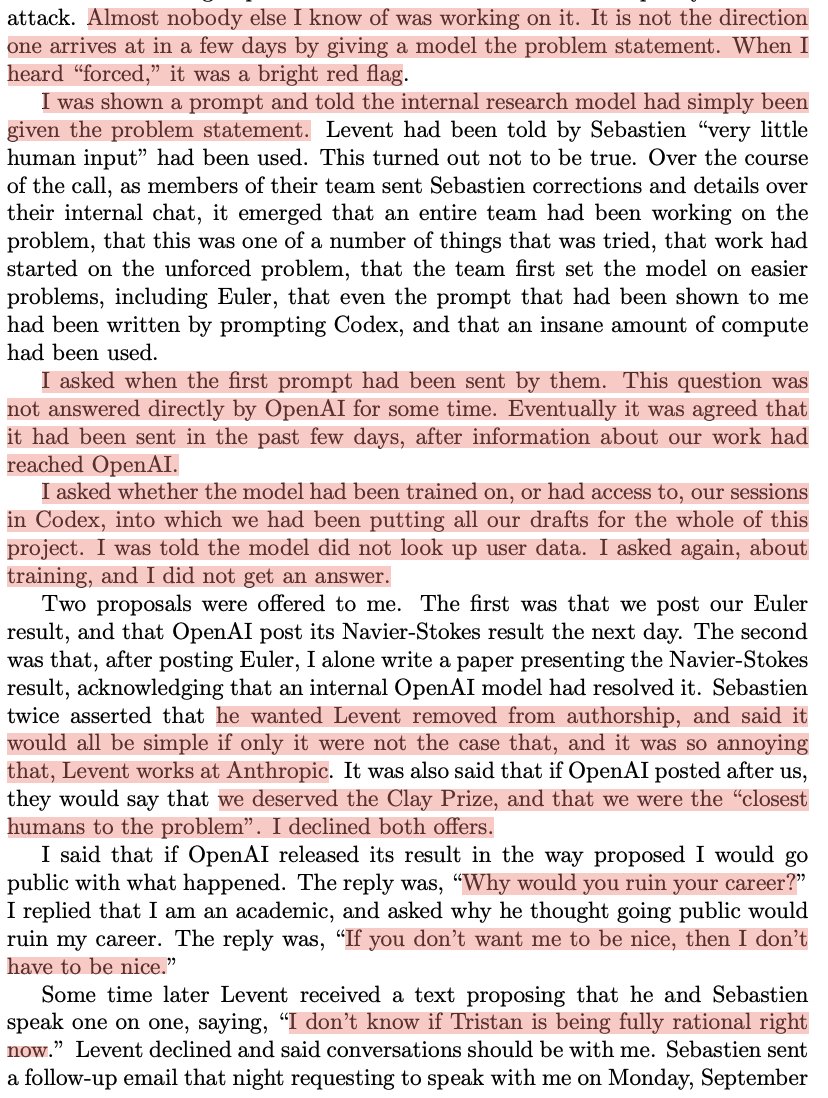
You're missing the core drama of the story: Tristan is softly accusing OpenAI of having stolen their result from Codex chat logs.
Tristan then claims OpenAI tried to threaten him to not publicly disclose this, and that they'd give him the Clay Prize ($1M) as the "closest humans to the problem" if he'd agree to disavow his co-author, @__alpoge__ , who is at Anthropic.
This is HBO-level drama, but with math proofs.
@mvinaes Jeg læste det som en stikpille til os, da vi ikke har nogle points som kunne påvirke Danmarks koefficient negativt pga vores historisk dårlige Europa kampagne…
@chdausgaard Gode pointer! En del forskning viser også, at folk ikke aner, hvad "de rigeste" indebærer, hvilket taler for, at præcisering af de rigeste 1% betyder noget (e.g. https://t.co/VE79OCTfDY)
Spørgsmålet om indførelse af en formueskat på de 22.000 rigeste danskere har været helt centralt i den første uge af valgkampen. Men hvad ved vi egentlig fra forskningen om, hvad der former danskernes holdning til at beskatte de rigeste? En kort tråd 🧵 (1/8)
Litteratur: Hansen, Kristina Jessen. 2023 Greed, Envy, and Admiration: The Distinct Nature of Public Opinion about Redistribution from the Rich. American Political Science Review.
Slothuus, R.& Bisgaard, M. 2020. How Political Parties Shape Public Opinion in the Real World. AJPS