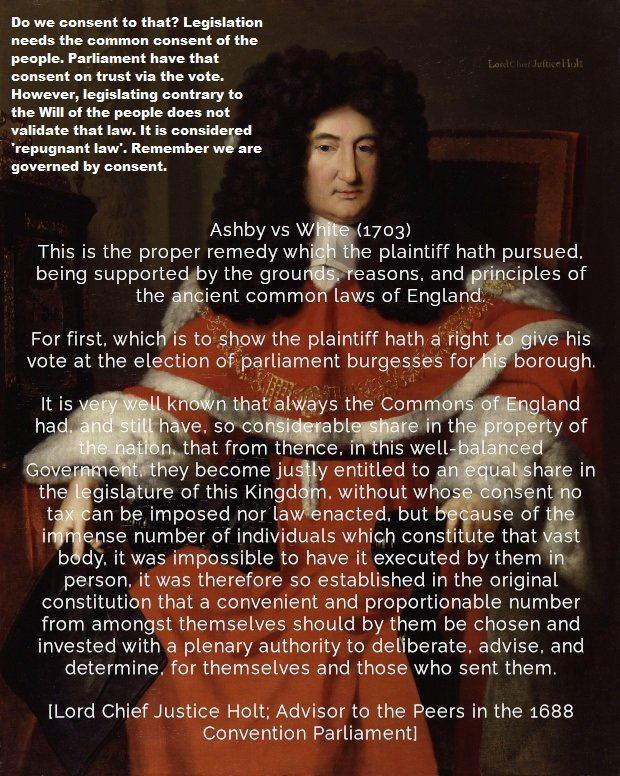
The English Bill of Rights (1688)
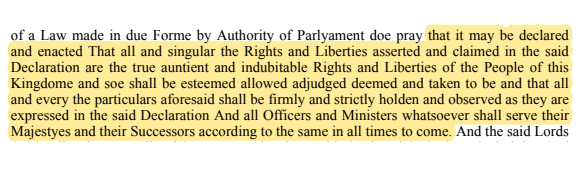
that it may be declared and enacted That all and singular the Rights and Liberties asserted and claimed in the said Declaration are the true auntient and indubitable Rights and Liberties of the People of this Kingdome
#English#Constitution
@Kingbingo_ (2) A public official' 'commits the offence of torture if-
(a) 'with the consent or acquiescence of a public official or person acting in an official capacity.'
(b) 'consents to or acquiesces in it.'
(3) 'an act of omission.'
https://t.co/PDhIRPSoGD https://t.co/r7M7lo9vm4
@MaggieOliverUK Arresting them for Torture: The law exists under English law, Criminal Justice Act 1988 section 134 - TORTURE. It also comes under UNCAT and can be brought via USA courts if the British AG refuses permission.
Privately Prosecute if needs be. If the AG says no. . .
1. NOT Misfeasance in Public office. The charge is TORTURE
2. Your problem will be the British trained lawyers and prosecution (CPS).
3. The trials should be heard in USA preferably TEXAS under universal jurisdiction, the British ratified it, i.e agreed these types of crimes could be tried abroad. The sentence is mandatory life in prison (no other sentence).
@benhabib6@BackBrexitBen @sammywoodhouse1 @elonmusk
Criminal Justice Act 1988 134Torture.
(1) A public official or person acting in an official capacity, whatever his nationality, commits the offence of torture if in the United Kingdom or elsewhere he intentionally inflicts severe pain or suffering on another in the performance or purported performance of his official duties.
(2) A person not falling within subsection (1) above commits the offence of torture, whatever his nationality, if—
(a) in the United Kingdom or elsewhere he intentionally inflicts severe pain or suffering on another at the instigation or with the consent or acquiescence—
(i) of a public official; or
(ii) of a person acting in an official capacity; and
(b) the official or other person is performing or purporting to perform his official duties when he instigates the commission of the offence or consents to or acquiesces in it.
(3) It is immaterial whether the pain or suffering is physical or mental and whether it is caused by an act or an omission.
(4) It shall be a defence for a person charged with an offence under this section in respect of any conduct of his to prove that he had lawful authority, justification or excuse for that conduct.
(5) For the purposes of this section “lawful authority, justification or excuse” means—
(a) in relation to pain or suffering inflicted in the United Kingdom, lawful authority, justification or excuse under the law of the part of the United Kingdom where it was inflicted;
(b) in relation to pain or suffering inflicted outside the United Kingdom—
(i) if it was inflicted by a United Kingdom official acting under the law of the United Kingdom or by a person acting in an official capacity under that law, lawful authority, justification or excuse under that law;
(ii) if it was inflicted by a United Kingdom official acting under the law of any part of the United Kingdom or by a person acting in an official capacity under such law, lawful authority, justification or excuse under the law of the part of the United Kingdom under whose law he was acting; and
(iii) in any other case, lawful authority, justification or excuse under the law of the place where it was inflicted.
(6) A person who commits the offence of torture shall be liable on conviction on indictment to imprisonment for life.
Stop playing political games and use the LAW as it should be used.
King Charles III has abdicated.
By his performance, he has renounced his right to govern, which the High Court of the 1688 Convention Parliament established as abdication; https://t.co/DU4afQQXlB
@BasilTheGreat A public official' 'commits the offence of torture if-
(a) 'with the consent or acquiescence of a public official or person acting in an official capacity.'
(b) 'consents to or acquiesces in it.'
(3) 'an act of omission.'
@BasilTheGreat Life in prison.
Section (6): 'Liable to imprisonment for life.'
Criminal Justice Act [1988], section 134: https://t.co/PDhIRPSoGD https://t.co/r7M7lo9vm4
@MaggieOliverUK Arresting them for Torture: The law exists under English law, Criminal Justice Act 1988 section 134 - TORTURE. It also comes under UNCAT and can be brought via USA courts if the British AG refuses permission.
Privately Prosecute if needs be. If the AG says no. . .
1. NOT Misfeasance in Public office. The charge is TORTURE
2. Your problem will be the British trained lawyers and prosecution (CPS).
3. The trials should be heard in USA preferably TEXAS under universal jurisdiction, the British ratified it, i.e agreed these types of crimes could be tried abroad. The sentence is mandatory life in prison (no other sentence).
@benhabib6@BackBrexitBen @sammywoodhouse1 @elonmusk
Criminal Justice Act 1988 134Torture.
(1) A public official or person acting in an official capacity, whatever his nationality, commits the offence of torture if in the United Kingdom or elsewhere he intentionally inflicts severe pain or suffering on another in the performance or purported performance of his official duties.
(2) A person not falling within subsection (1) above commits the offence of torture, whatever his nationality, if—
(a) in the United Kingdom or elsewhere he intentionally inflicts severe pain or suffering on another at the instigation or with the consent or acquiescence—
(i) of a public official; or
(ii) of a person acting in an official capacity; and
(b) the official or other person is performing or purporting to perform his official duties when he instigates the commission of the offence or consents to or acquiesces in it.
(3) It is immaterial whether the pain or suffering is physical or mental and whether it is caused by an act or an omission.
(4) It shall be a defence for a person charged with an offence under this section in respect of any conduct of his to prove that he had lawful authority, justification or excuse for that conduct.
(5) For the purposes of this section “lawful authority, justification or excuse” means—
(a) in relation to pain or suffering inflicted in the United Kingdom, lawful authority, justification or excuse under the law of the part of the United Kingdom where it was inflicted;
(b) in relation to pain or suffering inflicted outside the United Kingdom—
(i) if it was inflicted by a United Kingdom official acting under the law of the United Kingdom or by a person acting in an official capacity under that law, lawful authority, justification or excuse under that law;
(ii) if it was inflicted by a United Kingdom official acting under the law of any part of the United Kingdom or by a person acting in an official capacity under such law, lawful authority, justification or excuse under the law of the part of the United Kingdom under whose law he was acting; and
(iii) in any other case, lawful authority, justification or excuse under the law of the place where it was inflicted.
(6) A person who commits the offence of torture shall be liable on conviction on indictment to imprisonment for life.
Stop playing political games and use the LAW as it should be used.
@BasilTheGreat (2) A public official' 'commits the offence of torture if-
(a) 'with the consent or acquiescence of a public official or person acting in an official capacity.'
(b) 'consents to or acquiesces in it.'
(3) 'an act of omission.'
https://t.co/PDhIRPSoGD
https://t.co/r7M7lo9vm4
@MaggieOliverUK Arresting them for Torture: The law exists under English law, Criminal Justice Act 1988 section 134 - TORTURE. It also comes under UNCAT and can be brought via USA courts if the British AG refuses permission.
Privately Prosecute if needs be. If the AG says no. . .
1. NOT Misfeasance in Public office. The charge is TORTURE
2. Your problem will be the British trained lawyers and prosecution (CPS).
3. The trials should be heard in USA preferably TEXAS under universal jurisdiction, the British ratified it, i.e agreed these types of crimes could be tried abroad. The sentence is mandatory life in prison (no other sentence).
@benhabib6@BackBrexitBen @sammywoodhouse1 @elonmusk
Criminal Justice Act 1988 134Torture.
(1) A public official or person acting in an official capacity, whatever his nationality, commits the offence of torture if in the United Kingdom or elsewhere he intentionally inflicts severe pain or suffering on another in the performance or purported performance of his official duties.
(2) A person not falling within subsection (1) above commits the offence of torture, whatever his nationality, if—
(a) in the United Kingdom or elsewhere he intentionally inflicts severe pain or suffering on another at the instigation or with the consent or acquiescence—
(i) of a public official; or
(ii) of a person acting in an official capacity; and
(b) the official or other person is performing or purporting to perform his official duties when he instigates the commission of the offence or consents to or acquiesces in it.
(3) It is immaterial whether the pain or suffering is physical or mental and whether it is caused by an act or an omission.
(4) It shall be a defence for a person charged with an offence under this section in respect of any conduct of his to prove that he had lawful authority, justification or excuse for that conduct.
(5) For the purposes of this section “lawful authority, justification or excuse” means—
(a) in relation to pain or suffering inflicted in the United Kingdom, lawful authority, justification or excuse under the law of the part of the United Kingdom where it was inflicted;
(b) in relation to pain or suffering inflicted outside the United Kingdom—
(i) if it was inflicted by a United Kingdom official acting under the law of the United Kingdom or by a person acting in an official capacity under that law, lawful authority, justification or excuse under that law;
(ii) if it was inflicted by a United Kingdom official acting under the law of any part of the United Kingdom or by a person acting in an official capacity under such law, lawful authority, justification or excuse under the law of the part of the United Kingdom under whose law he was acting; and
(iii) in any other case, lawful authority, justification or excuse under the law of the place where it was inflicted.
(6) A person who commits the offence of torture shall be liable on conviction on indictment to imprisonment for life.
Stop playing political games and use the LAW as it should be used.
@harmless_human@Andypublicuk Correct.
A public official or person acting in an official capacity' - 'commits the offence of torture if...
Criminal Justice Act (1988): https://t.co/RPJJhViR6u
'Nowhere does it say the Rights of Parliament or the Rights of the Government, does it!'
It is OUR RIGHT that a Parliament exists for OUR benefit as expressly stated, 'for redress of all grievances, and for the amending, strengthening, and preserving of the laws,' 👇 👏👏👏👏👏
To add further weight to what @ABridgen said.
Primary constitutional statutes such as this are not your run of the mill Acts of Parliament. They are agreed compacts between the Monarch and People enshrined in law. They contain confirmation of the establishment of specific Rights and Liberties of our People and limitations on how we are to be governed, be it expressly by the King, or, by his Government. All of which is given the force of law.
The Bill of Rights is in essence the Declaration of Rights set in law. To look at the Bill of Rights from the correct perspective, all you need do is to understand the above, and that the 'Bill of Rights' is the short title given to that enacted compact at a later date. It was originally know by its description of what it does;
'An Act for the further Limitation of the Crown and better securing the Rights and Liberties of the Subject'.
Nowhere does it say the Rights of Parliament or the Rights of the Government, does it!
It wouldn't, because it is a compact between the Sovereign and our English People. A restating of the 'original contract'.
It is OUR RIGHT that a Parliament exists for OUR benefit as expressly stated, 'for redress of all grievances, and for the amending, strengthening, and preserving of the laws,'; not for a rogue State to redefine what the existence of a Parliament means in that compact, to then arbitrarily enact legislation that suppresses our Rights and Liberties that the very same text established.
That is constitutional subversion of the very worse kind, and even attempting to subvert our Constitution has in the past been worthy of the loss of one's life. See the Cato Street Conspiracy for example.
The Coronation Oath Act is explicit in that the Monarch is to solemnly swear to not only govern by our Law, but by STATUTES AGREED ON. The Bill of Rights is one such statute to which that statement is referring.
'Now in pursuance of the premisses, the said lords spiritual and temporal, and commons, in parliament assembled, for the ratifying, confirming and establishing the said declaration, and the articles, clauses, matters, and things therein contained, by the force of a law made in due form by authority of parliament, do pray that it may be declared and enacted, That all and singular the rights and liberties asserted and claimed in the said declaration, are the true, ancient, and indubitable rights and liberties of the people of this kingdom, and so shall be esteemed, allowed, adjudged, deemed, and taken to be, and that all and every the particulars aforesaid shall be firmly and strictly holden and observed, as they are expressed in the said declaration; and all officers and ministers whatsoever shall serve their Majesties and their successors according to the same in all times to come.'
There is no doubt that by giving Royal Assent (consent) to this, and by the reply after having been read the Declaration, that this Statute was most definitely agreed to.
'Day 15 February 1688.
His majesties Gracious answer to the Declaration of both houses.
My Lords and Gentlemen
This is certainly the greatest proof of the trust that you have in us that can be given which is the thing that maketh us value it the more and we thankfully accept what you have offered. And as I had no other intention of coming hither than to preserve your Religion, Laws and Liberties so you may be sure that I shall endeavour to support them and shall be willing to concur in anything that shall be for the good of the Kingdom and to do all that is in my power to advance the welfare and glory of the nation.'
By understanding our English Constitution we have all the tools we need to de-legitimise all that is being done to our People and to halt the Wilful destruction of our ancient civilisation.
@englishexit@RestoreBritain@AllForEnglandHQ
To add further weight to what @ABridgen said.
Primary constitutional statutes such as this are not your run of the mill Acts of Parliament. They are agreed compacts between the Monarch and People enshrined in law. They contain confirmation of the establishment of specific Rights and Liberties of our People and limitations on how we are to be governed, be it expressly by the King, or, by his Government. All of which is given the force of law.
The Bill of Rights is in essence the Declaration of Rights set in law. To look at the Bill of Rights from the correct perspective, all you need do is to understand the above, and that the 'Bill of Rights' is the short title given to that enacted compact at a later date. It was originally know by its description of what it does;
'An Act for the further Limitation of the Crown and better securing the Rights and Liberties of the Subject'.
Nowhere does it say the Rights of Parliament or the Rights of the Government, does it!
It wouldn't, because it is a compact between the Sovereign and our English People. A restating of the 'original contract'.
It is OUR RIGHT that a Parliament exists for OUR benefit as expressly stated, 'for redress of all grievances, and for the amending, strengthening, and preserving of the laws,'; not for a rogue State to redefine what the existence of a Parliament means in that compact, to then arbitrarily enact legislation that suppresses our Rights and Liberties that the very same text established.
That is constitutional subversion of the very worse kind, and even attempting to subvert our Constitution has in the past been worthy of the loss of one's life. See the Cato Street Conspiracy for example.
The Coronation Oath Act is explicit in that the Monarch is to solemnly swear to not only govern by our Law, but by STATUTES AGREED ON. The Bill of Rights is one such statute to which that statement is referring.
'Now in pursuance of the premisses, the said lords spiritual and temporal, and commons, in parliament assembled, for the ratifying, confirming and establishing the said declaration, and the articles, clauses, matters, and things therein contained, by the force of a law made in due form by authority of parliament, do pray that it may be declared and enacted, That all and singular the rights and liberties asserted and claimed in the said declaration, are the true, ancient, and indubitable rights and liberties of the people of this kingdom, and so shall be esteemed, allowed, adjudged, deemed, and taken to be, and that all and every the particulars aforesaid shall be firmly and strictly holden and observed, as they are expressed in the said declaration; and all officers and ministers whatsoever shall serve their Majesties and their successors according to the same in all times to come.'
There is no doubt that by giving Royal Assent (consent) to this, and by the reply after having been read the Declaration, that this Statute was most definitely agreed to.
'Day 15 February 1688.
His majesties Gracious answer to the Declaration of both houses.
My Lords and Gentlemen
This is certainly the greatest proof of the trust that you have in us that can be given which is the thing that maketh us value it the more and we thankfully accept what you have offered. And as I had no other intention of coming hither than to preserve your Religion, Laws and Liberties so you may be sure that I shall endeavour to support them and shall be willing to concur in anything that shall be for the good of the Kingdom and to do all that is in my power to advance the welfare and glory of the nation.'
By understanding our English Constitution we have all the tools we need to de-legitimise all that is being done to our People and to halt the Wilful destruction of our ancient civilisation.
@englishexit@RestoreBritain@AllForEnglandHQ
@Kingbingo_ We are governed by consent. If we don't have freedom of information, how can we make informed decisions? How could we make the decision of whether to consent or not? And how would we then choose the correct representative to vote in accordance with our will? Unconstitutional?
@RupertLowe10 (2) A public official' 'commits the offence of torture if-
(a) 'with the consent or acquiescence of a public official or person acting in an official capacity.'
(b) 'consents to or acquiesces in it.'
(3) 'an act of omission.'
https://t.co/RPJJhViR6u https://t.co/r7M7lo9vm4
@MaggieOliverUK Arresting them for Torture: The law exists under English law, Criminal Justice Act 1988 section 134 - TORTURE. It also comes under UNCAT and can be brought via USA courts if the British AG refuses permission.
Privately Prosecute if needs be. If the AG says no. . .
1. NOT Misfeasance in Public office. The charge is TORTURE
2. Your problem will be the British trained lawyers and prosecution (CPS).
3. The trials should be heard in USA preferably TEXAS under universal jurisdiction, the British ratified it, i.e agreed these types of crimes could be tried abroad. The sentence is mandatory life in prison (no other sentence).
@benhabib6@BackBrexitBen @sammywoodhouse1 @elonmusk
Criminal Justice Act 1988 134Torture.
(1) A public official or person acting in an official capacity, whatever his nationality, commits the offence of torture if in the United Kingdom or elsewhere he intentionally inflicts severe pain or suffering on another in the performance or purported performance of his official duties.
(2) A person not falling within subsection (1) above commits the offence of torture, whatever his nationality, if—
(a) in the United Kingdom or elsewhere he intentionally inflicts severe pain or suffering on another at the instigation or with the consent or acquiescence—
(i) of a public official; or
(ii) of a person acting in an official capacity; and
(b) the official or other person is performing or purporting to perform his official duties when he instigates the commission of the offence or consents to or acquiesces in it.
(3) It is immaterial whether the pain or suffering is physical or mental and whether it is caused by an act or an omission.
(4) It shall be a defence for a person charged with an offence under this section in respect of any conduct of his to prove that he had lawful authority, justification or excuse for that conduct.
(5) For the purposes of this section “lawful authority, justification or excuse” means—
(a) in relation to pain or suffering inflicted in the United Kingdom, lawful authority, justification or excuse under the law of the part of the United Kingdom where it was inflicted;
(b) in relation to pain or suffering inflicted outside the United Kingdom—
(i) if it was inflicted by a United Kingdom official acting under the law of the United Kingdom or by a person acting in an official capacity under that law, lawful authority, justification or excuse under that law;
(ii) if it was inflicted by a United Kingdom official acting under the law of any part of the United Kingdom or by a person acting in an official capacity under such law, lawful authority, justification or excuse under the law of the part of the United Kingdom under whose law he was acting; and
(iii) in any other case, lawful authority, justification or excuse under the law of the place where it was inflicted.
(6) A person who commits the offence of torture shall be liable on conviction on indictment to imprisonment for life.
Stop playing political games and use the LAW as it should be used.
@BROKENBRITAIN0 (2) A public official' 'commits the offence of torture if-
(a) 'with the consent or acquiescence of a public official or person acting in an official capacity.'
(b) 'consents to or acquiesces in it.'
(3) 'an act of omission.'
https://t.co/RPJJhViR6u https://t.co/r7M7lo9vm4
@MaggieOliverUK Arresting them for Torture: The law exists under English law, Criminal Justice Act 1988 section 134 - TORTURE. It also comes under UNCAT and can be brought via USA courts if the British AG refuses permission.
Privately Prosecute if needs be. If the AG says no. . .
1. NOT Misfeasance in Public office. The charge is TORTURE
2. Your problem will be the British trained lawyers and prosecution (CPS).
3. The trials should be heard in USA preferably TEXAS under universal jurisdiction, the British ratified it, i.e agreed these types of crimes could be tried abroad. The sentence is mandatory life in prison (no other sentence).
@benhabib6@BackBrexitBen @sammywoodhouse1 @elonmusk
Criminal Justice Act 1988 134Torture.
(1) A public official or person acting in an official capacity, whatever his nationality, commits the offence of torture if in the United Kingdom or elsewhere he intentionally inflicts severe pain or suffering on another in the performance or purported performance of his official duties.
(2) A person not falling within subsection (1) above commits the offence of torture, whatever his nationality, if—
(a) in the United Kingdom or elsewhere he intentionally inflicts severe pain or suffering on another at the instigation or with the consent or acquiescence—
(i) of a public official; or
(ii) of a person acting in an official capacity; and
(b) the official or other person is performing or purporting to perform his official duties when he instigates the commission of the offence or consents to or acquiesces in it.
(3) It is immaterial whether the pain or suffering is physical or mental and whether it is caused by an act or an omission.
(4) It shall be a defence for a person charged with an offence under this section in respect of any conduct of his to prove that he had lawful authority, justification or excuse for that conduct.
(5) For the purposes of this section “lawful authority, justification or excuse” means—
(a) in relation to pain or suffering inflicted in the United Kingdom, lawful authority, justification or excuse under the law of the part of the United Kingdom where it was inflicted;
(b) in relation to pain or suffering inflicted outside the United Kingdom—
(i) if it was inflicted by a United Kingdom official acting under the law of the United Kingdom or by a person acting in an official capacity under that law, lawful authority, justification or excuse under that law;
(ii) if it was inflicted by a United Kingdom official acting under the law of any part of the United Kingdom or by a person acting in an official capacity under such law, lawful authority, justification or excuse under the law of the part of the United Kingdom under whose law he was acting; and
(iii) in any other case, lawful authority, justification or excuse under the law of the place where it was inflicted.
(6) A person who commits the offence of torture shall be liable on conviction on indictment to imprisonment for life.
Stop playing political games and use the LAW as it should be used.
@DavidofEnglish Act of Settlement [1700], section 4:
'..the Laws of England are the Birthright of the People thereof'
https://t.co/oiWUK1getZ https://t.co/bL74nh6b18
Act of Settlement 1700, section 4
King MUST govern using our Laws
“..the Laws of England are the Birthright of the People thereof
and all the Kings and Queens who shall ascend the Throne of this Realm ought to administer the Government of the same according to the said Laws”
@DavidofEnglish For life. Criminal Justice Act [1988], section 134, Torture:
Section (6): 'Liable to imprisonment for life'
For all involved, including police, judges, MPs, Prime Ministers, and council officials. You don't need an inquiry – you need a jury. 👇 https://t.co/h1ZZOyUWkD
@elonmusk (2) A public official' 'commits the offence of torture if-
(a) 'with the consent or acquiescence of a public official or person acting in an official capacity.'
(b) 'consents to or acquiesces in it.'
(3) 'an act of omission.'
https://t.co/RPJJhViR6u https://t.co/r7M7lo9vm4
@elonmusk (2) A public official' 'commits the offence of torture if-
(a) 'with the consent or acquiescence of a public official or person acting in an official capacity.'
(b) 'consents to or acquiesces in it.'
(3) 'an act of omission.'
https://t.co/RPJJhViR6u https://t.co/r7M7lo9vm4
@MaggieOliverUK Arresting them for Torture: The law exists under English law, Criminal Justice Act 1988 section 134 - TORTURE. It also comes under UNCAT and can be brought via USA courts if the British AG refuses permission.
Privately Prosecute if needs be. If the AG says no. . .
1. NOT Misfeasance in Public office. The charge is TORTURE
2. Your problem will be the British trained lawyers and prosecution (CPS).
3. The trials should be heard in USA preferably TEXAS under universal jurisdiction, the British ratified it, i.e agreed these types of crimes could be tried abroad. The sentence is mandatory life in prison (no other sentence).
@benhabib6@BackBrexitBen @sammywoodhouse1 @elonmusk
Criminal Justice Act 1988 134Torture.
(1) A public official or person acting in an official capacity, whatever his nationality, commits the offence of torture if in the United Kingdom or elsewhere he intentionally inflicts severe pain or suffering on another in the performance or purported performance of his official duties.
(2) A person not falling within subsection (1) above commits the offence of torture, whatever his nationality, if—
(a) in the United Kingdom or elsewhere he intentionally inflicts severe pain or suffering on another at the instigation or with the consent or acquiescence—
(i) of a public official; or
(ii) of a person acting in an official capacity; and
(b) the official or other person is performing or purporting to perform his official duties when he instigates the commission of the offence or consents to or acquiesces in it.
(3) It is immaterial whether the pain or suffering is physical or mental and whether it is caused by an act or an omission.
(4) It shall be a defence for a person charged with an offence under this section in respect of any conduct of his to prove that he had lawful authority, justification or excuse for that conduct.
(5) For the purposes of this section “lawful authority, justification or excuse” means—
(a) in relation to pain or suffering inflicted in the United Kingdom, lawful authority, justification or excuse under the law of the part of the United Kingdom where it was inflicted;
(b) in relation to pain or suffering inflicted outside the United Kingdom—
(i) if it was inflicted by a United Kingdom official acting under the law of the United Kingdom or by a person acting in an official capacity under that law, lawful authority, justification or excuse under that law;
(ii) if it was inflicted by a United Kingdom official acting under the law of any part of the United Kingdom or by a person acting in an official capacity under such law, lawful authority, justification or excuse under the law of the part of the United Kingdom under whose law he was acting; and
(iii) in any other case, lawful authority, justification or excuse under the law of the place where it was inflicted.
(6) A person who commits the offence of torture shall be liable on conviction on indictment to imprisonment for life.
Stop playing political games and use the LAW as it should be used.
@Essex_Patriot A king can, by performance, renounce his Right to govern, which the High Court of the 1688 Convention Parliament established as abdication.
'King James, having abdicated the government & the throne being thereby vacant': https://t.co/DU4afQQXlB https://t.co/iSzHCmTF5W
What is done by the King's government, officers and ministers, is done by the King; and the King does not have a natural Right or lawful power to cause Injury to his subjects. Our Law is our Birthright, including the Law that makes Kings. Subversion of our Law by the King, whether directly or by his inaction's is a breach of the 'original contract' with the People, the consequence of which is his renouncing of the Trust placed in him by the People, and an abdication by deed/action.






![EnglishHistory's tweet photo. @BasilTheGreat Life in prison.
Section (6): 'Liable to imprisonment for life.'
Criminal Justice Act [1988], section 134: https://t.co/PDhIRPSoGD https://t.co/r7M7lo9vm4 https://t.co/hB9ZyW147R](https://pbs.twimg.com/media/HLFWv7sXYAAcDCL.jpg)