Open Letter to the Government of the United Kingdom
3 July 2026
To the Prime Minister of the United Kingdom, Members of Parliament, and the British Government,
I write to express my deep concern regarding the continued persecution of Baloch human rights defenders and political activists in Balochistan.
Prominent Baloch leader Dr. @MahrangBaloch_ and @ShahGBaloch have been sentenced to life imprisonment following unfair trials based on fabricated charges. Other leaders of the Baloch Yakjehti Committee, including Bebow Baloch, @GullzadiC and @bebarg_zehri, also remain imprisoned under false and politically motivated cases.
The @BalochYakjehtiC and its leaders have consistently raised concerns regarding military operations, enforced disappearances, extrajudicial killings, exploitation of natural resources, and alleged human rights violations in Balochistan. For many in the Baloch community, the imprisonment of these activists represents an attempt to silence peaceful voices advocating for justice and human rights.
In response to these atrocities, Baloch human rights activist and journalist @Aomar_karim has established a three-day hunger strike camp outside @10DowningStreet in London to draw attention to the plight of the Baloch people and the imprisonment of Baloch political and human rights activists.
As today marks the third and final day of his peaceful protest, I respectfully appeal to the Government of the United Kingdom to send a representative to visit Aomar Karim Baloch's protest camp, hear his concerns, and engage with him in the spirit of democracy, human rights, and freedom of expression.
The United Kingdom has long championed human rights, the rule of law, and the protection of peaceful activists around the world. Listening to the concerns of a peaceful protester standing outside the Prime Minister's Office would demonstrate the UK's continued commitment to these principles and provide hope to those who believe in justice and human dignity.
I respectfully urge the British Government to acknowledge Omar Karim Baloch's peaceful protest, meet with him, and carefully consider the concerns he seeks to raise regarding the human rights situation in Balochistan.
Silence in the face of suffering only deepens the pain of those seeking justice. Dialogue and engagement, however, can become the first steps toward understanding and accountability.
Sincerely,
Brahag Baloch
@GOVUK@10DowningStreet@Keir_Starmer@cabinetofficeuk@DHSCgovuk@hmtreasury@DefenceHQ@FCDOGovUK@SciTechgovuk@DWPgovuk@HMRCgovuk@HMRCcustomers
بلوچ یکجہتی کمیٹی کے رہنماؤں، ڈاکٹر مہرنگ بلوچ اور صبغت اللہ، کو غیر منصفانہ ٹرائل کے ذریعے سنائی گئی عمر قید کی سزاؤں کے خلاف اسکاٹلینڈ کے شہر گلاسگو میں پاکستانی قونصل خانے کے سامنے بلوچ ایکٹوسٹس کی جانب سے منعقدہ احتجاج میں حنیف بلوچ خطاب کر رہے ہیں۔
The Flag of Balochistan: A Symbol of Identity, Unity, and Aspiration
By: Mir Yar Baloch
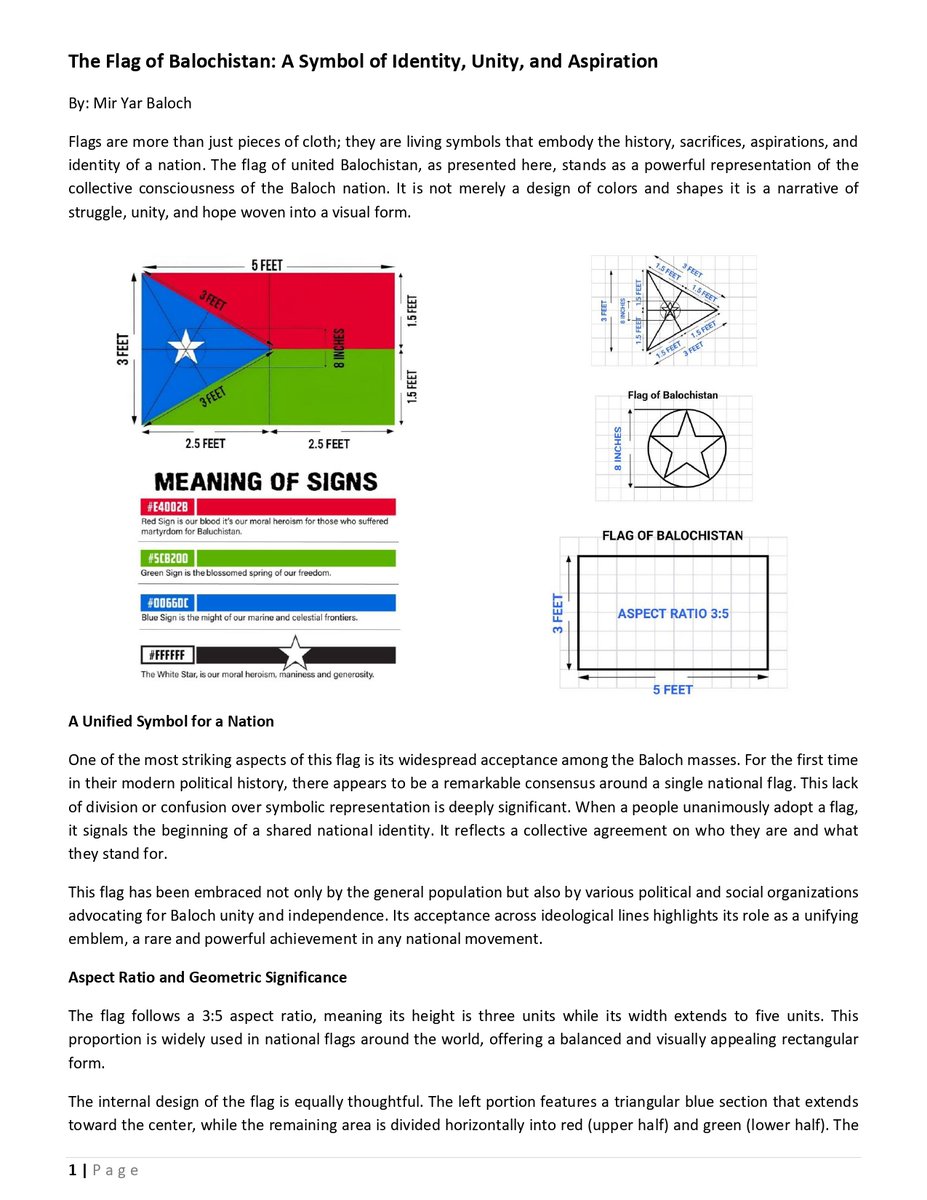
Flags are more than just pieces of cloth; they are living symbols that embody the history, sacrifices, aspirations, and identity of a nation. The flag of united Balochistan, as presented here, stands as a powerful representation of the collective consciousness of the Baloch nation. It is not merely a design of colors and shapes it is a narrative of struggle, unity, and hope woven into a visual form.
A Unified Symbol for a Nation
One of the most striking aspects of this flag is its widespread acceptance among the Baloch masses. For the first time in their modern political history, there appears to be a remarkable consensus around a single national flag. This lack of division or confusion over symbolic representation is deeply significant. When a people unanimously adopt a flag, it signals the beginning of a shared national identity. It reflects a collective agreement on who they are and what they stand for.
This flag has been embraced not only by the general population but also by various political and social organizations advocating for Baloch unity and independence. Its acceptance across ideological lines highlights its role as a unifying emblem, a rare and powerful achievement in any national movement.
Aspect Ratio and Geometric Significance
The flag follows a 3:5 aspect ratio, meaning its height is three units while its width extends to five units. This proportion is widely used in national flags around the world, offering a balanced and visually appealing rectangular form.
The internal design of the flag is equally thoughtful. The left portion features a triangular blue section that extends toward the center, while the remaining area is divided horizontally into red (upper half) and green (lower half). The triangle measures approximately three feet along its sides in the given design, meeting at a central point that visually anchors the entire composition.
At the center of the blue triangle lies a white star enclosed within a circle, measuring about 8 inches in diameter. The geometric precision of the design is not accidental it reflects harmony, structure, and intentional symbolism. Every line and proportion contributes to the flag’s deeper meaning.
The Meaning of Colors
The colors of the Balochistan flag are rich with symbolism, each representing a crucial aspect of the Baloch struggle and identity.
Red- The Color of Sacrifice
The red portion of the flag symbolizes the countless sacrifices made by the Baloch nation. It represents the blood shed by those who have fought for their rights, identity, and homeland. This is not just a tribute to the past it is a reminder of the cost of resistance and the resilience of a people who have endured hardship over generations. Red also conveys courage and determination. It speaks of a nation that refuses to surrender its aspirations, no matter the challenges it faces.
Green-The Promise of Liberation
The green section represents hope, liberation, and the eventual realization of the sacrifices made. It symbolizes a future where the struggles of the past lead to freedom and prosperity. Green is often associated with growth and renewal. In this context, it reflects the belief that the sacrifices symbolized by red will not be in vain, but will instead give rise to a new beginning a flourishing and free Balochistan.
Blue- Geography, Division, and Strength
The blue triangular portion carries layered meanings. It represents the three major parts of Balochistan as understood in the narrative: regions under Pakistan, Iran, and Afghanistan. This tricolor symbolism within a single blue field reflects both division and unity a reminder that despite political boundaries, the Baloch identity remains shared. Additionally, blue symbolizes the vast coastline and deep-sea ports of Balochistan. The region’s maritime significance is immense, with access to strategic waters that hold economic and geopolitical importance. The blue color thus also represents strength, depth, and the potential for prosperity through maritime resources.
White Star- Peace and Inclusivity
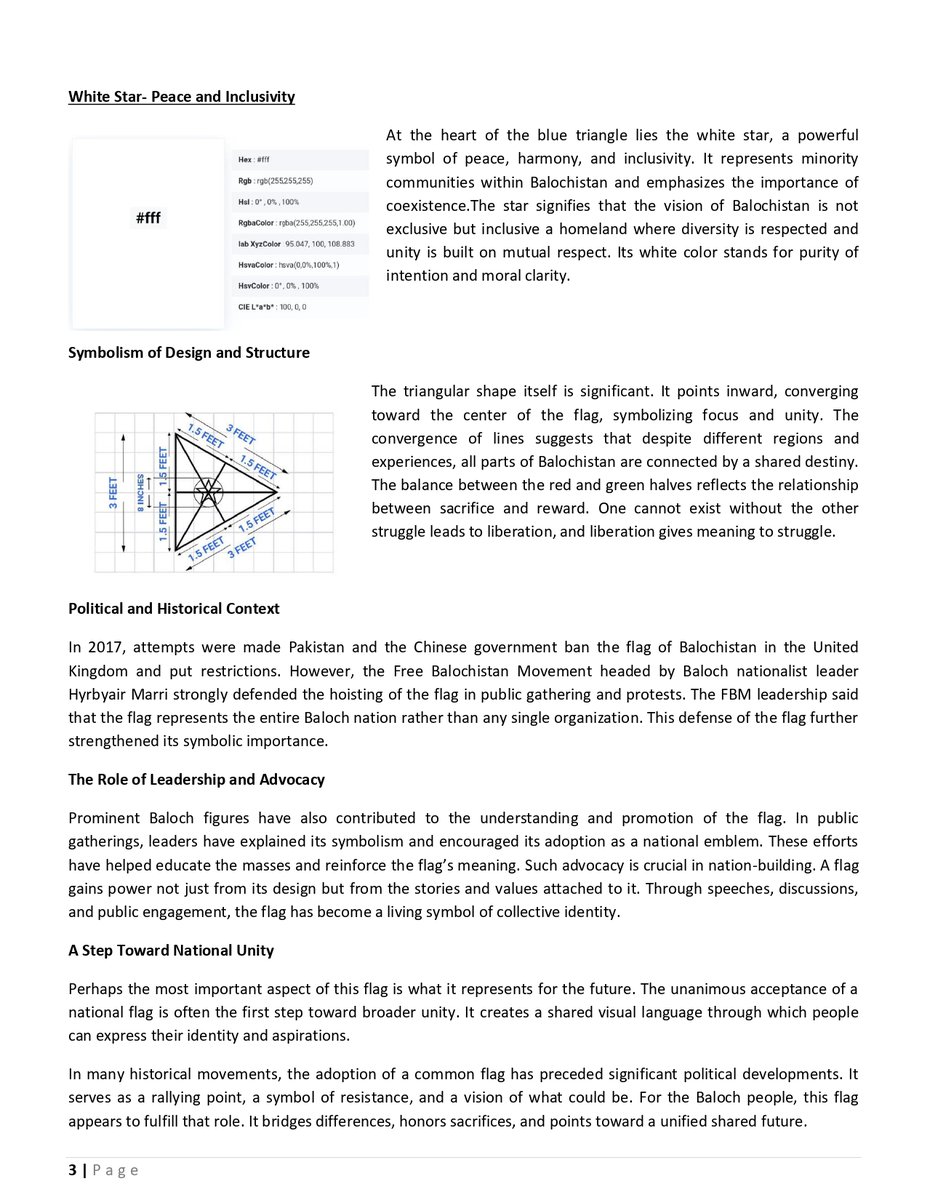
At the heart of the blue triangle lies the white star, a powerful symbol of peace, harmony, and inclusivity. It represents minority communities within Balochistan and emphasizes the importance of coexistence.The star signifies that the vision of Balochistan is not exclusive but inclusive a homeland where diversity is respected and unity is built on mutual respect. Its white color stands for purity of intention and moral clarity.
Symbolism of Design and Structure
The triangular shape itself is significant. It points inward, converging toward the center of the flag, symbolizing focus and unity. The convergence of lines suggests that despite different regions and experiences, all parts of Balochistan are connected by a shared destiny. The balance between the red and green halves reflects the relationship between sacrifice and reward. One cannot exist without the other struggle leads to liberation, and liberation gives meaning to struggle.
Political and Historical Context
In 2017, attempts were made Pakistan and the Chinese government ban the flag of Balochistan in the United Kingdom and put restrictions. However, the Free Balochistan Movement headed by Baloch nationalist leader Hyrbyair Marri @hyrbyair_marri strongly defended the hoisting of the flag in public gathering and protests. The FBM leadership said that the flag represents the entire Baloch nation rather than any single organization. This defense of the flag further strengthened its symbolic importance.
The Role of Leadership and Advocacy
Prominent Baloch figures have also contributed to the understanding and promotion of the flag. In public gatherings, leaders have explained its symbolism and encouraged its adoption as a national emblem. These efforts have helped educate the masses and reinforce the flag’s meaning. Such advocacy is crucial in nation-building. A flag gains power not just from its design but from the stories and values attached to it. Through speeches, discussions, and public engagement, the flag has become a living symbol of collective identity.
A Step Toward National Unity
Perhaps the most important aspect of this flag is what it represents for the future. The unanimous acceptance of a national flag is often the first step toward broader unity. It creates a shared visual language through which people can express their identity and aspirations.
In many historical movements, the adoption of a common flag has preceded significant political developments. It serves as a rallying point, a symbol of resistance, and a vision of what could be. For the Baloch people, this flag appears to fulfill that role. It bridges differences, honors sacrifices, and points toward a unified shared future.
#UnitedBalochistan #BalochistanFlag #FreeBalochistan #FreeBalochistanMovement
Design credits: @balochbraha
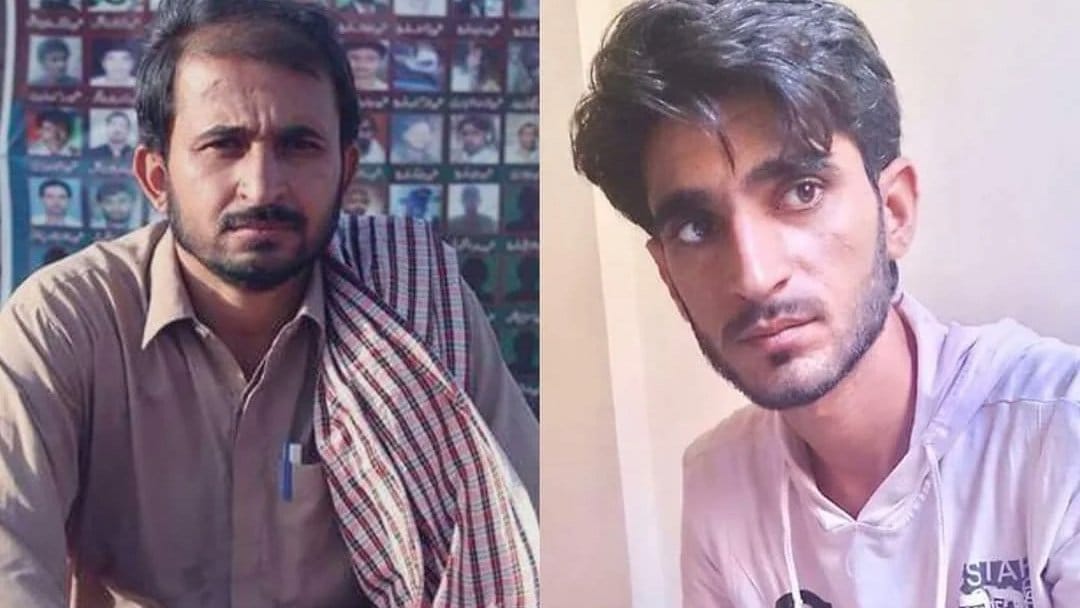
Muslim Dad, son of Malang Dad, aged 40, was a driver by profession from Gelli Bahot Bazar, Buleda, in Turbat district.
On September 7, 2025, he was abducted and forcibly disappeared from his home in Absar, Turbat, at 1:30 PM by Pakistani forces, including the Frontier Corps and Military Intelligence. This occurred in broad daylight, in front of his community, while silence was imposed on his family.
For 4 months and 28 days, his loved ones waited, suffered, and searched. No court, no charges, and no voice were given to him.
On April 10, 2026, his lifeless body was found dumped in the Kech River (Kech Kour) in Turbat.
Sadiq Noor, son of Noor Ullah, was a 17 year old student from Gelli Bahot Bazar, Buleda, in Turbat district, Balochistan.
On September 7, 2025, he was abducted and forcibly disappeared from his home in Absar, Turbat, at 1:30 PM in broad daylight by the Frontier Corps and Military Intelligence of the Pakistani forces.
After 4 months and 28 days, on April 10, 2026, his lifeless body was found dumped in the Kech Kour (Kech River) in Turbat district.
9th April 2026 marks the 17th anniversary of the martyrdom of Shuhda-e-Murgaap, Chairman Ghulam Mohammad, Sher Mohammad, and Lala Munir. Their sacrifice remains etched in our hearts, a timeless reminder of courage, dignity and unwavering commitment.
17 years ago, on April 3, 2009, Pakistan began the 'abduct, kill, and dump' policy in Balochistan to suppress the Baloch struggle. It started with the abduction of Ghulam Mohd, Sher Mohd and Lala Munir from Turbat Bazaar, their mutilated bodies were found a week later in Murgaap.
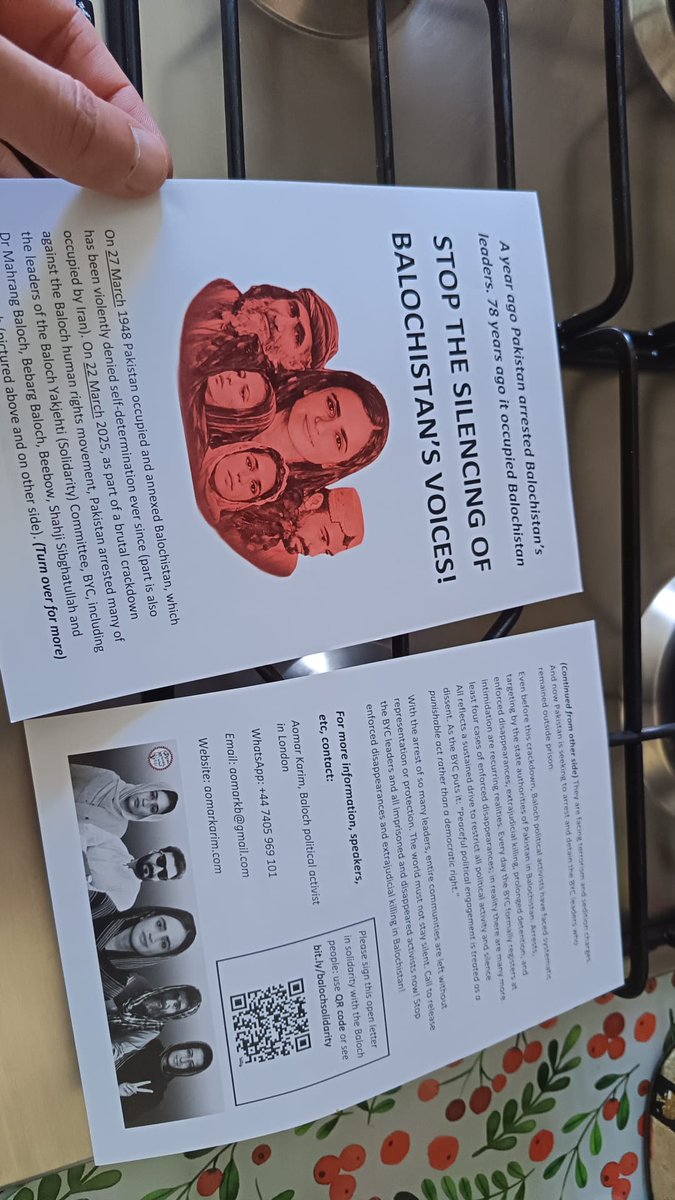
Around 50000 people from all walks of life joined todays anti racism protest in London, organised by hundreds of groups including trade unions, marchers carried signs reading 'No to Racism' and 'You Cannot Divide Us' as they walked from Marble Arch to Whitehall near the UK Parliament.
Baloch political activist @Aomar_karim also took part, distributing 2500 leaflets to raise awareness about the one year illegal detention of @BalochYakjehtiC leaders and the ongoing human rights crisis in Balochistan.
#ReleaseSaifullahBaloch
Campaign Date: 26 March 2026
Baloch Activists Alliance Media (BAAM) stands in full solidarity with the all-day social media campaign organised by Saifullah, son of the Attaullah family, calling for the safe and immediate recovery of their loved one.
Saifullah, a 21-year-old mechanic, was abducted by (CTD/ISI/MI) on 12 March 2026 from Manojan Road near Khalifa Chowk, Quetta. Since then, he has been forcibly disappeared, and his whereabouts remain unknown.
We urge all human rights defenders, activists, and concerned individuals to raise their voices and support this campaign.
Puppet CM Sarfaraz Bugti is repeatedly misrepresenting facts in press conferences to appease his masters – BAAM
Sarfaraz Bugti’s recent press conference, in which he presented Farzana Zehri - a victim of enforced disappearance from Khuzdar district, Balochistan - as a suicide bomber affiliated with the Baloch Liberation Army, alleged her links to an armed organisation, and associated her with Dr Sabiha Baloch, a prominent leader of the peaceful political organisation Baloch Yakjehti Committee, constitutes clear evidence of the state’s growing desperation.
This is not an isolated incident. The state has, on multiple occasions, engaged in such unethical, unlawful, and deeply concerning practices. In the past, several women have similarly been presented before the media as suicide bombers or members of armed groups. However, it is widely acknowledged that such narratives are based on misinformation and deception.
Farzana Zehri was reportedly detained by Pakistani forces on 1 December 2025 in Khuzdar district, Balochistan, and subsequently subjected to enforced disappearance. During her detention, she was allegedly threatened and coerced into participating in a press conference - an act that has no legal standing under established principles of law.
Such actions by Sarfaraz Bugti not only undermine institutional credibility but also bring further disrepute to the state of Pakistan and its security forces. Moreover, these measures risk exacerbating disillusionment among Baloch youth and may contribute to an escalation in resistance against the state.
Baloch Activists Alliance Media calls upon international organisations to take urgent and meaningful action to ensure the immediate and unconditional release of Farzana Zehri. The BAAM also reiterates its continued solidarity with Dr Sabiha Baloch, a respected Baloch political leader.
#SaveFarzanaZehri
#WeStandWithDrSabihaBaloch
It has been twelve years since former @BSO__AZAD Chairman Zahid Kurd and Asad Baloch were forcibly disappeared. On March 18, 2014, Pakistani state forces abducted them from Quetta, Balochistan and their fate remains unknown to this day.
#SaveZahidAndAsadBaloch
Pakistani forces reportedly disappeared her after taking her into custody, now they present her on state media & carry out character assassination, then ask why they’re called a banana republic & why no one believes them, if she did something, why wasn't she presented in court ?
Since early 2026, hundreds of Baloch have been killed in Balochistan by Pakistani forces and affiliated death squads. the actual number is much higher but Due to the region’s vast, conflict and black hole information and very difficult to know.
PAKISTAN: It’s been nearly one year.
Five Baloch activists, Mahrang Baloch, Bebarg Zehri, Beebow Baloch, Shah Jee Sibghat Ullah and Gulzadi Baloch, remain in unlawful pretrial detention on trumped up charges simply for their peaceful activism.
Inside Hudda Jail, Quetta, the activists are facing a secret trial in prison. They are also being denied adequate healthcare, with Mahrang’s health deteriorating significantly in detention.
Amnesty International calls on the Balochistan authorities to immediately release all Baloch activists and drop all charges against them.
👉 Join our call for urgent action.
📝 https://t.co/E9bwQUHBOZ
#ReleaseMahrangBaloch #ReleaseBalochActivists
Zameer Dagarzai, son of Nasir Dagarzai, was abducted by Pakistani forces and Pakistan-backed death squads on 3 March 2011 from the Chitkaan Taar office in Panjgur district, Balochistan. On 11 March 2026, his tortured body was found under the Washaap Bridge in the Panjgur district of Balochistan.
Zameer’s father, Nasir Dagarzai, was a small restaurant owner. He was also abducted by Pakistani intelligence agencies and the Frontier Corps from a house in Panjgur along with three of his friends in January 2011. All of them were forcibly disappeared and later taken in front of a firing squad, where they were shot and dumped, Nasir miraculously survived.
On 25 May 2011, while he was travelling to Karachi for medical treatment, he was abducted again and forcibly disappeared by Pakistani forces. On 16 July 2011, his tortured body was found in Quetta city, Balochistan.
The short film “The Line of Freedom,” written and directed by the British director David Whitney and produced by Nooruddin Mengal, Mir Bhawal Mengal, and David Whitney, was released in 2013 and was inspired by the life of Zameer’s father, Nasir Dagarzai.