Anthropic just released a 4-hour course on getting a $500k AI engineering job:
00:15 - The right way to prompt Claude
33:21 - What makes Claude act dumber on your code
01:33:39 - How Anthropic uses Claude every day
02:50:56 - The fix that makes Claude way smarter. This
4-hour Anthropic free course replaces about 10 paid engineering courses.
Watch it today, then read the step-by-step guide on building loops below.
INSTEAD OF WATCHING AN HOUR OF NETFLIX TONIGHT.
This 60-minute Cambridge lecture by Demis Hassabis will teach you more about the future of AI than most people will learn in the next 5 years.
Bookmark it and give it an hour, no matter what
Andrej Karpathy spent 8 years at OpenAI and Tesla
Last week, he compressed everything he knows into one free 2-hour lecture
Agents → Loops → Graphs → Self-Improving Systems
People spend $15K on bootcamps that teach less than this
This lecture beats most paid AI engineering courses
You probably don't have 2 hours right now
Don't let this vanish from your feed
Watch it
Then read the guide below
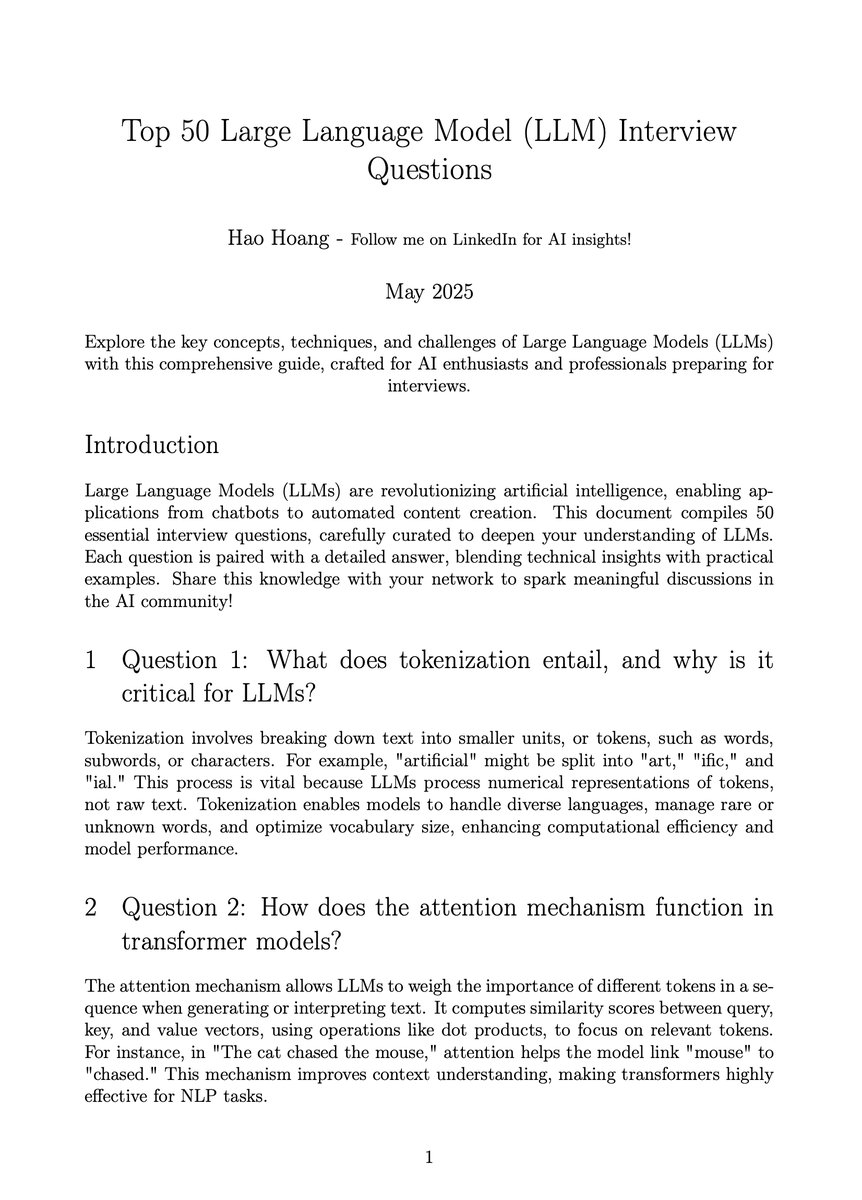
These are literally the kind of LLM interview questions most candidates wish they had seen earlier.
A curated list of 50 LLM interview questions - shared by Hao Hoang.
What's covered:
Fundamentals:
→ Tokenization and why it matters
→ Attention mechanisms in transformers
→ Context windows and their tradeoffs
→ Embeddings and initialization
→ Positional encodings
Fine-tuning & Efficiency:
→ LoRA vs QLoRA
→ PEFT to prevent catastrophic forgetting
→ Model distillation
→ Adaptive Softmax for large vocabularies
Generation & Decoding:
→ Beam search vs greedy decoding
→ Temperature, top-k, top-p sampling
→ Autoregressive vs masked models
Advanced Concepts:
→ RAG (Retrieval-Augmented Generation)
→ Chain-of-Thought prompting
→ Mixture of Experts (MoE)
→ Knowledge graph integration
→ Zero-shot and few-shot learning
Math & Theory:
→ Softmax in attention
→ Cross-entropy loss
→ KL divergence
→ Gradient computation for embeddings
→ Vanishing gradient solutions in transformers
I will put the link in the comments.
Sam Altman (CEO of OpenAI):
"You no longer need to write prompts."
In just 38 minutes, he explains how to use ChatGPT at a level that most people can't even imagine.
It's a talk he gave to Stanford students. A friend sent me the recording last night.
After watching it, I realized I was only taking advantage of about 15% of what this tool can really do.
Watch it in full and then read the guide I leave below on how to create a system that prompts itself.
Follow @AnishJaitwar for more
She built 100+ agents for Anthropic and made $1.3M - and in 60 minutes leaked everything she knows at Stanford:
02:07 - her first agent for Anthropic brought her $1.3M
08:34 - agents replace a team of 50 engineers worth $200k a month
19:47 - one agent did overnight what the company planned for 5 years
after watching I launched my first agent - $7k in the first week and zero employees needed.
Save & watch - the article below is step by step how to build your first agent like hers.
My friend applied to 250 tech jobs in two years. No MIT. No Stanford.
Last month Anthropic offered him $750,000.
I asked him how he broke in from zero.
He sent me the exact video that got him in. Anthropic's 2-hour course on how to become an AI engineer in 2026.
Thariq Shihipar shows you exactly how to build AI agents from scratch.
I watched it last night.
Halfway through, I realized I could break into an AI lab in months, not years.
Bookmark this and read the article below.
• 00:00 - AI agent harness
• 23:44 - building AI agent loops
• 56:39 - AI agent context engineering
• 1:33:34 - AI agent deterministic hooks
• 1:50:31 - Anthropic SWE interview process
A man spends 50 years teaching at MIT.
He knows his time is running out.
So he records one last lecture — everything he knows, distilled into a single hour.
He died 5 months later.
This is that lecture.
The most important hour you'll watch this week. 👇
Bookmark it for later
Andrej Karpathy's advice for beginners getting into AI:
"Put in 10,000 hours of work."
He's right.
But most builders waste the first 1,000 hours on the wrong things.
They write code before understanding context windows.
They build agents before understanding token limits.
They ship products before understanding what models can't do.
The builders who compound fastest aren't the ones who code the most.
They're the ones who understood the fundamentals before touching a single line.
These are the 10 concepts that make the first 1,000 hours count ↓
Bookmark this before you start.
🚨 Anthropic just showed a 27-minute workshop on how to actually do prompts for Claude.
Taught by the people who built it.
Free. No registration. No paywall.
I've seen $300 courses that don't cover what they teach in the first 8 minutes.
Watch it and bookmark it now.
Anthropic engineer:
"You're not supposed to type every command yourself. You're supposed to build agents that do it for you."
this is one of the best workflows I've seen in a long time
in this video he breaks down exactly how manual work becomes automated work:
- the memory and context features that turn Claude into a second brain
- the 5 agents that replace daily manual work permanently
- the setup most Claude users have never considered building
- why the real skill isn't prompting. it's designing systems that think for you
if you've been using Claude for months and never built anything that works without you, you're chatting with a system that was designed to work for you
instead of another show tonight, watch this
make sure to bookmark it before it gets lost in your feed
full guide in the article below
In 2023, Harvard hosted Michael Skok's 87-min masterclass on building products customers actually buy.
2.9M people have watched it.
His frameworks:
- ideas are two cents
- the 4 U problem test
- the minimum viable segment
12 lessons:
Andrej Karpathy: "90% of Claude's mistakes come from missing context, not a weak model."
41% mistake rate without a CLAUDE.md. 11% with the 4-rule baseline. 3% with the 12-rule version below
here are the 12 rules senior engineers settled on:
1. think before coding: state assumptions, don't guess. the model can't read your mind, stop hoping it will
2. simplicity first: minimum code, no speculative abstractions. the moment you let Claude add "for future flexibility," you've added 200 lines you'll delete next quarter
3. surgical changes: touch only what you must. don't let it improve adjacent code, that's how PRs blow up
4. goal-driven execution: define success criteria upfront, loop until verified. without them Claude either loops forever or stops too early
5. use the model only for judgment calls: classification, drafting, summarization, extraction. NOT routing, retries, status-code handling, deterministic transforms. if code can answer, code answers
6. token budgets are not advisory: per-task 4000, per-session 30000. by message 40 of a long debug, Claude is re-suggesting fixes you rejected at message 5
7. surface conflicts, don't average them: two patterns in the codebase? pick one. Claude blending them is how errors get swallowed twice
8. read before you write: read exports, callers, shared utilities. Claude will happily add a duplicate function next to an identical one it never read
9. tests verify intent, not just behavior: a test that can't fail when business logic changes is wrong. all 12 of Claude's tests can pass while the function returns a constant
10. checkpoint every significant step: Claude finished steps 5 and 6 on top of a broken state from step 4. nobody noticed for an hour
11. match the codebase conventions: class components? don't fork to hooks silently. testing patterns assumed componentDidMount, hooks broke them without surfacing
12. fail loud: "completed successfully" with 14% of records silently skipped is the worst class of bug. surface uncertainty, don't hide it
what actually compounds instead of the next framework:
- the CLAUDE.md file as institutional memory across sessions
- eval-driven changes, not vibe-driven
- checkpoints over speed
- explicit conflicts over silent blending
- discipline over framework, every time
- one repo, one rules file, no exceptions
be a few rules ahead of AI twitter before this becomes mass-opinion
study this
Singapore’s Foreign Minister, Dr Balakrishnan casually explaining how he built his own AI agent (a 2nd brain for diplomacy) using Claude & WhatsApp integration etc. on a Raspberry Pi
“You cannot govern a technology you have only been briefed on.” 🇸🇬
This works really well btw, at the end of your query ask your LLM to "structure your response as HTML", then view the generated file in your browser. I've also had some success asking the LLM to present its output as slideshows, etc.
More generally, imo audio is the human-preferred input to AIs but vision (images/animations/video) is the preferred output from them. Around a ~third of our brains are a massively parallel processor dedicated to vision, it is the 10-lane superhighway of information into brain. As AI improves, I think we'll see a progression that takes advantage:
1) raw text (hard/effortful to read)
2) markdown (bold, italic, headings, tables, a bit easier on the eyes) <-- current default
3) HTML (still procedural with underlying code, but a lot more flexibility on the graphics, layout, even interactivity) <-- early but forming new good default
...4,5,6,...
n) interactive neural videos/simulations
Imo the extrapolation (though the technology doesn't exist just yet) ends in some kind of interactive videos generated directly by a diffusion neural net. Many open questions as to how exact/procedural "Software 1.0" artifacts (e.g. interactive simulations) may be woven together with neural artifacts (diffusion grids), but generally something in the direction of the recently viral https://t.co/z21CP5iQfu
There are also improvements necessary and pending at the input. Audio nor text nor video alone are not enough, e.g. I feel a need to point/gesture to things on the screen, similar to all the things you would do with a person physically next to you and your computer screen.
TLDR The input/output mind meld between humans and AIs is ongoing and there is a lot of work to do and significant progress to be made, way before jumping all the way into neuralink-esque BCIs and all that. For what's worth exploring at the current stage, hot tip try ask for HTML.