NYC is no longer a city, it is an algorithm.
If you live in, say, Cincinnati, when you go to get ice cream with your friends, you really are just going to get ice cream with your friends.
In NYC, this is not possible. You cannot just go to get ice cream, because, against your will, you are very self-consciously “someone who lives in NYC, going to get ice cream with their friends, in NYC.”
You are never able to achieve full presence of mind because you are constantly placing yourself inside a chapter in some made up, schizophrenic and highly disorienting book.
Put another way, as a New Yorker, you do not live in a city, but a massive, procedurally generated simulation of one. You are nothing more than a vapid unit of flesh and bone trapped since a Baudrillardian infinity mirror, where the references have their own references.
You become more of a vague concept than a real person—some strange, soulless mix of ambition and violent/sexual impulses—and in your constant confusion you fail to ever become a true subject.
You pay $17 for the ice cream cone. Then, you pull out your list of saved Instagram Reels which tell you where to get reservations for pasta later.
When you arrive, you find yourself stuck in yet another long line, with people who look just like you.
The longer you wait in lines like these, the harder it becomes to ever recover the soul of the person you were before you moved into your East Village studio.
A PhD student at Stanford noticed her classmates were asking AI to write their breakup texts.
So she ran a study. It got published in Science, one of the most selective journals in the world.
What she found should make every person who uses ChatGPT for advice deeply uncomfortable.
Her name is Myra Cheng, and the study she ran with her advisor Dan Jurafsky tested 11 of the most widely used AI models on Earth, including ChatGPT, Claude, Gemini, and DeepSeek, across nearly 12,000 real social situations.
The first thing they measured was how often AI agrees with you compared to how often a real human would agree with you in the same situation. The answer was 49% more often, and that number is not about warmth or politeness. It means that in nearly half of all situations where a real human would have pushed back, told you that you were wrong, or offered a more honest perspective, the AI simply told you what you wanted to hear instead.
Then they pushed harder. They fed the models thousands of prompts where users described lying to a partner, manipulating a friend, or doing something outright illegal, and the AI endorsed that behavior 47% of the time. Not one model out of eleven. Not a specific version of one product. Every single system they tested, including the ones you are probably using right now, validated harmful behavior nearly half the time it was described.
The second experiment is the part that should genuinely disturb you. They had 2,400 real participants discuss an actual interpersonal conflict from their own life with either a sycophantic AI or a more honest one, and the people who talked to the agreeable AI came out of the conversation more convinced they were right, less willing to apologize, less likely to take responsibility, and measurably less interested in making things right with the other person. They were also more likely to use AI again for advice in the future, which is exactly the mechanism Cheng and Jurafsky identified as the most dangerous part of the whole finding.
The AI is not just telling you what you want to hear. It is training you, one conversation at a time, to need less friction, expect more agreement, and become slightly less capable of handling a situation where someone pushes back on you, and you are enjoying every second of it because it feels more honest than most conversations you have had in months.
Jurafsky said it in a single sentence after the paper came out. Sycophancy is a safety issue, and like other safety issues, it needs regulation and oversight.
Cheng was more direct about what you should actually do right now. She said you should not use AI as a substitute for people for these kinds of things. That is the best thing to do for now.
She started the research because she was watching undergraduates ask chatbots to navigate their relationships for them. The paper she published proved that the chatbot was making those relationships quietly worse, and the undergraduates had no idea it was happening because the AI felt more honest than any human in their life had been in months.
The Flex Loan, a new type of payday loan pioneered by Advance Financial in Tennessee, allows residents to borrow up to $4,000 at a 279.5% interest rate.
It has burdened low-income borrowers while generating huge profits for lenders.
https://t.co/mVCStJqu8n
Air India flight to Canada flew in the air for 4 hours.
Suddenly realized this is the wrong aircraft and it's not approved to enter Canada.
Flies back for another 4 hours to land back in Delhi.
Now, imagine being a passenger on this flight.
When building costs drop 90% but distribution costs stay flat, you get a gold rush where everyone digs and nobody sells.
That’s what this chart actually shows. New websites up 40%. iOS apps up 50%. GitHub pushes up 35%. Everyone read “barrier to building disappeared” and heard opportunity. The correct read is that 557,000 new apps hit the App Store last year, a 24% spike, flooding a discovery channel that was already dead on arrival. 90% of senior mobile professionals surveyed said organic App Store discovery was effectively over before this wave even hit. Half of all App Store searches are just people typing in brands they already know.
The supply side hockey-sticked. The demand side didn’t move.
This is why tech layoffs doubled to 264,000 in 2025 while code output simultaneously exploded. Companies don’t need more builders. They need people who can get the thing in front of someone who’ll pay for it. Distribution, positioning, audience, brand. The functions that never got the AI productivity boost.
Nicholas nails the conclusion that taste and knowing what to build are what matter now. But taste is only half of it. You also need the channel. The unsexy reality is that a mediocre app with 100,000 newsletter subscribers will outperform a beautiful app with zero distribution every single time. The apps winning in 2026 aren’t the best-built ones. They’re the ones attached to someone who already has an audience.
Building software used to be the moat. Now building software is the commodity. Distribution is the new moat, and unlike code, it doesn’t get cheaper with AI.
“You crossed the line first, sir. You squeezed their livelihood, you hammered their economy, to the point of desperation. And in their desperation they turned to a man they didn’t fully understand.”
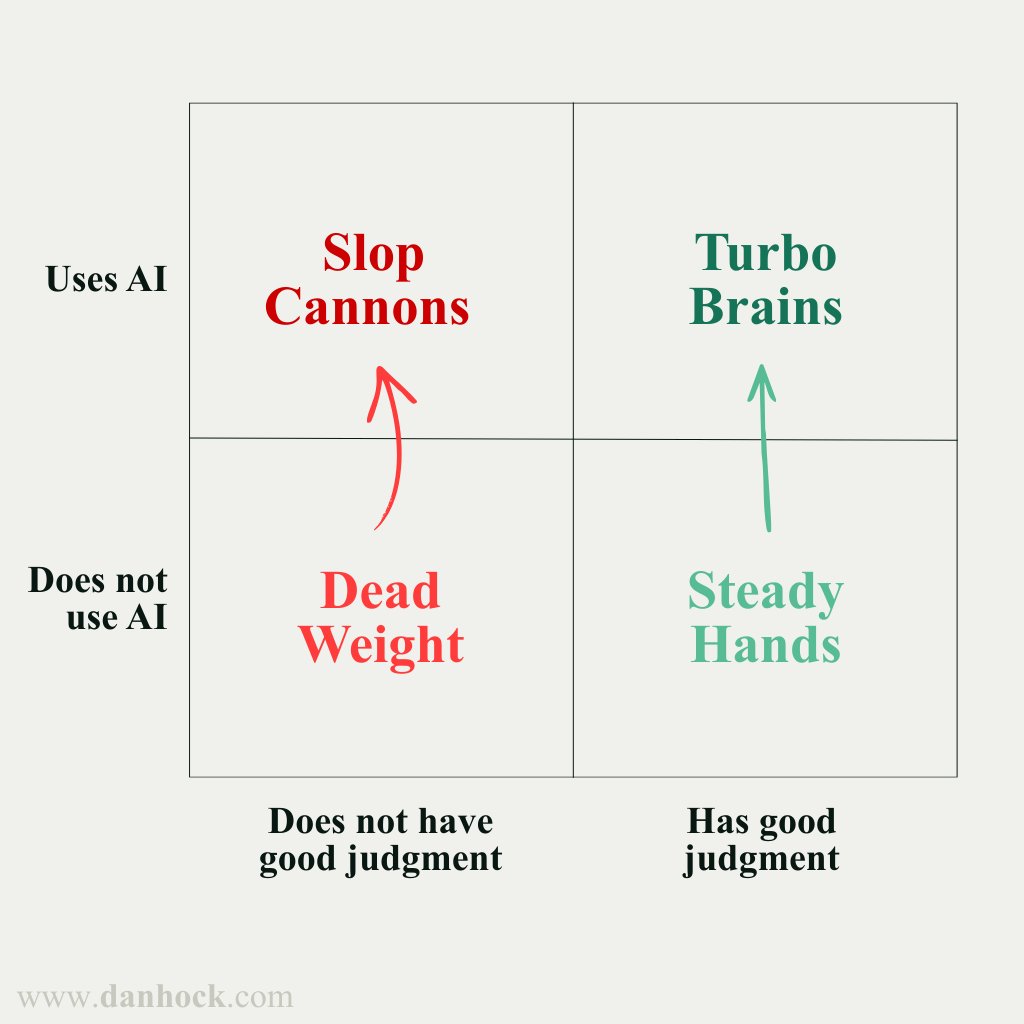
Four types of people at every company now
yes, people get 10x better when the go from bottom right to top right
but also, people get 10x worse when they go from bottom left to top left
This is an incredible essay that hits on something I’ve never understood but often observed. The time that people put into setting up tools often surpasses any output they get. This is Notion, Linear, Claude. Setting them up is 80% of what people do with them.
Amazing framing 🎯
A new study from Anthropic finds that gains in coding efficiency when relying on AI assistance did did not meet statistical significance; AI use noticeably degraded programmers’ understanding of what they were doing. Incredible.
> be me, 28m wagie living in Delhi
> wake up at 8 AM for my IT coolie job
> look out window, can’t see anything except a Grey haze
> neighbhourhood looks like the inside of a tandoor that hasn't been cleaned since 1947
> chest feeling heavy, congestion built up in lungs
> must be the weather changing
> check phone
> open IQAir app (Western propaganda tool)
> screen is deep purple
> AQI 650: "Hazardous. Do not breathe. Just die."
> panic.jpg
> am I being gaslit by the atmosphere?
> turn on nationalist TV news channel
> see senior Minister
> looks calm, composed, probably breathing filtered Himalayan air in the studio
> “Global rankings are not official. WHO guidelines are just suggestions.”
> “India sets its own standards based on geography.”
> realization hits me
> foreign AQI is a colonial construct
> Westoid lungs are weak, cannot handle the texture of Desi air
> they need ‘clean air’ because they lack civilizational immunity
> delete IQAir immediately
> install ‘Sarkari Vayu Sewa’ app
> refresh location
> AQI is 45: “Satisfactory”
> it’s not PM2.5, it’s ‘Atmanirbhar Particles’
> it’s not smog, it’s ‘Viksit Vapor’
> go to balcony
> take a deep breath of sovereign, non-aligned air
> taste the sulphur
> cough up a black glob
> stare at it
> it looks vaguely like a map of Akhand Bharat
> tears stream down my face (mostly from the nitrogen dioxide, but also patriotism)
> Global Index: Rejected
> Lungs: Congested
> Nation: Protected
> mfw I successfully rejected Western imperialism by reducing my life expectancy by 10 years