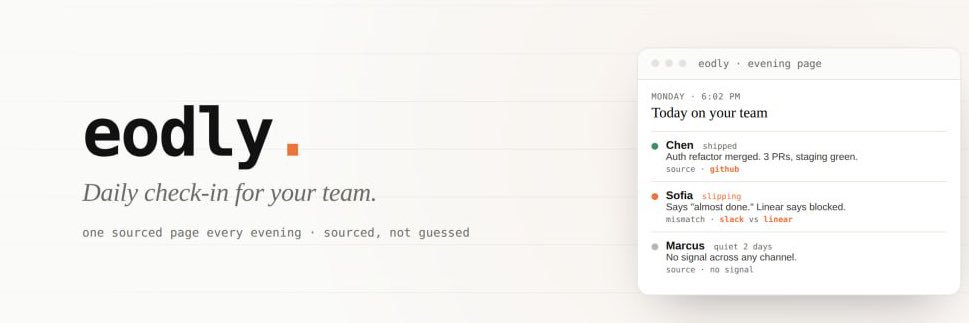
Every update sounds fine: "done", "live", "almost done". Eodly checks each one against the commits, tickets, and links, and puts it all on one page at seven. https://t.co/EF7lmvPeIl
Eodly reads what GitHub and Linear already recorded, then asks only about the part of the day that left no trace. Nobody is asked to report work a system already saw.
Eodly now connects to Claude with one sign-in.
Add https://t.co/Sw4nHM7gyO as a connector, approve it, and ask "who shipped and who is slipping?" Claude answers from end-of-day reports, checked against GitHub and Linear.
Read-only. Free plan included.
https://t.co/BgsxlZlp4i
Gallup notes manager engagement falls as span of control grows. Companies spent 2026 flattening org charts, which widens every span that is left. The math is not subtle.
We're opening the Eodly partner program today.
Creators: if your audience runs teams (founders, eng leads, ops people), you get 30% of every payment they make for the first 12 months. Free to join; paid monthly.
Looking for the first ten partners: https://t.co/AaqMV5lxSp
Asana's Anatomy of Work found knowledge workers spent close to two thirds of their time on work about work. Not the job. The reporting, chasing and searching that surrounds the job.
When you cannot see the work, you can buy surveillance or you can buy meetings. Most companies bought both. Neither produced a record of the day anyone trusted.
A playbook for anyone inheriting a bigger team: write down who you last heard from about what, and when. The gaps in that list are your real org chart.
Gallup's 2026 report puts manager engagement at 22%, down from 27% a year earlier and from 31% in 2022. The group tasked with holding teams together is the group coming apart fastest.
In 2022 Microsoft found 85% of leaders could not confidently say their people were productive. In the same study 87% of employees said they were. Both groups were honest. Only one of them could see the work.
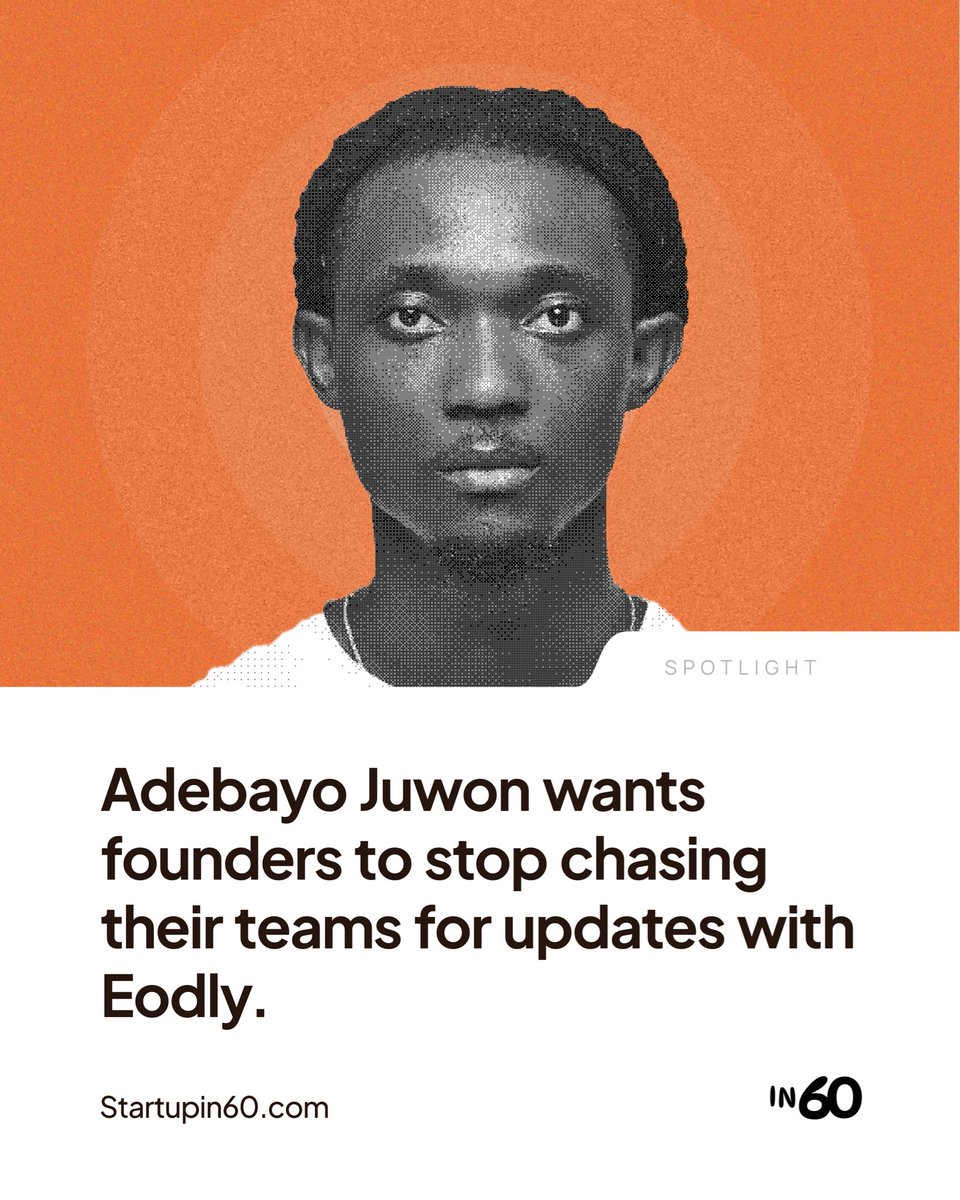
Adebayo Juwon spent eight years managing distributed teams across some of Africa's fastest-moving fintech and crypto companies. And he kept noticing the same problem.
Eodly is his attempt to fix that.
Full story: https://t.co/yWlGGnLiZz
The evening page always prints a section for who went silent today. On a good day it reads "None". That line is information too: nobody had to say they were fine for it to be known.
When a task has been "nearly done" two days running, ask for the last step by name. If nobody can name it, the task has an unknown step in it, and that step is the thing to talk about.
Problems reach a team lead in the order people feel comfortable raising them. That is rarely the order they happened. The one that matters most tends to arrive last, because it is the hardest one to say out loud.
Proud to power The Work Behind the Work, in60's new series on the work nobody sees.
EP 2: Dolapo Oshikoya, PM at PaidHR, on why a PM is really an "errand person" keeping everyone in sync.
https://t.co/3kJD4NfWzW
Dolapo Oshikoya thought a Product Manager was basically the next person after the CEO. Someone with all the power to make things happen.
Then he actually became one.
The PM is not the boss of everyone.
The evening page has no charts, no velocity trend, no score. Dashboards are built to be explored. This one is built to be finished. Reading it takes 40 seconds and ends with nothing left to click.
A playbook for leads: at the start of the week, write down what each person says they will finish. Read it back on Friday. The distance between the plan and the delivery is only visible if somebody wrote the plan down.
The update is hardest to write on exactly the day it matters most. A day that went well summarises itself. A day that went sideways does not, so it gets postponed until it can be explained.