My personal triumphs are definitely celebrated with sacrificial offerings and public feasting HELL TO THE YES
(I also complain about decimate, thank you very much)
https://t.co/Su3YiL80bc
Why did Adam Feuerstein block me?
Only Adam could say for sure. But I suspect two exchanges we had on X—one about Tavneos in July and another about UniQure's Huntington's disease gene therapy in March—may have contributed.
I find the block genuinely disappointing, not least because I've long found Adam's reporting interesting and valued being able to engage with it.
I don't expect journalists to answer every question or agree with every criticism. But I do think there is a meaningful difference between declining to engage with someone and blocking that person from participating in discussions about one's reporting.
And I think the substance of these exchanges matters.
1. Tavneos: A public assertion that went unexplained
In July, Adam responded to someone else's post about the Tavneos controversy, suggesting that it wasn't entirely certain whether the clinical trial had been falsified.
That caught my attention.
Given the documented evidence of data-integrity problems and regulatory failures surrounding the trial, I wanted to understand what, specifically, Adam believed remained uncertain.
He had publicly introduced that qualification into the discussion. I thought it was reasonable to ask him to explain the basis for it.
I asked twice. He didn't respond to either question.
I don't expect journalists to answer every question directed at them. But when an influential reporter voluntarily makes a public assertion casting uncertainty on something as consequential as clinical trial falsification, I think it's fair to ask what evidence supports that qualification.
And I think it's disappointing when a substantive question like that goes unanswered.
2. UniQure: The missing regulatory context and the treatment of Vinay Prasad
The more substantial exchange occurred in March, during the controversy surrounding UniQure's experimental Huntington's disease gene therapy, AMT-130.
For those unfamiliar with the story, Huntington's is a devastating, progressive neurological disease. AMT-130 is an experimental gene therapy administered directly into the brain.
In September 2025, UniQure announced results suggesting that AMT-130 had slowed disease progression by approximately 75% over three years compared with an external control group drawn from a natural-history database.
The results generated considerable excitement, particularly among patients and families facing a disease without an approved treatment shown to slow its progression.
But there was an important complication.
The trial had originally included a randomized, sham-surgery control group.
Earlier results from that comparison had not demonstrated a statistically significant benefit on the reported measures. After one year, participants assigned to sham surgery were permitted to receive AMT-130, eliminating the original randomized comparator for longer-term follow-up.
UniQure subsequently relied on comparisons with patients from an external natural-history database.
That distinction matters enormously.
An external comparison can be informative, particularly in rare diseases where randomized trials present practical and ethical challenges. But it also raises difficult questions about whether the groups are truly comparable and whether apparent benefits can be attributed to treatment.
In March 2026, UniQure announced that FDA continued to consider its existing evidence insufficient to support a marketing application and was recommending a new randomized, sham-controlled trial.
The company characterized the agency's position as a reversal of earlier regulatory guidance.
STAT reported the dispute, including the company's frustration and the implications for FDA's stated commitment to regulatory flexibility.
What I thought was missing was sufficient context about why FDA might have reached that position.
The earlier randomized findings weren't an incidental historical detail. They were directly relevant to evaluating the reliability of the later externally controlled results.
And that became increasingly clear as additional reporting emerged.
3. What the FDA's concerns actually were
On March 3, Adam published a follow-up STAT article quoting an unnamed senior FDA official who said agency reviewers were unconvinced that AMT-130 provided therapeutic benefit.
The article conveyed the FDA's skepticism, but it still offered relatively little explanation of the underlying scientific objections.
On March 5, Fierce Biotech published a much more detailed account of a briefing with a senior FDA official.
That reporting helped illuminate the actual regulatory disagreement.
The FDA's concerns included the substantial variability in Huntington's disease progression, the subjectivity of certain clinical outcomes, potential placebo effects, and the limitations of comparing treated patients with an external natural-history population.
But one question was particularly important:
Why did the externally controlled analysis suggest a benefit at one year when the randomized comparison had not demonstrated one?
That apparent discrepancy went directly to the reliability of the external comparator.
The FDA official questioned whether the natural-history patients provided a sufficiently comparable control group. UniQure, meanwhile, maintained that the early randomized study was too small and too short to reliably demonstrate the treatment's effect on disease progression.
These were legitimate scientific questions with enormous implications for patients, the company, and the regulatory standard being applied.
They also helped explain why the FDA's position could not be evaluated simply by asking whether the agency had become less flexible.
To me, this was essential context for understanding the controversy.
I was grateful for Fierce Biotech's reporting because it allowed readers to examine the reasoning rather than simply choose between competing narratives.
4. Adam subsequently acknowledged that important context was missing
Here's something I find particularly significant.
In his March 5 Biotech Scorecard newsletter, Adam published a Q&A addressing reader questions about his UniQure reporting.
One reader criticized the lack of detail about the FDA's objections.
Adam responded:
"This is a totally valid criticism."
He went on to explain that he had omitted the details largely because they complicated the narrative.
He then provided precisely the kind of regulatory context I had found missing: the earlier sham-controlled findings, the loss of the randomized comparator after crossover, and the FDA's concerns about the validity of the external comparison.
I appreciate that he acknowledged the criticism and provided the additional information.
But I also think the acknowledgment is important.
It demonstrates that questioning the adequacy of the initial reporting wasn't an unreasonable objection or a failure to appreciate STAT's previous coverage.
It was a substantive concern about what readers needed to understand the FDA's position.
5. How our exchange began
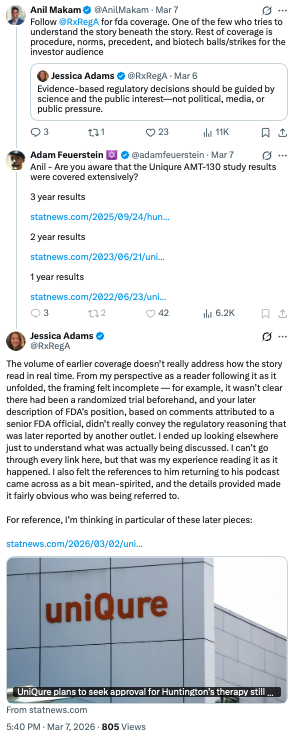
On March 7, someone complimented my coverage of the FDA, specifically noting my willingness to examine the evidence beneath the story rather than simply repeat prevailing narratives.
Adam entered the conversation to point out that STAT had been covering UniQure for years.
He linked to articles from 2022, 2023, and 2025.
That was true. STAT had covered the development of AMT-130 extensively.
But it wasn't the point I was making.
The existence of earlier reporting doesn't necessarily mean that a subsequent article adequately contextualizes a new development.
My criticism wasn't that STAT hadn't covered the story. It was that readers shouldn't have to reconstruct the regulatory reasoning from years of previous articles to understand what was happening in March.
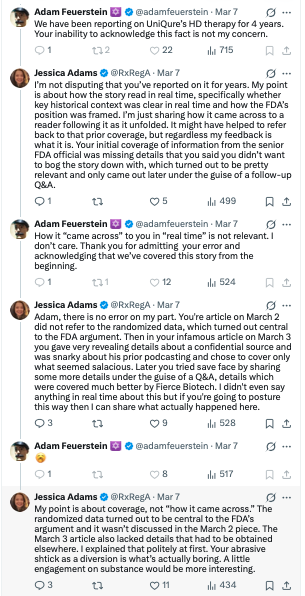
I tried to explain that distinction.
I acknowledged the earlier coverage and clarified that my criticism concerned the framing of the current controversy, particularly the absence of the randomized findings and the FDA's underlying scientific reasoning.
Adam responded that my failure to acknowledge STAT's years of reporting was not his concern.
But I had acknowledged it.
When I tried again to distinguish the historical coverage from the contemporaneous framing, he dismissed my concern about how the story came across to readers.
At that point, the exchange became increasingly contentious.
My own responses became sharper. I criticized what I saw as his abrasive, dismissive replies and described his earlier podcasting as snarky.
I don't pretend that my tone remained entirely restrained. But I had initially tried to explain a substantive distinction that I felt he wasn't addressing.
And it's worth remembering how the exchange began: I hadn't sought Adam out to confront him. He had entered a conversation that began with someone complimenting my work.
6. The treatment of Vinay Prasad: A separate concern about journalistic judgment
Another aspect of Adam's reporting troubled me, and it concerned the treatment of Vinay Prasad.
In his March 3 article, Adam quoted a senior FDA official speaking on condition of anonymity. Other reporting, including Fierce Biotech's account of an FDA briefing, likewise referred to an unnamed senior official.
In his March 5 newsletter, Adam explicitly defended his decision to grant the official anonymity.
Yet in a March 6 article, Adam continued to describe the individual as an anonymous senior FDA official while reproducing remarks in which the official identified himself as a professor, practicing hematologist-oncologist, and someone who missed hosting his podcast.
Those details appeared to point rather unmistakably to Vinay Prasad.
Adam then promoted the article on X, teasing what readers might learn about the official.
I found that strikingly inconsistent.
What's the point of maintaining anonymity in the text while simultaneously publishing details that effectively identify the person—and then drawing attention to them?
The article's derisive framing and the way Adam promoted it only compounded my discomfort. My concern wasn't that Prasad should be shielded from scrutiny or criticism. It was whether this reflected sound journalistic judgment.
I initially chose not to raise this concern during our exchange. I eventually did as the conversation became more contentious.
7. Why I find the block disappointing
What bothers me isn't that Adam disagreed with my assessment of his reporting.
Disagreement is inevitable, particularly when discussing complex regulatory decisions involving uncertain evidence, serious diseases, and competing views of what constitutes sufficient proof.
Nor do I think every journalist owes every reader a response.
But I do think journalists—especially influential reporters covering science and medicine—should be receptive to reasonable questions about their reporting and public statements.
That doesn't mean accepting every criticism. It doesn't mean tolerating harassment or personal attacks.
It means recognizing that substantive disagreement is part of the conversation.
What makes this particularly disappointing is that I genuinely valued Adam's reporting. I found it interesting, followed it regularly, and appreciated the opportunity to engage with it.
I would have preferred that we could simply disagree.
If Adam doesn't want to engage with me, that's entirely his choice.
But I wish that choice didn't extend to blocking me from commenting on or questioning his work.
And I think it's a shame if a good-faith attempt to discuss the evidence ultimately ends this way
Attended the 'Annual Measuring of the Pinchot Sycamore,' a wonderful celebration of Connecticut's largest and most beloved tree which has stood for over 300 years on the banks of the Farmington River and still grows about half an inch a year.
One new-to-me detail we learned in the course of our reporting: when Congress wrote the No Surprises Act, it ported over many parts of federal arbitration law.
It did not, however, bring over key enforcement provisions. Without an enforcement mechanism, supposedly binding arbitration decisions are being ignored.
https://t.co/5BLW8Io0Nm
Every parent wants a happy child. So we built MDD-PGT, the first genetic predictor of depression for embryo screening.
Kids with a lower MDD-PGT tend to sleep better, fight less and enjoy jokes more. With 10 embryos, picking the lowest-risk one cuts depression risk by over 40%.
The most wonderful thing that has occurred due to Patrick Stewart’s passing are the truly heartwarming, beautiful and laugh out loud stories that have come out about him, not just from stars but from day to day people who chanced upon him.
This is one of my favourites.
@urbangaygriot You change when you get invested enough in your local community to care about what happens there. For some people it's because they have kids in the schools; or maybe they own a local business; or even just a house. Property taxes are a huge motivator.
In addition to all the other disease harbored by wild pigs (pseudorabies?!?!?!?!) they apparently spread chronic wasting disease to deer and elk
https://t.co/NeBQz8Wyr0
Outstanding coverage of a major scandal by @Sara_Talpos. A lucrative drug (Tavneos or avacopan) was approved based on trial data that was found to have been manipulated, its side effects can be deadly & it remains on the market in the US. Thanks @undarkmag for shining light on this while mainstream media have been mostly quiet.
https://t.co/4mvhLzrwtz
@9brandon Me too. I believe @nytimes wrote a story on it but it’s paywalled.
The CDC doesn’t discuss the specific episodes except to note there’s been more mass exposures, too.
Curious.
I remember back when we thought that with infinite amount of compute and sampling we would predict protein-ligand binding with experimental accuracy for all known proteins and any arbitrary ligand.
What we found instead was that there are aspects of the physics and chemistry like buried waters, non-standard tautomers, crowding and weird weak interactions that we didn’t even know about.
I’m very optimistic about AI expanding the scope of what we can successfully model and predict, but you cannot simulate your way out of what’s simply unknown.
SCOOP: The CDC's deputy director is leaving.
Jennifer Shuford, an infectious-disease physician who had been Texas's health commissioner, was hired to help restore trust in CDC.
Now she's out after six months.
w @bylenasun
https://t.co/Ck4Nph0YZJ
As I've pointed out before, New Haven is like the Kharg Island of southern New England, supplying huge amounts of fossil fuels all over the region with enormous localized pollution impacts (shipment exhaust, off-gassing, spills) and very little localized economic benefit
BREAKING: COVID vaccine cover-up.
FDA safety officers found evidence of fatal myocarditis in children after mRNA shots, recommended urgent label warnings—then the findings were buried.
The New York Times helped run the cover.
#COVIDCoverup#FDA#NYT