... hier kann man sich den Vortrag bei der Heidelberger Akademie der Wissenschaften ansehen, es fängt ein bißchen plötzlich an und hört auch etwas abrupt auf, das hatte technische Gründe, aber es ist bis auf den Schluss und die Analysen alles dabei: https://t.co/1KvuyJ80Mu
The exponential growth in the discovery of genomic loci associated with human traits and diseases continues.
From 1 association for age-related macular degeneration in 2005 to >1 million by the end of 2025.
Data from the @GWASCatalog.
SV-GWAS is highly accessible now! Our new paper in @NatureGenet shows how HiFi long-read assemblies let us repurpose SNP-based GWAS data to impute structural variants (SVs) to interrogate their role in human complex traits and diseases. @WeiyangBai https://t.co/zSB90E3at0
@hbdchick I struggle to see what this says beyond what would be predicted from heritability being a mixture of large effect rare variants and small effect common variants, which we already knew.
This is incredibly misleading. The author admits the Lewis Terman's high IQ sample stunningly outperformed.
The author notes the low base rate fallacy makes his own claim false: mathematically, simulations by @Russwarne show Terman had a 53–83% probability of selecting neither future laureate just by chance.
The tweet omits the name of the great scientist from the lead. I guess it makes it more clicky but "A Stanford Psychologist" - it's like calling Newton "A Lincolnshire Man".
Crucially, the central claim in @ihtesham2005's post is false. Terman did not predict or claim that high IQ is genius or that it alone produces genius-level achievement.
Terman did expect, and did find, that when 8% of American men were getting degrees, 70% of Termites did. He did find that Termites incomes were roughly double the white-collar median.
The facts are that Terman treated high IQ as a practical, measurable proxy for selecting gifted children to study their real-world development. He viewed it as it is labeled on the tin: Ability, not Achievement.
This is about as basic a fact about IQ as there is.
But read this tweet, and unless you have a Termite-level IQ, you will come away with diametrically the wrong conclusion about what Lewis Terman thought and what he found.
This post provides a helpful antidote to this Gladwellesque traducing of history: https://t.co/XsesLGQo0t
Like Terman, and Galton, most researchers believe creative achievement requires creativity (of course) and staggering levels of industry. Both, of course are also heritable alongside IQ.
No news travels as fast as bullshit about dead people who should be heroes and guides. Sad.
@JonathanAnomaly said embryo genetics is moving beyond monogenic screening toward polygenic prediction validated within families, with IVG, gene editing, and synthetic chromosomes now back in the conversation. #SynBioBeta#Biotech
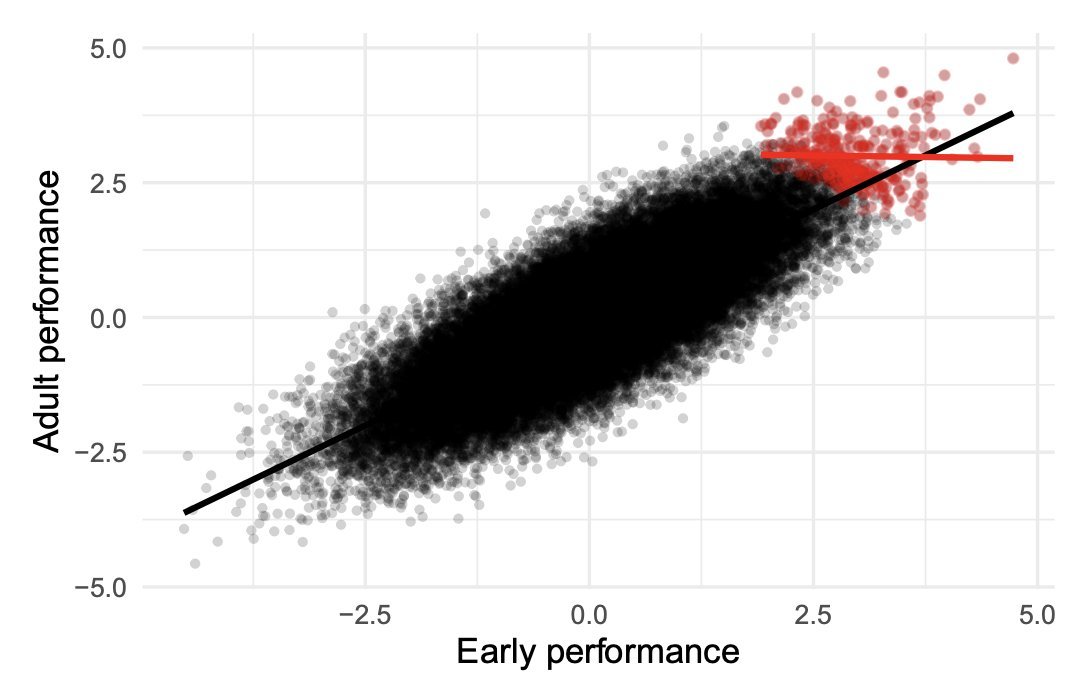
Among elite chess players, those with the lowest IQ are the best.
Among NBA players, the shortest ones are the best.
Among Hollywood actors, the least attractive are the most talented.
Among elite academics, those with poorer early academic performance are the best.
Among people with high LDL & high plaque burden, LDL is barely correlated with plaque burden.
Learn collider bias. Nice catch by @AlexTISYoung
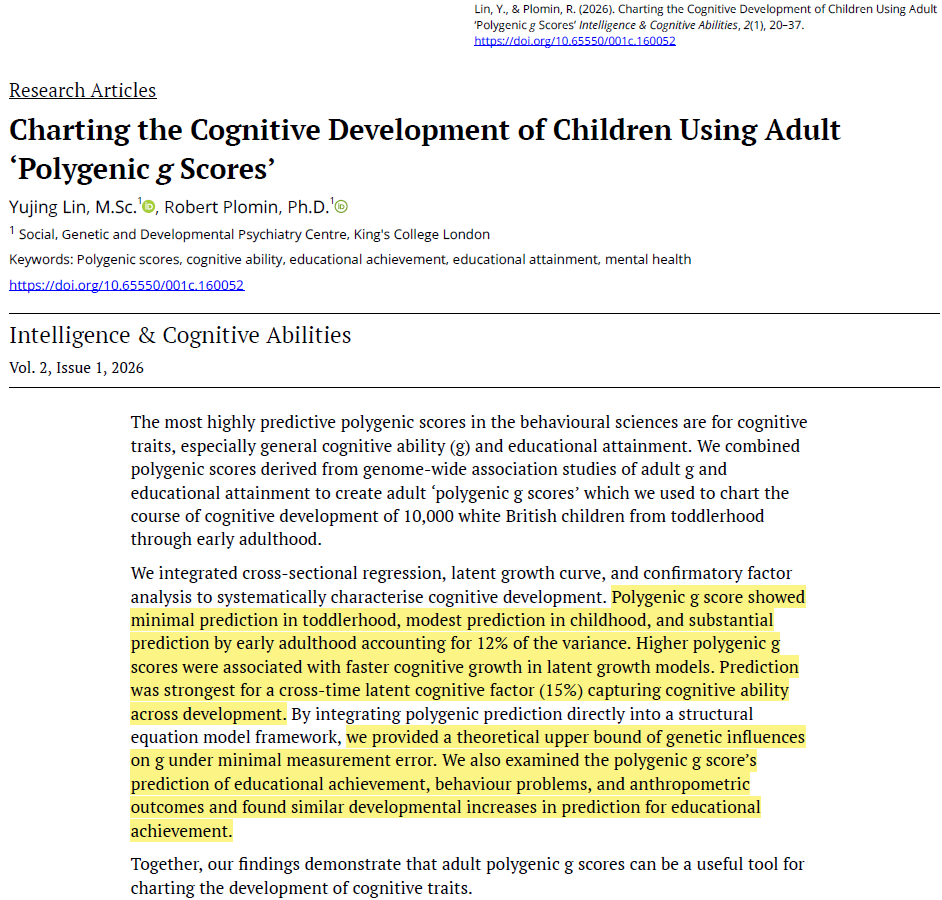
A new must-read article from the Plomin lab was published this week in @ICAJournal.
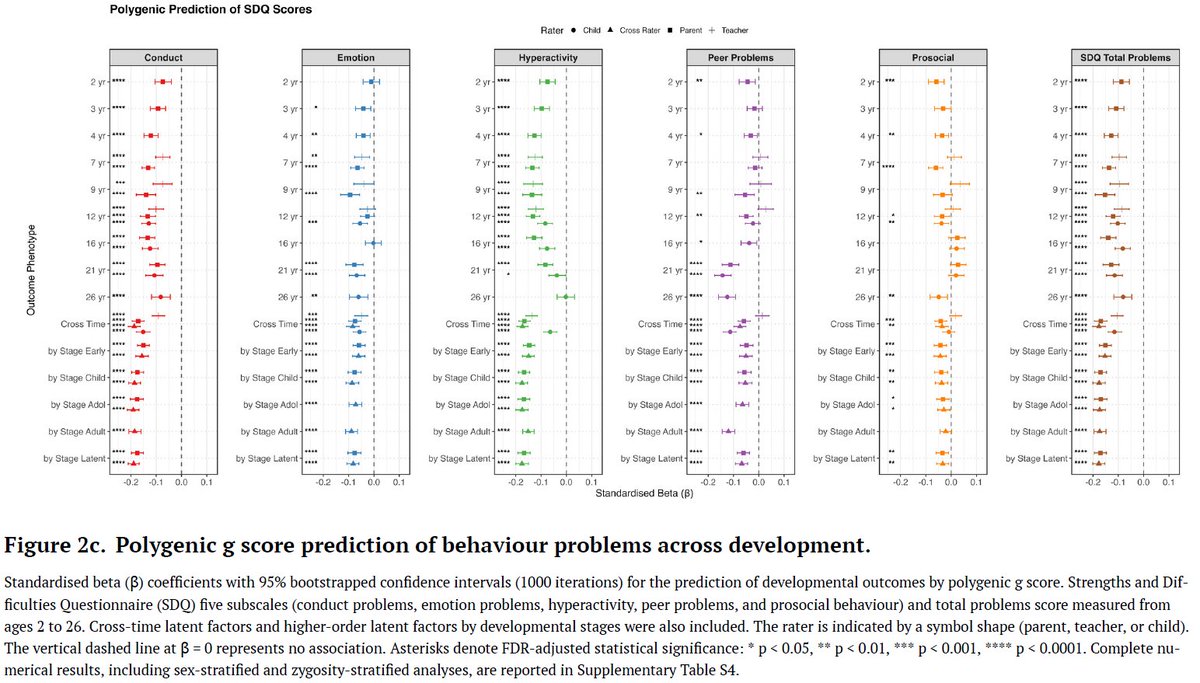
Lin and Plomin used polygenic scores (derived from DNA variation in people) predict life outcomes from ages 2 to 25 in the same sample. Results showed that the scores predicted cognitive abilities (including IQ) and educational attainment well (up to r = .37). But they could also predict some non-cognitive outcomes, such as conduct problems and hyperactivity.
Predictions of IQ started weak (r = .03 at age 2) and increased steadily through adulthood (r = .37 at age 25). Predictions of educational outcomes also increased throughout childhood, peaking at age 16. Non-cognitive predictions were weaker (all r's between 0 and .25), but that was expected because the polygenic scores were designed to maximally predict IQ and educational outcomes.
Because this was a longitudinal study, the authors could also see whether they could predict trends and growth. They found that children with higher polygenic scores started off with higher IQs and educational attainment and had faster growth over time. (In other words, "the rich got richer.")
The results confirm findings from other behavioral genetics studies using other methodologies. For example, the study supports the claim that heritability of IQ increases with age. The study also supports the idea that genes and environment become more strongly correlated as children grown into adulthood.
It's great work that pushes the field forward and confirms that children's phenotypes can be predicted with polygenic score derived from adult data. Read the full open-access article here:
https://t.co/uxMuQpZ3CY
Embryo Selection and Frontier Genomics with Dr. Alex Young – Manifold #111
Dr. Alex Young, a statistical geneticist and assistant professor in the Human Genetics department at UCLA, joins Steve Hsu to discuss the cutting edge of genomic prediction. They cover his research on polygenic embryo screening in IVF (including the ImputePGTA method), family-based DNA analysis, missing heritability, and the implications of polygenic scores for traits like education and disease. Alex also discusses his recent battles with cancer. @AlexTISYoung
Chapter Markers:
(00:00) - Alex Young Bio
(06:36) - Biobank Era Genetics
(10:49) - Missing Heritability Debate
(27:18) - Embryo Selection Controversy
(50:32) - Embryo Selection Backlash
(53:42) - Mexico City Admixture Study
(01:00:13) - Censorship Via Data Access Control
(01:05:02) - Battle With Cancer and Circulating Tumor DNA (ctDNA)
Good question! This was a pedigree with extensive family history: an affected maternal uncle with schizophrenia, another schizophrenia case, bipolar disorder in the maternal grandfather, and multiple additional mood-disorder diagnoses on both sides.
Because relatives were sequenced, we could estimate each embryo’s realized relatedness to affected individuals via IBD rather than rely only on pedigree-average kinship. The risk model then conditioned jointly on embryo PGS, family phenotypes, cross-disorder genetic correlations, and realized relatedness.
There was also meaningful PGS stratification: two embryos were around the mid-90s percentile for schizophrenia PGS, one was around the low-20s. Also the whole pedigree was very elevated for bipolar PGS overall.
We also gave the family several models depending on phenotype coding so they could understand the assumptions. Strict clinical-diagnosis-only scenarios gave lower risks, while the 18% vs 4% number comes from the broad model.
We checked rare/CNV-type burden too and did not find anything explanatory here. Our clinical geneticist also conducted a thorough pedigree review and found no actionable finding. The framework can incorporate rare-variant/CNV information when present, though.
This is probably worth writing up as a case study, as it shows what is possible when embryo PGS is combined with sequenced relatives and realized kinship in an informative pedigree.
It is. Google Health’s breast cancer screening AI was published in Nature without releasing model weights or code, and a group of 19 researchers criticized exactly that in a rebuttal that got published, but did not change the stance of the journal. GRAIL’s Galleri test uses proprietary machine-learning classifiers. Orchid describes their WGS amplification protocol as "laboratory-developed" and that's it . So yes, one can argue about whether this norm is good enough. But it is plainly not unusual for journals to publish validation studies of commercial biomedical tools without requiring full public release of the implementation.
I am not quite sure what you are referring to. Sasha posted the editor's note himself, which states that Timothy Bates was recused, had no involvement in any editorial decisions, and was not informed until after the final decision. The paper was handled by a separate editor. The claim that "none of it can be replicated" ignores that every core analysis is replicated with a reproducible score (Supplement 3, Tables S9-S23), as I already mentioned before. All reviewers agreed on the merits of the paper. And, indeed, as written in the note, it is common practice that commercial entities do not fully disclose proprietary details in their academic publications.
ADHD is highly genetic, but we still do not fully understand all the genetic factors involved.
A new large-scale study helps fill an important part of that gap.
#ADHD#genetics#psychiatry#mentalhealth
https://t.co/E5hgTXOZH6
Sasha is referring to a nonsignificant, slightly positive within-family beta of our cognitive ability predictor on Alzheimers (Fig 3 in our paper) and a (after multiple testing correction insignificant) slightly negative population beta of our pgs on autistic symptoms in ABCD (Fig 5A). We did in fact replicate the results in the main text (including these two) using publicly available data (Supplement 3 & Tables S9-S23), albeit (as expected) with less power. https://t.co/FGyh8CgMSn