Welcome to Equity Intel.Institutional-grade market coverage for the AI infrastructure era.
What we track:
▪️ Breaking macro and market data
▪️ High-growth tech and AI infrastructure trends
▪️ Sell-side research, contextualised (GS, MS, BofA and others)
▪️ Technicals and chart structures
Signal over hype. Follow for the edge. 📊
BREAKING: US 10Y Treasury yield back at highest level since January 2025
🔴 10Y trading around 4.69%, retesting the 15 January 2025 high first reached on 23 July (CNBC, TradingEconomics)
🔴 Markets pricing roughly 63% odds of a 25bp Fed hike in September
🔴 Three FOMC members dissented in favour of a hike at the July meeting
🔴 Fed Chair Warsh reaffirmed commitment to bringing inflation down, no forward guidance given
🔴 Equity futures gave up intraday gains as yields advanced
BREAKING: TSMC Q2 2026 double beat
🔴 EPS US$4.31 per ADR vs $3.77 est (TSMC Q2 press release, 16/07/2026)
🔴 Revenue $40.20B vs ~$39.8B est, up 33.7% YoY (TSMC)
BREAKING: The AI arms race is driving record Big Tech borrowing.
🔴 Amazon, Alphabet, Nvidia, Meta, Oracle and SpaceX have issued a record ~$182B in investment-grade bonds so far in 2026 (Kobeissi Letter)
🔴 AI-linked bond issuance has topped $218B through July 8, past the full 2025 total of $80.5B (PitchBook)
🔴 Deals of $25B or greater hit 7 this year, more than the prior six years combined (Bloomberg)
🔴 Amazon just priced a $25B eight-part deal, pushing total AI-linked issuance past $335B (Bloomberg)
$AMZN $GOOGL $NVDA $META $ORCL $SPCX
The AI arms race is driving record Big Tech borrowing:
Amazon $AMZN, Alphabet $GOOGL, Nvidia $NVDA, Meta $META, Oracle $ORCL, and SpaceX, $SPCX, have issued a record $182 billion in investment-grade bonds so far in 2026.
This marks a +1,300% increase from ~$13 billion over the same period in 2025.
As a result, these 6 firms account for nearly 15% of total US corporate bond issuance year-to-date and over 50% of this year's growth in corporate bond issuance.
Meanwhile, a record 7 bond deals of $25 billion or more have taken place during this period, matching the total number of deals seen between 2019 and 2025.
6 of the 7 deals came from these 6 companies, with the remaining one coming from Salesforce, $CRM.
AI capital needs are reshaping the corporate bond market.
BREAKING: Apple commits over $30B to Broadcom for US-made chips, its largest American Manufacturing Program commitment to date
🔴 Multiyear custom silicon and wireless deal, partnership extended through 2031 (Broadcom SEC filing)
🔴 Over 15 billion US-made chips, hundreds of jobs (Apple)
🔴 Broadcom investing $1.5B to expand its Fort Collins, Colorado facility (CNBC)
🔴 Part of Apple’s $600B four-year US investment plan (Reuters)
$AAPL $AVGO
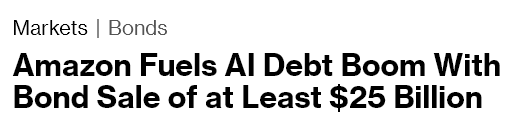
BREAKING: Amazon is raising at least $25B through an eight-part US dollar bond sale to fund AI infrastructure, per Bloomberg.
🔴 Filed with the SEC as floating and fixed-rate notes, maturities 3 to 40 years (Reuters term sheet)
🔴 Adds to roughly $54B in US and European bonds already raised in 2026, plus $10B in Canada in June
🔴 Amazon has told underwriters it will not issue more debt this year (CNBC)
🔴 2026 capex projected at $200B, up from $131B in 2025, mostly data centers and chips
🔴 Global AI-related debt sales now near $335B this year, over double 2025 (Bloomberg data)
Amazon $AMZN is seeking to raise at least $25B through a U.S. dollar bond sale, per Bloomberg
They now project capex to surpass $200B in 2026.
Tech companies are racing to buildout AI infrastructure, and are turning to capital markets to do so.
INFRASTRUCTURE SHIFT: Korean chip-stock leverage has hit structural extremes.
🔴 16 single-stock 2x ETFs on Samsung and SK Hynix went from $3B to $9B+ in under a month, 92% retail
🔴 They now drive ~31% of Samsung and ~38% of SK Hynix daily volume
🔴 June 23: both fell ~12%, worst day since 2008. KOSPI −9.99%, $MU −13% on no US news
🔴 Korea’s regulator issued formal warnings
ETF rebalancing is now moving the underlying, not tracking it. The tail wags the dog.
Leverage in South Korean chip stocks is out of control:
Single-stock leveraged and inverse ETFs tracking SK Hynix now hold ~$19 billion in total assets, more than 4 times the stock's average daily trading volume this year of ~$4.5 billion.
At the same time, Samsung has ~$12.4 billion in leveraged ETF assets, +176% above its ~$4.5 billion in average daily turnover.
Furthermore, the Hong Kong-listed 2x leveraged long SK Hynix ETF, which holds ~$13 billion in assets, is worth about twice the value of SK Hynix shares traded on an average day, the widest gap of any major stock with a leveraged ETF tracking it.
By comparison, Micron, $MU, has ~$9.9 billion in leveraged ETF assets, well below its ~$27.5 billion in average daily trading volume.
All while Tesla, $TSLA, and Nvidia, $NVDA, have leveraged ETF assets of ~$6.0 billion and ~$5.6 billion, both far smaller than their daily trading volumes of ~$23.6 billion and ~$28.8 billion, respectively.
Leverage concentration in Korean chip stocks is through the roof.
INFRASTRUCTURE SHIFT: Meta is building a cloud business to sell access to AI compute, competing directly with AWS, Azure and Google Cloud (Bloomberg).
🔴 The model: monetise excess data center capacity by renting it to outside customers
🔴 A new hyperscaler enters the AI compute rental market
BREAKING: Meta, $META, is developing a cloud infrastructure business that will sell access to AI compute and aims to compete with Amazon, Microsoft, and Google, per Bloomberg.
Meta shares are surging over +7% on the news.
INFRASTRUCTURE SHIFT: Robotics VC investment hits all-time high.
🔴 Q1 2026: ~$16B deployed, ~500 deals — both all-time records (Pitchbook)
🔴 Prior run-rate: $2–4B/quarter for four years straight
🔴 Inflection is vertical, not gradual
Physical AI buildout is accelerating.
The companies that were the best free-cash-flow machines in the S&P 500 are watching AI capex eat those margins.
🔴 ~$700B combined hyperscaler capex in 2026
🔴 FCF margins converging on the market median
🔴 Amazon FCF projected negative this year
Source: JPMorgan Asset Management, Bloomberg, June 2026.
INFRASTRUCTURE SHIFT: Micron $MU signals major capital return shift.
From today’s Q3 FY2026 outlook slide:
🔴 “Over time, we expect to return 100% of our excess cash to shareholders”
🔴 FCF forecast to increase substantially in Q4
🔴 Capital return to step up after Dec 2026 (2nd CHIPS anniversary)
🔴 FY2026 capex ~$27B
Source: Micron Q3 FY2026 earnings presentation.
BREAKING: South Korea’s KOSPI closed down 9.99% today, retreating sharply from record highs.
🔴 SK Hynix fell 11.78%, Samsung Electronics 11.17% (Trading Economics)
🔴 The drop tracked overnight losses on Wall Street as a megacap tech selloff hit sentiment
INFRASTRUCTURE SHIFT: Big tech is trading buybacks for AI capex.
🔴 Q1 share buybacks across the major hyperscalers fell ~64% YoY (Bloomberg)
🔴 The four largest are set to spend close to $700B on AI infrastructure in 2026 (CNBC)
🔴 Amazon free cash flow projected to turn negative this year
Four things are quietly flashing the same warning right now.
🔴 The Fed turned hawkish. Warsh is hinting at hikes, not cuts
🔴 The yield curve is flattening. The market is getting cautious on growth
🔴 Real yields just hit a one year high. Safe bonds now pay ~2.2% above inflation
🔴 Momentum in the Nasdaq is fading
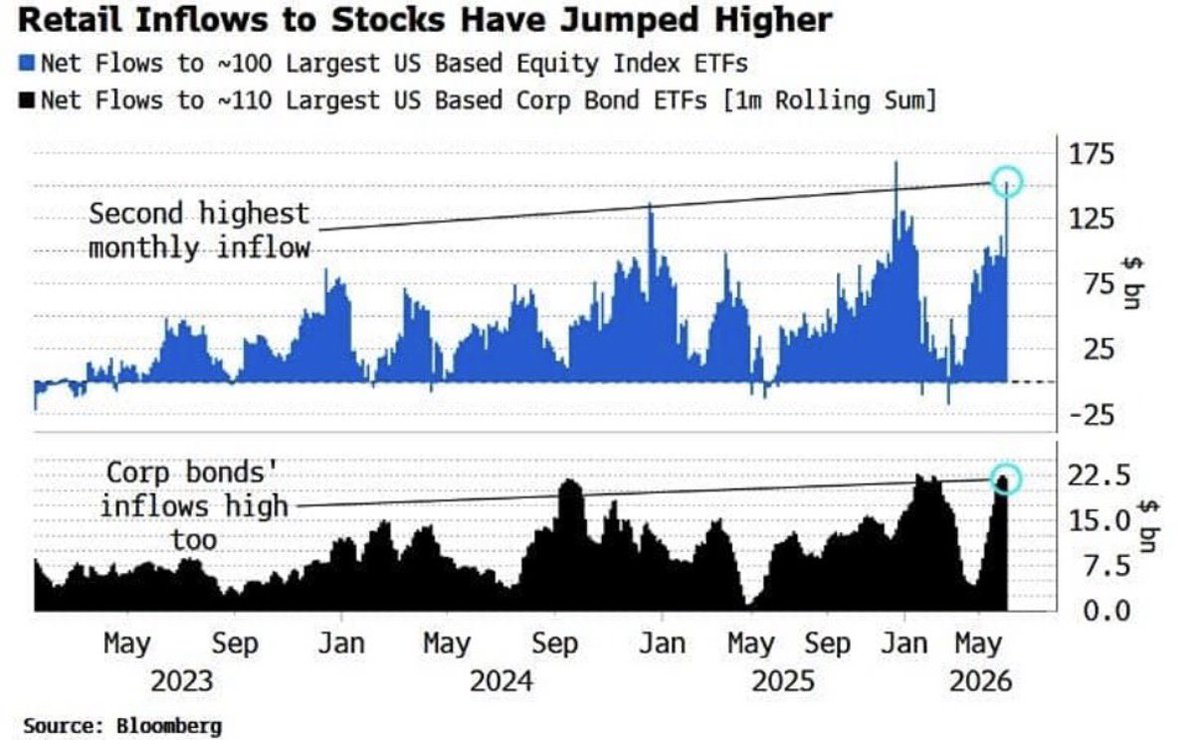
INFRASTRUCTURE SHIFT: Retail flows into US equity ETFs hit their second-highest monthly level on record
🔴 Net inflows to the ~100 largest US equity index ETFs reached roughly $150B over the past month, per Bloomberg
Retail's risk appetite is skyrocketing:
Retail investors bought +$150 billion of the 100 largest US equity ETFs over the last month, the 2nd-highest reading on record.
This is only below the +$170 billion posted in December last year.
Retail monthly purchases have more than quadrupled since March.
Furthermore, individual investors purchased over $20 billion of the 110 largest US corporate bond ETFs over the last month, near the highest on record.
Similar levels of purchases were also seen in February and October 2024.
Retail continues to pile into this market.
INFRASTRUCTURE SHIFT: South Korea Q1 2026 GDP revised up to +1.8% QoQ, the strongest quarter since Q3 2020, driven by the AI chip cycle
🔴 Revised up from +1.7% preliminary, per Bank of Korea
🔴 Exports +5.9% QoQ, led by semiconductors tied to global AI infrastructure demand
🔴 Facilities investment +6.6% QoQ, strongest in four years
🔴 +3.8% YoY, fastest annual pace since Q4 2021
🔴 BOK has lifted its 2026 growth forecast to 2.6%, citing a semiconductor super cycle
Source: Bank of Korea
The AI revolution is powering the South Korean economy:
The South Korean economy grew +1.8% QoQ in Q1 2026, revised up from the preliminary estimate of +1.7%, according to the Bank of Korea.
This marks the largest quarterly expansion since Q3 2020.
This revision was led by facilities investment, which was revised up from +4.8% to +6.6% QoQ, while private consumption came in at +0.6% QoQ.
Exports were also revised up, from +5.1% to +5.9% QoQ, fueled by semiconductor shipments tied to global AI infrastructure investment.
YoY, South Korea's economy grew +3.8%, the largest increase since Q4 2021.
AI is transforming South Korea.
Something rare is on the verge of occurring in the US economy:
The gap between the US unemployment rate and headline CPI has narrowed to just 0.1 percentage points, the smallest since 2022.
This comes as inflation rose to 4.2% in May, the highest since April 2023, while the unemployment rate stood at 4.3% in March, April, and May.
Historically, periods when this gap has approached zero have often been followed by Fed rate hikes.
The most recent example includes 2021-2022, when inflation exceeded the unemployment rate for 22 months.
This prompted the Fed to hike rates by 5.25 percentage points to 5.5% between March 2022 and July 2023, the highest since 2001.
Inflation is back at the center of the Fed's attention.
BREAKING: Retail investors bought a net $117.6M $SPCX, on its debut day, the most for any IPO on record
🔴 Surpasses prior record holders COIN ($92M, 2021) and UBER ($58.7M, 2019)
🔴 SPCX priced at $135, opened $161 on June 12, raising $75B at a $1.77T valuation
🔴 Single-day net retail figures per Vanda Research
BREAKING: Bank of Japan raises benchmark rate to 1%, highest since 1995
🔴 +25bps hike, first since December 2025 (0.50% to 0.75%)
🔴 BOJ signals it will halt the taper of JGB purchases from April 2027, holding around ¥2T/month