🚀 Today we’re releasing FlashOptim: better implementations of Adam, SGD, etc, that compute the same updates but save tons of memory. You can use it right now via `pip install flashoptim`. 🚀
https://t.co/nRrLSpjnwV
A bunch of cool ideas make this possible: [1/n]
We introduce a new method, EmbedOpt, for robustly steering protein sequence-to-structure diffusion models to fit experimental data (Cryo-EM, NMR) without training. 🧬📉 @mhli41@JiequnH@PilarCossio2
EmbedOpt tackles the brittleness of the previous coordinate-space steering methods by optimizing the conditional embedding instead. These embeddings capture rich co-evolutionary signals in protein diffusion models—unlocking a new, robust and semantically meaningful diffusion steering axis.
🚀 Result: Better fitting, wider hyperparam stability, and efficiency enabled by fewer diffusion steps
📄 Preprint: https://t.co/Ir7QcXyIW9
In today's episode of "Would You Please Just Look at the Data?"
Eric finds that in MMLU-Pro chemistry and physics subsets, blindly picking the answer that has a leading space is correct pretty often!
#quantumcomputing
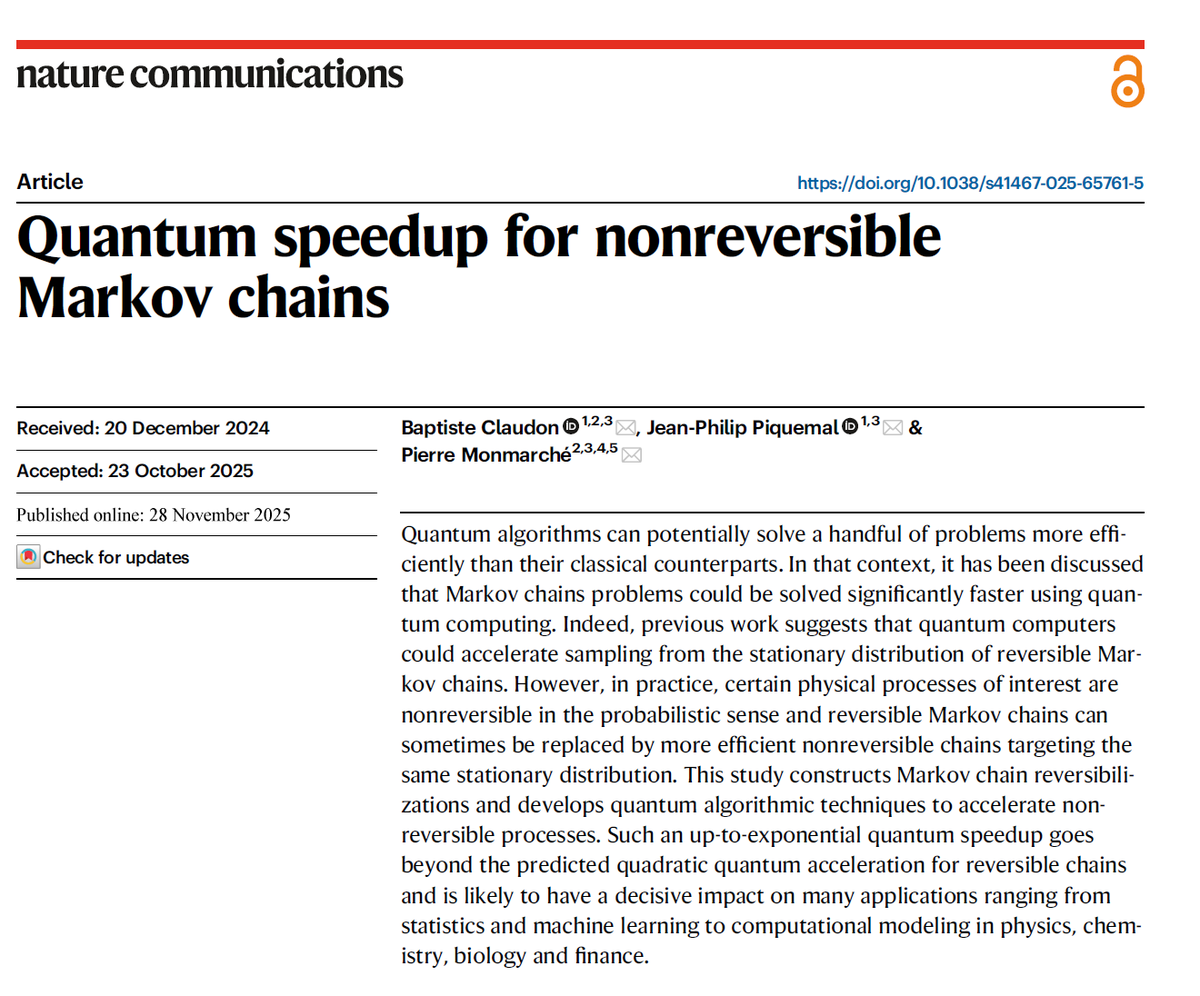
New paper published @NatureComms :
"Quantum Speedup for Nonreversible Markov Chains".
👉Check it out (#openaccess): https://t.co/TFgt0bUoe7
Can quantum algorithms accelerate the mixing of nonreversible Markov processes? This is the central question addressed in our study. Markov chains are widely used to model stochastic dynamics. While most quantum speedups for Markov chain sampling have been established in the reversible setting, many natural processes are inherently nonreversible, and efficient quantum algorithms for such cases remain less understood. Our results extend the quadratic speedup in sampling from the stationary measure of reversible chains to nonreversible ones and propose up-to-exponential quantum avantages over classical algorithms with applications ranging from statistics and machine learning to computational modeling in physics, chemistry, biology and finance.
This oustanding work is extracted from the PhD thesis of Baptiste Claudon (@qubit_pharma ) and part of an maths-chemistry interdisciplinary collaboration with Pierre Monmarché.
Tired of chasing references across dozens of papers? This monograph distills it all: the principles, intuition, and math behind diffusion models. Thrilled to share!
Muon’s speed arguably comes from approximate orthogonalization: a few fast Newton–Schulz iterations instead of an expensive full SVD. But this makes the update inexact. So how should hyperparameters change as approximation quality varies?🧵
1/n
@marceldotsci thanks Marcel, had a peak, looks to have lots of nice creature comforts like the comms module, as well as everything one needs for training. Are you happy with grain?
The long-anticipated g-xTB paper was just released on ChemRxiv. g-xTB is the next semiempirical method from Grimme and co-workers at @UniBonn. (I've heard rumors about this work for almost two years.)
Here's some quick thoughts upon an initial read:
@KozuchSebastian great read! Is it common for the “Synthesis details” to start with
“Warning! Silver azide and halogen azides are extremely hazardous…”?


![davisblalock's tweet photo. 🚀 Today we’re releasing FlashOptim: better implementations of Adam, SGD, etc, that compute the same updates but save tons of memory. You can use it right now via `pip install flashoptim`. 🚀
https://t.co/nRrLSpjnwV
A bunch of cool ideas make this possible: [1/n] https://t.co/xeaMyWztpv](https://pbs.twimg.com/media/HCgxeDgawAEzt6q.jpg)