To the Americans:
I've travelled all over the world. I've familiarized myself with many places, and met many people. And I'm a Canadian, although I’m privileged to reside once again in the States.
And here's something I've noticed, and it’s a key element of America's continuing greatness:
You bloody Americans value success, and you believe in its existence.
This is something that doesn't really happen anywhere else in the world. Even in other free democracies—the United Kingdom; Finland, Sweden, and Norway; Australia, New Zealand and Canada; Germany, France, and the Netherlands (great countries all)—a counterproductive cynicism too often reigns.
Success is equated with exploitation.
Ambition is looked upon with contempt.
This happens sometimes in the United States too—particularly among the miserable progressives, who confuse their resentment, ingratitude and unearned skepticism with wisdom.
But in your great country, by and large, striving is admired and success celebrated.
This means that more people strive and succeed in the US than anywhere else. And it's increasingly obvious. You remain stunningly more innovative and productive than any people anywhere else on the planet.
And so I say, as all should who are fortunate enough to live in the western world, let alone America:
Thank God for the United States.
Thank God for the wisdom of its founders.
Thank God for its faith in the free market and in the natural rights of man.
Happy birthday, you damn Yankees and Southerners.
Long may your admirable country dominate the world.
Long may your freedom and hope provide an example to those suffering everywhere at the hands of their malevolent states.
May your two and a half centuries of unparallelled success be just the beginning.
Your country is the light of the world, and the city on the hill.
Thank God for the USA.
Happy 250th.
Dr. Jordan B. Peterson
Reflecting on my last 15 yrs here in America. I love this country and grateful for those who died before us.
“This liberty will look easy by and by when nobody dies to get it.” - General George Washington
🇦🇷 MILEI: ARGENTINA ENDS DEFICIT FOR THE FIRST TIME IN 123 YEARS
"The deficit was the root of all our evils—without it, there’s no debt, no emission, no inflation.
Today, we have a sustained fiscal surplus, free of default, for the first time in 123 years.
This historic achievement came from the greatest adjustment in history and reducing monetary emission to zero.
A year ago, a degenerate printed 13% of GDP to win an election, fueling inflation.
Today, monetary emission is a thing of the past."
Source: @JMilei@agarra_pala
@PiyushKedia_@ankurnagpal@InCommonHQ No it wont. Per this tax rule, US-based engineers costs are amortized over 5 years while non-US based engineers are amortized over 15-years making the problem worse if you outsource.
@johnhickey1970@loop Pls correct me if I'm wrong here but it seems like you are comparing apples to oranges since you don't have Dec'23 return rate yet, which is your biggest month for returns... You should compare Jan-Nov YoY to see if your return rate is in fact trending down.
48 smart things Sam Walton wrote in his autobiography:
1. It never occurred to me that I might lose. It was almost as if I had a right to win. Thinking like that often seems to turn into a self-fulfilling prophecy.
2. We just got after it and *stayed* after it.
3. We just started repeating what worked.
4. We always ran a real tight organization. We had no excess people.
5. I went to the library and checked out *every* book on retailing.
6. Commit to your business. Believe in it more than anybody else.
7. There hasn’t been a day in my adult life when I haven’t spent time thinking about merchandising. It has been an absolute passion of mine.
8. I have always pursued everything I was interested in with a true passion—some would say obsession—to win.
9. One thing I don’t even have on my list is “work hard.” If you don’t know that already, or you’re not willing to do it, you probably won’t be going far enough to need my list anyway.
10. We were serious operators who were in it for the long haul.
11. We had a disciplined financial philosophy and we had growth on our minds.
12. Our money was made by controlling expenses.
13. You can make a lot of different mistakes and still recover if you run an efficient operation. Or you can be brilliant and still go out of business if you’re too inefficient.
14. We couldn’t care less about what is forecast or what the market says we ought to do.
15. Whatever money we made in one store, we’d put it in another new one, and just keep on going.
16. Many of our best opportunities were created out of necessity. The things that we were forced to learn and do because we started out under financed and under capitalized.
17. I overcame every single one of my personal shortcomings by the sheer passion I brought to my work.
18. It didn’t take me long to start experimenting—that’s just the way I am and always have been.
19. I have always been a Maverick.
20. I’ve always thought of problems as challenges. I didn’t dwell on my disappointment.
21. I constantly meddled with the status quo.
22. I was never in anything for the short haul.
23. One thing I never did—which I’m really proud of—was to push any of my kids too hard. I knew I was a fairly overactive fellow and I didn’t expect them to try to be just like me.
24. Control your expenses better than your competition. This is where you can always find the competitive advantage. We ranked number one in our industry for the lowest ratio of expenses to sales.
25. Most everything I’ve done I’ve copied from somebody else.
26. I like to keep everybody guessing. I don't want our competitors getting too comfortable with feeling that they can predict what we're going to do next.
27. I've never done much investing in anything except Walmart.
28. We were obsessed with keeping our prices below everybody else’s. Our dedication to that idea was total.
29. We looked for the action-oriented, do-it-now, go type of folks.
30. We started out swimming upstream and it’s made us strong and lean and alert.
31. My competitive nature was such that I saw his success and admired it. I didn’t envy it. I admired it. I said to myself: maybe I will be as successful as he is someday.
32. I’ve always held the bar pretty high for myself: I’ve set extremely high personal goals.
33. I learned a long time ago that exercising your ego in public is definitely not the way to build an effective organization.
34. I learned a lesson which has stuck with me all through the years: you can learn from everybody.
35. I was always looking for offbeat suppliers or sources.
36. Growing up as the oldest child, I felt like I took a lot of the brunt of my parent's domestic discord. I swore early on that if I ever had a family, I would never expose it to that kind of squabbling.
37. I have always had the soul of an operator, somebody who wants to make things work well, then better, then the best they possibly can.
38. I probably visited more headquarter offices of more discounters than anybody else—ever. I would just show up and as often as not, they’d let me in. I’d ask lots of questions about pricing and distribution, whatever. I learned a lot that way.
39. We have been ahead of most other retailers in investing in sophisticated equipment and technology.
40. My role has been to pick good people and give them maximum authority and responsibility.
41. My style as an executive has been dictated by my talents. I’ve played to my strengths and relied on others to make up for my weaknesses.
42. One way I’ve managed to keep up with everything on my plate is by coming in to the office really early. (4:30am) That early morning time is tremendously valuable: it’s uninterrupted time when I think and plan and sort things out.
43. I’m always asked if there ever came a point, once we got rolling, when I knew what lay ahead. I don’t think that I did.
44. It’s generally my gut that makes the final decision. If it feels right, I tend to go for it, and if it doesn’t, I back off.
45. Nothing else can quite substitute for a few well-chosen, well-timed, sincere words of praise. They’re absolutely free—and worth a fortune.
46. The folks on the front lines—the ones who actually talk to the customer—are the only ones who really know what’s going on out there. You’d better find out what they know.
47. Go the other way. Ignore the conventional wisdom. If everybody else is doing it one way, there’s a good chance you can find your niche by going in exactly the opposite direction.
48. I enjoyed doing what I was doing so much and seeing the thing grow and develop, that I never could quit.
I've read Sam's autobiography two or three times. Listen to episode 234 to learn more!
@erichoke I have been doing interval training: day 1: deck of cards, pick an exercise for each suit (heart=pull-ups, diamond=squats, etc) do the reps based on card flipped (e.g. ace=11 push-ups), day 2: run for 30 mins, day 3: deck of cards, day 4: peloton or run, etc
@girdley Ray Dalio thinks otherwise in his book “The changing world order”. If we don’t address some critical internal problems (e.g. national debt, education, political conflict, large disparity between rich vs poor) we might cede the #1 superpower spot to China over next 3-10 yrs.
My notes from Poor Charlie's Almanack: The Wit and Wisdom of Charlie Munger turned into maxims:
1. Find a simple idea and take it seriously.
2. Good ideas are rare. When you find one bet heavily.
3. Humans have been writing down their best ideas for 5,000 years. Read them.
4. Avoiding stupid mistakes is more important than being smart.
5. Don’t work with anyone you don’t admire.
6. Don’t sell anything you wouldn’t buy.
7. Avoiding a bad habit is easier than breaking a bad habit.
8. Work on your best idea. Don't diversify
9. Incentives rule everything around you. Look for them.
10. Great businesses are built by going ridiculously far in maximizing or minimizing one or a few things. Think Costco.
11. Learning is changing behavior.
12. Do the unpleasant tasks first.
13. Charlie has read hundreds of biographies. Do the same.
14. Stop multitasking. Concentrate.
15. Many hard problems are solved best when approached backwards.
16. Think of ideas as tools. When a better tool comes along use it.
17. Clip your business and personal expenses. Small leaks sink big ships.
18. Make friends with smart dead people. Adam Smith, Darwin, Cicero, Ben Franklin —whoever interests you. Read their writing. Steal their ideas. They don’t need them anymore.
19. Don't confuse intelligence with invincibility.
20. Bad things will happen to you. It’s inevitable. When they do get up and keep going and remember the next maxim.
21. Self pity has no utility.
22. Find out what you are best at. Then pound away at it. Forever.
23. Only plays games where you have an edge.
24. Avoid mob rule. Avoid demagogues. Avoid dogma. Avoid bureaucracy.
25. Optimize for independence.
25. Use money to buy freedom.
26. Develop durability.
27. What do you have an *intense* interest in? Do that for money.
28. Self improvement has no end.
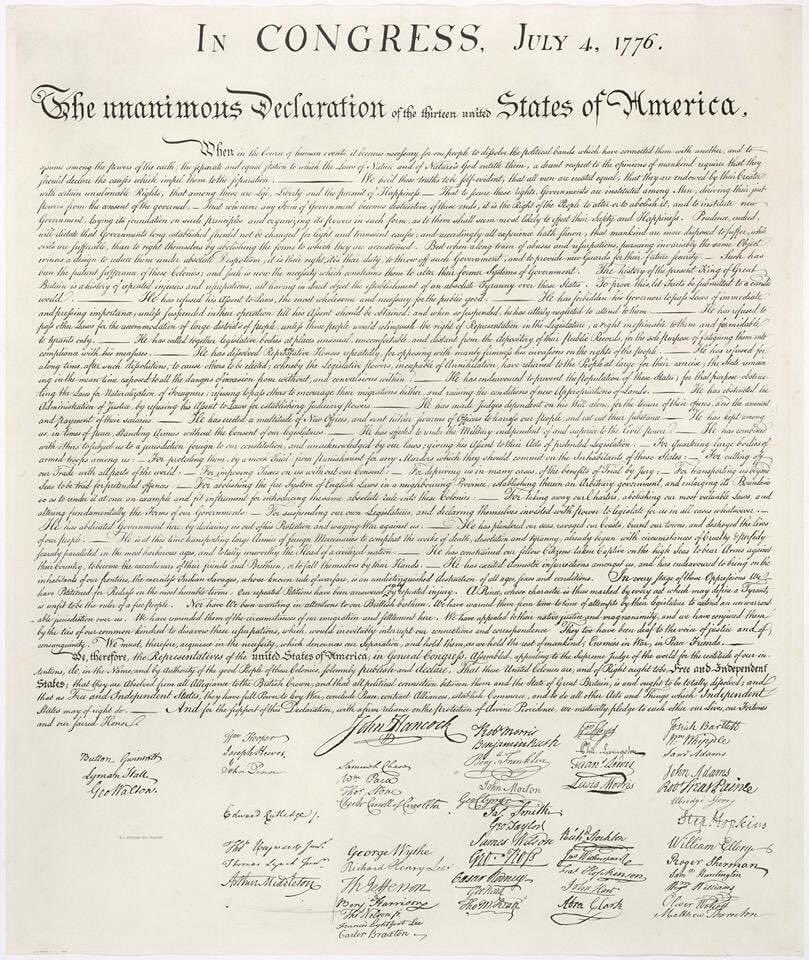
“Have you ever wondered what happened to the 56 men who signed the Declaration of Independence?
Five signers were captured by the British as traitors, and tortured before they died. Twelve had their homes ransacked and burned. Two lost their sons in the revolutionary army, another had two sons captured. Nine of the 56 fought and died from wounds or hardships of the revolutionary war.
They signed and they pledged their lives, their fortunes, and their sacred honor.
What kind of men were they? Twenty-four were lawyers and jurists. Eleven were merchants, nine were farmers and large plantation owners, men of means, well educated. But they signed the Declaration of Independence knowing full well that the penalty would be death if they were captured.
Carter Braxton of Virginia, a wealthy planter and trader, saw his ships swept from the seas by the British Navy. He sold his home and properties to pay his debts, and died in rags.
Thomas McKeam was so hounded by the British that he was forced to move his family almost constantly. He served in the Congress without pay, and his family was kept in hiding. His possessions were taken from him, and poverty was his reward.
Vandals or soldiers or both, looted the properties of Ellery, Clymer, Hall, Walton, Gwinnett, Heyward, Ruttledge, and Middleton.
At the battle of Yorktown, Thomas Nelson Jr., noted that the British General Cornwallis had taken over the Nelson home for his headquarters. The owner quietly urged General George Washington to open fire. The home was destroyed, and Nelson died bankrupt.
Francis Lewis had his home and properties destroyed. The enemy jailed his wife, and she died within a few months.
John Hart was driven from his wife’s bedside as she was dying. Their 13 children fled for their lives. His fields and his gristmill were laid to waste. For more than a year he lived in forests and caves, returning home to find his wife dead and his children vanished. A few weeks later he died from exhaustion and a broken heart. Norris and Livingston suffered similar fates.
Such were the stories and sacrifices of the American Revolution. These were not wild eyed, rabble-rousing ruffians. They were soft-spoken men of means and education. They had security, but they valued liberty more. Standing tall, straight, and unwavering, they pledged: ‘For the support of this declaration, with firm reliance on the protection of the divine providence, we mutually pledge to each other, our lives, our fortunes, and our sacred honor.’”
Michael W Smith
@Jack_Raines The drop was caused by the departure of their 10 year CEO Bracken Darrel who announced his departure on June 13. Btw that controller was made >10 yrs ago. It’s like using a Nintendo controller to navigate a submarine.
@Karim__Hamidou@buccocapital S&M is mostly an upfront cost while the revenue will be coming in monthly over time. So let’s say your CAC is $1k, you get $200 of monthly revenue at 70% GM. Your payback is 7months ($1k/$200x70%). Meaning it takes you 7 months to payback your CAC, then you start making money
Just a few notes to myself (a driven & ambitious person):
1) Kings are overrated and usually unhappy. It is much better to be kingmaker.
2) Eventually, everyone realizes that they don’t want to be Elon Musk or Steve Jobs. How quickly do you want to get there?
3) Legacy is overrated. So is impact.
4) Learn from everyone & everything. Don’t view people as better or worse than you, worthy or unworthy of teaching you. And if something doesn’t fully resonate, don’t reject it wholesale. Try extracting the useful bits and learn from those. Wisdom is everywhere, if you can spot it.
5) When you find someone inspiring, try to separate their content and their charisma. And if it’s the charisma that inspires, be very careful.
6) The chief indicator of authentic confidence isn’t bravado. It’s the person’s openness to discovering why they’re wrong.
7) Whatever industry or domain you are in is probably smaller than you imagine it is. People talk. Don’t burn bridges over the small stuff.
8) When in doubt about where to take a job, pick the place with the better people. Even if it ends up being the wrong bet, you will still be more fulfilled with your work.
9) In the tech industry, things often change. Platforms change, technologies change, office signs change, employers change, centers of gravity change. The one thing that remains constant is the people. Always optimize for the people.
10) If you choose to understand just one cognitive bias, let it be the Fundamental Attribution Error. If you choose to understand one more cognitive bias, let it be Confirmation Bias.
Last but not least, very important note:
No rule is valid for every single situation in life. Except this rule.