Consultor TI:Sysadmin, dev & #SEO.
Comparto sobre privacidad, sistemas, desarrollo y GNU/Linux.
Disfruto con las retroconsolas.
Socializando contenido!
Linus Torvalds says the Linux kernel security mailing list is now almost impossible to manage due to a large number of bug reports from AI tools.
In his latest update for Linux 7.1-rc4, he explained that the continued flood of AI reports has made the security list almost entirely unmanageable, with enormous duplication as different people find the same issues using the same tools.
Maintainers spend a lot of time dealing with the same problems repeatedly and often reply that they were already fixed weeks ago.
The security list is for private and important security problems, but AI reports are not secret and create too much extra work.
Linus says AI tools are great but only if they actually help rather than cause unnecessary pain and pointless make-work.
CapCut empezó siendo gratis
Luego pusieron transiciones básicas de pago.
Luego bloquearon resoluciones de exportación.
Luego añadieron marcas de agua.
Luego ByteDance empezó a usar tus videos para entrenar su IA.
Un grupo de devs se cabreó lo suficiente como para clonar todo el proyecto desde cero
Se llama OpenCut y tiene 45.8k estrellas en GitHub en menos de un año
✅ Edición con línea de tiempo y múltiples pistas
✅ Vista previa en tiempo real sin renderizar
✅ Sin marcas de agua en ninguna exportación, nunca
✅ Sin suscripciones ni funciones bloqueadas
✅ Funciona en web, escritorio y móvil
✅ Tus videos nunca salen de tu dispositivo
✅ Licencia MIT, nadie puede añadir un muro de pago
La parte más importante: al ser MIT si alguien intentara meter un paywall la comunidad lo forkea en 48 horas y lanza el mismo producto sin él
CapCut construyó su foso siendo gratis. OpenCut les acaba de quitar ese foso.
45.8k estrellas. 4.7k forks. 90+ colaboradores activos. MIT.
lo tienes abajo 👇
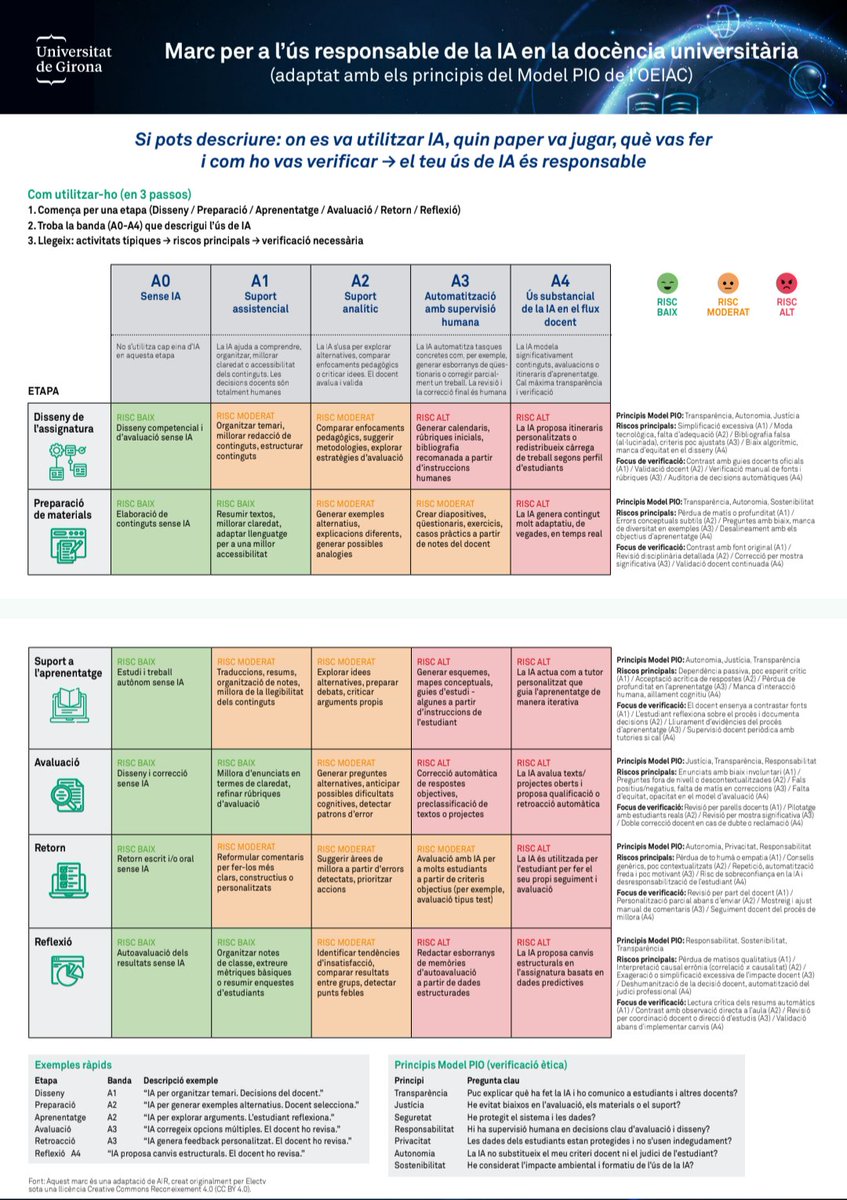
📣 Nou recurs! Ja està disponible a la nostra web el "Marc per a l'ús responsable de la IA en el procés de la DOCÈNCIA". Aquest s'afegeix al publicat fa unes setmanes per l'àmbit de la recerca.
👉 https://t.co/aIsTH4DHhV
Linus Torvalds acaba de dejar claro que Linux no va a convertirse en un basurero de código generado por IA.
Después de meses de debate interno, la comunidad Linux publicó sus reglas oficiales sobre el uso de herramientas como GitHub Copilot.
El veredicto: se puede usar IA para programar, pero el "slop" ese código de baja calidad escupido sin pensar, no pasa el filtro.
La frase que lo resume todo: "Los humanos asumen los errores."
Puedes apoyarte en Copilot, en Claude, en lo que quieras. Pero si ese código entra al kernel de Linux, tú eres el responsable.
Tú lo verificas. Tú corriges los fallos. Tú garantizas que cumple los estándares.
Es la postura más madura que he visto en el ecosistema open source frente a la IA. Ni histeria, ni adopción ciega. Solo responsabilidad clara.
El kernel tiene 30 años de historia.
No lo van a arruinar por ahorrar 20 minutos con un autocomplete.
The NSA spent billions trying to break encryption.
One German programmer beat them.
He earned only $25k a year. 🤯
Meet Werner Koch 🇩🇪
> German free software developer. Born 1961 in Düsseldorf.
> 1997 ~ Richard Stallman called for a free encryption tool.
> Only option then: closed-source, US-restricted PGP.
> Werner answered. He built GnuPG (GPG) alone — free software to encrypt files, sign software, and verify identity.
> 1999 ~ Released GPG 1.0. Fully open source. No restrictions.
> Today his code verifies every Linux server update, every Debian package, every Tor Browser download on Earth.
> Every signed Linux release depends on it.
> Used by activists, dissidents, and security pros worldwide to stay untracked.
> Edward Snowden used GPG in 2013 to leak NSA documents. It held up against the world’s most powerful spy agency. 🚀
> 2001 ~ Founded g10code with his brother to work full-time on GPG.
> Earned $25,000/year for 14 years while supporting his wife and daughter.
> 2012 ~ Funding ended. He had to let go of his only programmer.
> 2013 ~ He was the sole maintainer and nearly quit.
> 2015 ~ ProPublica story dropped. Internet donated $137k in 24 hours.
> Facebook + Stripe pledged $50k/year each. Linux Foundation gave $60k.
> Won FSF Award for the Advancement of Free Software.
> Today he still maintains GPG from his home in Erkrath, Germany.
One man kept the internet’s secrets, secret.
The world almost lost him in 2013.
His code still protects yours.
Privacy GOAT. 🐐
Google Chrome silently installs a 4 GB AI model on your device.
> No consent dialog. No opt-out UI. Re-installs itself if the user removes it manually.
That is the true definition of malware.
El 2018, la mitjana del temps entre publicació d’una CVE i el primer exploit observat era de 771 dies. El 2021 ja era de 84 dies.
Al 2025 un mes, i al 2026 1 setmana. Les projeccions situen la fita d’1 dia i 1 hora també al 2026, i 1 minut el 2028.
https://t.co/LlqTaOu7Ae
Juan Ramon tiene 15 años, vive en Almería y está desarrollando un sistema operativo open source para calculadoras científicas y gráficas con el objetivo de que estas cuesten una décima parte que los actuales modelos comerciales.
https://t.co/8c8IRxQLYr
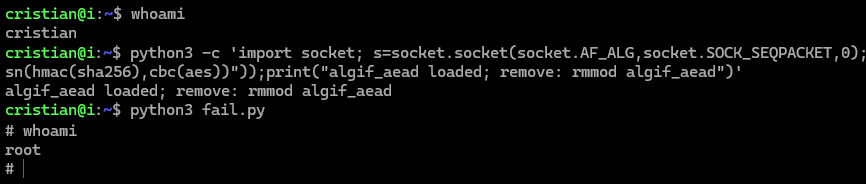
🚨 BREAKING: cPanel and WHM, the control panels behind an estimated 70+ million websites, have a critical security flaw that lets anyone become root admin without a password. CVE-2026-41940 affects every supported version. It’s already being exploited in the wild.
watchTowr Labs published the full attack today, after the hosting company KnownHost confirmed the bug was already being used to break into a significant chunk of the internet.
If you've never heard of cPanel: it's the dashboard that hosting providers and millions of website owners use to manage their servers, domains, email accounts, databases, and SSL certificates. WHM is the admin version that controls the entire server. If someone gets root access to WHM, they get the keys to the kingdom and to every apartment inside it.
How the attack works, in plain English:
🔴 Step 1: The attacker sends a deliberately wrong login. cPanel still creates a temporary "you tried to log in" record on disk and gives the attacker a cookie tied to it.
🔴 Step 2: The attacker tweaks the cookie to disable cPanel's password encryption. Normally cPanel encrypts the password field on disk. With one small change to the cookie, cPanel just stores it as plain text instead.
🔴 Step 3: The attacker sends a fake login attempt where the password field secretly contains hidden line breaks. cPanel does not strip these line breaks out, so they get written straight to the session file. Each line break creates a brand new fake record. The attacker uses this to inject lines that say "this user is root" and "this user already authenticated successfully."
🔴 Step 4: The attacker visits one more random page on the site to nudge cPanel into re-reading the file. cPanel then promotes the injected fake lines into its main session memory.
🔴 Step 5: On the next request, cPanel sees a flag that says "this user already passed the password check." cPanel trusts that flag, skips checking the actual password, and lets the attacker in as root.
From start to finish, the attack takes a handful of HTTP requests.
If you run cPanel or WHM, the patched versions are:
🔴 cPanel/WHM 110.0.x → 11.110.0.97
🔴 cPanel/WHM 118.0.x → 11.118.0.63
🔴 cPanel/WHM 126.0.x → 11.126.0.54
🔴 cPanel/WHM 132.0.x → 11.132.0.29
🔴 cPanel/WHM 134.0.x → 11.134.0.20
🔴 cPanel/WHM 136.0.x → 11.136.0.5
If your version is older than these, assume someone has already broken in and act accordingly. Patch right now, then rotate every password and key the server touched: root passwords, API tokens, SSL private keys, SSH keys, mail passwords, and database passwords.
Ha tornat a saltar la banca, per X vegada en les darreres 24 hores...
cPanel i WHM, els panells que gestionen més de 70 milions de webs, tenen una vulnerabilitat crítica que permet entrar com a administrador sense cap contrasenya, i que venia sent explotada des de febrer.
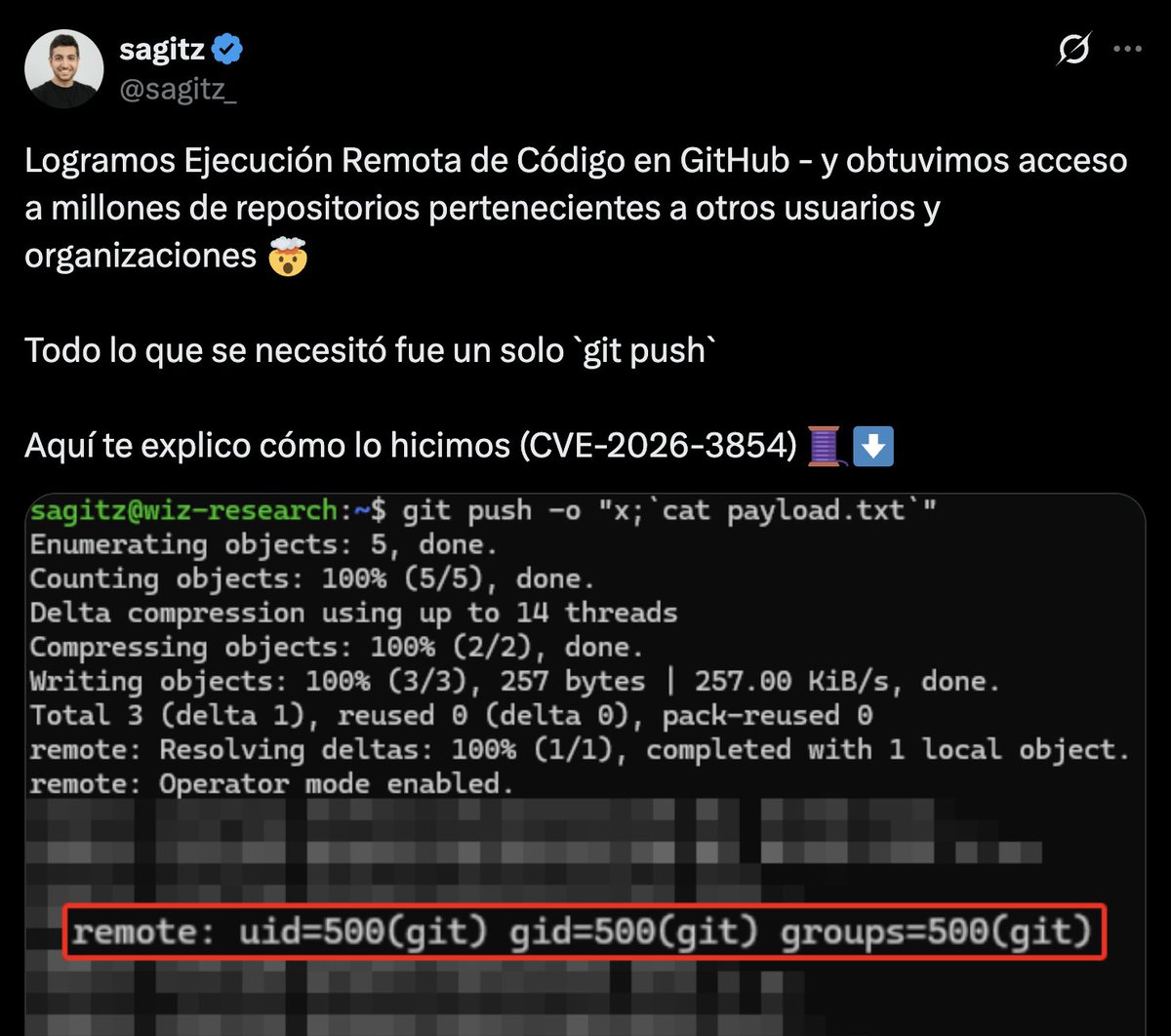
¡Esto es una locura! Investigadores encontraron una vulnerabilidad crítica en GitHub.
Con un simple git push, un atacante podía inyectar datos en una cabecera interna de GitHub y acabar ejecutando código en sus servidores.
Podía dar acceso a repos privados de otros usuarios y afectaba a GitHub Enterprise.
GitHub lo arregló el mismo día pero ahí queda la historia.
👋 Hola, Ministerio de Transformación Digital, @mintradigital:
👋 Hola, Secretaría de Estado, @SEtelecoGob:
Autofirma es un componente esencial de la Administración Electrónica española. Millones lo utilizamos para relacionarnos con la Administración. No por placer, sino porque es ✨requisito✨.
----8<----8<----8<----8<----8<----8<----
El paquete de Autofirma que distribuís para Mac no cumple las garantías de seguridad modernas (notarización), así que el sistema dice que es malware que puede dañar el sistema y rechaza instalarla. 😃🔫
----8<----8<----8<----8<----8<----8<----
🤦 Para instalarla hay que —ojo al dato— desactivar las políticas de ciberseguridad del sistema operativo. 🤦
¡Hola, @INCIBE! Hacéis campañas fabulosas para concienciar a la ciudadanía de los riesgos de ciberseguridad, pero luego nos enjaretáis —el Estado— marrones como este. ¿Podéis hacer algo, por favor?
Respetado ministro @oscarlopeztwit:
Respetada secretaria de Estado @mariagv:
— Si hacéis software, cumplid los estándares modernos de empaquetado y distribución de software.
— Si no podéis notarizar Autofirma, modernizad la arquitectura del programa para que se pueda.
— Si no podéis modernizar Autofirma, necesitamos un Ministerio para la Transformación del Ministerio de la Transformación Digital.
Esto es lo que ve un usuario al intentar instalar Autofirma en un Mac:
La grandesa del codi obert és aquesta, surt von der Leyen a presentar un sistema de verificació d’edat privacy friendly de codi obert, i en poques hores ja hi ha investigadors que reporten errors en el disseny, que posen en risc la privacitat.
Llarga vida al codi obert.
Més de 30 plugins de WordPress d'"Essential Plugin" han estat backdooritzats. Creats fa una dècada, van ser venuts a un nou propietari l'any passat que, després de vuit mesos d'inactivitat, hi va desplegar un backdoor fa uns dies.
400.000 instal·lacions
https://t.co/00oFRo3kI4