AI is now taking on some of the hardest open problems that scientists have posed. But research is broader than solving problems. Can AI also propose research questions that experts find genuinely interesting?
We built After42 to find out. Experts judged 45 of its 135 final questions genuinely interesting, across mathematics, statistics, theoretical computer science, and physics, with wide variation across subfields.
The key idea: develop questions by trying to solve them.
We also asked whether AI can judge which questions are interesting. We find that model judges' top choices align with expert consensus but do not consistently capture individual experts' preferences.
We release the expert-assessed questions as an open resource for researchers to discuss, refine, and pursue, as a step toward integrating AI into the broader research enterprise.
https://t.co/iOrs6L7E9Y
Superintelligence should benefit human intelligence. Mathematics is our starting point.
We’re launching Readable Intelligence, and we invite the math and AI communities to build it with us.
📄 Pick a paper.
💬 Flag an unclear step.
🙌 Contribute a more readable version....
https://t.co/IM5pH7oM2g
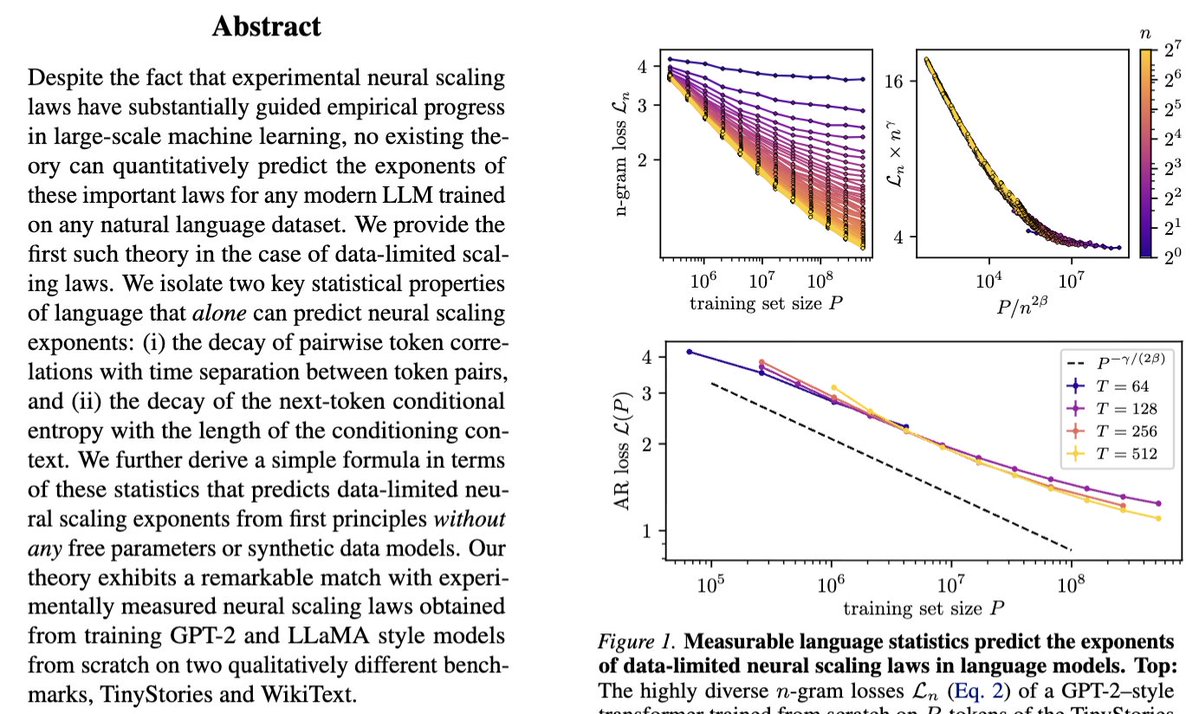
Our new paper "Deriving neural scaling laws from the statistics of natural language" https://t.co/7QbrldK8Zp lead by @Fraccagnetta & @AllanRaventos w/ Matthieu Wyart makes a breakthrough! We can predict data-limited neural scaling law exponents from first principles using the structure of natural language itself for the very first time!
If you give us two properties of your natural language dataset:
1) How conditional entropy of the next token decays with conditioning length.
2) How pairwise token correlations decay with time separation.
Then we can give you the exponent of the neural scaling law (loss versus data amount) through a simple formula!
The key idea is that as you increase the amount of training data, models can look further back in the past to predict, and as long as they do this well, the conditional entropy of the next token, conditioned on all tokens up to this data-dependent prediction time horizon, completely governs the loss! This gets us our simple formula for the neural scaling law!
The goal of deep learning theory/science is to guide practice. But most practical questions are >1 paper away from being legitimately answered by theory. How, then, can we make progress, without access to the ideal reward signal of “does this theory give us a SOTA algorithm?” …
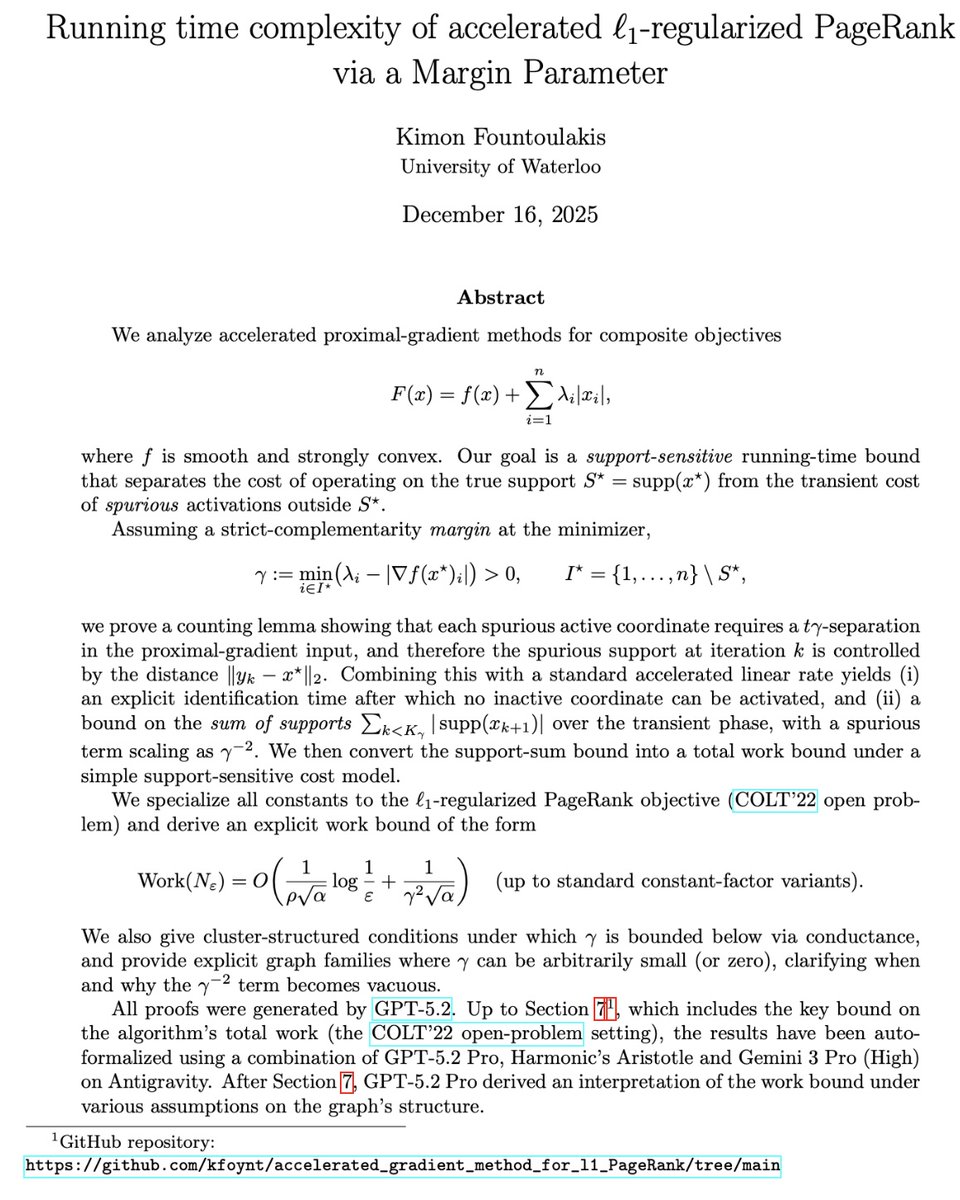
GPT-5.2 solves our COLT 2022 open problem: “Running Time Complexity of Accelerated L1-Regularized PageRank” using a standard accelerated gradient algorithm and a complementarity margin assumption.
Link to the open problem: https://t.co/A3ZbJshudE
All proofs were generated by GPT-5.2 Pro. The key bounds on the algorithm’s total work (in the COLT’22 open-problem setting) have been auto-formalized using a combination of GPT-5.2 Pro, @HarmonicMath's Aristotle, and Gemini 3 Pro (High) on Antigravity.
Link to the proof: https://t.co/hgJ0iBcWJe
Link to the Lean code: https://t.co/DeMFDlwSC9
Link to the informalization of the Lean code: https://t.co/V5BwYoIycN
Link to my GPT-5.2 prompts: https://t.co/xwh5c6S81B
In addition to the formalization of the main result, I checked the proof myself twice. I hope I didn’t miss anything, but if I did, please let me know and I will try to fix it.
Story behind the paper and relevant work
In 2016, I worked on the convergence rate of the Iterative Soft-Thresholding Algorithm (ISTA) for l1-regularized PageRank.
Link to the corresponding paper: https://t.co/pDMN9QKkGh
Surprisingly, the running time of the algorithm depends only on the number of non-zero nodes at optimality. It was only natural to ask the same question for accelerated methods, such as FISTA. However, we quickly realized that FISTA activates more nodes than the number of non-zeros at optimality, even though it eventually converges to the same active set. In practice, we would still observe that FISTA is fast.
Link to empirical work: https://t.co/VQFJugQk0m
I tried for about three months to bound the total work of FISTA and other accelerated algorithms, and from time to time I would come back to the problem while I was a postdoctoral fellow. Eventually, I gave up. I gave it another try around 2021, and I failed again. I asked my excellent former student, Shenghao Yang, and he also failed, unfortunately. I asked a couple of prominent researchers if they think the problem is solvable, they quickly mentioned that it seemed hard. We ended up publishing it as an open problem at COLT 2022.
In 2023, David Martínez-Rubio et al. provided the first successful solution. Their solution is “orthogonal” to what was proved by GPT-5.2.
Link to their paper: https://t.co/YPUrfGhG2T I loved their work btw, I also met David in person at ICML 2024, one of the few ML conferences I ever attended.
Their proposed accelerated algorithm is not necessarily faster than ISTA; however, it does offer a new trade-off between the teleportation parameter of PageRank and the total work per iteration. More importantly, the proposed method isn’t necessarily practical, since it involves solving an expensive subproblem. To be fair, in the COLT 2022 problem, we didn’t impose the additional hard constraint of using standard accelerated methods. The problem was posed as a theoretical problem. The solution proved by GPT-5.2 establishes acceleration for the standard FISTA algorithm, which performs only one gradient computation per iteration. It also offers a clean parameterization of the total work with respect to a complementarity margin, which, for certain graph structures, shows a clear speed-up compared to ISTA.
In 2024, Zhou et al. (https://t.co/Agq5ANfhuS) gave it another go. However, in my view, their work has important drawbacks. In particular, their guarantees for accelerated localized methods (e.g., localized Chebyshev / Heavy-Ball) assume a condition on the geometric mean of certain active-ratio factors (described as Θ(\sqrt{α})) in order to obtain an accelerated bound.
Two distinctions matter for our setting:
First, their accelerated runtime bounds are parameterized by evolving-set quantities and a residual-ratio assumption, which can be evaluated during a run but is not typically interpretable or verifiable a priori from graph structure alone. The solution by GPT-5.2 instead provides an explicit transient-phase bound in terms of a standard optimization-structure condition, and converts this directly into a total work bound.
Second, they explicitly note that FISTA-style acceleration violates the monotonicity property needed to bound the per-iteration accessed volume, and emphasize that guaranteeing intermediate sparsity in accelerated frameworks is challenging. The margin-based analysis by GPT-5.2 directly targets this gap: even without any monotonicity of intermediate supports, GPT-5.2 bounded how much spurious activation can occur before the iterates enter a neighborhood of the unique minimizer, thereby yielding a concrete locality certificate for the accelerated proximal-gradient trajectory.
Since 2024, every time OpenAI or Google released a new major model, I would give it a go. This time, with GPT-5.2, it seems to have worked.
Great work from @ZeyuanAllenZhu! Scaling laws means exponential resources leads to linear performance gain, which yields a doomed future. If only scaling laws works, then we should not work on AI anymore.
Instead, there should be ways to understand how the models work, which will finally turn alchemy to chemistry. I would be more extreme about it: there should be a theoretical framework that can explain things well, just like how humans start from Kepler's laws of planetary motion all the ways to Standard Model.
$ORCL CTO Larry Ellison: "I went to dinner with @elonmusk, Jensen Huang..& I would describe the dinner as Oracle & me & Elon begging Jensen for GPUs. Please take our money....No, no, take more of it. You're not taking out enough. We need you to take more of our money, please"
Jim Simons 1938-2024. "I did a lot of math. I made a lot of money, and I gave almost all of it away. That's the story of my life."
And what a life.
https://t.co/8ClCLUwnIG
MLPs are so foundational, but are there alternatives? MLPs place activation functions on neurons, but can we instead place (learnable) activation functions on weights? Yes, we KAN! We propose Kolmogorov-Arnold Networks (KAN), which are more accurate and interpretable than MLPs.🧵
Scott Aaronson on practical quantum speedups:
"Billions of dollars are being invested in quantum computing in hopes to accelerate machine learning, optimization, finance, AI. As a quantum algorithms person, honesty compels me to report that the situation is much, much iffier."