Annotating CryoET Volumes: A Machine Learning Challenge
1. This study tackles a major bottleneck in cryo-electron tomography (cryoET)—the challenging and time-consuming process of annotating 3D cellular volumes. To address this, the authors introduced a machine learning challenge to drive innovation in automated particle labeling for cryoET datasets.
2. A key innovation is the creation of a “phantom” sample that mimics the cellular environment, allowing for the generation of high-quality ground truth annotations. This approach provides a diverse dataset that includes various protein complexes, each with distinct shapes and sizes, to train and benchmark machine learning algorithms.
3. The challenge aims to foster collaboration between cryoET and ML experts. By creating a standardized, annotated dataset, the authors hope to push the limits of current particle-picking algorithms, making the annotation of cellular tomograms more efficient and accurate.
4. The dataset, available on the CryoET Data Portal, consists of 492 tomograms featuring six distinct particle types. The dataset serves as a resource for participants to develop ML models capable of recognizing multiple protein classes across various cellular environments.
5. The evaluation metric for the challenge prioritizes models that can accurately label smaller particles, with weighted scoring emphasizing hard-to-detect particles. This is crucial for advancing the accuracy and reliability of cryoET analyses in biological research.
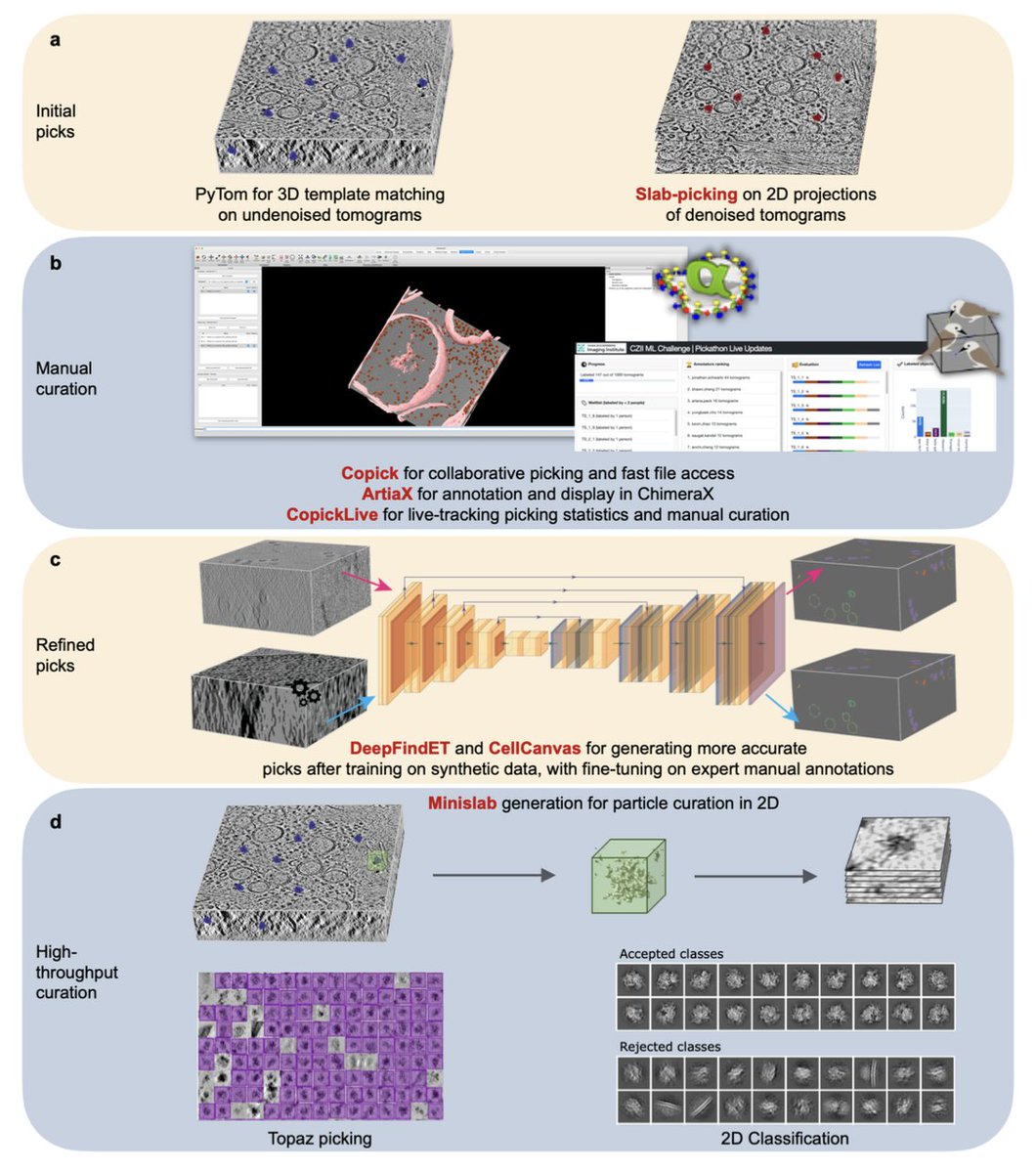
6. The study highlights several newly developed tools, including DenoisET, Copick, and DeepFindET, which enhance cryoET data processing and annotation. These tools were instrumental in curating the phantom dataset and are open to the community for further cryoET advancements.
7. The authors anticipate that this challenge will serve as the foundation for future contests, aiming to solve more complex annotation problems, such as distinguishing particles in crowded cellular environments and labeling membrane-bound proteins.
@kisharrington@bcarra2@DanielSerwas@emontabana@kimanius
📜Paper: https://t.co/pYKo0erYJO
#CryoET #MachineLearning #StructuralBiology #Bioinformatics #MLChallenge #ProteinAnnotation #CellBiology
CZII’s particle picking machine learning challenge is up and running. There are already 1000 signups on Kaggle. Follow this page for an introduction and links to all sorts of material and resources, including two preprints: https://t.co/sHiVdRNING
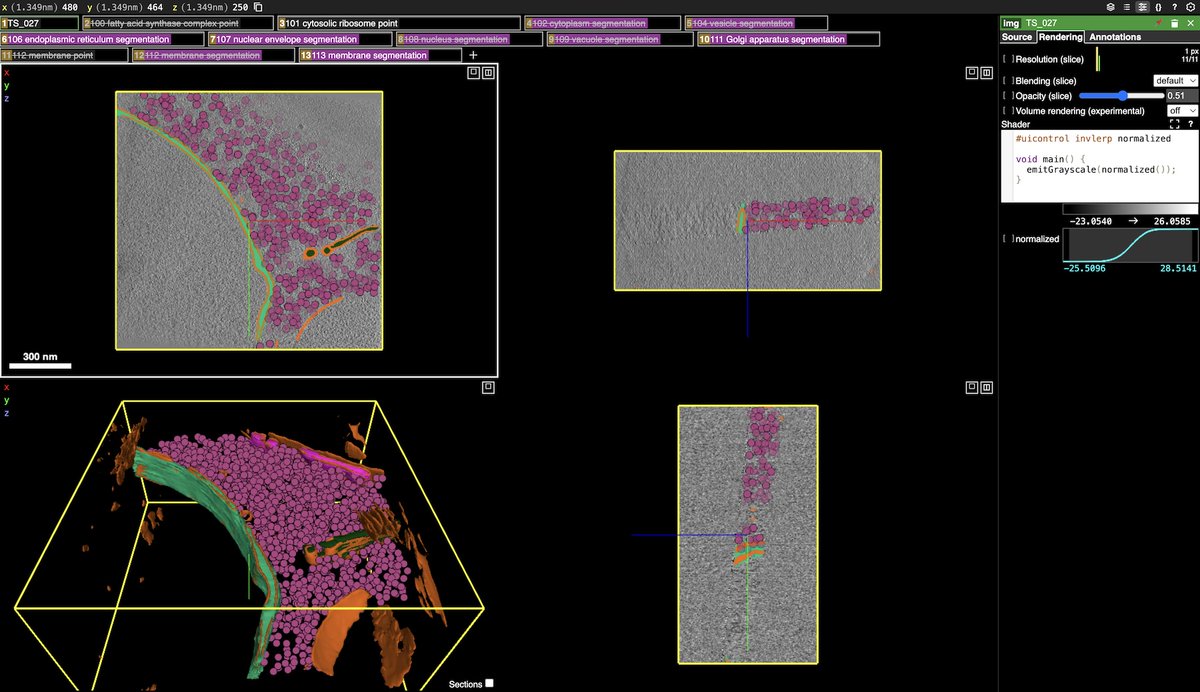
New activity on the Chan Zuckerberg Imaging Institute’s CryoET Data Portal https://t.co/RHrjnvjqWi ; segmentations can now be visualized in the browser for 15,000+ tomograms. We would love feedback https://t.co/H8I9GB65zM on how we can improve and expand.
Annotation is a significant bottleneck for deriving insights from #CryoET. By adapting @lorenzlamm + @bengeliscious’ deep-learning MemBrain algorithm, #CZImagingInstitute’s @ErmelUtz was able to annotate cell membranes from 13k+ tomograms in a few days https://t.co/on1WyjDsPt
Post-processing manual or automatic segmentation results is a frequent task for #TeamTomo. Mean curvature driven filters can be useful to fill in holes, remove noise and smooth the resulting surfaces, as discussed here by @Achilleas49er: https://t.co/PgskWLhcLR
@cryo2go Default low-pass for picking is 20 A.
Default limit for 2D classification is 6 A (set separately for alignment and reconstruction).
Default limit for ab initio reconstruction is 35 A->12 A.
@DTegunov @Achilleas49er It's not stated in the withdrawal notice, but reflected in the Author Information section accessible using the Info/History tab. As to why, I'm not sure.