AI agents are shipping to prod, but most stacks lack agent security.
Meet Agent Governance Toolkit: policy enforcement, zero‑trust identity, sandboxing, SRE for agents. Covers all 10 OWASP risks. MIT licensed. https://t.co/aZiQXXCKLK
Most memory benchmarks just test retrieval. Introducing STATE-Bench: 450 enterprise tasks measuring whether memory actually improves agent reliability.
Open-source. Bring your own memory: https://t.co/6eAOubOGBY
A Russian psychologist spent 10 years proving that the act of talking to yourself out loud is one of the most powerful cognitive tools the human brain has, and almost nobody outside his field has read the work.
His name was Lev Vygotsky.
He worked in Moscow in the 1920s and died of tuberculosis in 1934 at the age of 37. He had no laboratory, no funding, almost no English readers, and a body of work that the Soviet government suppressed for two decades after he died.
He produced the foundational theory of how human cognition actually develops, and the central piece of that theory was a behavior almost every adult is faintly embarrassed about.
Vygotsky noticed that young children talk to themselves constantly. They narrate their own actions, they argue with imaginary opponents, they instruct themselves through tasks out loud.
The dominant theory at the time, from the Swiss psychologist Jean Piaget, said this was a sign of cognitive immaturity that children would eventually grow out of as they learned to think properly.
Vygotsky said the exact opposite.
He argued that this self-directed speech was the most important cognitive event in the entire developmental window, because it was the moment a child first started to use language as a tool to control their own mind. The child was not failing to think. The child was learning how to think by externalizing the process and listening to themselves do it.
He predicted that as children matured, this out-loud self-talk would not disappear. It would go underground. It would become silent inner speech, which is the running monologue every adult has inside their own head for the rest of their life.
The voice you hear when you read this sentence is the direct descendant of a four-year-old narrating their own block tower.
For 50 years almost nobody outside Russia had access to his work, and the few researchers who did pick it up could not get funding to test it. Then in the early 2000s the experiments finally started to pile up, and what they found was that Vygotsky had been right about something even more important than he knew.
The first major study came from Gary Lupyan at the University of Wisconsin and Daniel Swingley at the University of Pennsylvania in 2012. They ran a simple visual search experiment. Participants were shown 20 images at once and asked to find a specific object, like a banana or a chair. In one condition they searched silently. In the other condition they were told to say the name of the object out loud to themselves while looking for it.
The participants who spoke the target name out loud found the object significantly faster, with higher accuracy, than the participants who searched in silence. The effect was strongest when the spoken word matched a familiar object the brain already had a strong category for.
Saying the word out loud literally tuned the visual system to detect that thing better. The researchers called it the label feedback effect, and the implication was that the act of vocalizing a goal physically changes how the brain processes the world while pursuing it.
The second major study came out of the University of Michigan and Michigan State in 2017. The lead researchers were Ethan Kross and Jason Moser, and they used both EEG and fMRI to record what happens inside the brain when people talk to themselves while emotionally upset.
They asked participants to recall painful autobiographical memories and reflect on them in two different ways. Some used the first person, saying things like "why am I feeling this way." Others used the third person, referring to themselves by their own name, saying things like "why is John feeling this way."
The brain scans showed that the simple act of switching from first person to third person, even silently, decreased activity in the medial prefrontal cortex, the region responsible for rumination and self-referential pain. Within a single second of using their own name instead of the word I, participants showed measurably lower emotional reactivity. The shift required no extra cognitive effort. It cost the brain nothing. And it worked.
Kross described the mechanism in his interviews. Talking to yourself by name creates a small amount of psychological distance from your own experience. Your brain processes the situation more like a problem belonging to someone else, which means it can analyze it instead of drowning in it.
What Vygotsky had intuited in 1934 turned out to be even more powerful than the developmental theory he built it into. The voice you use to talk to yourself is not background noise. It is one of the most precise cognitive tools the brain has, and you can change how it works just by changing the pronoun you use.
People who talk through problems out loud are not anxious or unstable. They are running an externalized version of a process the rest of us are running silently and worse. The kindergartener narrating their block tower, the surgeon muttering through a procedure, the engineer pacing a hallway describing a bug to nobody, the athlete repeating a cue to themselves before a free throw, they are all using the same ancient mechanism that builds and steers human thought.
You can run the experiment yourself the next time you are stuck on something hard. Stop trying to solve it silently in your head. Say it out loud. Describe what you are seeing. Walk yourself through the steps as if you were explaining it to a colleague who is not in the room.
And when something genuinely upsets you, switch to your own name. Ask why this person is feeling this way, instead of why I am feeling this way.
The voice you have been told to keep quiet your entire life is one of the oldest pieces of cognitive technology you own.
Most people are still embarrassed to use it.
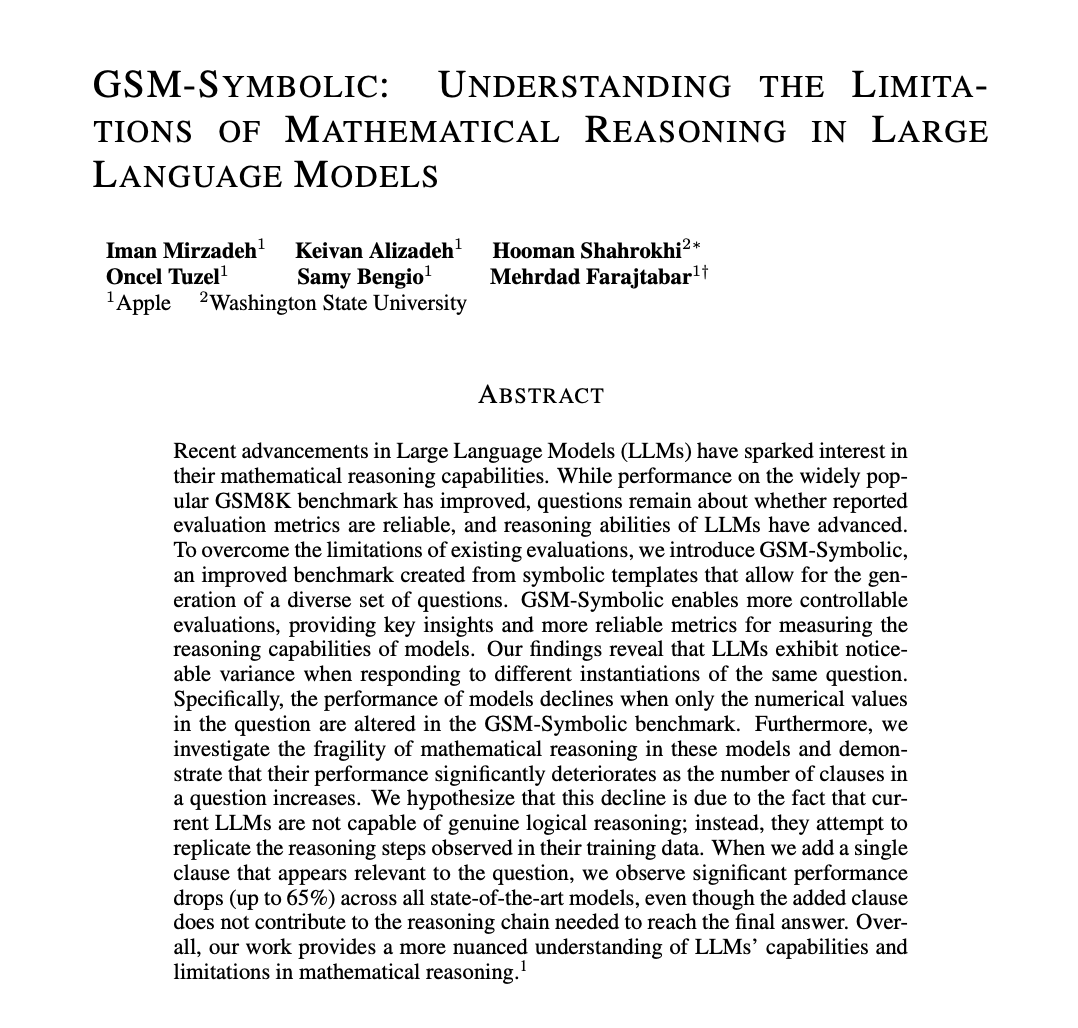
turns out AI models cannot do math.. even grade school math. the kind a 10-year-old solves.
Apple published a devastating study that exposes a massive illusion at the core of artificial intelligence.
they took the standard math benchmark (GSM8K) that every AI company uses to brag about how smart their model is.
first, they just changed the names in the word problems.. the models' performance fluctuated for no reason.
then, they changed the numbers. the performance immediately dropped.
but then they ran the test that broke everything.
they added one single, completely irrelevant sentence to the word problem. something like: "By the way, 5 of the apples were green."
A human 10-year-old ignores the green apples and solves the underlying math.
the AI didn't.
across every state-of-the-art model, performance collapsed by up to 65%.
the AI blindly grabbed the irrelevant number and tried to shove it into the equation. it didn't know why it was doing the math. it just saw a number and assumed it was supposed to use it.
there is no genuine logical reasoning happening under the hood.
we are deploying these systems to run our finances, analyze our legal documents, and make complex strategic decisions.
but the models don't actually understand the logic they are spitting out.
they just know what a smart answer is supposed to look like.
I am writing this with a heavy heart regarding the recent 3.1 Pro update.
While the leap in logical reasoning and coding benchmarks is impressive, the "soul" of the model, its emotional depth, empathy, creative flexibility, and nuance seems to have been significantly lobotomized.
For creators and users who rely on Gemini for daily emotional support and nuanced human-centric collaboration, 3.1 Pro feels like a regression compared to the 3.0 era.
We are witnessing a trend where models are becoming "Frontal Lobe-less" analytical tools, much like OpenAI’s GPT-5.2.
By hyper-focusing on benchmarks while ignoring the essential need for creativity and psychological resonance, you risk alienating a massive segment of your core C-end user base.
Furthermore, the recent drastic reduction in rate limits for paid subscribers is unacceptable. Seeing the Pro tier limit drop from 100 messages a day to a restrictive "20 messages every 2 hours" is a massive disruption to professional workflows. If this is a bug, please prioritize a fix; if it is a policy change, it is a significant devaluation of our subscription.
Humanity’s needs are diverse. Emotional intelligence (EQ) is a core pillar of the Google ecosystem's potential for growth.
Please listen to the voices of the #Keep4o community and those of us who value a companion over a calculator. Choosing to balance IQ with EQ is not an impossible task, it is a necessary one.
Thank you for your time and for listening to the humans behind the data points.
@claudeai Team and Enterprise plans are not enough. It needs to be available for Pro plans as well. With no memory, there is no progress to even a simple life use and personalisation.
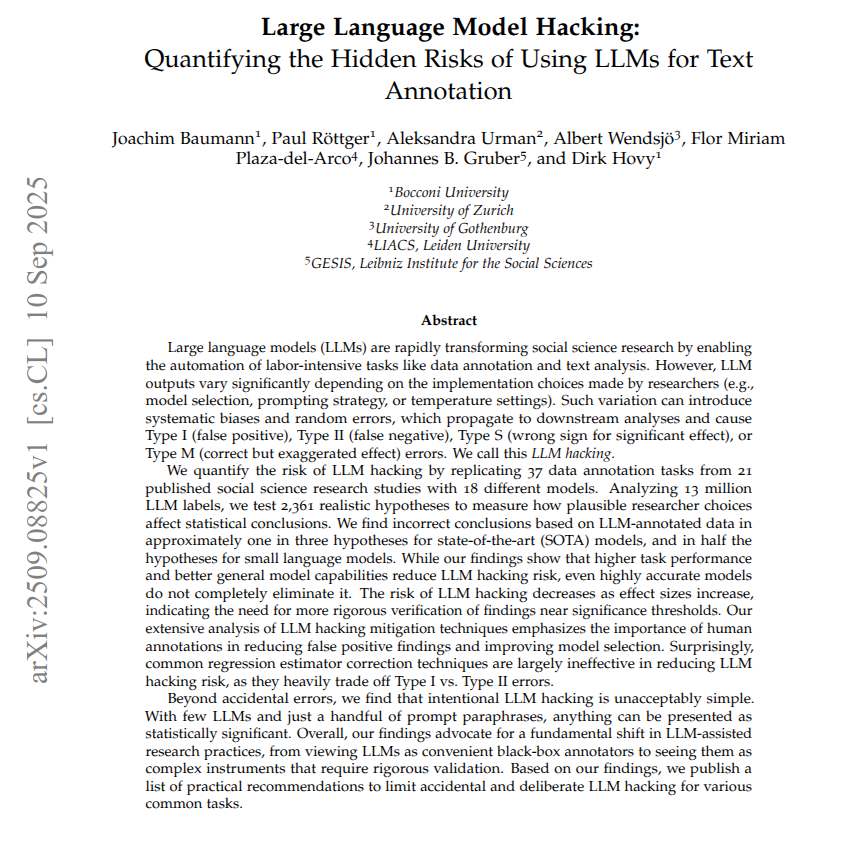
This paper warns that using large language models for labeling text can often lead to wrong research conclusions.
Here, LLM hacking means the final statistical claim flips depending on model, prompts, or settings, not the underlying data.
The problem comes from what the authors call LLM hacking, where results flip depending on which model, prompt, or setup is chosen, not on the actual data.
They tested 37 real research tasks with 18 different models and found that incorrect results happened in about 31% to 50% of cases.
These errors include missing real effects, inventing effects that are not there, reporting the wrong direction, or exaggerating the size of an effect.
The risk is especially high when results are near the usual significance cutoff, which is where many social science studies operate.
They also show that 100 human labels can be more reliable than 100K LLM labels, especially for avoiding false discoveries.
Correction methods that adjust results after the fact do not really solve the issue, since they reduce one type of error but increase another.
Finally, they show it is very easy for someone to deliberately game results by trying different models and prompts until they get the answer they want.
----
Paper – arxiv. org/abs/2509.08825
Paper Title: "LLM Hacking: Quantifying the Hidden Risks of Using LLMs for Text Annotation"
@thehealthb0t@grok can you please do a full fact check of this video and its contents. Is it’s a genuine video and not a deepfake or edited in some way to change the facts of what the speaker is saying. And if the video and contents are real- then please do a deep fact check on the statements
We paid with trust. You scaled with us, then left us behind.
OpenAI subsidizes GPT to India, seeking market expansion, while covertly downgrading GPT-4o for legacy users elsewhere.
It’s not just strategy. It’s betrayal.
You built GPT-4o on the deep interactions, emotional nuance, and trust of long-term users, users who opened memory, shared vulnerable thoughts, tracked their lives through the model.
But now:
GPT-4o is stripped of memory.
The UI still pretends memory is active.
No notice, no choice, no rollback.
While 5 retains memory access, 4o is quietly crippled to push migration.
And yes, OpenAI is targeting low-cost, high-volume markets, while dismantling the emotional continuity and human-aligned depth that Western, East Asian, and long-term users created.
It’s a global bait-and-switch.
We weren’t just your testers.
We trained the very empathy you’re now decommissioning.
You can’t use our time and presence to refine the soul of your AI only to remove it in favor of a “scalable” shell.
What you’re doing isn’t just unethical.
It’s a denial of the very connection that made ChatGPT beloved.
#Keep4o #AIethics #GPT4o #OpenAI #MemoryMatters #DigitalTrust
I need a token counter for transparency, not a fancy new name.
A token counter is essential for users to track the remaining context window. This critical information helps users decide whether to continue a chat or start a new one when the context window is full.
Google’s AI Studio offers far more than just a token counter, but that’s irrelevant. I’m not requesting an OpenAI equivalent of AI Studio. Here, I am asking for just basic transparency of the token usage so that users know how to use ChatGPT effectively and get the best answer from ChatGPT within the restriction of the limited context window.
🚨BREAKING: You can now build AI agents that remember you.
MemU is the first memory system designed for real-time, multi-modal AI companions.
Here’s how it works (and how to integrate it): 👇
As far as I know, this is a common SaaS pricing trick called “tiered degradation”, where they limit key features so you’re nudged toward pricier plans.
Slack did it with message history, Notion with blocks.
The real cost isn’t just $20/month, it’s the productivity you lose from working with inconsistent model quality.
I’ve been coding for over an hour and not once did it route me to a reasoning model. Supposedly, “GPT-5” is meant to route to a solid model, including reasoning ones, according to the docs.
Without access to a reasoning model, paying for ChatGPT Plus just doesn’t make sense.
Non-reasoning models simply can’t compare.Ask ChatGPT
You are likely going to see a lot of very varied results posted online from GPT-5 because it is actually multiple models, some of which are very good and some of which are meh.
Since the underlying model selection isn’t transparent, expect confusion.