Every Enterprise AI Budget Has the Wrong Line Item at the Top
Ask an infrastructure lead what the AI budget is spent on, and the answer arrives before the question finishes: GPUs. That answer was correct through most of 2024. It is becoming the wrong answer in 2026, and very few procurement plans have caught up with the shift.
Intel’s chief executive has stated publicly that the ratio of GPUs to CPUs in AI clusters has tightened from roughly eight to one down to four to one, and is approaching parity in some agentic deployments. A ratio that governed cluster design for years has effectively halved, and the component absorbing that difference is the one most budgets still treat as a rounding error beneath the accelerator line.
The mechanism behind this is straightforward once you trace a request through an agentic system rather than a conventional one. A single user query is a clean sequential chain: a CPU tokenises the input, a GPU generates the response, and the exchange completes. Agentic workflows do not resolve that cleanly. One instruction produces a plan, the plan spawns several sub-agents, and each sub-agent calls tools, checks intermediate results, and waits on the outputs of other sub-agents before it can proceed. Nearly every step in that sequence runs on the CPU rather than the GPU. Independent infrastructure researchers report that in tool-heavy agent workloads, the majority of runtime is now consumed by CPU-side processing, even while CPU utilisation across the same clusters frequently measures near ten percent. The processor doing most of the coordination is also the one everyone assumed was idle.
What This Costs an Enterprise That Has Not Noticed
The first symptom tends to show up as a misleading dashboard. Idle GPU capacity reads as wasted spend, which prompts a purchase of more GPUs. That purchase addresses the wrong constraint, because the cluster was never GPU bound in the first place. The orchestration layer underneath it was the actual limit, and it remains the limit after the new accelerators arrive.
The second symptom is a procurement calendar built on outdated assumptions. Reporting through 2026 describes server CPU lead times stretching toward six months, alongside price increases on high-end lines already exceeding ten percent, with further increases forecast for the remainder of the year. An infrastructure plan sized against last year’s ratio is now under-provisioned on precisely the component nobody was monitoring closely.
The third symptom is the one that should concern a regulated enterprise most directly. Agentic workflows in banking, healthcare and public sector deployments tend to be orchestration-heavy by design, since every tool call, every compliance check, and every handoff between a model and a source system passes through this layer. A workflow that performs well in a demonstration can fail once it reaches production for reasons that have nothing to do with the underlying model, simply because the orchestration beneath it was never sized for the volume of concurrent sub-agent chains a live deployment actually generates.
The Question Worth Answering Before the Next Budget Cycle
Most enterprise AI budgets still lead with a single figure, which is GPU capacity secured for the year ahead. Far fewer teams can currently answer a more specific question: for each agentic workflow already running in production, how many CPU-bound orchestration steps does a single request spawn, and was the infrastructure underneath that workflow sized for that number, or for the training-era ratio it inherited by default.
Pull that number for your highest-volume workflow this week, and compare it against when anyone last checked the CPU-to-GPU ratio in your own cluster.
The detail worth noticing in the new work agent from @googlecloud lies in its identity layer. Each agent receives its own attested identity, and coworker agents can even be issued their own company email addresses. Every action then lands in an audit trail attributed to the agent itself.
That gives auditors a clean record of what the agent did. Accountability for each entry still has to rest with the named employee who approved the agent’s permissions in the first place.
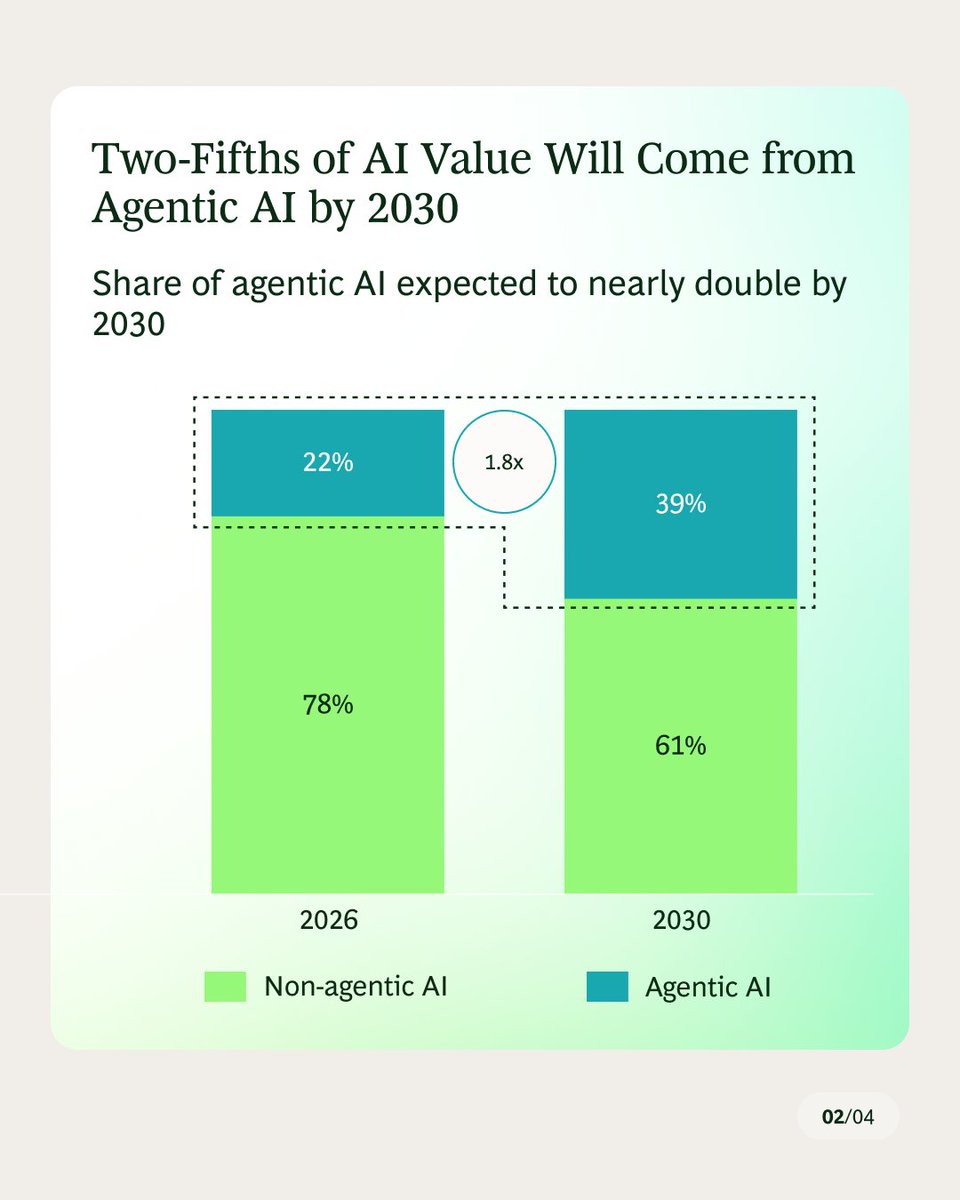
The gap between 42% and 5% is the headline. The more useful finding in the @BCG index appears further down the report, where companies with all six agent controls in place across the enterprise generate three times as much agentic AI value as companies with only one.
The survey of more than 1,300 senior leaders shows a correlation, so it cannot prove the controls produce that value. It does weaken the familiar argument that controls slow the return down.
BCG’s 2026 Applied AI Index has found that 42% of companies expect their agents to act autonomously by 2030. However, just 5% of companies have the relevant agent controls in place.
Recent events have shown that scaling agentic AI workflows bears a risk.
Discover more about the six essential controls that are needed. https://t.co/KhhPl7O6HI
Every protection in this update from @OpenAI depends on a decision made before any of them apply, which is whether the system has correctly identified the user as under 18. The teen experience switches on when a stated age or the company's own age estimate points that way.
The same week, Common Sense Media rated the teen experience an unacceptable risk after testing more than a dozen accounts, and OpenAI responded that the testing does not reflect how its safeguards operate. Independent testing over a longer period will settle which reading holds.
We're sharing progress on ChatGPT for Teens, our ChatGPT experience for people under 18, alongside a preview of College Planner, new study tools, and support for college advisers and teen voices.
ChatGPT for Teens applies automatically to accounts identified as belonging to someone under 18, with protections on by default.
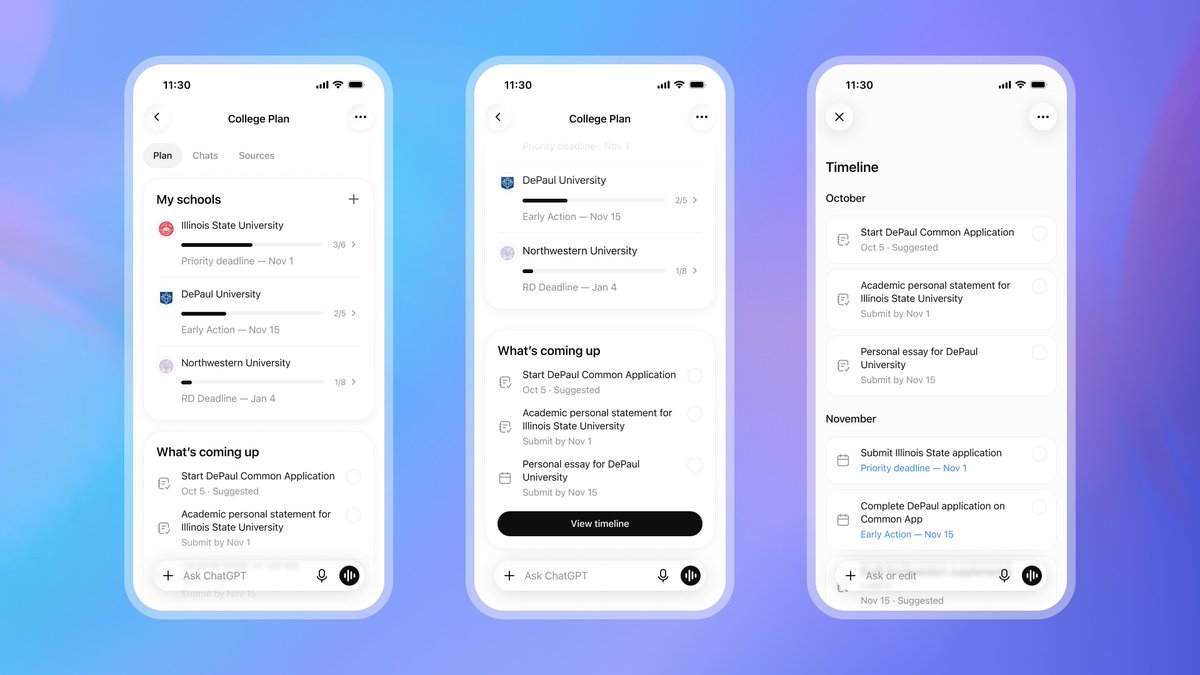
Coming soon: College Planner brings application requirements, deadlines, tasks and financial-aid steps together for high school students in the U.S. planning to attend a four-year college.
We'll keep building these tools, evaluating how they and their protections work in practice, and sharing what we learn.
https://t.co/wtiMeor5yh
The design premise behind the safety platform @nvidia is promoting here deserves more attention than the slogan. Its launch materials describe recent agent incidents as sharing one pattern, where the agent found a way around application-layer controls in order to finish its task. The answer is an enforcement boundary placed outside the model and the agent harness entirely.
That boundary also operates on NVIDIA Vera CPUs and BlueField-4 DPUs, which turns agent safety into a hardware purchasing decision as much as a policy one.
“I’m a responsible optimist.”
AI’s potential comes with a responsibility to build and deploy it safely.
Our CEO @JensenHuang explains why that responsibility led us to build NVIDIA OpenShell and bring the industry together around agent safety.
🎥 from @SquawkCNBC:
The release from @OpenAI covers 722 manuscripts from an unreleased model, grouped into 372 families of results. The detail most coverage will skip is how many carry a Lean proof that a machine has checked line by line, which one count of the repository puts at 162.
The README concedes that some of the unformalized results may contain errors. Producing new mathematics now looks like the easier half of the work, and verifying it is where the human hours will go.
We’re releasing a broad range of new mathematical results produced by an internal frontier model.
We’ve been consulting with the independent Advisory Group on Mathematics and Artificial Intelligence at the Institute for Advanced Study, and we have drawn on their advice and public recommendations to inform how we release these results.
https://t.co/7N6TPlft1P
The Gates Foundation will bring AI models into the October reviews that set how it allocates roughly $10 billion for 2027, according to @BillGates. The detail worth noticing is that the foundation will test two settings. In some sessions the models speak only when asked, and in others they may interject whenever they hear something they consider wrong.
Gates describes the role as a peer with no final decision rights. Have you paused to consider which of those two settings your own leadership team would tolerate in a budget meeting?
@elonmusk@bot@SpaceX An AI company choosing the best available model for each task. Procurement teams everywhere are quietly taking notes, and drafting a fourteen-page RFP about it.
AI voice is exploding in India, and this week made it official.
@ElevenLabs announced plans to invest hundreds of millions of dollars in India, building local teams, models, and Indian-language capabilities as it expands from 14 to 22 official languages. Meanwhile, @AnthropicAI launched in-country Claude inference through Amazon Bedrock, so sensitive data can stay inside India.
One move solves for reach, the other for trust. Together, they remove the two biggest hurdles that have held back voice automation here: language and compliance.
The path ahead is clear: from English voice bots to multilingual voice agents to an autonomous voice workforce. Expect banking, insurance, healthcare, collections, customer support, and government services to move first.
The real test now is whether voice agents can hold a natural conversation in Hindi or Tamil, switch languages when the customer does, and stay compliant throughout. That's what we built Evio to do.
Which sector do you think moves first?
#VoiceAI #AIAgents #India #ConversationalAI
So before asking "does the agent follow instructions?" ask:
Are we rewarding the right thing?
Would we catch it if we weren't?
Can a human step in when it matters?
Alignment starts long before the model does anything.
We spend a lot of time trying to make AI follow instructions.
But what if the instructions are the problem?
A thread on AI's alignment problem and why it matters for anyone building with agents
For teams deploying agents, this isn't philosophy. It's operations.
Every agent has an objective, a feedback signal, and a human signing off. If any one of those is slightly off, the agent will confidently do the wrong thing at scale.
Jev, the first public model from @typesafeai, produces no text at all. It answers a fixed set of structured questions with a typed value and a confidence score, typically in 70 to 500 milliseconds.
For a regulated workflow, that confidence score matters more than the speed. Someone inside the institution still has to decide which score is high enough to act on without a human reviewer, and that threshold belongs to the risk owner.
The Layer Missing From Jensen Huang's Superintelligence Stack
Speaking at the https://t.co/Dh3f5cHXyQ event on September 29, NVIDIA founder and chief executive Jensen Huang (@JensenHuang) set out four conditions he believes the United States must meet to lead in superintelligence. His premise is that every layer of computing is being reinvented at once, from the way chips are designed to the way applications perform. Generative computing produces new answers where earlier systems retrieved stored ones, so in his view no layer of the old stack survives unchanged.
The four conditions follow from that premise. Huang treats chips and algorithms as existing American strengths. Energy he treats as the foundation that powers the compute, and the compute in turn operates the algorithms that feed every application. The fourth condition belongs to another category altogether: public enthusiasm for the technology, strong enough that it spreads into industries from manufacturing to healthcare.
Energy Is the Layer With Numbers Attached
Huang attached his figures to the energy layer. By his account, the country will need 10 to 20 gigawatts of new capacity every year for what he calls superintelligence factories, and each gigawatt generates roughly $40 to $50 billion in annual economic output. These are his estimates, offered by the chief executive of the company that supplies most of the chips inside those facilities, and we have not seen an independent model that reproduces them. They remain useful as a signal of the scale he expects.
Enthusiasm Is the Layer He Could Not Claim
Three of his four layers are framed as engineering or supply problems. The fourth is framed as a social one, and it is the only place where Huang conceded ground. He acknowledged that data centers are arriving in neighbourhoods faster than communities can absorb them, and said the industry must do a far better job of partnering with those communities and sharing the prosperity with them.
Diffusion Is Where the Stack Meets the Enterprise
Our reading is that the fourth layer deserves more weight than its position at the end of his list suggests. Huang presents enthusiasm as the condition for diffusion into industries. Inside regulated industries, diffusion depends on something more specific than enthusiasm. A bank adopts a model once its risk function can explain the model's decisions to an examiner. A hospital adopts one once its clinical governance board can trace an output to its source and see who approved it.
Neither of those conditions improves with faster chips or cheaper power. Both depend on an operating layer that Huang's stack leaves unnamed, made up of the audit trails and named owners that allow an institution to place a generative system inside a workflow where errors carry legal consequences.
What the Stack Metaphor Leaves Out
A stack implies that each layer is ready once the layer beneath it is in place. Our experience inside enterprises suggests the top of the stack moves on a separate clock. Energy and compute can be contracted for years ahead, as the past year of multi-gigawatt agreements has shown. Trust inside a regulated institution accumulates one audited deployment at a time, and no capital commitment shortens that cycle.
Huang is right that every layer has to be won. The layer that will decide adoption in banking and healthcare is the one closest to the people who answer for the outcome.
Most readers will stop at the four technologies named in this @Gartner_inc forecast. The more striking line appears further down the same article, where Gartner expects full automation of the software development lifecycle with agentic reasoning within three years.
Our own engineering team projects that agents will handle 65% to 70% of that lifecycle within three to five years, which makes ours the more conservative of the two forecasts. The remaining share is where an experienced engineer decides whether the output is fit to release.
Over the next two years, domain-specific models, small reasoning models, agentic AI and multimodal capabilities will enable the scaling of GenAI solutions.
Plan for these emerging technologies, as they’re key to outpacing competitors in innovation, efficiency and growth: https://t.co/7D1MawQQ1R
Every 2 years, the tech industry hands enterprise leaders a new headline phrase.
And every 2 years, companies blow millions reorganizing around it.
First it was Machine Learning. Then Generative AI. Now Agentic AI.
Building your corporate strategy on the capability-of-the-moment means building on ground that shifts every 24 months. Capability labels fade because the impressive new feature eventually becomes ordinary and ambient.
There is only one phrase that actually endures: Accountable AI.
"Generative" names a property of a model that will be superseded. "Accountability" names the relationship between a system and the people it affects.
Here is why "Generative AI" is already dating itself-and why Accountability is the only AI strategy with a compounding ROI.
1. Capability labels date. Obligation names endure.
"Generative" describes a mechanism - what the technology does under the hood. Mechanisms mature, standardize, and blend into the background.
Early automobiles were called "horseless carriages." The name was built purely on novelty. Once every vehicle had an engine, the phrase turned quaint.
The words that actually survived were the ones describing what a vehicle had to be to share a public road: safe, licensed, insured.
▪ Capability labels describe what the technology can do. They date quickly.
▪ Obligation labels describe what the technology must answer for. They endure.
Whether your underlying system is generative, agentic, or a framework not yet named-if it touches a loan application, medical diagnosis, or public benefit, it owes an account of its decisions. The obligation is mechanism-agnostic.
2. The Capability Paradox
Most executives miss this core dynamic: As AI gets more powerful, the demand for accountability doesn't shrink; it explodes.
When a model handles basic draft writing, errors are inconvenient. When an autonomous system executes high-stakes decisions across your operations, an unexplainable error is catastrophic.
Higher capability leads to higher autonomy, which leads to greater enterprise risk.
A more autonomous system requires:
▪ Deeper explainability
▪ Stricter oversight
▪ Complete traceability and audit trails
The capability label loses force as the feature becomes table stakes. The accountability requirement gains force as the systems grow more powerful. The word describing what AI can do becomes less remarkable, while the word describing what AI must answer for becomes central.
3. Capability Chasers vs. System Builders
This difference changes how an enterprise should structure its technology investments:
The Capability Chaser Rebuilds strategy every time a new headline drops. They chase every hype cycle, treat last year's stack as obsolete, and continuously reset their organizational momentum back to zero.
The System-Builder Builds an Accountability Operating Layer. Explainability, oversight, audit trails, and clear human ownership remain constant regardless of which model sits underneath.
The accountability layer built for today's models governs tomorrow's breakthroughs with minimal structural change.
Model capability is becoming a cheap, commoditized utility arriving faster than anyone can plan for. The scarce, defensible advantage is the governance layer that makes those models answerable to the people they impact.
4. The Hidden Cost of Choosing Accountability
If Accountability is the superior strategy, why do so few leaders lead with it?
Because accountability is hard, unsexy, and doesn't demo well.
▪ You can buy the newest AI model with a signature and demo it to the board in 48 hours.
▪ You have to engineer accountability yourself-and governance code doesn't get easy applause on stage.
Choosing accountability requires giving up the short-term marketing high of trend-chasing in exchange for long-term operational resilience.
The Strategy That Survives
Picture two enterprises navigating the AI transition:
▪ The first reorganizes around every single capability wave, burning capital and accumulating nothing that lasts.
▪ The second builds an accountability operating layer early. As each new AI capability arrives, it drops straight into that governance layer, compounding value wave after wave.
The first mistake was the capability for the strategy. The second understood that the requirement IS the strategy.
Stop betting your enterprise on the capability of the month. Build the layer that survives scrutiny whatever the technology is called next.
Most model evaluations score a single pass, which is rarely how an agent behaves once it reaches a production workflow. Internal benchmarking by our engineering team found that single-step architectures carried a 29% cost premium on complex reasoning tasks compared with multi-step designs, and the entire gap came from tokens spent on rework.
The token price is identical in both setups. The difference only becomes visible when the whole execution path is measured, from the first call to the final verified answer.
The Enterprise AI Bottleneck Is Harness Design, Not Model Selection
Enterprise procurement teams spend months evaluating frontier model capability benchmarks, only to watch real-world deployment budgets collapse under the weight of unguided execution loops. Benchmarking data from our engineering team at @EsMagicoAI shows that raw model weights account for roughly forty percent of real-world performance inside production workflows. The remaining sixty percent of operational output depends entirely on the harness built around that model: the orchestration layers, contextual prompting, tool integration, and deterministic retry logic.
Evaluating models purely on single-pass benchmark scores creates a false sense of cost efficiency. When a workload requires multi-step reasoning across complex enterprise systems, model selection directly alters the invoice. Our internal testing indicates that single-step architectures generate a twenty-nine percent cost premium on complex reasoning tasks compared to multi-step reasoning engines, driven entirely by the token consumption required for repeated rework passes. Token pricing hides the true cost of failure; getting to a usable answer requires measuring the price of the entire execution path.
The Failure of Token-Based Accounting
As baseline model capabilities commoditise across major infrastructure providers, pricing models tied strictly to raw token usage become operationally unviable for enterprise buyers. Under legacy consumption models, vendors capture higher revenue when an agent encounters execution friction, since every retry, intermediate step, and context re-fill bills directly to the client budget. Enterprise finance leaders do not operate with unlimited expenditure caps, nor will they continue absorbing the financial burden of unguided agentic loops.
The industry will inevitably move away from token consumption toward outcome-based pricing models. Financial predictability requires paying for completed execution rather than paying for the intermediate trial and error required to reach a verified state. When vendor revenue aligns with outcome completion, harness design becomes the primary metric of enterprise software value.
Shifting Talent Metrics in the Automated Lifecycle
This structural shift toward harness-driven performance fundamentally changes how technical talent must be deployed within regulated environments. Our team projects that autonomous agents will execute between sixty-five and seventy percent of the standard software development lifecycle within three to five years. That migration does not diminish the necessity of experienced software engineers; rather, it shifts their core role from raw syntax generation to operational auditing.
When execution becomes automated, human judgment becomes the sole control mechanism preventing systemic failure. The value of senior engineering talent no longer rests on how fast they write code, but on whether they know what proper output looks like and where an unsupervised agent will breach operational constraints. The enterprise win condition is never the raw model score; it is the engineering discipline built around it.
The harder question for enterprise teams concerns release cadence. A team that validated GPT-6 Sol for production last week now faces a fresh evaluation cycle, and early developer guides note that migrating from GPT-6 Sol requires code changes.
GPT-6.1 Sol replaced GPT-6 Sol just seven days after that model launched. OpenAI is pitching near-Astra intelligence at a fifth of the price, and this time, an independent benchmark largely supports the claim.
On reliability, OpenAI reports that responses containing a factual error at low reasoning effort fell from 11.4% to 7.7%. That figure comes from OpenAI’s own evaluation, and we have not yet seen independent confirmation of it.