Back after a long break.
We’re publishing The Sidecar Report: public equities run by aligned owner-operators.
First idea below. More to come.
https://t.co/EtDPgIO00x
[Sidecar Idea #1] $FRPH
- Baker family runs it; insiders own 24%
- DC apartments/industrial projects obscure a high-margin quarry royalty
- Currently ~78% of our NAV (10/16 close)
- Our value for the other assets implies ~11x royalty NOI
- $369m cap, trades ~$2m/day
Chris Hohn is buying rocks and everyone is too busy chasing AI to notice.
TCI's latest 13F, filed in August: a brand new $758M position in $MLM and $722M in $VMC. Fresh money, not adds.
The pricing power is structural. Local monopolies on permitted reserves, freight economics that wall off imports, and a product every road, data center, LNG terminal and power project needs. Vulcan printed mix adjusted pricing up 5% last quarter with aggregates cash gross profit per ton over $12. Martin Marietta is running plus 4% with midyear increases still flowing.
The margin story is a catch up on delay. Two years of diesel and energy inflation masked the compounding underneath. VMC posted $654M of EBITDA while eating a $40M fuel headwind. Price locks in every January and again at midyear while costs reset daily. When the fuel drag fades, the margin expansion shows up late. That lag is the setup.
$MLM's Lhoist deal is the sleeper. $13.5B for the national lime leader: 2 billion tons of reserves, over 200 years of reserve life, and industrial demand from steel, environmental and chemical markets that doesn't cycle with housing. Accretive to earnings and margins in year one. Lime prices like aggregates, but almost nobody models it yet.
The residential bear case is the gift. The affordability trough has private volumes dead, which keeps these cheap, while both footprints sit squarely on data center, power and LNG corridors. A housing reset is upside, not risk.
Hohn doesn't trade stories. He owns franchises for a decade at a time. And right now he's buying rocks.
[Sidecar Idea #1] $FRPH
- Baker family runs it; insiders own 24%
- DC apartments/industrial projects obscure a high-margin quarry royalty
- Currently ~78% of our NAV (10/16 close)
- Our value for the other assets implies ~11x royalty NOI
- $369m cap, trades ~$2m/day
Back after a long break.
We’re publishing The Sidecar Report: public equities run by aligned owner-operators.
First idea below. More to come.
https://t.co/EtDPgIO00x
21/ Musings on $OTCM:
- High-quality business that has consistently grown revenue, earnings, FCF
- ~30% FCF margins, ~60% ROIC, 14.4x EV/FCF
- Operates as a quasi-monopoly and benefits from network effects, scalability, and embedded optionality
- Insiders own 42% of the company
Wrote up $CLPR recently:
- NYC multi-family REIT trading at ~30-70% of NAV
- CLPR's properties are 95% leased and rents are still rising
- As you wait for the discount to close, you can snack on a 4% yield
- Management is aligned and own 40% of the stock
https://t.co/xcPYfT3SXp
20a/ Marc Rubinstein’s @MarcRuby piece is a fantastic read:
“Stock exchanges are fascinating businesses… Like other network businesses, they tend towards monopoly and are in a constant dance with regulators over their competitive positioning.”
https://t.co/kFXnSNczTi
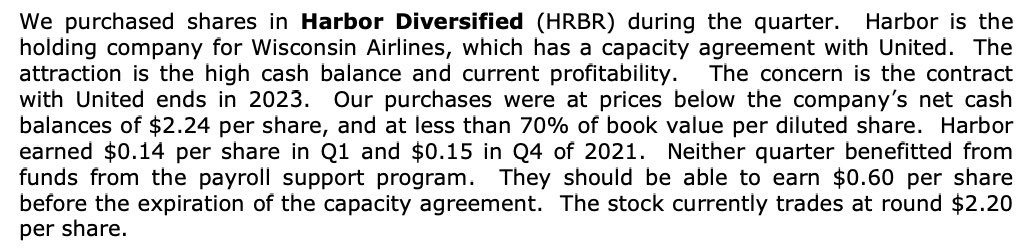
Cedar Creek's @eriksen_tim Q2 2022 Letter contains a short blurb on $HRBR:
“Our purchases were at prices below the company’s net cash balances of $2.24 per share, and at less than 70% of book value per diluted share.“
Letter Link: https://t.co/OxAtO6XGSI
17/ Thoughts on $HRBR:
- Trading around liquidation value
- Shareholders essentially own a free call option that expires in February ’23 that could help re-rate the stock price
- Insiders own ~51% and the company has been repurchasing shares at prices above the current price
4a/ Had written up $TXG before when it was at ~$170 / share.
High valuations (58x P/S, 23x P/B), heavy insider selling, small market position, unknown litigation risks and an exciting new field all pointed to one thing: an overpriced stock that risked permanent loss of capital.
Creating a thread for the stocks that I would currently avoid.
As much as investing is about knowing what to invest in, it is also about knowing what not to invest in.
“All I want to know is where I’m going to die, so I’ll never go there.” — Charlie Munger
4/ Thoughts on $TXG 🚩
- Life sciences co trading at 8x P/S, 4.9x P/B (had compressed from a P/S of 58x, P/B of 23x)
- Has never been profitable, expects to incur losses in the future
- Insiders are consistent sellers over the years; from $70 up to $200 and back down to $50
I've noticed that a lot of investors tend to "graduate" to increasing levels of abstraction and meta-games as they gain more experience, and get further and further away from just a simple analysis of a business and valuation. Why is simplicity frowned upon in this business?