The older I get, the more I realize that showing up is the key to life.
It sounds so simple, but it's surprisingly rare. Because it's easy to do when you're getting patted on the back for it. It's easy when the rewards feel certain. It's easy when the progress is clear.
But most people stop when it's none of those things. Few have the courage to keep showing up through the valley.
So, if you want to win, just show up. Show up when it’s hard. Show up when no one’s watching. Show up when you don't feel like it. Show up when the rewards are uncertain.
Show up.
Never bet against the person who just keeps showing up.
Designing for trust.
When I asked dozens of data leaders how accurate their AI tools were, the answers ranged from 30% to 85%.
That’s the Achilles heel of LLMs: they don’t know what they don't know. They speak with all the clarity and confidence of a sales rep in a polished blazer, while making dozens of common assumptions behind the scenes without ever flagging them as assumptions.
For some use cases (like coding) you can tell instantly: if the app does what you wanted, it works. For data, judging the quality the output does not work. The query runs, a number comes back, and how can you tell which of 25.5% or 40.5% is the lie?
That’s why I’m obsessed with how to design for trust. At Sundial we spend a disproportionate amount of time thinking about how to signal what a high-quality answer looks like, and what factors contribute. Vetted metrics from your most-used dashboards? High trust. Random SQL written on a table that only 2 people used in the past quarter? Maybe take that with a grain of salt.
Humans are fine-tuned for trust with other humans. We read it off a hundred signals: track record, tone, hedging, who someone trained under, whether their last claim held up. AI hands you a confident sentence in a chat box and asks you to figure out the rest.
There’s a lot of sexy parts of AI building (the speed! The translation magic! The viral demos!) There's a lot of unsexy stuff too: observability, audit trails, structured data. The signals that tell a human when to trust an answer and when to push back. But in operationalizing AI, these elements are what separates a technology from a lived-in tool.
In 2021, make sure you become a creator and a builder.
It ain't gotta even be an income source, but try to put something into the world rather than take.
Produce something rather than just consume. It'll change your life.
Everyone has an opinion on design.
There's always an immediate gut reaction: "Ooh, I love this!" or "Meh."
But how do you go beyond that to honing your skills of giving helpful, actionable feedback?
Here are the 7 questions I run through when critiquing a product's design
1) What is the user journey to get here?
You can’t furnish a room if you don’t know how someone lives.
So learn the context: Who is the user? When do they use this product? Why? How did they arrive here, and what's on their mind?
Don't critique unless you know this.
2) What do we want users to feel and achieve here?
“If you don’t know where you’re going, you’ll end up someplace else.”
Let’s understand what a successful outcome looks like before we start lobbing feedback about the design.
3) How important is this page/experience?
In a perfect world, we make everything perfect.
In the real world, let's spend more collective energy on the stuff that really matters. More eyeballs? More high-stakes? = more thorough inspection of every detail.
4) What is our scope/timeline/team?
If speed is critical, let’s get the greatest bang for the least effort. If we have more time and people, then let's remove constraints (#7) and dream bigger. The "best" design differs according to the time/people/money you have.
5) For every proposed design change, am I confident it is better that what currently exists?
If no:
a) cut it
b) iterate on / improve the design
c) get more user feedback
d) A/B test it
6) What can we remove from this experience and have it work just as well?
When faced with a problem, we bias toward adding stuff to solve it rather than removing. So gut check if it's necessary.
7) If we could throw all our constraints away, would we still design it like this?
While we can't typically throw all constraints away (see #4), it's still worthwhile to ask because we accept some things as constraints (due to legacy, etc) when they really aren't.
6) What can we remove from this experience and have it work just as well?
When faced with a problem, we bias toward adding stuff to solve it rather than removing. So gut check if it's necessary.
https://t.co/tj645yXhyU
6/7
Product Thinking -- Why it matters, what it is, what it isn't, and how you improve your skills.
aka: "Look Ma, I wrote an article instead of a tweet thread!"
https://t.co/maB0JrDJyr
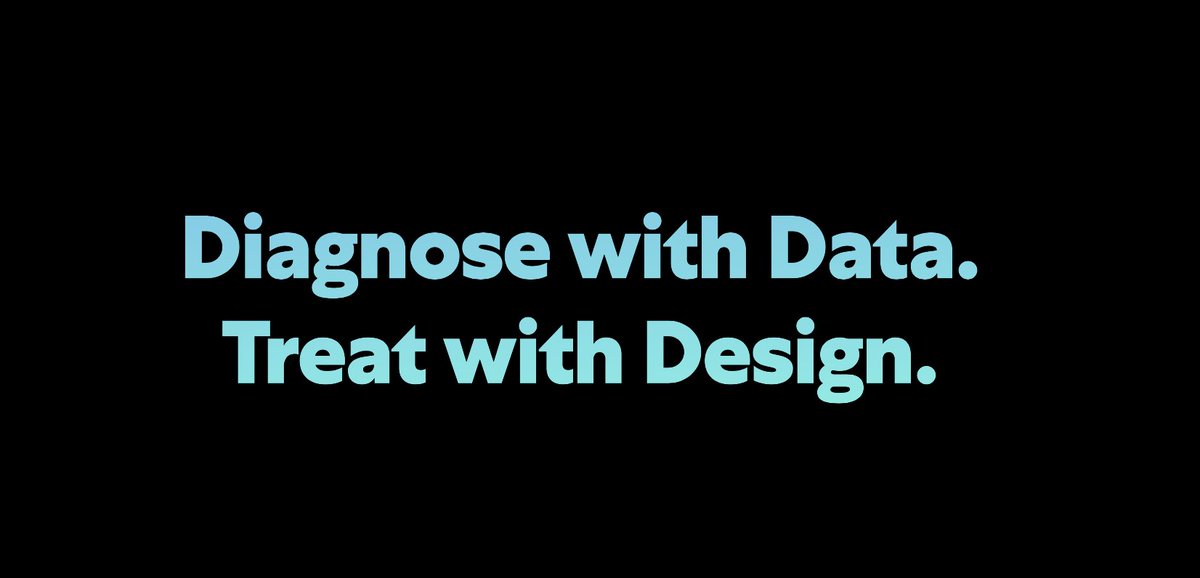
My co-founder Chandra Narayanan's quote has become something of a product-builder's mantra for us: Diagnose with data and treat with design.
There is so much packed into those sentences! Thread going deeper 👇 (1/15)
“When thinking in products, UX designers should be able to answer the following questions first: What problem do we solve? (User problem). For whom are we doing this? (Target audience). Why are we doing this? (Vision).” — @JAF_Designer https://t.co/bPaUkSDtVR
Great designers are strong at "product thinking." This is a key aspect of many design interviews, as well as many PM or VC ones.
But what exactly is product thinking? And how does one get good at it?
Thread below 👇
“There’s an interesting article on ‘Why product thinking is the next big thing in UX design’ by Nikkel Blasse. In this article, Nikkel talks about the importance of thinking in products and not in features.” — @narenkatakam https://t.co/2aqbs7LaEO
I’M TRYING TO GO TO SPACE & you can help me get there!
If you retweet this video, I’ll print your name on a shirt and wear it in space in your honor ☄️
#inspiration4contest#sendsimonetospace
https://t.co/SvPEQzHmYK
@david_perell@noampomsky It is the unfortunate reality of the system which forces people to choose their careers based on safety and money rather than passion and meaning. Only a few have the luck, courage and perseverance to get out of this rut (or not get into it in the first place).