Nando Reis, Marcelo Adnet, Fábio Porchat, Felipe Neto, Anitta... Parece que todo mundo resolveu que esse negócio de falar de política é besteira, depois que o Lula criou 56 impostos, o filho dele roubou bilhões do INSS, a gasolina foi pra 7 reais, tem sigilo de 100 anos até pra compra da Janja no shopping e o pobre não come mais carne.
Besteira ficar discutindo isso, né pessoal?
Você comprou uma UTI voadora de R$ 61,3 milhões pra salvar vidas.
Eles arrancaram os equipamentos médicos e a transformaram em jatinho VIP.
O que sobrou pros pacientes? A conta.
A Cultura Woke funciona assim: inventa um problema que não existe e impõe uma solução que ninguém precisa 🤡
O sociólogo Antônio Risério está certo em se indignar!
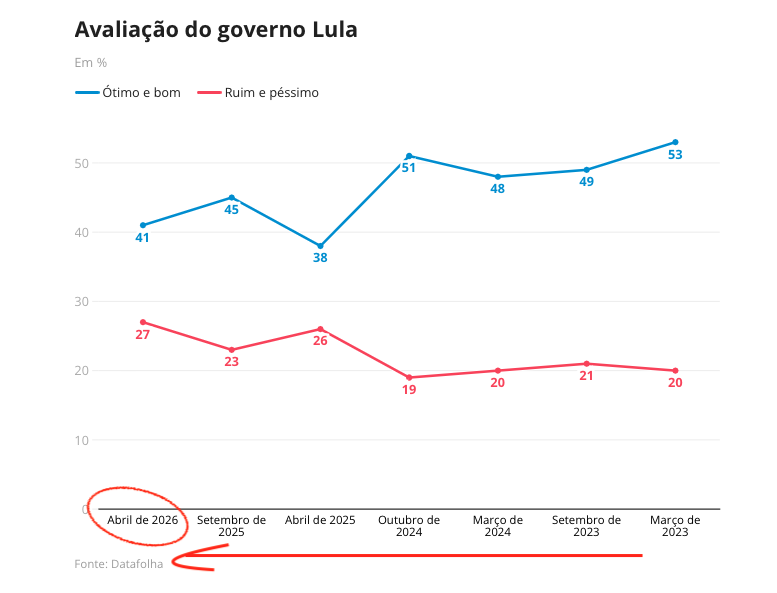
O @JornalOGlobo cometeu um crime hediondo de infografia. Um não, dois.
Criaram uma série histórica na qual o tempo corre para trás - para ser lido da direita pra esquerda, o que ninguém faz. Ou seja, desinforma.
Para coroar, os intervalos entre as medições (que não são constantes) aparecem como iguais no gráfico. Ou seja, o eixo X tem uma escala fantasiosa.
Obrigado @UnJourSansFinCH pela dica.
I concluded my Henry Family lecture at the University of Miami last Thursday by saying:
“Two things are important right now in life: deep learning and fertility. Everything else is noise.”
We are only starting to glimpse what these two forces will do to global life over the next fifty years. And they interact: deep learning will reshape demographics, and demographic collapse will reshape automation.
Nearly all my posts on X (except some parochial commentary on Spanish economic policy) revolve around these two facts. So does most of my current research. Even work that does not seem directly connected turns out to be, once you look carefully.
My papers on geoeconomics and international macro are about figuring out some of the consequences of deep learning and fertility. For example, my work on China focuses on its abysmal demographic future and how the U.S. is positioning itself (rightly or wrongly) to address it.
And my work on political polarization and the welfare state is about the consequences of decades of low fertility in Western Europe. When people talk about political change in Western Europe, they are talking about low fertility, whether they know it or not. It is not clear that modern representative democracy can survive sustained fertility rates of 1.3. I do not say that with glee.
The reason I decided to spend my life on academic work in economics is that I realized, when I was much younger, that daily events are irrelevant. The things that concern the media and 99 percent of commentary on X are largely irrelevant. One political party does better or worse in the next electoral cycle because of internal fights or a good campaign. At a fundamental level, none of it matters: the political outcome 25 years from now will not depend on those accidents. As Alexander Gerschenkron said, Clio is not a tidy housewife. The rise of any political movement is always full of advances and retreats. Social change waxes and wanes.
But at the end of the day, as my favorite historian Fernand Braudel put it:
“The events of history are merely surface disturbances, crests of foam that the tides of history carry on their strong backs.”
or in the much better original:
“Les événements de l’histoire ne sont que des agitations de surface, des crêtes d’écume que les marées de l’histoire portent sur leur dos puissant.”
The tides of history today are deep learning and fertility.
O legado de Hans Rosling, mesmo depois de falecido, continua vivo.
Os indicadores socioeconômicos do mundo estão melhorando - para desespero de populistas e enganadores de ambos os lados.