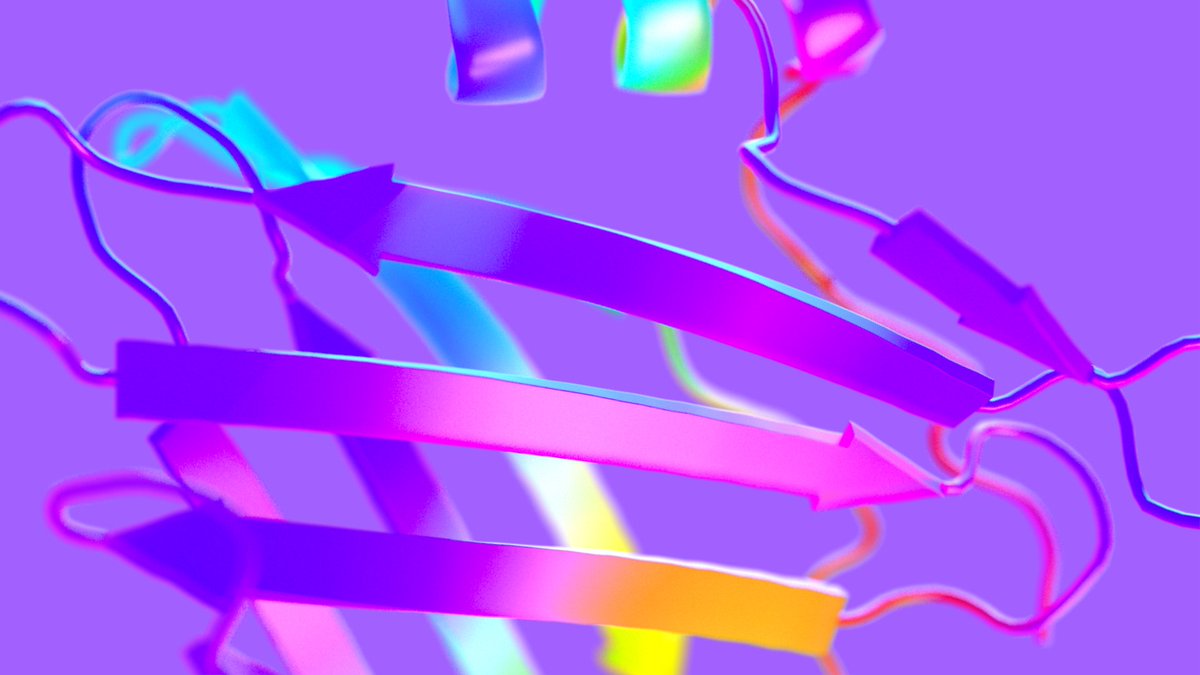
My team at Deepmind (protein design) is hiring an experimentalist with enzyme expertise. Please RT and/or apply! I'm happy to answer any questions as well. https://t.co/2acSQJX4At
I had an incredible time chatting with @Avsecz, a brilliant mind at @GoogleDeepMind, for our https://t.co/M7iDpX7VxM Scientist Spotlight series.
https://t.co/EB1XT9irqn
New scRNA-seq analysis platform from Arthur Radley
Branching topology of the human embryo transcriptome revealed by entropy sort feature weighting https://t.co/TN0IqFRrXf
We seek a Research Fellow in Computational Biology to join our team at the @unisouthampton . I would be happy to chat with anyone interested in the position about the role, project, or environment we create for you to work in. https://t.co/okONLxYX0m
We're hiring a research scientist to join our Quantum Chemistry and Materials team ⚛️🚨
The team is working on using machine learning to better our understanding of the universe, down at the level of quantum physics.
See: https://t.co/Rb34sXBFWT
Share: https://t.co/A2UkPfeS2A
Proud to see the work of an excellent PhD student, Arthur Radley, now published in @stemcellreports - a cool method to do feature selection in single cell data mitigating noise https://t.co/6o6eZdEhaP Work together with Austin Smith, Elena Corujo-Simon and Jenny Nichols
Thrilled to announce the launch of a new Alphabet company @IsomorphicLabs. Our mission is to reimagine the drug discovery process from first principles with an AI-first approach, to accelerate biomedical breakthroughs and find cures for diseases. Details: https://t.co/WQrG36ddgZ
Happy to see Nature Methods publish our team’s work on using AI to improve prediction of how DNA sequence influences gene expression. Our first step in research on improving understanding of the fundamental building blocks of life.
Big day for team #AlphaFold! The human proteome & the 20 organisms we are sharing today have been the subject of countless research papers & breakthroughs over time. By sharing this foundational resource, we hope to aid many more scientists in their work; present & future!
Today with @emblebi, we're launching the #AlphaFold Protein Structure Database, which offers the most complete and accurate picture of the human proteome, doubling humanity’s accumulated knowledge of high-accuracy human protein structures - for free: https://t.co/vtBGmTkKhy 1/
Last year we presented #AlphaFold v2 which predicts 3D structures of proteins down to atomic accuracy. Today we’re proud to share the methods in @Nature w/open source code. Excited to see the research this enables. More very soon!
https://t.co/6uiV51Xly5
https://t.co/CLo7EKubBT
🤖 Want to come join my lab @BristolBioSci as a Research Technician for 8-months and program our OT-2 robot for all things #synbio and @nanopore sequencing? Well, if you're a creative, synbio-curious Python programmer, here's your chance! Pls RT https://t.co/JbaVcC4H8a
@mincle Ah yes, didn't mention this so thanks for asking. You don't need complete data - you can have partial constraints (e.g. only a few of the genes measured) and the solver will apply what is told must hold.
@mincle We used correlation to identify possible interactions, but that's not the only approach. General (not v. exciting) rule of thumb: the more possible interactions, the more constraints you'll need to reduce the uncertainty to the point where you have a predictive set of models.
@mincle It's a tricky qus to answer as really it depends on the number of possible vs definite interactions, and then how much 'diverse' behaviour the constraints capture (e.g. perturbations that elicit different dynamics).