Major love and interest in all nature and evolution. bird/wildlife watching . Studied theropods and crocs. MRes in evolution studying fossil crocodyliformes.
Our paper on the cranial morphology of Koumpiodontosuchus is finally published!! , very happy to see this as it is the cumulation of my masters work, and my second publication! Would not have been done without Chris Barker and a great team @TetZoo@NeilJGostling
Art @MarkWitton
@owlithology Honestly getting some field guides and just going out photographing and trying to ID what you see is the best way to learn, it will never be the same as online. Insect ID to the species level can be hard for some groups, but is useful to learn how to ID the main insect clades.
@Permianhero@TM9380 Lower sea levels expose more continental shelf so you have literally more coastline and more shallow sea environments, which favours waders and similar species. Rising sea level has the opposite effect.
@TM9380 (1/11) This depends on the assumption that the mass estimates extrapolated from limb circumference are reliable, but as we showed in our 2025 review paper on dinosaur body size (which this new study did not cite), they are not necessarily a precise proxy for mass in large bipeds.
A recent study on megaraptora suggests that these theropods were somewhere around 40-70% lighter than other theropods of similar size. For instance Maip is dimensionally similar to Allosaurus fragilis but only weighed around 1.3 tons(Allosaurus is generally estimated around 2-3).
Montagu's Harrier, UK's rarest breeding raptor, nests successfully in England for second year in a row.
Excellent partnership working between RSPB and farmers.
Press release ⬇️
https://t.co/E1qaSlaOuq
However, Brian Engh explained why he reconstructed Exopria cover like this in great detail.
And to answer this "fleshy" mouth corner,
it doesn't have anything to do with altriciality.
Instead, it's because that area to be flexible for large-gaping but narrow mouth of Theropod.
@TM9380@DanPalaeon1 There was definitely some stuff inconsistent with the prey-predator interpretation, if I remember right part of the mammal went between the radius and ulna of the ceratopsian which suggests decomposition had happened
A seahorse-shaped fish long mislabeled in museum drawers is not a seahorse after all: just seven specimens over 65 years point to a separate branch with the seahorse body plan evolved twice. @ConversationEDU https://t.co/RiccVg3Ng4
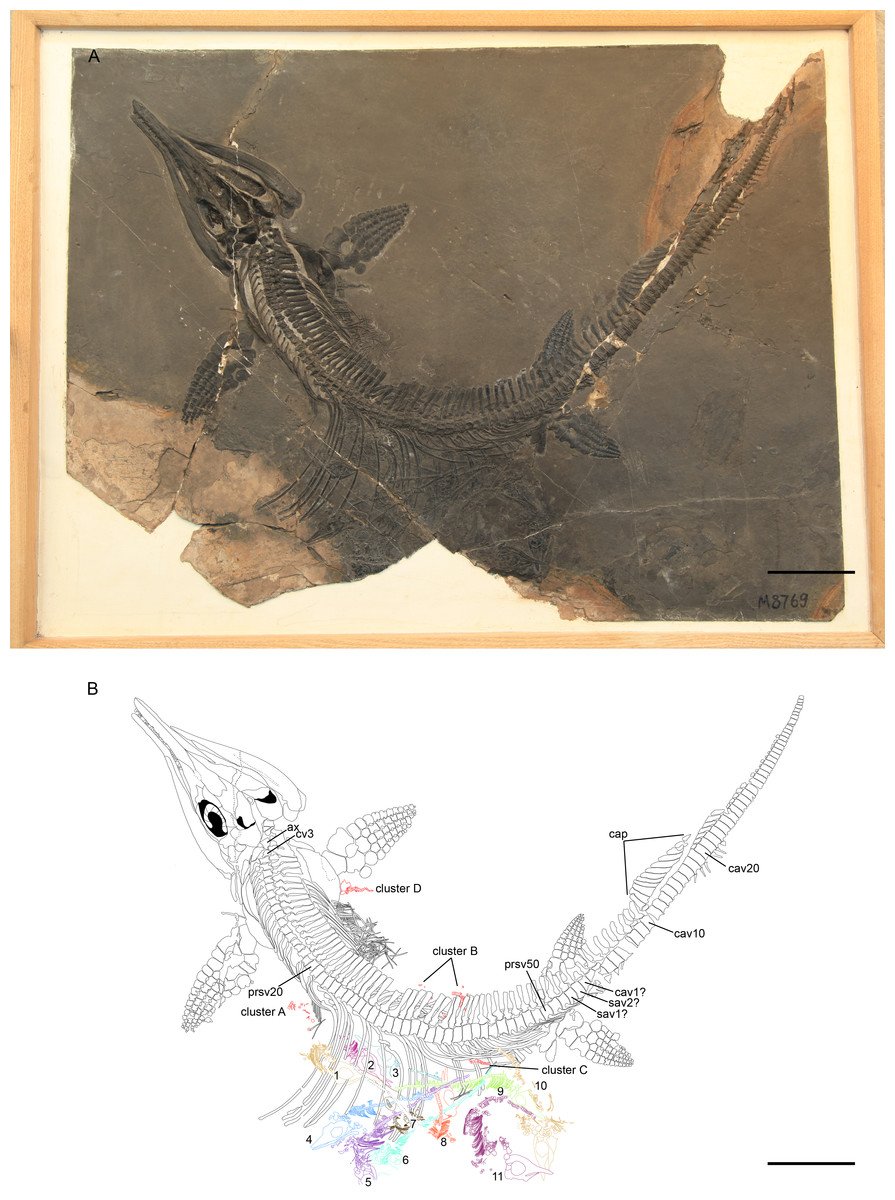
A spectacular new find from the Albian Toolebuc Formation of Queensland; a dismembered skeleton of Platypterygius australis with pterosaur remains in its gut content and bite marks on its vertebrae left by the giant pliosaurid Kronosaurus.
https://t.co/zE8RvR04CO
A tiny fly larva living in one of Africa's deepest lakes has evolved air-filled organs strong enough to withstand pressures found more than 200 meters underwater, according to a new Science study.
The findings challenge a long-standing explanation for why insects have never colonized the open ocean. https://t.co/A8a1Atq5lu