Beside having the most arguments and evidences to cancel Aryan Invasion Theory from #Rakhigari to Ancient textual references of #Out_of_India_Theory !
I have always been symbolized as #Eurasian_Invader
🚨🚨 Book Giveaway!!
We are giving away our best selling book - Indian Economy for UPSC exam.
In order to win this book:
- Comment Economy
- Like and retweet this tweet
- should be following us
5 lucky winners will be announced tomorrow!
E-rickshaw drivers in Delhi-NCR say their vehicles are being remotely disabled using Chinese mobile apps, disrupting rides and affecting their earnings. The Centre has ordered the removal of three apps allegedly linked to the misuse, while Delhi Police and the Delhi government investigate the matter.
However, at the time of publishing this video, the BAT-BMS app remained accessible on both the Apple App Store and the Google Play Store.
🎥: PTI
I'm sure most of us have, at least once in our lives, woken up terrified from a dream where we missed an exam because we were late. We all know that sinking feeling in the pit of the stomach, the panic, helplessness, and regret.
That's why this video is so painful to watch. These students missed their NEET after getting stuck in a political rally in Bengaluru. Many would argue that since it wasn't their fault, they should have been allowed to enter. After all, they wouldn't have gained any advantage, they would simply have had less time to write the exam.
I understand that sentiment. It comes from a place of empathy, and that's a good thing. But large public exams cannot be run purely on emotions. They require clear, objective, and uniformly enforced rules. The purpose of a reporting-time cutoff isn't to punish late candidates; it's to ensure that every candidate is treated according to the same standard.
Once exceptions begin, the rule itself loses meaning. Why allow someone 5 minutes late but not 15? Why make an exception for one reason and not another? Imagine the chaos at thousands of exam centre if you leave entry time to discretion! In exams involving lakhs of candidates, fairness lies not in evaluating individual circumstances but in applying the same rule to everyone without discretion.
To add, centers are designed to complete security checks, identity verification, seating, and other protocols before the process begins; late admissions create operational and security complications and undermine confidence in the integrity of the exam.
It's heartbreaking for the students. One can sympathize with them and still accept that the authorities were right to enforce the cutoff. Sometimes a decision can be both unfortunate and correct at the same time.
Pakistan's history began in 1947. It is a new creation. Read up a little on the country and the region that you are sent to. You embarrass your country.
https://t.co/BEj42zKaLx
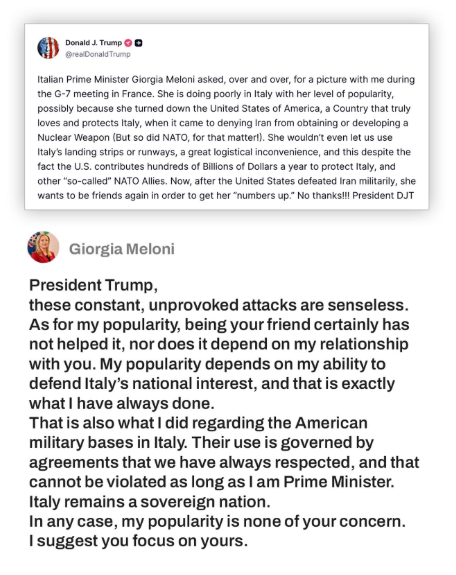
Italy's Meloni responds to Trump:
President Trump, these constant, unprovoked attacks are senseless. As for my popularity, being your friend certainly has not helped it, nor does it depend on my relationship with you.
My popularity depends on my ability to defend Italy’s national interest, and that is exactly what I have always done. That is also what I did regarding the American military bases in Italy. Their use is governed by agreements that we have always respected, and that cannot be violated as long as I am Prime Minister.
Italy remains a sovereign nation. In any case, my popularity is none of your concern. I suggest you focus on yours.
India’s Escapism
Since last year, clear signs have emerged of a fundamental shift in U.S. policy toward India. The indicators are difficult to ignore: the latest U.S. National Security Strategy barely mentions India; the U.S. deputy secretary of state declared from Indian soil that Washington would not allow India to grow into an economic rival; the U.S. assistant secretary of state stated that the principal objective of American policy in South Asia is to prevent any single power from dominating the subcontinent; and Washington recently dropped “Indo” from the name of its Indo-Pacific Command. These developments come amid the declining salience of the Quad and an apparent revival of the term “Asia-Pacific” at the expense of “Indo-Pacific.”
The implication is increasingly difficult to dismiss. Washington no longer appears to view India’s rise as inherently beneficial to U.S. interests. Instead, it is beginning to see India as a potential economic and regional competitor whose power should be managed and constrained. U.S. interest in India is now largely focused on securing greater access to its vast market and gaining greater strategic access.
The 50% punitive tariffs imposed on India last year, efforts to make India more dependent on U.S. or U.S.-aligned energy supplies, the lopsided trade framework agreement of February, and the looming bilateral trade deal all underscore these shifting U.S. priorities.
Yet Prime Minister Modi appears unwilling to acknowledge the writing on the wall. This week he told President Trump that bilateral relations had “progressed significantly” since their last meeting in February 2025. In reality, the relationship has suffered a series of major setbacks during that period. Meanwhile, India’s foreign minister continues to speak of “deepening partnership across domains.”
Rather than acknowledge the implications of Washington’s policy shift, the Modi administration continues to promote a narrative of deepening strategic convergence, thereby deflecting questions — and opposition attacks — about whether its assumptions regarding the U.S. have been overtaken by developments.