Lots of politics, plenty of travel, public transport geek & delving into the Eurovision Song Contest. My views are my own. Retweets not always endorsements.
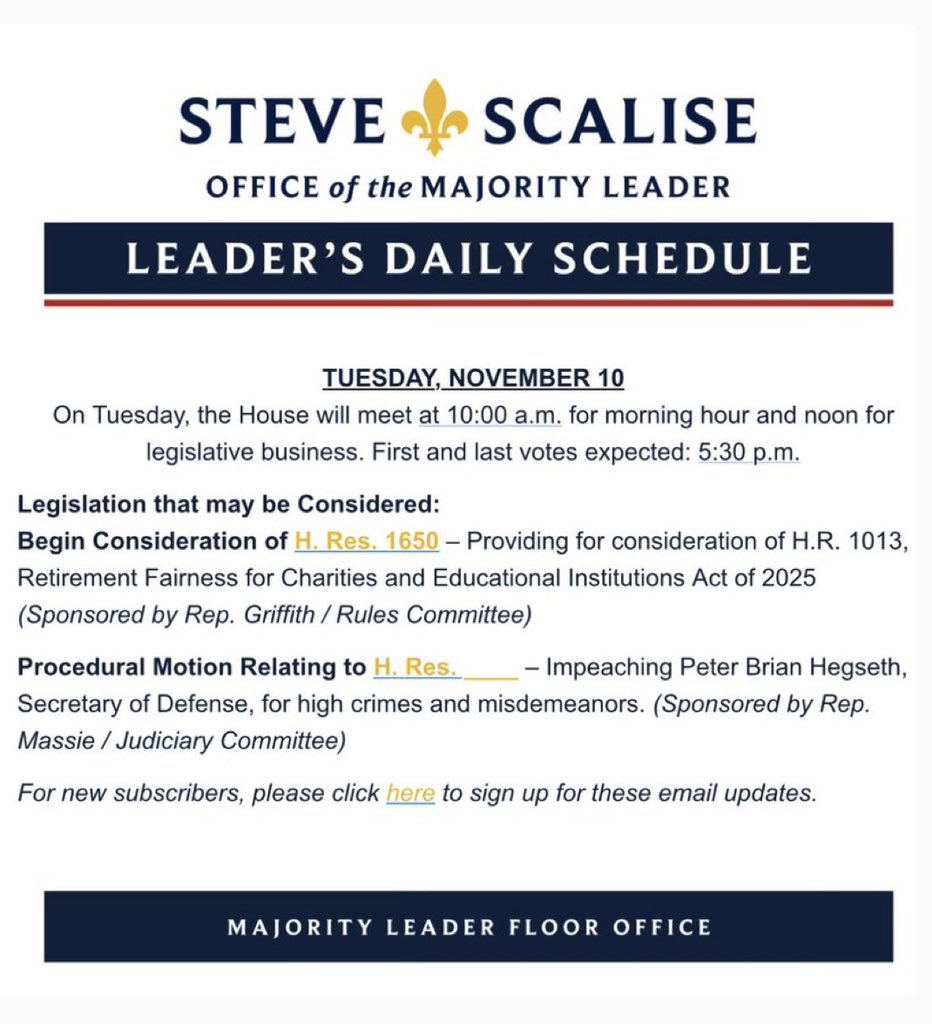
🚨 NEW: The House will vote today on the first step of Pete Hegseth’s impeachment
The initial vote is a procedural motion that could table the resolution or refer it to committee, effectively killing it
If that motion fails, the House will then hold a formal debate and vote on the articles of impeachment
🚨 NEW: What happens if the House votes to impeach Pete Hegseth?
- A 50% majority in the House of Representatives is needed to impeach Pete Hegseth
- Because two House seats are currently vacant, 217 Representatives would need to vote YEA for Hegseth to be impeached
- Assuming all Democrats plus Republican Thomas Massie vote YEA, only two more Republican Representatives would need to flip for the impeachment motion to succeed
- Hegseth would be the first Secretary of Defence/War to be impeached since 1876 and only the third Cabinet Secretary ever
- After being formally charged by the House, he would then be sent to the Senate for a trial
- Following the trial, Senators would vote on whether or not to remove Hegseth as Secretary of Defence, with a two thirds majority (67 out of 100 Senators) needed for his removal
- If he is convicted by the Senate, Hegseth would immediately be removed as Secretary of Defence, becoming the first ever Cabinet Secretary and only the 9th person in US history to be removed from office by impeachment
New post:
Probably the most important political trend of the year has been Farage's growing unpopularity, which has dropped Reform to third place in the polls.
How did it all go so wrong for him? Is he now the main block on the radical right in the UK?
https://t.co/66ysdkaqSD
“Is this it?”
The very sharp share falls in the US were concentrated in data centre buildout adjacent stocks and Elon Musk adjacent stocks.
Falls in Asia also a bit wider. In Europe more widespread but much shallower falls.
Clearly given the astonishing investment cycle and build up in valuations, a reckoning was always coming. S&P futures are up from here though. For now it feels like a corrective reappraisal brought on by the less supportive political environment in the US. It could be the trigger, the pin in the bubble. Fridays can be perilous especially towards the end of trading.
For now there is some degree of discernment rather than outright panic.
@Jenny_1884 You have to question why Andy Burnham is so desperate to rejoin the EU when we all know membership reduces trade barriers and cross border service provision.
A midterms loss doesn't always indicate a party is about to lose the presidency but when it's this bad, it probably does. Especially given the mess the Republicans are in.
Once every ten days, a bright canary-yellow bullet train glides into Tokyo Station at full speed, yet not a single passenger is allowed to step on board.
Its windows are mostly covered from the inside, its timetable is never published for the public, and there are no ticketed seats in any of its seven cars.
In Japan, every child and every commuter knows this train by two English words: Doctor Yellow.
Since the Tokaido Shinkansen began running between Tokyo and Osaka in October 1964, Japanese bullet trains have carried more than seven billion passengers at speeds up to one hundred and eighty-five miles per hour with zero passenger fatalities from derailments or collisions.
Critics sometimes assume that kind of sixty-year safety record is a miracle of luck.
It is not luck; it is what happens when a nation builds a high-speed hospital train whose only patient is the steel track itself.
Why does Japan run a seven-car bullet train painted bright yellow with zero paying customers on board?
In the early days of high-speed rail, engineers realized that checking hundreds of miles of track on foot at night with hand gauges was too slow, and that tracks behave differently when a three-hundred-ton train slams over them at one hundred and sixty-eight miles per hour.
So Japanese railway engineers took a seven-car Class 923 Shinkansen trainset and packed every car from nose to tail with laser-optical sensors, gyroscopes, accelerometers, and high-speed cameras.
Running in the middle of the regular passenger schedule at a full one hundred and sixty-eight miles per hour, Doctor Yellow fires laser beams onto the left and right rails to measure track width, vertical dip, and curvature alignment down to one-tenth of a millimeter, about the thickness of a single human hair.
At the same time, two special observation domes built into the roof and laser pantographs check the overhead high-voltage copper wire for microscopic wear before a single spark can cause a power outage.
The instant Doctor Yellow detects a rail that has shifted by even a fraction of an inch, it beams the exact GPS coordinates to maintenance crews waiting along the line so they can fix the spot that very night after the last passenger train goes to sleep.
Because its schedule is kept secret so crowds do not pack the platforms, Japanese commuters treat spotting Doctor Yellow by chance as a genuine good-luck charm that brings happiness for the rest of the week.
Safety is never an accident when engineers check their work down to the width of a hair.
(Note: Every photograph-style illustration on my feed is created by AI.)
This helps explain my point about this election not being just about gas prices.
Voters who saw the economy as the main issue split fairly evenly. Those who put democracy first overwhelmingly voted Democrat.
Masterful @josh_wingrove midterms wrap as Vance, DeSantis, Romney turn on Trump
“The Republican Party’s generational collapse in this week’s midterm elections ushered in a wave of finger-pointing largely aimed at the Oval Office”
Free to read: https://t.co/l7B3KPL8iy