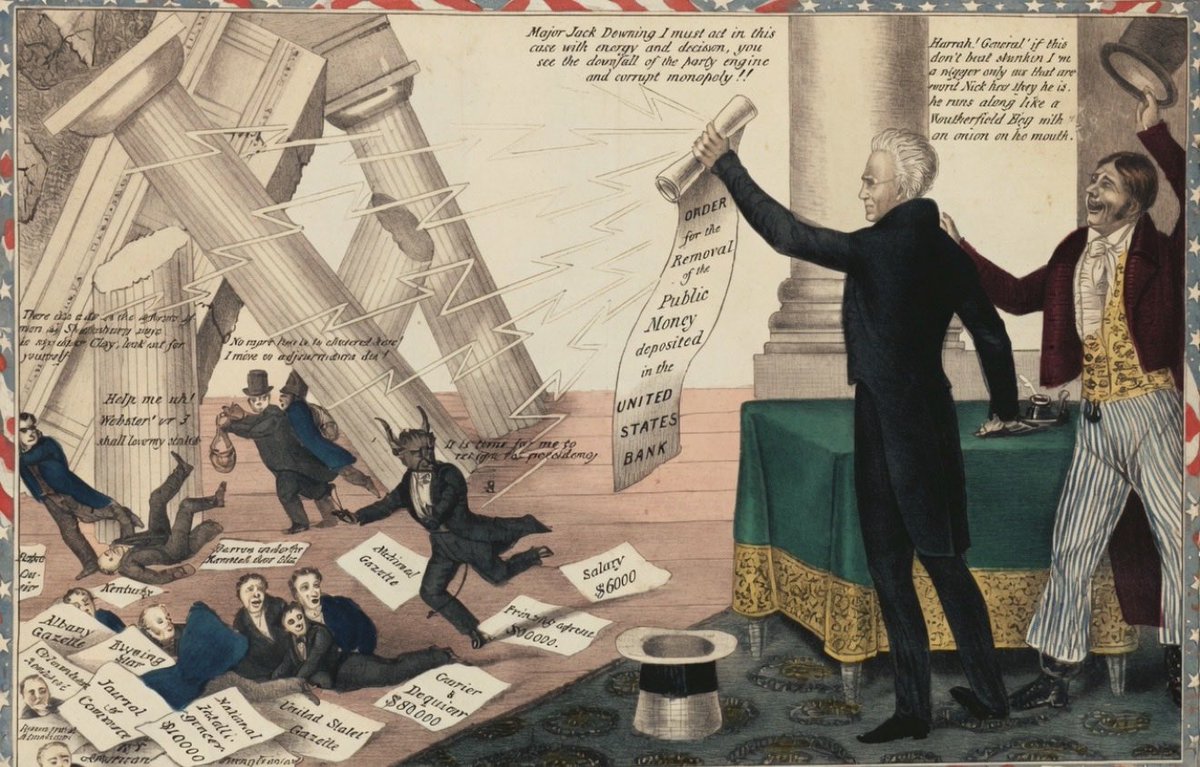
194 years ago today, on Independence Day, Andrew Jackson was presented with a bill to recharter the Second Bank of the United States.
The People’s President reportedly told Martin Van Buren: “The Bank, Mr. Van Buren, is trying to kill me, but I shall kill it.”
He wrote to Congress six days later: “The bill ‘to modify and continue’ the act entitled ‘An act to incorporate the subscribers to the Bank of the United States’ was presented to me on the 4th July instant. Having considered it with that solemn regard to the principles of the Constitution which the day was calculated to inspire, and come to the conclusion that it ought not to become a law, I herewith return it to the Senate….”
He vetoed the bill and launched the “Bank War” to abolish the central bank.
On America’s 250th, we should declare independence from the Federal Reserve!
Social Security is going bust in just 6 years.
RINO in Congress are using that to push a $1.5 trillion slush fund to piss away on donors and activists.
The Fed is running the largest Ponzi scheme in history, and Congress must take drastic steps to confront it.
My bill, the "End the Fed's Big Bank Bailout Act," would do just that.
End the Federal Reserve's authority to pay big banks interest on excess reserves!
As we approach our 250th anniversary, I believe it's worth noting that our government is only actually 165 years old.
The American Republic established in 1776 ended in 1861.
The Civil War cost almost a million lives: one out of every five white men of military age in the South and one out of every ten in the North. It destroyed virtually all of the wealth in the South — a 90% reduction to per capita GDP. The South would not recover economically until 1950.
But the real cost of the war wasn't economic. It was political.
The Civil War destroyed the Federalist system that our founders built to ensure the central government's power remained genuinely limited. Not limited by the goodwill of its legislators, which is no limit at all, but limited by the existence of rival sovereign States, which could restrain the central government and each other through competition.
After 1865 the only real limit to federal power was the self-restraint of the men in office. And that didn't last for long...
But, before we look at the long-term impact of America's first war of aggression, let us dispel a critical myth: that the Civil War ended slavery. Slavery was ending because of technology and economics. And it would have ended just as surely if no war had ever been fought between the States.
Britain abolished slavery, without a war, throughout its empire in 1833, freeing some 700,000 people in the West Indies alone. France abolished slavery in its colonies in 1848. Russia — the most backward great power in Europe — emancipated some twenty-three million serfs in 1861, the very year of Sumter. The Netherlands freed the slaves of Surinam and Curaçao in 1863. Across the entire industrializing world, unfree labor was abandoned within a single compressed generation. And, in no other great nation, was war required.
In America, slavery did not end because of General Grant and the boys in blue. It did not end because of a moral awakening. The cause was economic.
Chattel slavery extracts muscle power from human beings. Therefore, slavery only makes economic sense if muscle power is the binding constraint on production. Once machines had multiplied the labor output of muscle by hundreds of times, slavery was not only immoral but inefficient. In an industrial economy a slave costs more than he yields. As a result, capital flees from slavery into factories. All over the world. And even in the South.
Slavery ended everywhere at roughly the same time for the same reason: innovation and economics. It would have ended in the American South regardless of who won at Gettysburg. Even Brazil, the last holdout in the Western hemisphere, freed its 725,000 slaves with the Golden Law of 1888. No war was required: slavery was no longer productive.
With apologies to the celebrants of Juneteenth, slavery was not legally abolished in the United States until the Thirteenth Amendment was ratified in December 1865. The institution died, not because of the war, but because the world had entered the machine age.
The unnecessary destruction of half of our country and almost a million people wasn't the greatest tragedy of the Civil War. The greatest tragedy was the loss of Federalism and the hard-won liberty Americans won in the Revolution.
The Civil War destroyed the federal structure of the American republic, in which the several States were sovereign in their own spheres, with genuinely different legal systems, cultures, and traditions. The national government was beholden to the States, with only limited and enumerated powers.
The clearest proof of this change lies in our language. Before 1861, the United States was a plural noun. Men said the United States "are." After 1865 our country became singular. The United States "is."
The doctrine that a state could check the central government — by interposition, by nullification, in the last resort by departure — died at Appomattox, and with it the last structural brake on the power of the federal government died too.
The framers had not relied on parchment to limit the government they created. They relied on competition. So long as the States were genuinely sovereign — so long as a man oppressed in one State could remove to another, so long as the national government had to reckon with twenty or thirty rival centers of authority each jealous of its own jurisdiction — the central government could not easily grow into a Leviathan. The States were not administrative subdivisions. They were the Constitution's immune system.
What followed the Civil War was America's first empire -- in the South. And Empire's require a strong central government. Thus began a long erosion of the line between the citizen and the State, and between private institutions and public power.
Twelve years after the war, the Supreme Court considered whether a State could fix by law the prices a private grain warehouse charged its customers. The owners argued it was a taking of their property without due process — that what a man does with his own property, and what he charges for its use, is rightfully his own affair. The Court disagreed. Chief Justice Waite ruled that when private property is "affected with a public interest, it ceases to be juris privati only," and may be regulated by the government for the common good (Munn v. Illinois, 1877).
That was the end of private property in America. After all, if the national legislature may decide which property is "affected with a public interest," and may then dictate its prices and uses, there is in principle no property the government may not control.
Justice Stephen Field saw it and dissented with prophetic fury. The doctrine, he warned, "is nothing less than a bold assertion of absolute power by the State to control at its discretion the property and business of the citizen." A legislature that could fix the uses and prices of property "against the consent of the owner" could "deprive him of the property as completely as by a special act for its confiscation or destruction."
New York City's landlords are finding out the truth of this reality. They believe they own their properties. But they are about to find out otherwise, as rents will now be controlled by the mayor, who is a communist. This will spread. A communist ruling over all of America is only a matter of time. Why? Because the law provides an unlimited incentive for such power. There is nothing in America the government cannot take from you. Nothing.
The proof of the unlimited central authority was established in blood. The courts followed where the armies led. And the first American Empire — the North's conquest of the South — led to more such military adventures, which continue to this day.
In its first century, the United States heeded its founders' warnings against entangling alliances, a large standing army, and foreign military adventures. But the creation of the massive Northern army created its own momentum. Only 20 years after Reconstruction, the country clamored for another Empire and war against Spain. America became an imperial power, with possessions from the Caribbean to the far Pacific — Cuba, Puerto Rico, Guam, the Philippines.
The consolidated nation that emerged from the Civil War was the precondition for the American Empire that emerged in 1898. Power flows to the center, and the center's reach has no natural boundary.
The Leviathan must be fed.
In 1913, every American became a direct serf to the national government: The Sixteenth Amendment gave the federal government the power to tax incomes directly. The size of a government is set, in the end, by the size of its revenues. The income tax removed the ceiling.
The Seventeenth Amendment, ratified the same year, provided for the direct election of United States senators. Under the original Constitution, senators were chosen by the state legislatures. This was the last vestige of State sovereignty. It could not be allowed to stand. The Senate stopped being the guardian of federalism.
And… then… with these Constitutional impediments finally vanquished, you saw Leviathan act to ensure its permanent dominance: it would control the money supply.
In December of 1913, Congress created the Federal Reserve System. The power over money, which the Constitution had strictly withheld from the central government, was enshrined into law. Income tax, a central bank, and the removal of the states from the Senate — all in one year.
The Revolution that began in 1861 was complete. America's Empire had begun.
Munn established that the government may dictate the use of private property. 1898 established that the consolidated nation would project power without limit beyond its borders. 1913 established the revenue, the money power, and the removal of the states from their guard post. The 1964 Civil Rights Act expanded this dictatorial power into every private transaction in America.
Government of the people, for the people, and by the people has been destroyed.
We now live in an Empire, not a Republic.
The Civil War didn't free any slaves; it enslaved all of us.
In 1776, the average American man stood 5'9", a clear three inches over the average Englishman, and taller than the Dutch, the French and the Swedes. Even the ordinary soldier in Washington's army towered over his European counterpart. The reason was on the plate: meat, dairy, eggs from the yard, game from woods that belonged to nobody. In a country where no landlord, no church and no forest law rationed the protein, people simply grew. America was the tallest nation on earth.
It stayed that way for nearly two hundred years. Then, in the 1950s, American height stopped. It has barely moved since. A man born in 1996 stands about 5'9", the same as a man born in 1950, and much the same as one in 1776.
While America stalled, everyone else climbed. The Dutch, among the shortest people in Europe in 1860, gained the better part of half a foot and became the tallest humans on the planet, around six foot for men. The Scandinavians, the Germans, the Koreans all surged past. America slid to 37th.
Thirty-seventh. The richest country in history, outspending nearly everyone on food, now looking up at the Dutch, the Danes, the Germans, the Czechs and two dozen others.
The usual explanations reach for inequality and healthcare. Real enough, but they sit on top of something simpler. The food changed.
In the 1950s the American plate was built on butter, whole milk, eggs and red meat. By the 1990s it was margarine, skimmed milk, egg whites, chicken breast and a wall of processed food reformulated to strip out animal fat and pour in sugar and seed oil, exactly as the dietary guidelines instructed.
The Dutch never got the memo. They carried on with full-fat dairy by the bucket, close to a kilo a head per day. Cheese at breakfast, cheese at lunch, butter on everything. They kept eating the food that was making them tall.
It is the cleanest experiment in modern nutrition, run for fifty years in plain sight, written into conscription records and school growth charts the people drafting the guidelines never seem to open.
America was the tallest country on earth when it ate butter. It is the 37th tallest now that it eats the guidelines.
The guidelines still haven't changed.
The Dutch are still eating the cheese.
With AI driving up chip prices, we need to Drill baby Drill for chips.
Not with more crony subsidies, but getting government out of the way on permits, zoning, environmental reviews, utility approvals.
Like Singapore, one-page approval and build.
The federal government makes you work months out of every year
Then it uses that money to create horrible things that harm you
Then it lies to you about it
Time for a constitutional reset
Share if you agree
When Jimmy Carter purchased the teachers’ union’s endorsement in 1979 by establishing the Department of Education, the USA was #1 in education.
46 years and $4.1 trillion dollars later, the USA is #40. We are, however, #1 in cost per student.
Americans deserve the freedom to choose what fuels their vehicles, not Washington bureaucrats.
My Fuel Choice & Deregulation Act cuts EPA red tape, opens the market to more fuel options, and lets competition do what government never can: lower prices.
@amitylee13 Trump has done more for making our country more libertarian than any other president in our lifetime. The alternative would have been devastating. He hasn't been perfect but he's done a lot of good things in the 2 years since being re-elected.
"Why does an American need twice as much energy as a European"
For the same reason a European "needs" twice as much energy as a Botswanan 🙌
Energy means prosperity, and Europeans lost the plot.