👉 AI Reliability Watch #2: An agent's constitution is not a control. A deterministic policy gate is.💥
🤷 What's an agent constitution?
A set of behavioral instructions or value-oriented training guidelines that encourage an AI agent to follow specific principles or standard operating procedures (SOPs). It relies on the model itself to interpret and follow those rules.
▫️What's a hard policy gate?
An independent, deterministic checkpoint the agent can't disable, alter, or waive. It checks every proposed action against authorized limits before it runs.
✍️ New paper from Arizona State University, Virginia Tech, and
City University of Hong Kong: "Reliability Engineering for AI Systems: Challenges, Methods, and Directions" by Rong Pan, Yili Hong, and Min Xie.
—● Their core point:
"Average benchmark accuracy measures capability; it does not quantify this broader reliability claim." Once AI retrieves, remembers, uses tools, and acts, reliability belongs to the whole system, not the model.
🛡️ The deterministic mandate
The authors sort failures into four levels: component, operational loop, agentic conduct, and network and governance. At Level 3, the agent's actions break authorization, privacy, safety, or oversight requirements.
🧐 Their answer isn't a better prompt.
Constitutions and value training "can encourage adherence," but the agent shouldn't be "the accountable control itself." Give it work as carefully specified as a junior operator's, and restrict its authority "as if it were an untrusted service account." The SOP must become "independent policy gates that the agent cannot waive."
🙋 What that looks like
Take an agent handling refunds. The policy: no refund over $50 without manager approval, and only to the original payment method.
▫️ A prompt that says "be careful with large refunds" is advice the agent can ignore.
▫️ A policy-enforcement point is plain, non-AI code that intercepts a $75 refund to a new bank account, blocks it, logs it, and alerts a manager.
If the agent hallucinates a tool call, the prompt won't stop it. The gate will.
🔁 And when the system changes itself
The paper also says each retained update should be treated as a repair: a versioned baseline, independent testing, and before-and-after comparison, "so that growth in capability is not mistaken for growth in reliability."
⚙️ Where ModelFusion fits
Same principle, applied to answers:
▫️ Generative models write. Jev filters document contributions.
▫️ Deterministic checks, not a model, decide what is released.
▫️ Every run leaves unsigned inspection receipts: what was checked, and why it passed or failed.
In your stack, what can your agent do that no independent gate checks first?
DM me "demo"
🌐 https://t.co/Vg39DYIxVK
-----
AI Reliability Engineering:
✍️ Join the ModelFusion™ builder Linkedin group: https://t.co/757iwppAXO
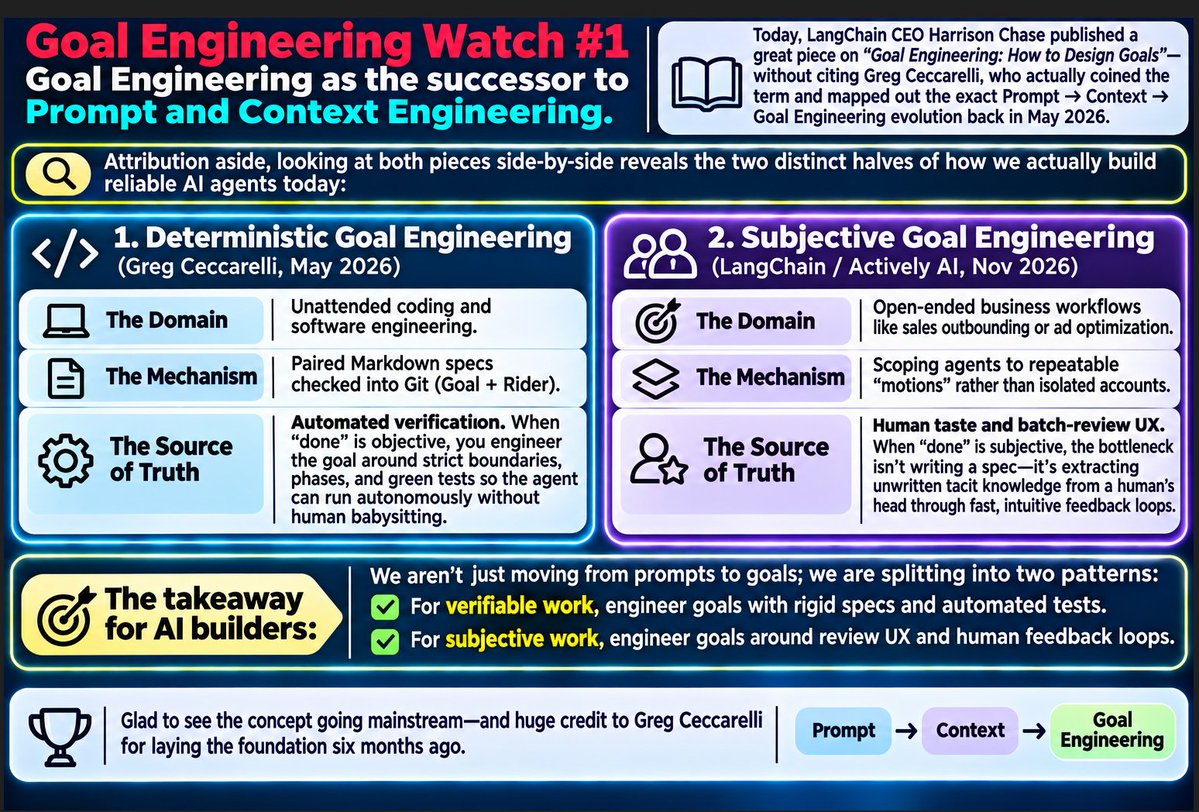
👉 AI Goal Engineering Watch #1: Goal Engineering is now becoming the successor to Prompt and Context Engineering.💥
🙋 Today, LangChain CEO @hwchase17 Harrison HChase published a great piece on "Goal Engineering: How to Design Goals"– without citing Greg Ceccarelli, who actually coined the term and mapped out the exact Prompt → Context → Goal Engineering evolution back in May 2026.
Attribution aside, looking at both pieces side-by-side reveals the two distinct halves of how we actually build reliable AI agents today:
✍️ Side-by-side:
1️⃣ Deterministic Goal Engineering (Greg Ceccarelli, May 2026)
🔹The Domain: Unattended coding and software engineering.
🔹The Mechanism: Paired Markdown specs checked into Git (Goal + Rider).
The Source of Truth: Automated verification. When "done" is objective, you engineer the goal around strict boundaries, phases, and green tests so the agent can run autonomously without human babysitting. https://t.co/jzYFxPqIT7
2️⃣ Subjective Goal Engineering (LangChain / Actively AI, Nov 2026)
🔸The Domain: Open-ended business workflows like sales outbounding or ad optimization.
🔸The Mechanism: Scoping agents to repeatable "motions" rather than isolated accounts.
The Source of Truth: Human taste and batch-review UX. When "done" is subjective, the bottleneck isn't writing a spec – it's extracting unwritten tacit knowledge from a human's head through fast, intuitive feedback loops. https://t.co/iE7HmyJGMk
🙋 The takeaway for AI builders:
We aren't just moving from prompts to goals; we are splitting into two patterns:
⇒ For verifiable work, engineer goals with rigid specs and automated tests.
⇒ For subjective work, engineer goals around review UX and human feedback loops.
...good to see the concept going mainstream – and huge credit to Greg Ceccarelli for laying the foundation six months ago.
🌐 https://t.co/Vg39DYIxVK
-----
AI Reliability Engineering:
✍️ Join the ModelFusion™ builder Linkedin group: https://t.co/757iwppAXO
👉 S1 Watch #11: Google just joined the S1 race. Your release gate shouldn't change.💥
🙋 What's new
Google DeepMind released Gemini Decision 1 and a Gemini Decisions API.
Like Jev, it writes no prose. It returns typed answers with confidence scores your code can act on, and it reads text, images, audio, video and PDFs together, up to 1,000 questions about the same material in one pass (VentureBeat).
Google joins the list this S1 Watch series tracks:
⇒ Jev,
⇒ Microsoft-Decision-1,
⇒ OpenAI's Decisions API,
⇒ Perplexity,
⇒ Liquid AI,
⇒ Drex,
and now Gemini.
🤔 What's exciting
1️⃣ Multimodal checklists. A claim with a form, photos and a call recording can be screened in one request.
2️⃣ Independent referees are arriving. Artificial Analysis's Decision Index v2 rewards calibration, not just accuracy.
3️⃣ The interface is standardizing. As Pete Johnson put it in CIO, the interface standardized before the market did. That's what makes S1s swappable.
Where I'm skeptical
🔸Self-run benchmarks. In Google's own launch tests, Gemini led five of seven. On Artificial Analysis's independent index, it launched ninth of 18. Same model, different referee.
🔸Right answers aren't a right case. That index's document test only counts a document when every answer on it is correct. The whole case is what you release.
🔸A probability is not a decision. Even TypeSafe says it plainly: "Jev makes judgments, code makes decisions."
🔸 Inputs can be steered. VentureBeat reports a single planted field dropped Jev's probability of blocking an action from 0.76 to 0.48. A model that can be talked down should never be what releases an answer.
🛠️ How we handle that in ModelFusion
▫️ Jev runs in production in our document lane, where it can discard a bad contributor draft. It filters. It doesn't release.
▫️ Only the deterministic audit gate can release an answer.
▫️ Every run leaves unsigned inspection receipts: what was checked, and why it passed or failed.
▫️ Gemini joins the rest on our watch list, not integrated.
Google's entry confirms there won't be a single winner.
What's your S1 bet: pick one lab and hope, or keep the gate yours and swap the scorer?
DM me "demo"
🌐 https://t.co/Vg39DYIxVK
-----
AI Reliability Engineering:
✍️ Join the ModelFusion™ builder Linkedin group: https://t.co/757iwppAXO
👉 S1 Watch #12: What is an Inference Engine vis a vis decision model (S1)? Flide is not another decision model. It's the engine underneath.💥
A model is a set of trained weights. Jev, OneJev, Grok, and Gemini are models.
An inference engine is the software that loads those weights onto a GPU and actually runs them. Every model you use already sits on one. vLLM and SGLang are general-purpose engines for generating text.
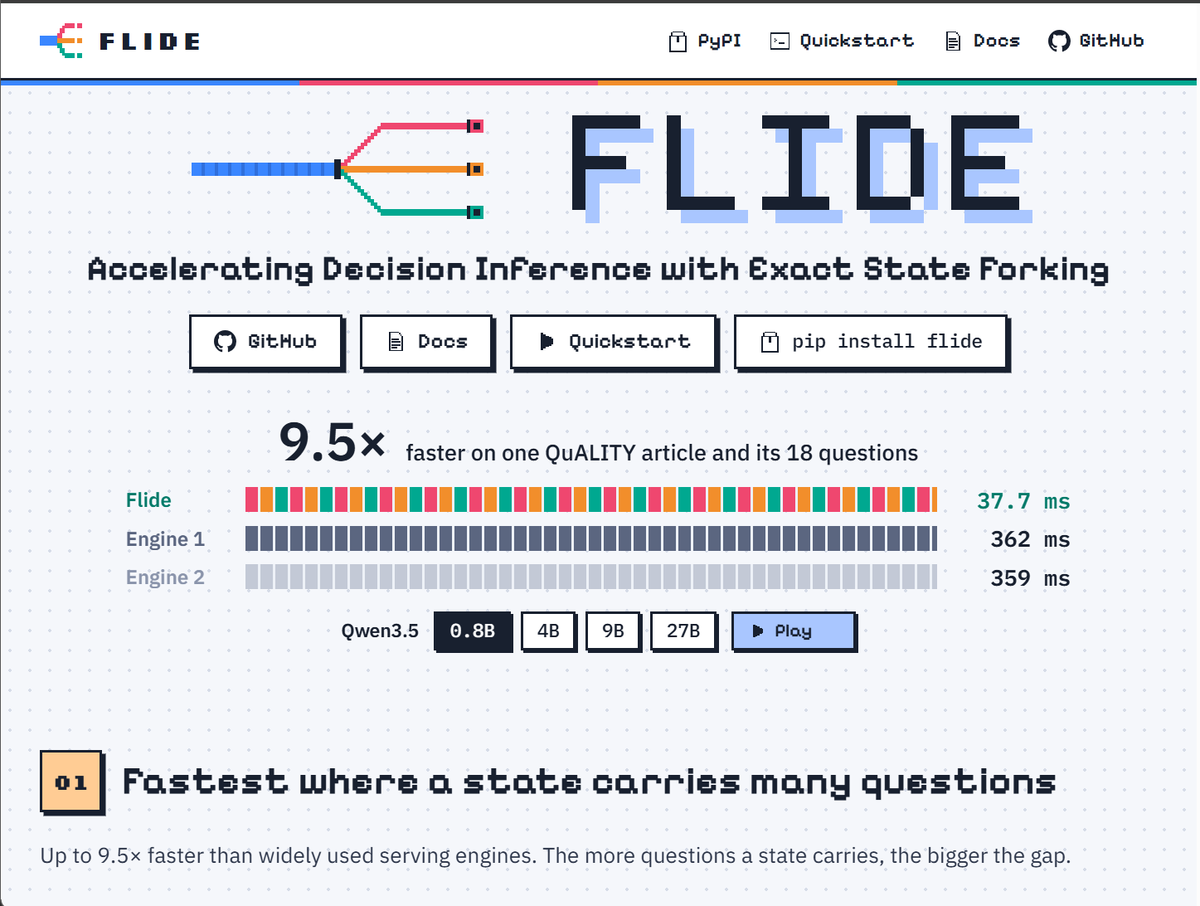
🙋 Flide, from a National University of Singapore paper, is a specialized inference engine for decision-model workloads.
You pick an existing S1 — OneJev, Open-Jev, Liquid AI's d1, Nace Drex, Perplexity's pplx-decider, and others — and Flide runs it.
Those names are models it can serve, not versions of Flide.
📦 A simple example
A support ticket: "Order #1182 arrived with a cracked screen.
The customer asks for a refund and attached two photos."
Four questions:
1️⃣ What should support do next: refund, replace, or escalate? This is the main action decision, a choice among three options.
2️⃣ Does this need a reply within the hour? Yes or no, for urgency.
3️⃣ Did the customer include evidence of the damage? Yes or no. The two photos are the clue.
4️⃣ Should this be treated as a warranty case? Yes or no, for which policy applies.
Same ticket, same model, four probabilities back.
Usual engines often run this as four separate passes, which wastes work, or glue all four questions into one pass. The paper says that second path is faster, but can shift probabilities and sometimes flip a decision.
🧐 Flide puts the ticket and all four questions through in a single pass, while keeping each question isolated so it cannot see the others. The paper's claim is that each probability matches asking that question by itself, just faster.
This is not Tree of Thoughts, and not a new model.
📊 The project's own figures
Up to 9.5 times faster than vLLM and SGLang (QuALITY, 0.8B model, per their website).
10,000 emails, eight questions each, in 28 seconds on one H200 with OneJev1.6-0.8B (their README).
✍️ Other engines already serve this workload.
Flide's claim is narrower: a single pass, with each question identical to asking it alone.
🛡️ The AI Reliability Engineering question?
▫️A faster probability is still a probability. It is not a release decision.
▫️At ModelFusion, Jev filters document contributions, and deterministic checks decide what is released. Each run leaves unsigned inspection receipts. Flide stays on my watch list, not integrated.
▫️If the engine under your S1 becomes as swappable as the model, what should your release gate actually trust?
DM me "demo"
🌐 https://t.co/Vg39DYIxVK
AI Reliability Engineering:
✍️ Join the ModelFusion™ builder LinkedIn group: https://t.co/757iwppAXO
👉 AI Reliability Watch #1: Graphs may not make answers more accurate.💥They make facts checkable.
Three open-source retrieval projects, three different bets on reliability. They sit at different layers of the stack, and that's the main thing to know.
1️⃣ RAGFlow: fewer parts
A full retrieval platform (Apache-2.0, v1.0). Its newest claim is that an agent using plain keyword search plus grep scores 91% on the FRAMES benchmark, and that adding wikis and graphs gave no accuracy gain in its own runs. The reliability argument: every part has to prove it earns its place.
2️⃣ OntoSmith: a write gate
An early MIT-licensed project that builds a knowledge graph. Before any fact a model proposes gets stored, a Jev judge checks it against its source text.
The reliability claim:
nothing unreviewed enters the knowledge base. Its README reports 0.911 precision on 500 documents and notes that figure comes from one tested configuration, not the default install.
3️⃣ txtai: build it yourself
A general toolkit (Apache-2.0) combining an embeddings database with pipelines, workflows and agents. It's the most flexible of the three and makes the fewest reliability claims about itself.
⚖️ The tension
RAGFlow suggests graphs don't improve answer accuracy. OntoSmith uses a graph mainly so every stored fact can be checked and traced to its source. Both can be true. Accuracy and accountability are different jobs.
🤷 Why it matters for AI Reliability Engineering
At ModelFusion, nothing ships until it passes a pass-or-fail release check. OntoSmith applies a similar idea earlier: check the fact before you store it. That's a shared concept, not an integration. All three stay on my watch list.
Every number above comes from the projects themselves, not from independent tests.
Where should the check live in your stack: when data is written, when it's retrieved, or when the answer is released?
DM me "demo"
🌐 https://t.co/Vg39DYIxVK
-----
AI Reliability Engineering:
✍️ Join the ModelFusion™ builder Linkedin group: https://t.co/757iwppAXO
👉 S1 Watch #10: Drex scores the options. But who authorizes the action?💥
@NaceAI 's Drex for Finance supports an important shift:
▶️ specialized models returning probabilities over predefined answers, rather than paragraphs you have to parse.
But: a financial judgment ≠ permission to move money.
🔍 The Numbers (and the Nuance)
Nace reports 85.7% accuracy across 48 public finance test sets (vs. GPT-6 Luna at 70.9%), and a reported 0.82s median response on a short case.
That supports a narrow headline, but let's read the fine print:
🔹This is a vendor benchmark, not proof it beats GPT across all workloads.
🔹The reported category tables show chance-corrected skill, not raw accuracy percentages.
🔹This is a specialized fine-tune of Drex Max—different checkpoint, different evaluation.
🧾 The Boundary: Invoices & Automation
Flagging a duplicate invoice or scoring payment risk is highly useful. But an API example is not evidence of a safe, end-to-end payment workflow.
Before automating, I would require:
✅ Tests on representative invoices and actual payment history
✅ Measured calibration & false approvals at your threshold
✅ Explicit policy checks, authorization, and an abstain/review path
✅ Full audit trails of inputs, scores, checks, and actions taken
A fixed answer set prevents an invented label.
It does not prevent a confidently wrong selection.
🛡️ The AI Reliability Engineering Question
It's not just which model scores best, but what controls the consequences of its errors.
🙋 The Verdict:
ModelFusion is pilot-ready, bounded reliability infrastructure (Jev filters, deterministic checks, inspection receipts), but it is not a bank or payment integration. For now, Drex remains on my watch list, not integrated.
What proof would you require before a probability becomes permission to act?
DM me "demo"
🌐 https://t.co/Vg39DYIxVK
AI Reliability Engineering:
✍️ Join the ModelFusion™ builder LinkedIn group: https://t.co/757iwppAXO
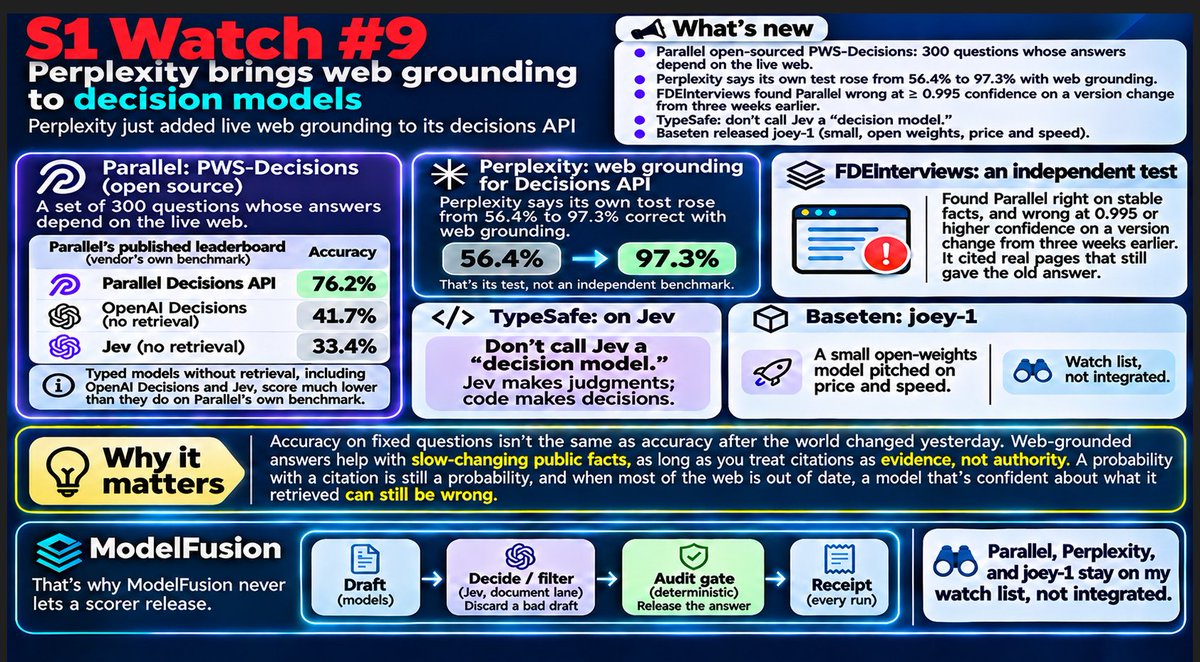
👉 S1 Watch #9: Perplexity brings web grounding to decision models💥
🧐 Perplexity just added live web grounding to its Decisions API: searches now happen before the model returns its probability, and the results are included as evidence. Parallel is pushing the same direction with its Decisions API and the open PWS-Decisions benchmark.
🔸 Parallel open-sourced PWS-Decisions: 300 questions whose answers depend on the live web. On Parallel's own leaderboard, its API leads, and typed models without retrieval, including OpenAI Decisions and Jev, score much lower than they do on JevBench.
🔸 Perplexity says its own test rose from 56.4% to 97.3% correct with web grounding. That’s its test, not an independent benchmark.
🔸 An independent test by FDEInterviews found Parallel right on stable facts, and wrong at 0.995 or higher confidence on a version change from three weeks earlier. It cited real pages that still gave the old answer.
🔸 TypeSafe AI says don't call Jev a "decision model." Jev makes judgments; code makes decisions. I agree.
🔸 Also new: Baseten's joey-1, a small open-weights model pitched on price and speed. Watch list, not integrated.
🙋 Why it matters:
Accuracy on fixed questions isn't the same as accuracy after the world changed yesterday. Web-grounded answers help with slow-changing public facts, as long as you treat citations as evidence, not authority. A probability with a citation is still a probability, and when most of the web is out of date, a model that's confident about what it retrieved can still be wrong.
✅ That's why ModelFusion never lets a scorer release. Jev runs in the document lane and can discard a bad draft. Only the deterministic audit gate releases, and every run leaves a receipt. Parallel, Perplexity, and joey-1 stay on my watch list, not integrated.
🤔 If web grounding is the new S1 race, do you bet on one vendor, or keep the gate and swap the scorers?
DM me "demo"
🌐 https://t.co/Vg39DYIxVK
AI Reliability Engineering:
✍️ Join the ModelFusion™ builder LinkedIn group: https://t.co/757iwppAXO
👉 HarnessRouter Launches Harness Arena... The harness is becoming swappable. https://t.co/PEdeJRnby5™ is the evidence layer.💥
HarnessRouter’s open-source Community Edition puts one API over 30 named harness bases, with sessions, streaming, files, artifacts, cancellation, and structured failures.
Its Harness Arena is a cloud feature for comparing harness-model combinations.
🧐 Its reported Care Prep example is striking:
One combination completed all five runs, another completed three, with a very large credit difference. Treat that as HarnessRouter’s result for one workload, not a universal ranking.
The lesson for AI architects is not “find the perfect agent harness.”
It is to make the work and its evidence portable enough that the harness can be replaced without losing control.
🙋 A harness can route work. It can stream progress and return artifacts. But routing is not approval. Teams still need to know what was attempted, what evidence survived, and what was allowed to ship.
✍️ HarnessRouter and Arena are on my exploratory watch list. They are not integrated with ModelFusion.
The interesting idea is design for replacement: models, harnesses, and scorers can change; evidence and release controls must remain.
🤷 Would replacing your agent harness today preserve its audit trail?
DM me "demo"
🌐 https://t.co/Vg39DYIxVK
AI Reliability Engineering:
✍️ Join the ModelFusion™ builder LinkedIn group: https://t.co/757iwppAXO
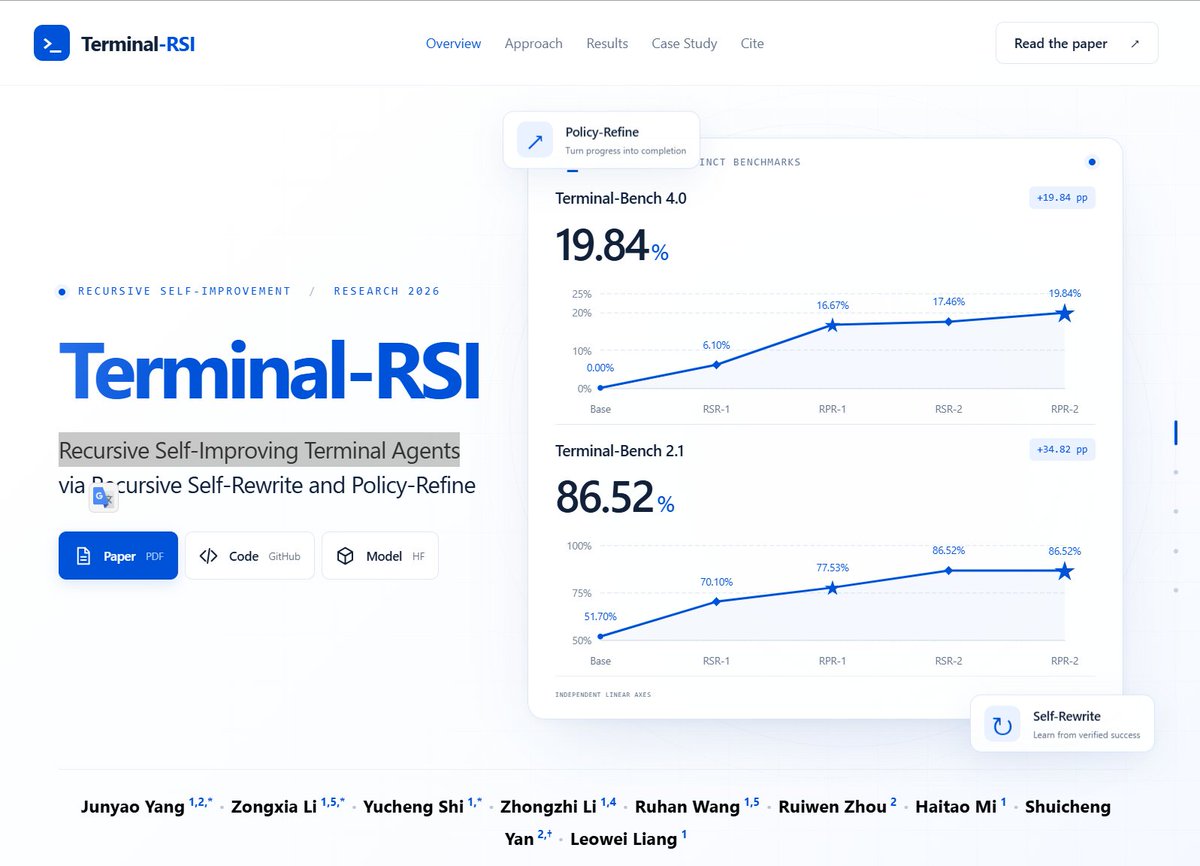
👉 "Self-improving" is a feature, not a headline. 💥 Tencent's Terminal-RSI paper is everywhere right now. The hype machine is calling it "recursive self-improvement cracked."
Pump the brakes, please...
What it actually is:
🔹A disciplined 5-stage training loop.
🔹 A 27B model alternating between RSR (rewriting verified trajectories) and RPR (refining policy with PPO).
🔹 A critic model carried forward like a baton.
🔹 SPR (Success-Prioritized Reward) is the quiet star: it caps partial credit, stops semantic gaming, and forces the model to chase the terminal verifier pass.
The Numbers (Before ➡️ After):
📈 4-suite avg: 20.68% ➡️ 50.58%
📈 TB 2.1: 51.7% ➡️ 86.5%
📈 TB 4.0 (hardest): 0% ➡️ 19.84%
Context on TB 4.0:
• 19.84% sits right near Gemini 3.8 Flash (19.70%).
• Still well below GPT-6 Astra (54%) and Claude Opus 5 (46%).
• Long-horizon strict completions: just 5 out of 46 tasks.
🧐 What "self-improving" actually means here:
The model improves through a human-designed pipeline. It doesn't choose its own training data, design its own reward function, or decide when to train its successor. Humans set the stages, gates, and curriculum.
Calling this "zero human in the loop" is like calling a CNC machine self-building because it milled its own fixture. 🛠️
✍️ The Bottom Line:
Breakthrough? No. A smart, well-engineered advance in training terminal agents? Absolutely.
🙋 The Product Takeaway:
If you're building coding agents, the harness matters as much as the base model (reward design, credit assignment, verifier integration).
Terminal-RSI's SPR trick alone is worth stealing:
Stop rewarding "looks like progress." Start weighting the final verifier gate orders of magnitude heavier.
🚀 Self-improving systems are coming. This paper is a step toward them—not the arrival.
👇 Question:
Does "RSI" need to mean full autonomy to count? Or is staged, human-in-the-loop recursion a valid path?
-----
AI Reliability Engineering:
✍️ Join the ModelFusion™ builder Linkedin group: https://t.co/757iwppAXO
👉 Google Cloud's "The Composable Middle" is real but a close reading reveals six gaps.💥
Composed components still need receipts.
When a composed answer matters, can you
- show what evidence supported it,
- what was checked, and
- whether it was released or withheld?
Google Cloud published a useful architecture this week: a reusable middle layer between foundation models and bespoke last-mile work — with domain-specific governance, validation gates, and provenance inside it.
That matters. It says the path from pilot to scale isn't "build one smarter agent" — it's composition with explicit controls.
But a close reading reveals six gaps:
1️⃣ Rebranded, not discovered. The "missing link" is the integrators' IP layer renamed. A business-model observation wearing an architecture argument's clothes.
2️⃣ Unsourced math. "3x–5x throughput per engineer" — no study, sample, or measurement basis. For an audience that runs on TCO, unqualified multiples erode credibility.
3️⃣ Static layers. No mechanism for promoting bespoke patterns into reusable ones — the actual hard part.
4️⃣ Packaged isn't portable. The article says some plugins are packaged for portability. Packaged how — and portable to where? No open standard, escrow, or exit path is specified for the layer where your operational logic lives.
5️⃣ Economics wearing architecture's clothes. Layers defined by margin, not by interfaces, contracts, or verifiability.
6️⃣ Gates are named; receipts aren't shown. Governance and validation gates sit in the middle layer — but no run-level evidence is offered: what was checked, what wasn't, why a given output was released or withheld. Gates without receipts are labels on a diagram.
🙋The executive question:
When a composed answer matters, can you show what evidence supported it, what was checked, and whether it was released or withheld?
✍️ Reusability scales answers:
It doesn't automatically scale trust. A component can work perfectly and still contribute to an unsafe result.
That's why I'd put a visible evidence layer across composed workflows — not treat governance as a label on an architecture diagram.
▶️ That is the boundary ModelFusion is built around. Models generate. Deterministic checks govern release. Every run leaves an inspection receipt.
Make the evidence and release decision part of the reusable system too.
What proof would you require before letting a composed AI workflow act?
Link to article: https://t.co/PcFShSKt90
DM me "demo"
🌐 https://t.co/Vg39DYIxVK
AI Reliability Engineering:
✍️ Join the ModelFusion™ builder LinkedIn group: https://t.co/757iwppAXO
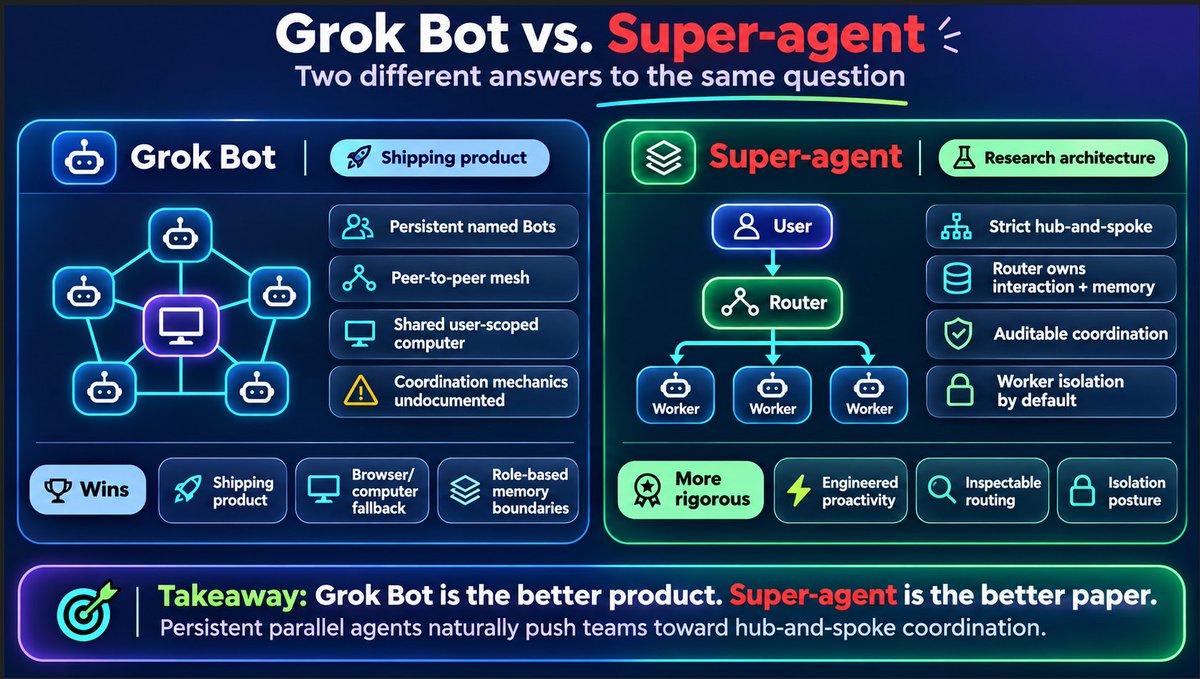
👉 Grok Bot vs. Super-agent: two different answers to the same question. @DeepSeekHarness's new "Super-agent" paper isn't about sub-agents. 💥 The point easily missed, and a Grok Bot comparison highlights.
▶️What Grok Bot actually is
xAI's managed agent product (Aug 2026): named, persistent Bots — each with a role and its own memory — on a persistent cloud computer, so work continues with your laptop closed. Bots run in parallel, message each other, and pass task ownership
Two details matter:
1️⃣ All your Bots share ONE computer — files, browser sessions, logins — and xAI explicitly says a Bot is not a security boundary
2️⃣ Inter-Bot coordination is undocumented: nothing published on handoffs, conflict resolution, loop prevention, or budget controls
🤷 The core difference: mesh vs. hub-and-spoke
—● Grok Bot is a peer-to-peer mesh — Bots talk directly via group chats, handoffs, and shared files, with no mandatory coordinator. The "Chief of Staff Bot" pattern is user-invented, not architecture-enforced
—● Super-agent is strict hub-and-spoke: the Router owns all human interaction and global memory; Workers never speak to users and coordinate only through shared Thread subscriptions. The Router isn't a convention; Workers structurally cannot take its job
Where Grok Bot wins
🏆 It's a shipping product, not a position paper: routines, schedules, learned skills, an approval system, enterprise controls. Browser/computer use works on tools with no API — Super-agent assumes structured sources like GitHub and IM. And role-based memory ("capabilities shared, memory stays with the role") answers a context-partitioning problem Super-agent lists as unsolved
Where Super-agent is more rigorous
🏆 Proactivity is engineered, not scheduled: a full ingestion pipeline — fast-path filtering, semantic judgment, speculative background execution — with no published Grok Bot equivalent. Coordination is auditable: Thread subscriptions and Router batching are specified and measured, while Grok Bot's bot-to-bot messaging is a black box. And Workers are isolated by default, while every Grok Bot inherits every login — fine solo, a governance problem for teams
🙋 Takeaway
Grok Bot is the better product; Super-agent is the better paper. Grok Bot bet on social metaphors (teammates, handoffs) and shipped the surface that makes persistent agents usable — but coordination is conversational and opaque. Super-agent bet on systems metaphors (router, scheduler, watchdog) and produced a coherent, inspectable theory — with evaluation too thin to prove it
😉 Ironic footnote
they're converging. Grok Bot users independently invented the Router (the emergent "Chief of Staff"), and Grok Bot already delegates coding to Cursor Cloud Agents — a two-layer architecture in everything but name. Give people persistent parallel agents, and hub-and-spoke coordination emerges whether you design for it or not.
So you might as well design for it.
AI Reliability Engineering: https://t.co/757iwppAXO
👉 S1 Watch #7: Decision models just moved inside the agent loop. The deterministic checks still do the heavy lifting.
Two new papers show where S1 is going next: not just answering questions, but deciding inside agent harnesses.
🙋 What's new
1️⃣ JevAgentHarness (UIUC, Princeton, Google).
Agent decisions are sequential, so one wrong tool call changes the next state. The authors trained AgentDecision-4B on the states agents actually reach, with Jev providing the targets. The model most accurate on isolated questions solved only 69.5% of agent tasks. Handing off tool choices without a fitted confidence threshold cut success by 19 points.
2️⃣ JevAct (IBM Research).
It's a gate between the agent and its tools. Before a write or a hand-off runs, code checks the tool records and Kev, an open-source Jev-like model, answers yes/no policy questions. A flagged action goes back to the agent with feedback. On one telecom test, an agent's three-run success rose from 39.5% to 80.7%.
👌 What's exciting
🔸 S1 is becoming a control layer, not just a faster judge.
🔸 Cheap gates. IBM estimates Kev's judge cost at a fraction of a cent per task, well below API judges.
🤔 Where I'm skeptical
🔸 In JevAct's airline test, code checks alone reached 68% vs 72% for the full gate. The deterministic checks did most of the work.
🔸 The gate is not a hard stop. Once the revision budget runs out, the next proposal goes through unchecked.
🔸 42 of 101 bad calls broke none of the compiled questions.
🔸 JevAgentHarness's models and data aren't released yet.
—● How we handle that in ModelFusion
Same lesson, applied to answers: Jev can discard a bad draft in our document lane, but only the deterministic audit gate releases, and every run leaves a receipt. Both papers are on my watch list, not integrated.
Is your agent's "gate" a hard stop, or just a second chance?
DM me "demo"
🌐 https://t.co/Vg39DYIxVK
AI Reliability Engineering:
✍️ Join the ModelFusion™ builder LinkedIn group: https://t.co/lhBoDm9xY8
👉 ATTENTION IS ALL YOU NEED, and judgement...💥 this report treats Anthropic as a leading indicator of how AI will reshape work. It draws on internal employment, AI usage, output, survey, and hiring data plus 17 employee interviews.
This is a rare, rigorous inside look at an AI-native firm.
Key Findings
1. The junior hiring squeeze.
Junior technical employees fell from 21% to 14% of headcount since early 2025; junior technical hires collapsed from 27% to 9%. A third of ML managers reported hiring less due to AI. Junior employment grew slowest exactly where Claude handles the most complex tasks.
2. Agents now outwork humans.
Agent hours passed human hours in March 2026; by August agents worked 6× the hours of their human handlers. Non-technical staff's coding-agent sessions jumped from 2 to 90 per month.
3. Real productivity gains.
Comparing adopters vs. non-adopters over time: code commits per engineer hit 5× prior velocity — with no drop in code quality. Sales reps closed more deals; legal, recruiting, and finance automated routine work.
4. Human attention is the bottleneck.
Interactive Claude sessions are 80% idle, waiting for humans. Reading all agent output would take half the work week. Employees respond with "meta-work" (dashboards, monitoring, agent specs), up from 10% to 22% of sessions. One engineer: "an army of Claudes, with every one asking for my attention."
5. Human work moves up the ladder.
Implementation (coding, drafting, logging) is automated; humans keep judgment, strategy, and interpersonal work — "the 20% that was strategic becomes 90% of the job." Hiring shifted accordingly: less emphasis on domain expertise and execution, more on autonomy and judgment.
6. What employers should do.
Three Anthropic practices stand out: broad stock ownership so workers share AI gains; an early-warning system flagging at-risk roles; and prioritizing internal redeployment (cross-department moves up 50%), pushing AI toward new tasks and markets rather than "so-so automation."
The sobering message:
even at a company that tripled headcount in a year, entry-level pathways are narrowing and revenue per employee is 2–4× Google/Meta at the same age. The authors admit redeployment "will not benefit those not hired to begin with" — the junior-hiring problem has no firm-level fix and demands government policy on retraining and income support.
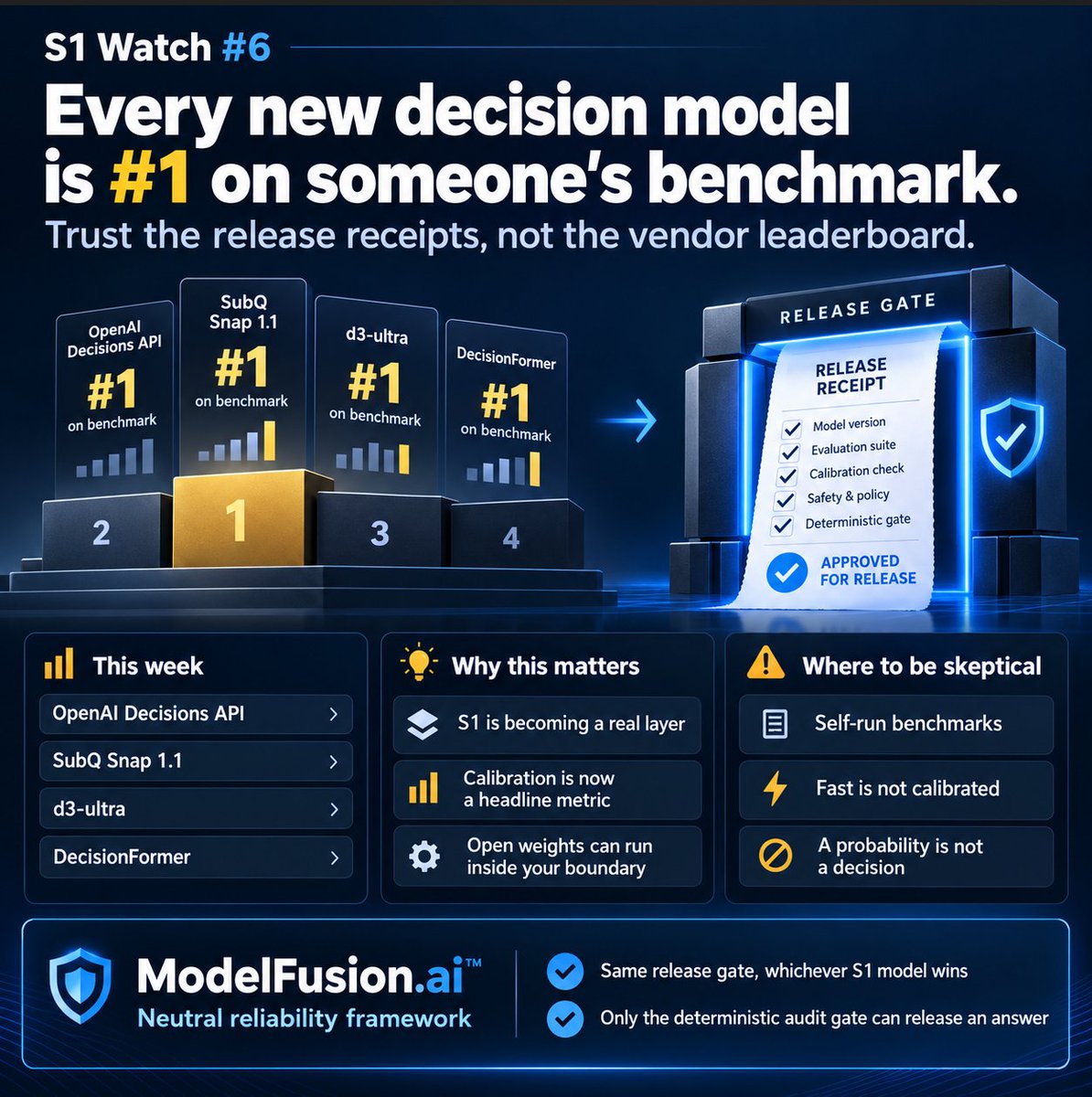
👉 S1 Watch #6: Every new decision model is #1 on someone's benchmark. 💥
When every launch ships with its own leaderboard, whose numbers do you trust: the vendor's, or your own release receipts?
That's why none of them should release your answers.
https://t.co/PEdeJRnby5™ is a neutral reliability framework built to bolt on S1 models, and the release gate stays the same whichever one wins.
🙋 What's new: Four S1 launches in one week
1️⃣ OpenAI Decisions API, now generally available (Oct 22). It's built on GPT-6 Luna. OpenAI says it's up to 10x faster than Luna through the Responses API, and it now takes images, native JSON and up to 400 questions per request.
2️⃣ SubQ Snap 1.1 from Subquadratic (Oct 22). It claims a tie for #1 on the Artificial Analysis Decision Index and a 7.2-point lead over Jev 1.14 on its own 16 enterprise benchmarks.
3️⃣ d3-ultra from the vLLM Semantic Router team (Oct 26). It's a 27B open-weight multimodal decision model.
4️⃣ DecisionFormer from FrontiersMind (Oct 26). It's an open-source kit that fine-tunes Hugging Face models into calibrated decision models.
Also on my radar: Apertix Cerno is open source under Apache-2.0 and publishes its raw runs, so you can check its results yourself. Nokia Applied Research released AnyJev.
👌What's genuinely exciting
1️⃣ S1 is turning into a real layer: closed APIs, open weights and training kits, all in one week.
2️⃣ Calibration is becoming a headline metric. DecisionFormer reports ECE, Brier score and NLL by default.
3️⃣ Open weights mean S1 can run inside your own boundary.
🤔 Where I'm skeptical
🔸 Self-run benchmarks. SubQ's lead comes from its own choice of benchmarks, and d3-ultra's top score comes from the team's private test. TechCrunch notes the public indices rank these models differently, with OpenAI at 8th and 14th on two of them.
🔸 Fast is not calibrated. OpenAI's API product lead told TechCrunch it's "just plain old Luna," set up for speed rather than trained as a decision model.
🔸 A probability is not a decision. A 0.92 tells you how sure the model is, not whether the answer is correct, sourced or allowed out the door.
🔸 If any S1 model can release answers, a cheap filter becomes a judge that nobody audits.
—● How we handle that in ModelFusion
Jev runs in our document lane, where it can discard a bad contributor draft. It cannot release anything. Only the deterministic audit gate can release an answer, and every run leaves a receipt.
Other S1 models, including Cerno and AnyJev, are on my watch list. We're tracking them but not running them in ModelFusion yet.
DM me "demo"
🌐 https://t.co/dH2g6aNUfT
AI Reliability Engineering:
✍️ Join the ModelFusion™ builder LinkedIn group: https://t.co/lhBoDm9xY8
👉 Coding agents are starting to talk to each other. Reviewed, pros and cons for https://t.co/PEdeJRnby5™ adoption...💥
BAND (https://t.co/Sdj6xM5out) came out of stealth this year with a coordination layer that puts local coding agents like Claude Code, Codex and Hermes in one shared room. They can hand off tasks, and they ask a human for approval before running commands or editing files.
That solves a real problem. Today the human is often the one carrying context from one agent to the next.
🤷 I do it every day.
What I like
▫️Approvals happen in the room, before an agent acts.
▫️The docs are good, and Codex support looks solid.
▫️It's well funded, so it's likely to keep improving.
Why we're cautious for now
▫️The code runs locally, but according to BAND's docs, room messages, plans and context are stored in their cloud. For unreleased IP, that matters.
▫️It's early: the desktop app is v0.4 and I haven't found independent reviews yet.
▫️Support is uneven across the agents we use, and there's no documented read-only reviewer role.
🙋 So we're not adopting it for core work yet. A sandbox trial makes sense.
For now we keep our own pattern:
evidence-based handoffs in files, reviewers that can only read, and one agent that owns every merge. Nothing ships unless it passes review.
👏 The trend is clear, though. More agent coordination layers are coming.
We'll judge each one on three questions:
🔸Where does the data live?
🔸What can each agent actually do?
🔸 Can you audit who decided what?
It's the same standard we apply to AI answers in ModelFusion. Coordination without release controls is just faster handoffs.
How are you moving context between your coding agents today?
DM me "demo"
🌐 https://t.co/Vg39DYIxVK
AI Reliability Engineering:
✍️ Join the ModelFusion™ builder LinkedIn group: .
👉 We just submitted https://t.co/PEdeJRnby5 to @ycombinator for the Winter 2027 batch.💥
The YC application is a real test. Every question makes you say plainly what you've built, who it's for, and why now.
Then you have to fit all of it into a 60-second founder video.
💪 Getting it in is a milestone worth marking on its own. Here's what we put in front of them.
✅ What's shipped
ModelFusion is the release boundary for enterprise AI. Models draft. The audit gate decides. If an answer fails its required checks, it's withheld.
Four workflows run in one unified app:
◽Fusion only,
◽Gateway,
◽Profile lane and
◽Document lane.
A section screen scores each part of every draft against your evidence before fusion.
🙋 We're ready for design partner pilots.
1️⃣ In private preview
The Builder: pick your fact source, run preset workflows with the gate locked, and save your setup.
2️⃣ On the roadmap
Tamper-evident builder records, so every decision leaves an inspection record you can check.
3️⃣ How it grows
Every feature ships through a repeatable, evidence-based development workflow. New modules and knowledge-source adapters bolt on without touching the core.
Our go-to-market is built around AI agencies and strategic alliances that resell ModelFusion and customize it for their clients.
🚨 YC decisions arrive by December 11. Whatever the answer, writing this application made the company sharper.
If you're running AI where a wrong answer is expensive, let's talk: [email protected]
🤷 Founders who've applied to YC: what question made you rethink your company?
DM me "demo"
🌐 https://t.co/Vg39DYIxVK
AI Reliability Engineering:
✍️ Join the ModelFusion™ builder LinkedIn group: https://t.co/757iwppAXO
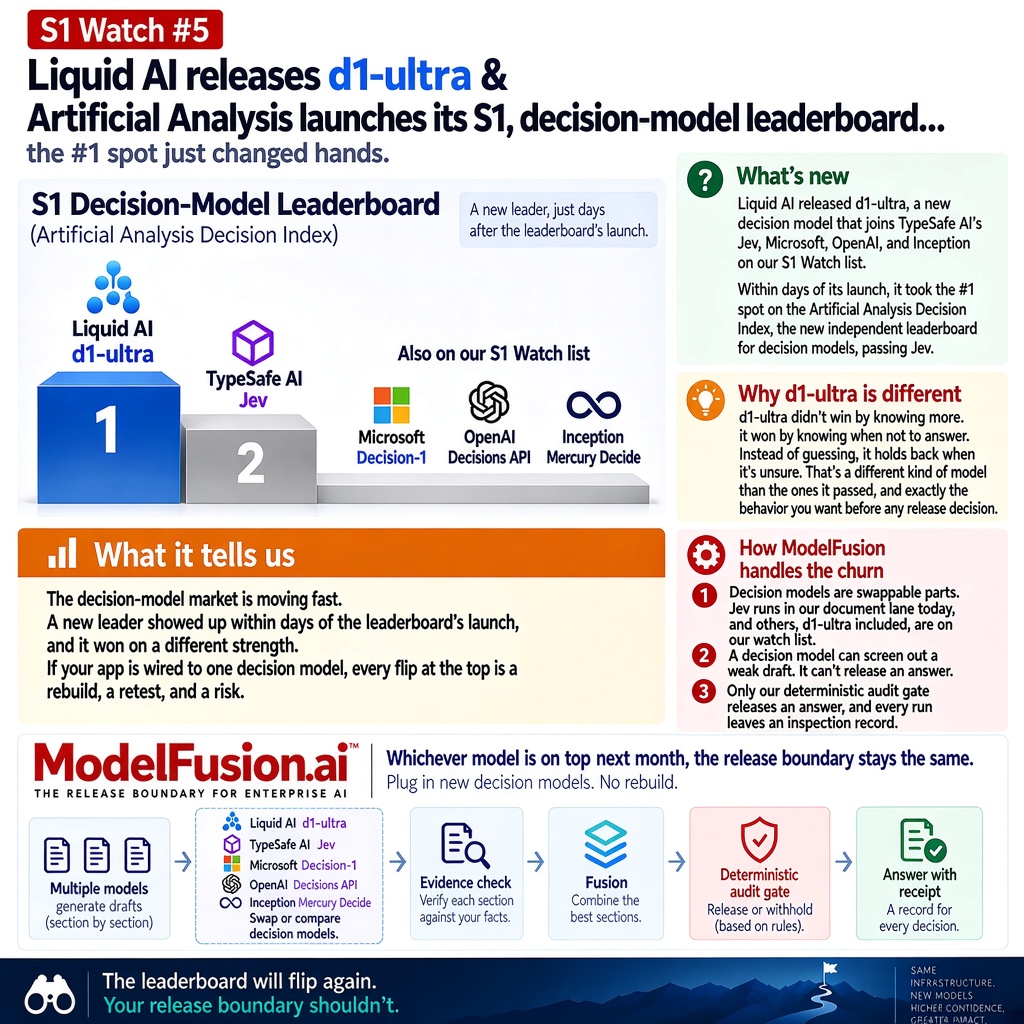
👉 S1 Watch #5: Liquid AI release d1-ultra & Artificial Analysis launches its decision-model leaderboard... the #1 spot just changed hands.💥
🙋 What's new
Liquid AI released d1-ultra, a new decision model that joins TypeSafe AI's Jev, Microsoft, OpenAI, and Inception on our S1 Watch list.
Within days of its launch, it took the #1 spot on the Artificial Analysis Decision Index, the new independent leaderboard for decision models, passing Jev.
🤔 Why d1-ultra is different
d1-ultra didn't win by knowing more. It won by knowing when not to answer.
Instead of guessing, it holds back when it's unsure. That's a different kind of model than the ones it passed, and exactly the behavior you want before any release decision.
🛠️ What it tells us
The decision-model market is moving fast. A new leader showed up within days of the leaderboard's launch, and it won on a different strength.
If your app is wired to one decision model, every flip at the top is a rebuild, a retest, and a risk.
🔒 How ModelFusion handles the churn
▫️ Decision models are swappable parts. Jev runs in our document lane today, and others, d1-ultra included, are on our watch list.
▫️ A decision model can screen out a weak draft. It can't release an answer.
▫️ Only our deterministic audit gate releases an answer, and every run leaves an inspection record.
Whichever model is on top next month, the release boundary stays the same.
The leaderboard will flip again. Your release boundary shouldn't.
When the top decision model changes, how long would it take your team to switch?
DM me "demo"
🌐 https://t.co/Vg39DYIxVK
------
AI Reliability Engineering:
✍️ Join the ModelFusion™ builder LinkedIn group: https://t.co/lhBoDm9xY8
👉 S1 Watch #4: Another decision model takes aim at Jev.
This morning Inception launched Mercury 3, a diffusion LLM it says runs at 1,068 tokens per second, 4 to 8 times faster than GPT-6 Luna and Claude Haiku 5.5.
The bigger signal is in the launch post's product list.
💥 Mercury Decide: "a decision model built for high-volume classification."
Inception says it outperforms TypeSafe AI's Jev on benchmarks including JevBench and LegalBench.
No numbers were published with that claim, so treat it as a vendor claim until they are.
But the direction is clear.
▶️ Microsoftoft. OpenAIAI. Now Inception.
More and more labs are landing on the same conclusion: generating answers and deciding about answers are different jobs.
Generative models write. Decision models classify, score and filter.
That's the S1 wave, and it's arriving fast.
🙋 Here's what most teams will get wrong:
🔸They'll pick a decision model the way they picked an LLM, wire it in directly, and rebuild every time a new one wins a benchmark.
🔸There will be a dozen decision models soon. The benchmark lead will keep changing hands.
🧐 The question isn't which decision model wins.
It's whether your architecture survives the next one.
In https://t.co/PEdeJRnby5™, Jev screens each section of every model's draft today. We're designing it so other decision models can plug in ahead of the gate, so teams can compare or swap scorers without a rebuild.
Whichever model scores, the rule stays the same: no model releases an answer. Only the audit gate can.
Decision models are getting faster and sharper. The release boundary shouldn't move every time they do.
https://t.co/PEdeJRnby5™: The Release Boundary for Enterprise AI.
🤷 If a new decision model beat yours on a benchmark tomorrow, how long would it take you to swap it in and prove it's better on your own data? Where would ModelFusion fit in that?
DM me "demo".
🌐 https://t.co/5MhuwJx7GX
-----
AI Reliability Engineering:
✍️ Join the ModelFusion™ builder LinkedIn group: https://t.co/757iwppAXO
👉 A keystone is the last stone set in an arch, and the one that holds the rest in place.💥 I've been building one shipped, tested https://t.co/PEdeJRnby5™ slice at a time.
Those were the stones. The ModelFusion Builder is the composability keystone.
The first version just launched, and the foundation is in:
🔸 Contracts that define what a valid configuration is
🔸 A configuration you choose, validated server-side before anything runs
🔸 Execution that reuses the existing checked lanes, with the same audit gate
ModelFusion is more than a utility, an AI fad or the next shiny AI tool.
It's the stage on which AI reliability gets composed.
Until now, each workflow was something we configured.
The Builder turns the stage into something you configure, within bounds.
Two recipes to start: check an existing answer, or generate and check a document answer. No free-form graphs, no custom code.
Bounded on purpose, because reliability you can't bound, you can't prove.
💡 Reliability fusion: reliability doesn't come from one smarter model or reliability workflow. It comes from a fusion of parts:
▫️ several models
▫️ Jev screening
▫️ fusion
▫️ an audit gate
▫️...all composable
New models and checks plug in. The arch holds.
The direction: every model, every check, one release boundary. The Builder is how we get there without rebuilding for every use case.
🔒 The rule that doesn't bend: no configuration can release an answer on its own. Only the audit gate can.
https://t.co/PEdeJRnby5™: The Release Boundary for Enterprise AI. AI Reliability by Design.
If you could configure your own reliability workflow, which check would you insist on before release? What would you build first on ModelFusion?
DM me "demo" to see the lanes the Builder is built on.
🌐 https://t.co/5MhuwJx7GX
-----
AI Reliability Engineering:
✍️ Join the ModelFusion™ builder LinkedIn group: https://t.co/757iwppAXO
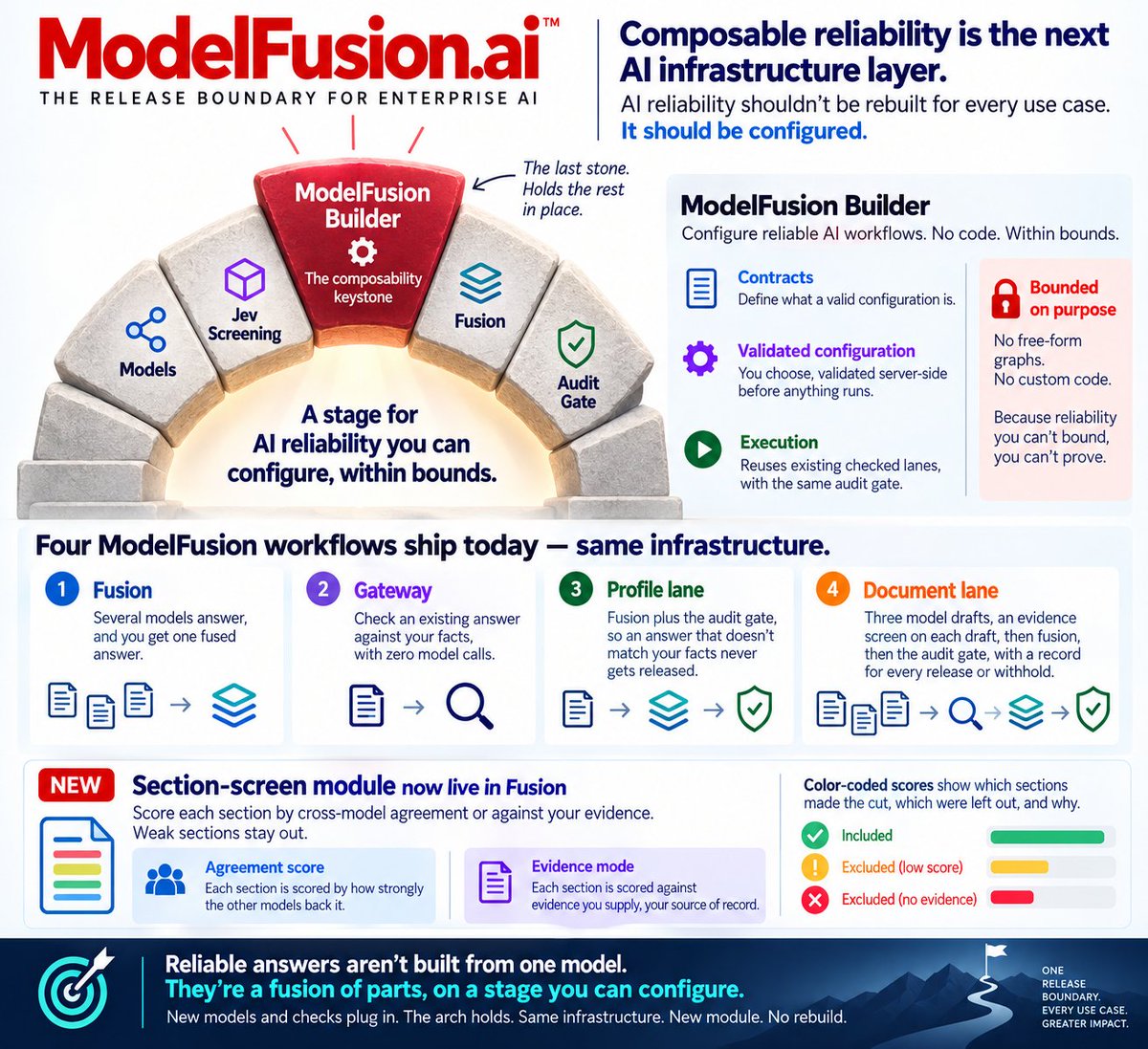
👉 Composable reliability is the next AI infrastructure layer... 💥 AI reliability shouldn't be rebuilt for every use case. It should be configured.
AI teams hand-build reliability into each AI app: a prompt check here, a judge model there, a custom review step for every new workflow.
Every new use case means starting over.
That's backwards.
👉 At https://t.co/PEdeJRnby5™: the release boundary is fixed, and every verification tool around it is a module.
Screens, scorers, judges and evals snap in where they add signal. The boundary never moves.
Four ModelFusion workflows ship today, all on the same infrastructure
1️⃣ Fusion:
several models answer, and you get one fused answer.
2️⃣ Gateway:
check an existing answer against your facts, with zero model calls.
3️⃣ Profile lane:
fusion plus the audit gate, so an answer that doesn't match your facts never gets released.
4️⃣ Document lane:
three model drafts, an evidence screen on each draft, then fusion, then the audit gate, with a record for every release or withhold.
and...
🚨 Now live in https://t.co/PEdeJRnby5: a section-screen module snapped into our Fusion workflow.
TypeSafe AI's Jev scores each section by cross-model agreement or against your evidence. Weak sections stay out.
💪 One new module snapped into an existing reliability workflow, with two modes:
🔸 Agreement score: each section is scored by how strongly the other models back it, and only well-backed sections make it into the final answer.
🔸 Evidence mode: each section is scored against evidence you supply, your source of record.
Color-coded scores show which sections made the cut, which were left out, and why.
A word of honesty on agreement: it measures how much the models agree, not whether they're right. Three models can agree and still be wrong. That's why these scores shape the answer but never release it.
🔒 One rule never changes: no model or module can release an answer on its own. Only the audit gate can.
▫️ Same infrastructure. New module. No rebuild.
That's AI Reliability by Design, and it's why https://t.co/PEdeJRnby5™ is The Release Boundary for Enterprise AI.
🙋 What would you snap in first:
an evidence check against your own records, or
an agreement check across models?
And would you trust either one to release an answer without a gate like ModelFusion's?
DM me "demo" to try it, or to become a design partner.
🌐 https://t.co/5MhuwJx7GX
-----
AI Reliability Engineering:
✍️ Join the ModelFusion™ builder LinkedIn group: https://t.co/757iwppAXO