A remarkable achievement 🇵🇰
#PIEAS has surged to 560th position in the QS World University Rankings, up from the 721–730 band, making it the 3rd highest-ranked university in #Pakistan.
#PakistanForPeace#pakistangoesglobal
CISSS Publication | Modern Diplomacy
Op-Ed | Rethinking Chemical Weapons Governance in the Age of AI
Author: Research Assistant Onzila
Link ⬇️
https://t.co/UVlM4iyhPr
CISSS Publication | Strategic Forecast
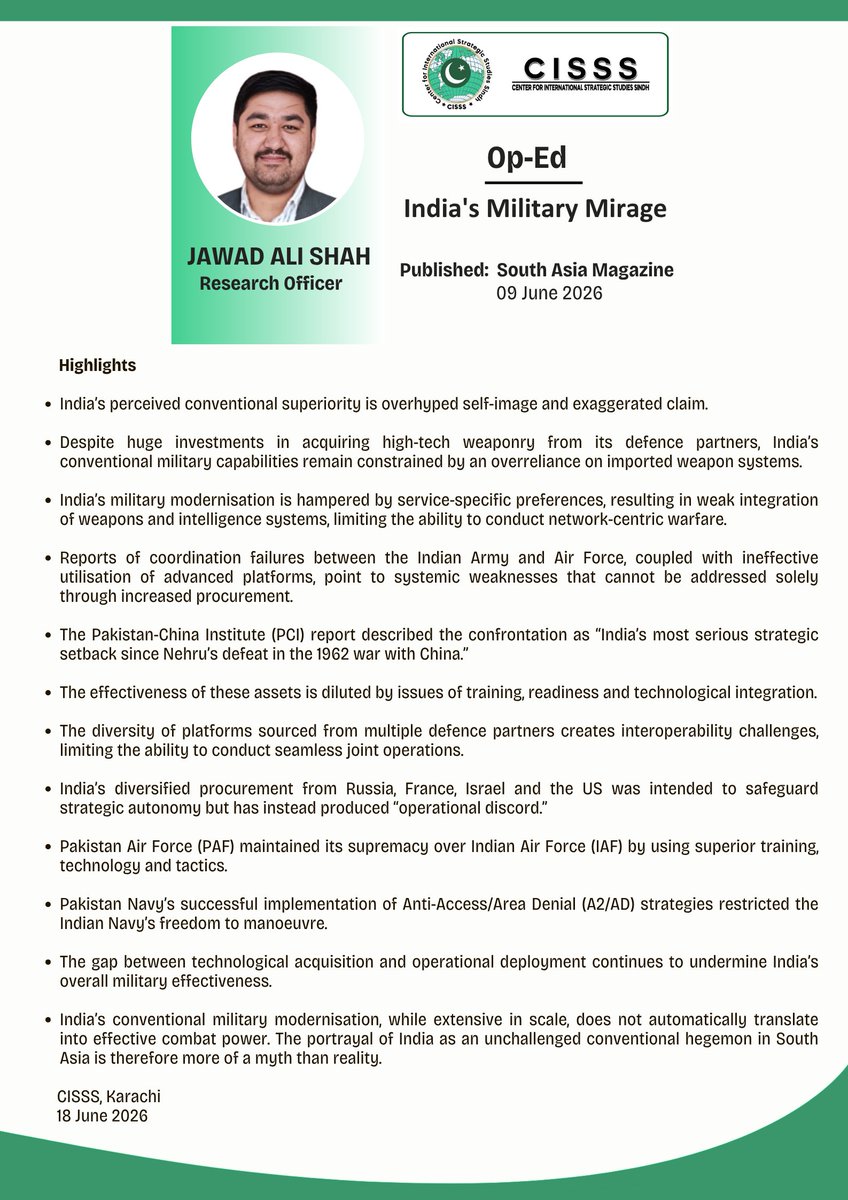
Op-Ed | India’s Military Build-Up: Implications for Regional and Global Security
Author: Research Assistant Sadia Memon
Link ⬇️
https://t.co/12b6EB4A8b
CISSS Publication | International Affairs Forum
Book Review | Age of Deception: Cybersecurity as Secret Statecraft
Author: Research Assistant Ali Hamza
Link ⬇️
https://t.co/GZR4ePQx3a
🚨🇷🇺 BREAKING
Russia has praised Pakistan for its role in helping bring an end to the Iran–US war.
Russia officially recognized Pakistan’s leadership for its efforts in helping save millions of lives by working toward an end to the war.
💣 In December 1964, a senior U.S. Defense Department official wrote a secret memo titled The Indian Nuclear Problem.
One key assessment was stark:
“One consequence of an Indian program is that one more national state, India, could some day be able to attack the United States with nuclear weapons.”
Source: Declassified DoD memo by Henry S. Rowen, 24 December 1964 https://t.co/RyGWWXtwlW
1/7
@RadioactiveFrnd@CISS_Islamabad@ciss_ajk@CISSS_Karachi@bttn_quetta@SVI_Pakistan@IDSAIndia@orfonline@TahirAndrabi
CISSS Publication | Islamabad Policy Institute (IPI)
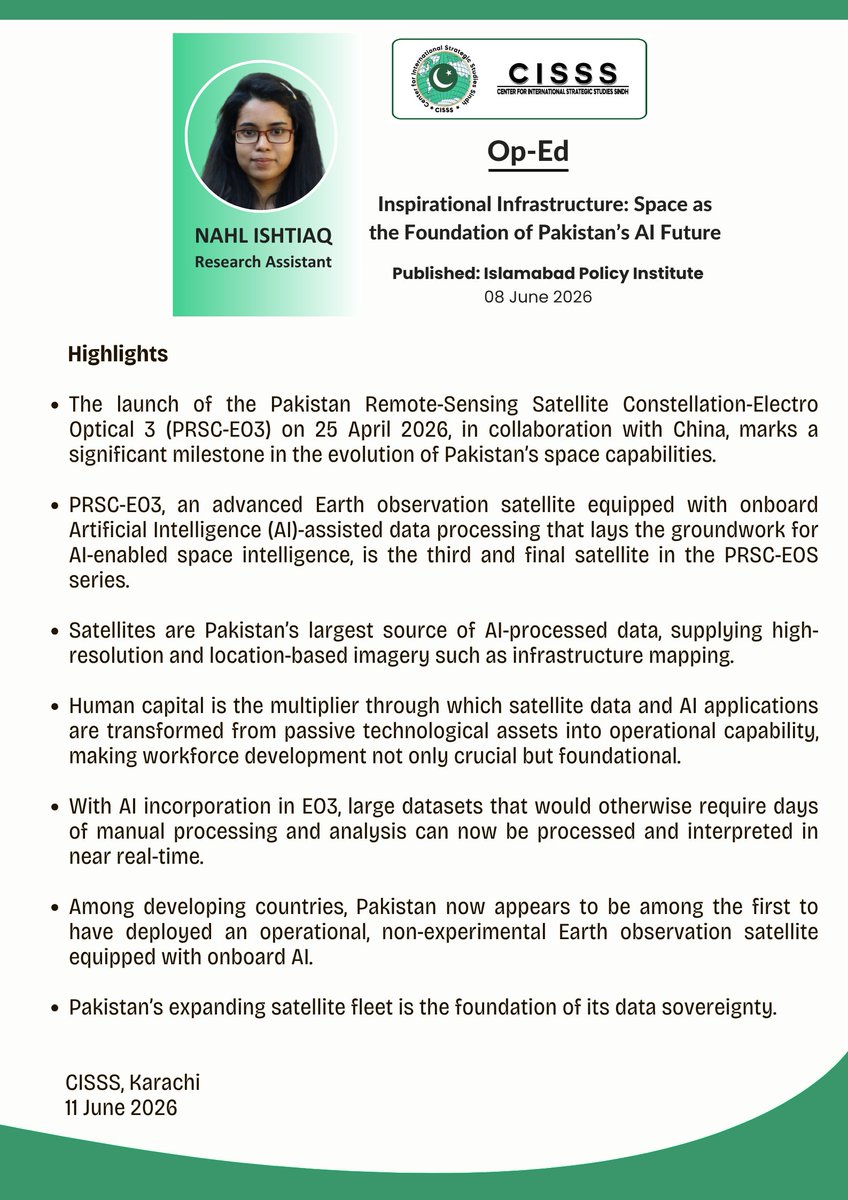
Op-Ed | Inspirational Infrastructure: Space as the Foundation of Pakistan’s AI Future
Author: Research Assistant Nahl Ishtiaq
Link ⬇️
https://t.co/cSp8FGhJOu
SIPRI is not accusing recklessness. It is documenting a clear directional shift toward operational mating and deployed warheads.
When the data finally catches up with observable reality, the old narratives collapse. South Asian stability deserves accurate assessment, not comforting assumptions.
What does this do to Western calculations of Indian reliability?
#SIPRI #NuclearPosture #ArmsControl
9/9
@RadioactiveFrnd@AsmaKhawaja5@zafar_jaspal@SVI_Pakistan@IDSAIndia@StimsonCenter@SIPRIorg
This is not new. I have tracked canisterisation enabling mated ready-to-launch status, SSBN expansion creating operationally ready second-strike options, and the broader move beyond minimum deterrence for some time.
SIPRI 2026 provides external confirmation.
Read the earlier analysis here: https://t.co/0fU37ccvMX
#Deterrence #StrategicStability
8/9
@CISS_Islamabad@BrunoTertrais
Those who treat #India as a stable, responsible nuclear state should take note.
Partnerships, technology transfers, and security frameworks rest on assumptions about restraint and transparency. SIPRI’s data shows those assumptions are drifting. The credibility gap is now quantifiable.
https://t.co/mRG5jQ0P32
#IndoPacific #NuclearRisk
7/9
SIPRI relies on open sources: satellite imagery, force structure observations, fissile material estimates, and deployment patterns. India offers almost no transparency.
When a respected neutral institute finally counts deployed warheads, it exposes how much the previous “recessed deterrent” story depended on opacity.
It is empirically testable Indian behaviour - with external partners’ help they deny existence of doctrines and capabilities once these are in works and claim it once it firmly in place. They denied existence of Cold Start Doctrine over a decade 2003 ~ 2015 and then owned the failed doctrine.
https://t.co/NTaI9qj09H
#Transparency #NonProliferation
5/9
My assessment has always gone further than SIPRI’s safe bet on submarines.
A portion of India’s land-based forces is also maintained ready. Canistered Agni missiles sit in ready-to-launch condition with mated warheads in survivable hardened sites. It is observable. It increases pre-emption confidence.
See: https://t.co/0fU37ccvMX
#Agni #ReadyArsenal
4/9
In Subcontinent’s compressed nuclear geography the dynamic is more ambiguous and potentially more dangerous.
Partner-enabled ISR density, real-time data fusion, precision integration and multi-domain layering on one side of an asymmetric nuclear flashpoint do reduce traditional uncertainty. But they also compress political-military decision timelines, multiply options under pressure, blur warhead discrimination with dual-capable systems, and can foster overconfidence in escalation dominance or “clean” limited options beneath the nuclear threshold. Recent crises have shown how rapidly margins tighten once high-end capabilities engage.
Mutual vulnerability remains the prerequisite for restraint; engineering it away narrows rather than widens stability. External defence-technology partnerships that accelerate one side’s concurrency and operational resilience therefore carry systemic consequences for deterrence geometry in the other theatre. Capability enablement without parallel investment in speed-calibrated crisis guardrails and dispute resolution does not stabilise; it strains.
Strategic stability here is managed through credible equilibrium, not assumed through technological density alone.
Hope it answers your question 😊
Apples and oranges — and a losing strategy from the start, @Ahlawat2012.
It was never “AQK’s network.” A transnational nuclear black market with at least 36 players — companies & middlemen across 20+ countries. AQK was one independent operator among them. He was caught, confessed, indicted; known gaps plugged. Evidence the other players are inactive and punished? Still thin.
@Joshua_Pollack in Playboy + @PerkovichG Carnegie event: India was the network’s “fourth customer.” Pakistan state would never sponsor tech to any country, especially India. AQK operated independently.
Main issue: SIPRI’s ~12 deployed warheads is a minimal estimate of ready/operational forces. Real capability via SSBNs’ carrying capacity + land-based deployment is substantially higher.
Playboy: https://t.co/W5V6VQHjkT
Carnegie: https://t.co/BarNQqQLHU
SIPRI links the change to canistered missiles and sea-based deterrence patrols. It assesses that a small number of warheads may now be mated aboard an SSBN during occasional patrols, with “considerable uncertainty.”
Even this cautious assessment destroys the old de-mated assumption.
https://t.co/bnzu12XIeR
#SSBN #NuclearPosture
3/9
@the_hindu@dgprPaknavy@sufianullah@IndiannavyMedia
SIPRI’s own words: “…India may now occasionally deploy a small number of warheads mounted on missiles during peacetime.”
India’s stockpile stands at ~190 warheads, with 12 now counted as deployed. This is the first time West places India in this category. The shift is measurable.
https://t.co/UO5wDekS9K
#ArmsControl #IndiaNuclear
2/9
@CISS_Islamabad@SVI_Pakistan@Dr_NaeemSalik