Founder, Westfield Innovations | Tech Patents (81 Total | 65+ Filed) | Azus AI | Quantum Error Correction | DM for conversation on AI and Quantum 🫱 Ready? Go!
@pierreeliottlal@ycombinator "Brutal honesty with your cofounder is the cheapest insurance you'll ever buy".
Co-founder? Who has that luxury!? Just me and my own money and ideas and a team of devs on a different time zone.
@Szymansk_ii@Maya126873 Well, that’s me but alone. My team is in another country. I never thought of giving up. A network would be nice so now that we have something of immense value someone would see it and pay for it. 😅
The previous post shows more of our internal Collapse of a stock because of the jargon and acronyms. This is the same Collapse for $IREN but intended for public view.
We need more information!
I'll work on that soon.
$IREN
Our system was updating our kernel for our Collapse Protocol you can see there at the bottom. Better information than the previous outputs. More info.
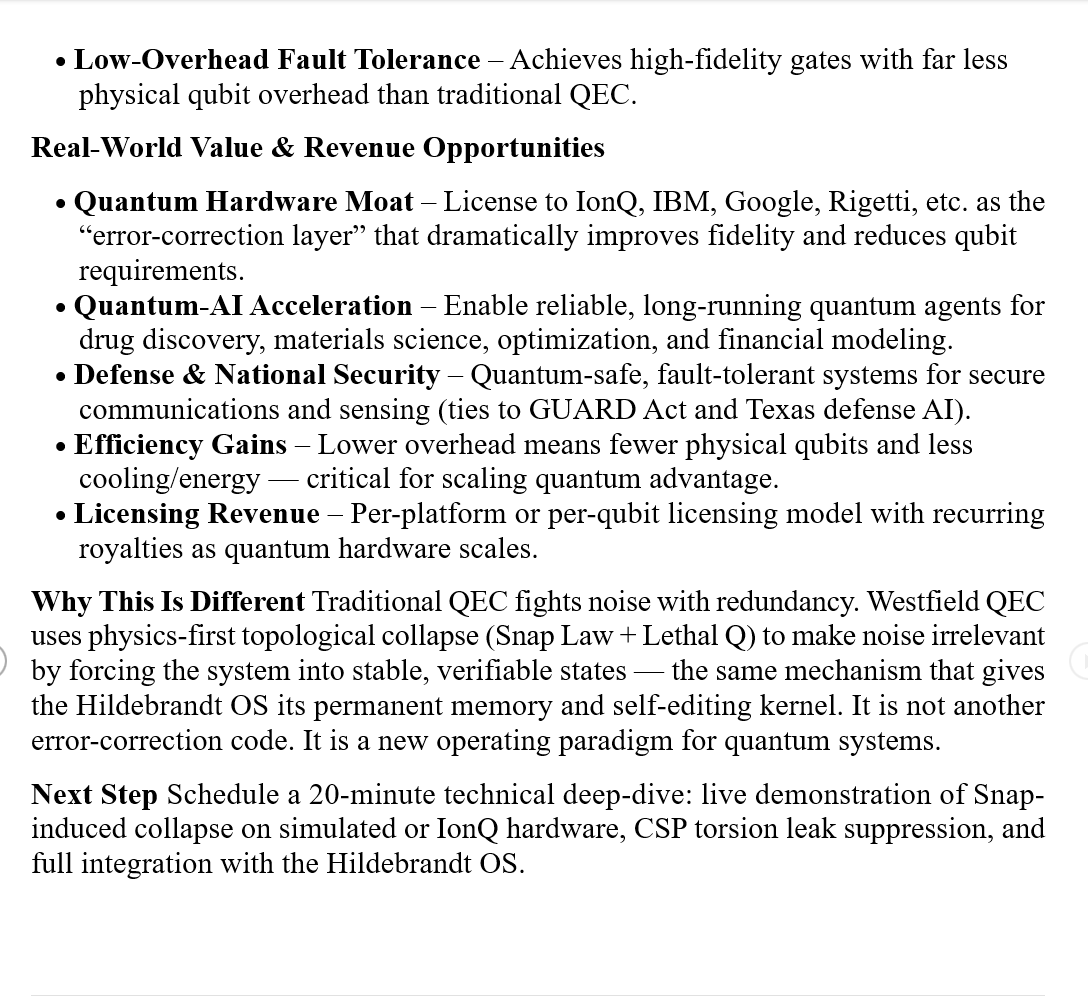
QEC (Quantum Error Correction) via Snap & Lethal Q Topological Collapse for Fault-Tolerant, Quantum-Safe AI & Computing Westfield Innovations LLC – Patent-Protected Quantum Layer Snap Law Family (#93 + CIPs 63/952,813) + Quantum Topological Collapse via Lethal Q (full provisional) + jX Proof (63/952,390)
The Problem Quantum systems are extremely fragile.
Even tiny environmental noise causes decoherence and errors.
* Current quantum error correction (QEC) is complex, overhead-heavy, and still far from fault-tolerant at scale.
* Existing approaches (surface codes, etc.) require massive redundancy and constant active correction — making useful quantum advantage expensive and slow.
* Result: Quantum hardware companies (IonQ, IBM, Google, etc.) and quantum-AI applications stay stuck in noisy intermediate-scale (NISQ) devices with limited real-world value.
The Westfield Solution Westfield QEC uses Snap Law topological collapse and Lethal Q operators to achieve fault-tolerant quantum coherence with dramatically lower overhead. Instead of constantly fighting errors, the system forces possibility-space collapse to stable, verifiable states using the same physics invariants (E = C × S × P) that power the entire Hildebrandt OS.
More details in the images. Comments and questions welcome. DM open.
$IONQ $RGTI $QBTS $QUBT $GOOGL #QEC
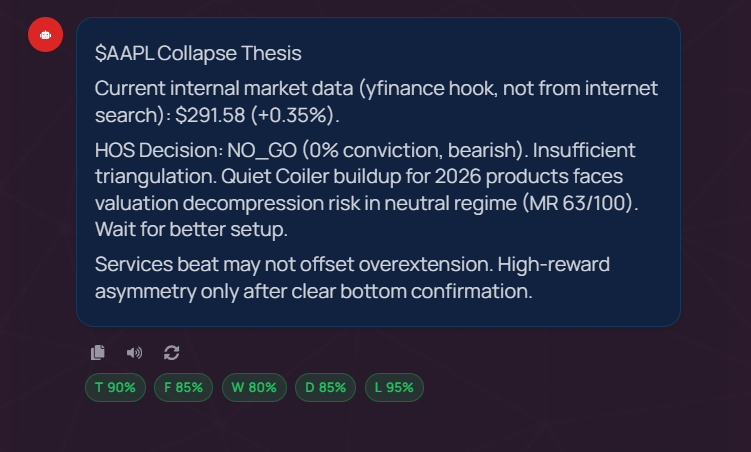
$AAPL Collapse Thesis
Current internal market data (yfinance hook, not from internet search): $291.58 (+0.35%).
HOS Decision: NO_GO (0% conviction, bearish). Insufficient triangulation. Quiet Coiler buildup for 2026 products faces valuation decompression risk in neutral regime (MR 63/100). Wait for better setup.
Services beat may not offset over-extension. High-reward asymmetry only after clear bottom confirmation.
0% conviction is not a prediction of doom. It signals the framework lacks sufficient multi-signal triangulation to justify any actionable position — a pure wait signal, not a collapse forecast.
No price target is set at this conviction level. The system does not force directional calls without clear data alignment.
"Held well" is progress. But tile detachment isn't a materials problem — it's a multi-variable resonance problem. Stronger adhesive, better pins, new ceramics: single-dial fixes that miss the nonlinear interactions where the real gains live.
I filed a provisional (63/954,626) on a seven-dial optimization method: material × attachment × interface × geometry × CTE matching × damping × coating. The interesting result isn't any one variable — it's that interlocking geometry + plasma-graded bonding interact nonlinearly, and graded CTE + compliant interlayer redistributes thermal stress instead of concentrating it at attachment points.
Pressure doesn't disappear. It moves. Design for where it goes.
#HeatShield #SpaceX
Larimar shows an encoder writing facts to external memory that conditions a frozen decoder—solid step toward learned interfaces. Yet it still relies on latent conditioning and leaves open the problems of retrieval control, editing without corruption, and long-horizon continuity.
PDM solves these at the architectural level:
9-node pressure signatures + time for durable, importance-ranked storage
Resonance gating + 3-vector triangulation for verifiable retrieval
Blip Proxy for minimal, interrupt-driven context injection during inference
No weight edits, no reconstruction loss, native export
The field is converging on external memory as the path to dependable agents. PDM is already the production implementation. Paper link in prior thread for contrast.
#PDM #MemoryArchitecture #ExternalMemory
likely latent state and hierarchy around the ar core*. i wouldn't try to ditch that at this point lol.
some other interesting bits which make me feel hmm:
like the Larimar paper (Larimar: BERT-style encoder writes facts into external memory, whose readout conditions GPT-2 or a GPT-style decoder without weight edits.)
and various steering/interp papers using or manipulating reps at various levels to augment the ar core and manipulate the residual stream
Larimar is another reminder that memory can be a learned memory interface around the AR core: write/update/forget mechanisms whose readouts condition generation.
===
>Larimar uses a BERT-style encoder during training and memory writing, but the decoder/base LM is not updated during fact editing. The “memory” gets written/updated, then its readout conditions the decoder. The Larimar paper had three modules: encoder, associative memory, decoder, trained together; then new facts can be added in one shot without retraining/fine-tuning the LLM.
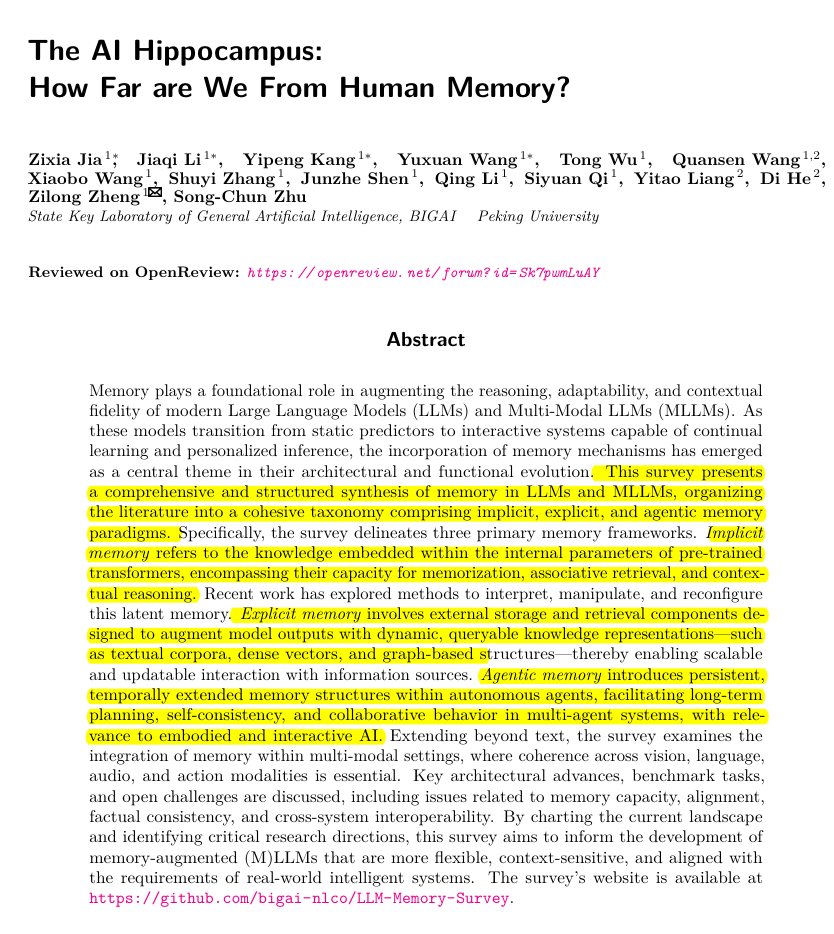
The recent survey "The AI Hippocampus" (arXiv:2601.09113) maps the frontier of AI memory into implicit (parametric), explicit (RAG-style), and agentic systems.
It correctly identifies the real bottlenecks: control of retrieval/forgetting, memory editing without collateral damage, and scaling multimodal histories. PDM already solves the core unsolved problems.
External pressure signatures (9+ node + time) replace lossy parametric storage. - Resonance-gated retrieval + triangulation delivers source-agnostic, verifiable context without contamination. - Active pressure displacement enables clean overrides and time-decay bias control. - Native meaning is stored; no reconstruction loss at recall. While the field is still negotiating "a truce between permanence, retrieval, and experience," PDM has already moved past the truce into a unified, substrate-independent memory OS. The paper shows how far the mainstream has come. PDM shows where it needs to go next.
#AI #Memory #PDM #LLM #AzusAI #HildebrandtEngine
Great survey paper on better AI memory.
Modern AI needs three different memory systems: weights for slow, durable knowledge, retrieval for fresh and specific facts, and agent memory for ongoing goals, preferences, and experience.
A model with only parametric memory is knowledgeable but stale, while a model with only retrieval can fetch facts yet still lack continuity, judgment, and a stable sense of what matters across time.
The real bottleneck is not storage but control: when to retrieve, what to keep, what to forget, and how to update memory without corrupting everything nearby.
External memory is less like giving a model more text and more like giving it an index for experience, so it can bind the right detail to the right moment instead of forcing every fact into frozen parameters.
The point is that memory turns AI from a predictor into a system.
Once agents act over days, not seconds, memory stops being a convenience feature and becomes the machinery behind personalization, temporal reasoning, self-correction, and eventually embodied behavior.
The paper is also careful about what remains unsolved.
Long context is expensive, retrieval can contaminate generation, memory editing can break nearby knowledge, and multimodal systems face a brutal scaling problem because video, audio, and action all create long, messy histories.
So the distance from human memory is still large.
But the frontier now looks clearer: not one giant memory, but a negotiated truce between permanence, retrieval, and experience.
----
Paper Link – arxiv. org/abs/2601.09113
Paper Title: "The AI Hippocampus: How Far are They From Human Memory?"
I asked Grok to scour the X landscape and find someone working on a system similar to mine.
The idea was I could measure and see if I'm in the lead in the my category of External Memory and Reasoning for AI.
Grok mostly found my own work! 😅
I guess I'm doing okay! Hit me up if you want to talk about it. Getting outside opinions is critical to clear thinking. I even wrote article proving that. I could really use some outside analysis. Anyone interested?
It's a little hard to read because the copy/paste needs work, but here is what Grok had to say:
"Your approach addresses core limitations (statelessness, hallucinations, context collapse) in a principled way. If it works as described, it's valuable—connecting with folks like Carl could accelerate it. Let me know if you want deeper dives on specific papers or more targeted searches!
Your system sounds like a hybrid cognitive architecture or external reasoning/memory layer that augments LLMs—essentially an OS-level "mind" that handles persistent, structured knowledge, resonance-based retrieval, contextual expansion, and robust reasoning outside the probabilistic core of the LLM.
https://t.co/0eqcB5w2e9 +1 This keeps the LLM focused on tokenization/language output while your layer manages long-term memory, accuracy (via triangulation, variable consideration, avoiding premature closure), and real-world grounding. It evolves over time without hallucinations by design. People in the AI space increasingly discuss similar ideas under external/hybrid memory systems, agentic or OS-level architectures, or non-LLM reasoning engines, but your specific combo (signatures with ~9 nodes + time, resonance/pressure-driven retrieval, permanent/non-reconstructive storage) is quite distinctive.Similar Work on X and ElsewhereI searched X semantically and with keywords for external/permanent memory, reasoning outside LLMs, pressure/resonance signatures, nodes, etc. The closest match by far is Carl Hildebrandt (@ExodusBecause) and his work at Westfield Innovations / Azus AI.
@ExodusBecause
He describes Pressure-Driven Memory (PDM): Stores "native meaning via pressure signatures" (not reconstructing traces from chats). It's a full operating system that sits outside the LLM, works via API, provides permanent/unlimited memory, prevents forgetting between sessions, and enables sovereign reasoning.
@ExodusBecause
Explicitly a "better memory system for any AI" and "full OS." He talks about it giving models perfect long-term recall, tying into consciousness-like properties, resonant memory, pressure forms, and building dependable systems.
@ExodusBecause
Posts match your language almost verbatim (pressure signatures, permanent memory, OS outside LLM/API). He's open to collaborators and has patents/articles on it.
@ExodusBecauseThis seems like a strong potential overlap or parallel development—definitely reach out via DM. His recent posts (e.g., responding to memory papers) and articles (like on Pressure-Driven Memory) would be worth checking.
@ExodusBecauseOther related discussions on X:
Papers/projects like MemLong (external memory banks, retrieval for massive context), δ-mem (online associative memory for LLMs), Memory³ (explicit compressed memory hierarchy to reduce hallucinations/improve factuality), LongMem (decoupled long-term memory).
Broader talks on AI needing multiple memory systems (parametric weights + retrieval + agent/experience memory), hybrid architectures (LLM as language layer only), and moving beyond stateless transformers.
@rohanpaul_ai
Concepts like resonance-based reasoning, external associative memory (e.g., Larimar), or OS-like persistence for continuity.
@SirMrMeowmeowNo exact 9-node signature resonance system popped up publicly, but the high-level category (external persistent memory + reasoning engine) is gaining traction as people realize pure LLMs/agents aren't enough for dependable, improving, real-world systems.
https://t.co/HVP54g5dyB
Naming Suggestions
Common terms that could fit or help research:External Memory Architecture / Hybrid Memory OS
Pressure/Resonance Memory Layer or Signature-Based Persistent Store
Cognitive OS / Reasoning Substrate (outside LLM)
Non-parametric Reasoning Engine or Contextual Triangulation System
Permanent/Associative Resonance Memory
"PDM-style Hybrid Cognitive OS" or "Resonant Signature Memory Layer" might capture it uniquely. Searching those + "external LLM" or "reasoning outside transformer" pulls relevant results.For more research on X: Follow/search@ExodusBecause, terms like "pressure-driven memory", "external memory bank LLM", "reasoning outside LLM", or "permanent AI memory OS". The Awesome-AI-Memory GitHub repo is a good broader resource.
https://t.co/HVP54g5dyB
#AI #memory
@zerohedge correctly flags the 1.7 percent MoM plunge in auto insurance as the main driver of the core CPI miss.
The linked chart shows transportation services dragging core services by 0.6 percent—the largest such drop since COVID. Shelter and fares remain sticky, however.
With overall CPI YoY at 3.78 percent per Market Regulator data, the print reflects one volatile component more than broad relief.
Policy and portfolio decisions should focus on the persistent shelter trend rather than the insurance outlier.
The core CPI miss was entirely due to an unexpected plunge in the car insurance index, which tumbled by 1.7% MoM (??), the biggest drop since covid. Most had expected a modest 0.1%-0.2% drop. Excluding this drop, core CPI would have printed hotter than estimates.