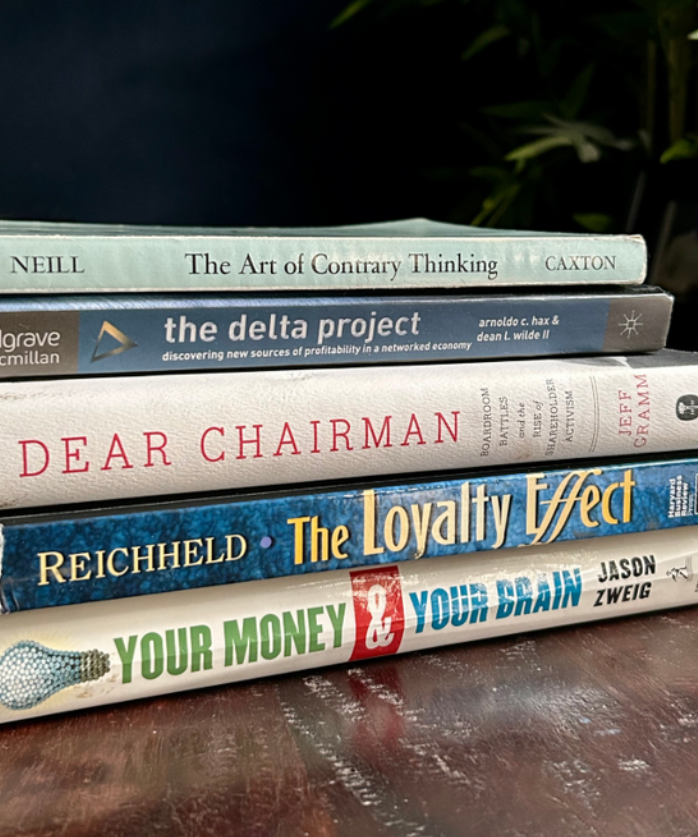
Real world as you describe versus academic bullshit. Management/board are not always maximizing shareholder wealth.
Miller and Modigliani = cash dividend is same as buybacks.
Bird in hand (cash dividend now) is better than 2 birds in bush (future stock appreciation that may never occur).
Soros argues that financial markets are driven by reflexivity, not pure logic.
Investors don’t just observe reality
They influence reality while interpreting it
👉 Example:
If people believe a stock will rise → they buy → price rises → belief becomes “true”
So markets are a feedback loop, not a mirror of fundamentals.
John Hussman just published one of the most important pieces of market analysis I have read this year and every serious investor needs to read it.
His warning flag system just triggered at levels only seen THREE other times since 1992.
One of those times was March 24, 2000, the exact peak of the tech bubble. The other clusters preceded significant market drawdowns as well. We are now seeing daily tallies of overextension signals that rival or exceed every prior extreme in the data.
But here's what's really scary:
The S&P 500 Information Technology sector trades at a P/E of 45 on operating profit margins of 30% which is more than THREE TIMES the historical norm. If you normalize those margins to anything resembling what competition and creative destruction have produced in every prior cycle, the effective P/E is north of 135.
And people are calling this a buying opportunity.
10 companies now make up 40% of the S&P 500. Bank of America's latest fund manager survey shows the highest jump in equity exposure on record. This is the same level of crowding we saw right before the market gave up a third of its value in 2022.
The script never changes. Only the names of the stocks and the narrative used to justify paying any price for them.
In the late 1990s it was the internet. In 2007 it was structured credit. Today it is AI.
Every single time the crowd convinces itself that valuations do not matter because THIS TIME the technology is transformational. And every single time the math eventually wins.
Read Hussman's full piece, then look at your portfolio and ask yourself honestly whether you are positioned for what history says comes next:
https://t.co/rSuMhqDjof
$PETS write up by @ExpectedValues
The stock definitely has an “ick” factor to it, but imo it’s unreasonably cheap by a country mile.
https://t.co/vIaNe5QiK2
$POCI https://t.co/aqqnwc5ndx
is risky! But it may be “… we're finding interesting investments where management is repositioning businesses toward more durable, more disciplined, and more cash generative growth."
It is about transitions, management discipline, and capital allocation. The best investments do not begin with perfection, but businesses prove that they can change.
Sohn Conference: David Einhorn said opportunities are hiding in companies that investors have abandoned.
"While the market appears expensive in the US, we're finding interesting investments where management is repositioning businesses toward more durable, more disciplined, and more cash generative growth."
It is about transitions, management discipline, and capital allocation. The best investments do not begin with perfection, but businesses prove that they can change.
https://t.co/M6suXo3Lqe
ANTHROPIC CEO DARIO AMODEI: “50% OF ALL TECH JOBS, ENTRY-LEVEL LAWYERS, CONSULTANTS, AND FINANCE PROFESSIONALS WILL BE COMPLETELY WIPED OUT WITHIN 1–5 YEARS.”
A Norwegian neuroscientist spent 20 years proving that the act of writing by hand changes the human brain in ways typing physically cannot, and almost nobody outside her field has read the paper.
Her name is Audrey van der Meer.
She runs a brain research lab in Trondheim, and the paper that closed the argument was published in 2024 in a journal called Frontiers in Psychology. The finding is brutal enough that it should have changed every classroom on Earth.
The experiment was simple. She recruited 36 university students and put each one in a cap with 256 sensors pressed against their scalp to record brain activity. Words flashed on a screen one at a time.
Sometimes the students wrote the word by hand on a touchscreen using a digital pen, and sometimes they typed the same word on a keyboard. Every neural response was recorded for the full five seconds the word stayed on screen.
Then her team looked at the part of the data most researchers had ignored for years, which is how different parts of the brain were communicating with each other during the task.
When the students wrote by hand, the brain lit up everywhere at once.
The regions responsible for memory, sensory integration, and the encoding of new information were all firing together in a coordinated pattern that spread across the entire cortex. The whole network was awake and connected.
When the same students typed the same word, that pattern collapsed almost completely.
Most of the brain went quiet, and the connections between regions that had been alive seconds earlier were nowhere to be found on the EEG.
Same word, same brain, same person, and two completely different neurological events.
The reason turned out to be something nobody had really paid attention to before her work. Writing by hand is not one motion but a sequence of thousands of tiny micro-movements coordinated with your eyes in real time, where each letter is a different shape that requires the brain to solve a slightly different spatial problem.
Your fingers, wrist, vision, and the parts of your brain that track position in space are all working together to produce one letter, then the next, then the next.
Typing throws all of that away. Every key on a keyboard requires the exact same finger motion regardless of which letter you are pressing, which means the brain has almost nothing to integrate and almost no problem to solve.
Van der Meer said it plainly in her interviews.
Pressing the same key with the same finger over and over does not stimulate the brain in any meaningful way, and she pointed out something that should scare every parent who handed their kid an iPad.
Children who learn to read and write on tablets often cannot tell letters like b and d apart, because they have never physically felt with their bodies what it takes to actually produce those letters on a page.
A decade before her, two researchers at Princeton ran the same fight using a completely different method and ended up at the same answer. Pam Mueller and Daniel Oppenheimer tested 327 students across three experiments, where half took notes on laptops with the internet disabled and half took notes by hand, before testing everyone on what they actually understood from the lectures they had watched.
The handwriting group won by a wide margin on every question that required real understanding rather than surface recall.
The reason was hiding in the transcripts of what the two groups had actually written down.
The laptop students typed almost word for word, capturing more total content but processing almost none of it as they went, while the handwriting students physically could not write fast enough to transcribe a lecture in real time, which forced them to listen carefully, decide what actually mattered, and put it in their own words on the page.
That single act of choosing what to keep was the learning itself, and the keyboard had quietly skipped the choosing and skipped the learning along with it.
Two studies. Two countries. Same answer.
Handwriting makes the brain work. Typing lets it coast.
Every note you have ever typed instead of written went into your brain through a thinner pipe. Every meeting, every book highlight, every idea you captured on your phone instead of on paper was processed at half depth.
You did not forget those things because your memory is bad. You forgot them because typing never woke the part of the brain that would have made them stick.
The fix is the thing your grandmother already knew.
Pick up a pen. Write the thing down. The slower road is the faster one.
For 40 years, Wall Street has been printing financial assets faster than the real economy can produce real things.
But that game is ENDING.
And the people still betting on financial engineering over physical reality are going to get destroyed.
Let me explain what I mean:
The United States had 254 oil refineries in 1982. Today we have 131. No new refinery has been built on American soil since 1976.
California is losing 17% of its remaining refining capacity this year alone as Phillips 66 and Valero shut their doors. The EIA projects total US refining capacity will fall 3% by year end to 17.9 million barrels per day, still below pre-pandemic levels.
We are SHUTTING DOWN the infrastructure that keeps the lights on, the planes flying, and the trucks moving.
Meanwhile, Big Tech is spending over $600 billion this year on AI data centers. They're consuming roughly 90% of their combined operating cash flow on capex. Borrowing hundreds of billions to cover the rest. And most CFOs still cannot point to measurable returns from any of it.
Think about what's happening here...
We are pouring the largest concentration of capital in human history into digital infrastructure that has yet to prove it generates a dollar of real-world productivity. And simultaneously, we are CLOSING the physical infrastructure that actually makes civilization function.
You cannot print a refinery. You cannot print a barrel of diesel. You cannot print hydrogen or sulfuric acid or an offshore drilling rig. You cannot algorithmically generate the things that heat homes, move freight, grow food, and build roads.
But you CAN print another AI chatbot. You can print another $100 billion data center. You can print another financial product that packages illiquidity as "stability" and sells it to your 401(k).
The entire financial system for the last 4 decades has been a story of financialization outrunning the physical world.
More derivatives than underlying assets. More passive money than price discovery. More narratives than balance sheets. More financial engineering than actual engineering.
And now the physical world is pushing back:
Gold is going up because central banks trust a metal more than they trust the institutions managing fiat currencies.
Energy stocks are repricing because the world suddenly realized that shutting down refineries and underinvesting in production for a decade has consequences. Real assets are outperforming financial assets because you cannot print scarcity.
The S&P 500 measured in dollars looks fine. Measured in gold, it has been LOSING value for years.
People are suffering from money illusion. They see nominal gains and think they're getting richer. But they're not - the unit of account is shrinking.
In my 45 years, the single most reliable pattern I've observed is this:
Every era of excess financialization eventually collides with physical reality. EVERY single time.
The junk bond mania of the 1980s collided with actual default rates. The dot-com bubble collided with the fact that eyeballs aren't earnings. The housing crisis collided with the fact that a $40,000 income cannot service a $500,000 mortgage.
This time, the collision is between $600 billion in AI spending with no proven returns and a physical world that's been starved of investment for a generation.
Own what's real:
- Gold
- Silver
- Energy
- The companies that produce the things civilization cannot function without
The last 40 years rewarded those who owned financial assets. The next 10 will reward those who own physical ones.
The regime is changing.
GARY NAILS IT.
I have relentlessly being saying that yields are going much higher.
Caveat Emptor.
The high beta juice is about to get destroyed.
Financially illiterate momentum BRO will be annihilated.
"In 35 years of institutional finance, I've had one original idea. And I kind of stole it from Joe Stiglitz."
Tom Costello (@tcoste110) explains:
"Right now there are 8 or 10 million super smart engineering students thinking they're going to write a program trading system, connect it to a Robin Hood API, and poof — a Lambo appears in their driveway."
"This is not real life."
"They build mean reversion. It doesn't work. Every mean reversion strategy that works has been running for a decade. Or 40 years."
"They build SP500 arbitrage. Everybody's doing that too, and they're co-located. They're getting the trade and you're not."
"Momentum. PCA. Factor deconstruction. None of it works."
"They assume that because they have a new idea for them, it's a new idea for everyone. That's absolutely not the case."
"I've only ever done three things. I've bought, I've sold, and I've waited. That's all anybody else is doing either."
"The bottom 40% of hedge funds lose money every year."
Tom Costello (@tcoste110) ex-Tudor PM, ex-Caxton, ex-Moore Capital — explains:
"Hedge fund returns are Pareto distributed. Like a chart of wealth — Elon at the top, a bunch of other billionaires, then it gets flat pretty quickly."
"In the hedge fund industry, that distribution falls right around the 40% mark."
"60% profitable. The bottom 40% lose money every year."
"25% of the bottom 25% will go out of business and be replaced by another 25% pretty much every year."
"There's nothing we can do to help them. They're asking the wrong questions."
"AI's not going to help them. Machine learning's not going to. They misunderstand the markets in a fundamental way. They can't be saved."