$CGEH was on the move today rising %19.87 after the $FCEL earnings and I think that I know why.
$FCEL reported Q2 results today. The financials were soft. Revenue fell 5% year over year to $35.6M, the company posted a $77.6M net loss, and adjusted EBITDA remained negative at $17.1M.
The pipeline, however, was the interesting part:
Submitted proposals expanded to 4 GW, an increase of more than 250% in a single quarter.
Average proposal size doubled, rising from 65 MW to 130 MW.
Roughly 89% of that pipeline is data center demand.
Management is expanding the Torrington facility from 350 MW to 500 MW of annual capacity to meet it.
CEO Jason Few framed the backdrop directly, noting that AI and high density compute are driving “a step change in power demand, while grid timelines remain too slow to meet that need.” The solution he described is behind the meter baseload generation: native DC output, no interconnection queue, no Title V air permitting, low noise, and waste heat that can be redirected to cool the facility.
The takeaway is that demand for on site AI power is large, real, and accelerating.
So why did $CGEH possibly move due to this?(counter my argument)
Because the report validated the category, not the company. $FCEL and Capstone sell into the same problem: on site, behind the meter power for data centers that cannot wait years for grid interconnection. When the larger, more visible name confirms that demand is real and accelerating, the market extends that read to the smaller comparable names, and Capstone is the most direct on site generation proxy in that group. It is also small and thinly traded, so a sympathy bid moves it further than it would a larger stock. Part of today’s move was the read across being logical. Part of it was simply float.
Being honest about what today was: a sentiment move, not a Capstone specific catalyst. The company did not report news today. It rose because the thesis it sits inside got external validation from a peer.
That said, the read across is not unreasonable. The constraints $FCEL’s customers care about, speed to power, siting, and cooling, are the same ones Capstone’s product is built around. Its 800 VDC microturbine, developed with Microgrids 4 AI, is designed to feed NVIDIA Kyber and Rubin Ultra racks directly. It has manufacturing capacity available now, roughly 350 MW on a single shift and scaling toward 1 GW across additional shifts, while larger OEMs quote lead times into the 2029 through 2032 window. It is already EBITDA positive, grew revenue 33% year over year last quarter, and recapitalized its balance sheet in March with a $112.5M investment from Monarch.
The part that matters, and the part today’s move does not change: Capstone has not yet announced a signed hyperscaler contract. Management has called its data center pipeline “magnitudes, magnitudes above” its commercial and industrial pipeline, but a pipeline is not backlog. Today the market priced in validated demand and favorable positioning, nothing more. What would make the move durable is conversion of that pipeline into an actual contract. That is the catalyst to watch.
Not financial advice. Posted as an observational thesis for discussion. Thinly traded OTC name, trades accordingly. OTC trading is dumb risk. Long $TMC
$TMC The Metals Company.
They sit on the only SEC compliant deep sea reserve ever filed. Four critical metals in one rock, nickel, copper, cobalt, manganese, sitting loose on the seafloor. No drilling, no blasting, no 29 year mine timeline. You send a collector down and pick them up off the bottom.
$23.6B stated NPV, and it trades around 10% of that. Late stage developers usually trade at 30% of NAV after a permit grant, which puts fair value near $16, more than double from here. A producer rerate points much higher, toward the $38 to $54 the stated NPV per share actually implies.
While most US projects sit in a decades long permitting grind,
$TMC is years ahead. NOAA full compliance done, production agreement signed, US permit decision expected by Q1 2027.
What happens to rare earth and critical mineral stocks if China decides to tighten restrictions even further?
The sector is already one of the most heavily shorted sectors. What if we’re staring at the ingredients for one of the largest short squeezes we’ve ever seen?
Imagine waking up on a Monday morning to an announcement of new Chinese restrictions that dropped overnight.
And what if those restrictions aren’t temporary? What if they’re permanent?
At some point, the market may begin assigning a strategic premium to domestic producers, processors, refiners, and recyclers like we’ve never seen before.
Without China, these companies don’t just serve one industry… they sit at the foundation of defense, energy, aerospace, semiconductors, EVs, robotics, and advanced manufacturing.
The question isn’t whether the world needs these materials. The question is what they’re worth when China is no longer a reliable supplier.
Worst day for the Nasdaq since October.
Two things hit at once. Broadcom's weak guidance set off a chip selloff, and then a hot jobs report, 172K jobs against 85K expected, sent Treasury yields jumping.
Rate cut hopes evaporated for the short term.
A hot jobs report is good news for the economy. Strong hiring means more people earning and spending, and consumer spending is most of the economy. That's a stronger economy and stronger demand for everything these metals end up in. The only catch is it pushes rate cuts further out, and that delay is what stocks reacted to today pressuring anything priced on future growth.
A small near term shock against a bigger picture that is improving, not breaking.
Sell off is broad today. Most S&P sectors are red, and the damage was worst right at the top. $NVDA down about 5%, the chip leaders worse, Micron and AMD down 9 to 10%, Broadcom red again after Thursday. When the biggest names in the market are selling off like that, almost nothing gets spared.
High beta stocks always take the worst of a day like this. When yields spike and money comes off the table, the names that move most on the way up move most on the way down.
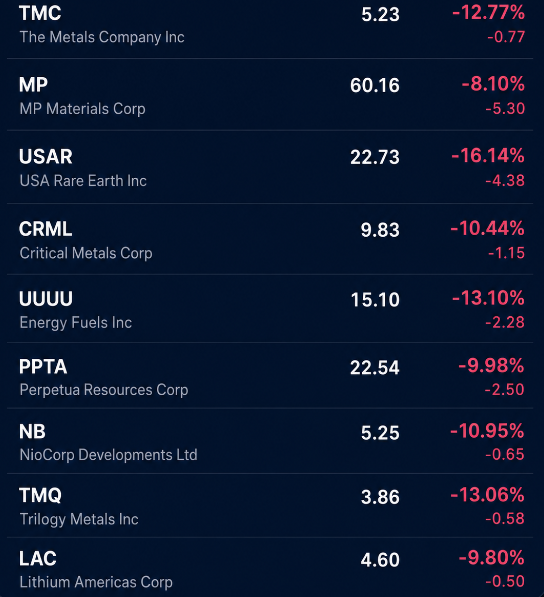
Critical minerals got caught right in it. $USAR down 16%, MP down 8%, and TMC down 13%. None of them got hit for a company reason today.
$TMC got hit as a high beta name in a hot tape full of fast algos, not because anything changed for the company. The metals are still on the seafloor, the permit is still expected Q1 2027, the catalysts are still stacked.
And days like today are exactly where options go to die. A strong thesis points you to the direction, never the timing, and no one can time a tape like this. Options ask you to be right twice, on the call and on the clock. Shares only ask once. They let you hold the direction and wait, and a red afternoon cant touch a position that has no deadline on it.
Days like this are exactly when knowing what you own matters.
I dont care where it closes today. Long $TMC, not advice.
Worst day for the Nasdaq since October.
Two things hit at once. Broadcom's weak guidance set off a chip selloff, and then a hot jobs report, 172K jobs against 85K expected, sent Treasury yields jumping.
Rate cut hopes evaporated for the short term.
A hot jobs report is good news for the economy. Strong hiring means more people earning and spending, and consumer spending is most of the economy. That's a stronger economy and stronger demand for everything these metals end up in. The only catch is it pushes rate cuts further out, and that delay is what stocks reacted to today pressuring anything priced on future growth.
A small near term shock against a bigger picture that is improving, not breaking.
Sell off is broad today. Most S&P sectors are red, and the damage was worst right at the top. $NVDA down about 5%, the chip leaders worse, Micron and AMD down 9 to 10%, Broadcom red again after Thursday. When the biggest names in the market are selling off like that, almost nothing gets spared.
High beta stocks always take the worst of a day like this. When yields spike and money comes off the table, the names that move most on the way up move most on the way down.
Critical minerals got caught right in it. $USAR down 16%, MP down 8%, and TMC down 13%. None of them got hit for a company reason today.
$TMC got hit as a high beta name in a hot tape full of fast algos, not because anything changed for the company. The metals are still on the seafloor, the permit is still expected Q1 2027, the catalysts are still stacked.
And days like today are exactly where options go to die. A strong thesis points you to the direction, never the timing, and no one can time a tape like this. Options ask you to be right twice, on the call and on the clock. Shares only ask once. They let you hold the direction and wait, and a red afternoon cant touch a position that has no deadline on it.
Days like this are exactly when knowing what you own matters.
I dont care where it closes today. Long $TMC, not advice.
A new peer-reviewed paper published in @JMSE_MDPI based upon eight offshore campaigns conducted between 2019-2022 establishes a rigorous baseline of the natural chemical and physical functioning of the marine ecosystem on our initial production area. This data provides a clear picture of how the ecosystem changes over space and time, and the basis against which we can effectively monitor and mitigate our impacts.
Read the paper: https://t.co/nIgvEx3A5G
In 1957 the Soviets launched Sputnik and the space race began. Most Americans only realized it had started once they were already behind.
The same thing is happening right now. Except this race isn't above us. It's on the floor of the ocean.
CNN and Mongabay just spent a year, backed by the Pulitzer Center, tracking China's deep sea mining fleet. What they found reads less like mining and more like a chess move.
Eight Chinese ships. Five years of movement data. 814 days spent in or near the international zones licensed for seabed mining.
China has been quietly making deep sea moves with tiny Pacific nations most people couldn't find on a map.
It signed with the Cook Islands and opened talks with Kiribati. It already holds more seabed exploration contracts than any nation on earth, and it funds the global regulator more than anyone else.
Read that again. It is the exact space race playbook. Reach the frontier first, plant your flag, control the ground, and sort out the rules later.
The part almost nobody says out loud. The deep sea isn't only about metals, the nickel and copper and cobalt that everything from AI infrastructure to the defense industry runs on. It is about who controls the next strategic frontier on the planet.
China clearly understands that. They are already racing. The real question is whether anyone reaches the frontier before the race is quietly decided.
One company is far enough along to put the US side of this race on the board.
The Metals Company, $TMC. Leading the US regulatory path by years. The only SEC compliant deep sea reserve ever filed, NOAA full compliance done, production agreement signed, permit decision expected by end of Q1 2027.
Holding TMC. Not financial advice. Do your own research.
$MP $USAR $CRML $LAC, Korea Zinc (KRX: 010130), Pacific Metals / PAMCO (TSE: 5541)
Poland recently signed a broad critical minerals agreement with the United States, which includes collaboration on responsible deep-sea mining. Like Japan, which has also signed a similar agreement with the U.S., Poland collaborated with American scientists at NOAA on research into the impacts of sediment plumes during the 1990s.
https://t.co/dAHWJU68ra #deepseamining $TMC
$AVGO Q2 '26 Earnings
Bullish Takeaway:
Broadcom achieved record Q2 FY26 revenue of $22,187 million, an increase of 48 percent from the prior year period, demonstrating strong top-line growth. Broadcom also generated $10,262 million in free cash flow for the second quarter, representing 46 percent of revenue.
Broadcom's Q2 semiconductor revenue from AI reached $10.8 billion, growing 143% year-over-year, which was above its forecast. This growth was driven by increasing demand for custom AI accelerators and AI networking.
Adjusted EBITDA for Broadcom increased 52% year-over-year to a record $15,244 million in Q2 FY26, representing 69% of revenue. This reflects Broadcom's strong operating leverage and efficient business model.
Bearish Takeaway:
Broadcom is not readily able to provide a reconciliation of projected non-GAAP financial measures to the relevant projected GAAP measures without unreasonable effort, limiting transparency for future financial performance.
Broadcom faces risks associated with global economic conditions and uncertainty, government regulations, trade restrictions, and trade tensions. These external factors could materially affect Broadcom's future business results.
The semiconductor industry is undergoing profound change due to AI, and Broadcom also has significant indebtedness. The company needs to generate sufficient cash flows to service and repay such debt.
$AVGO Q2 '26 Earnings
Bullish Takeaway:
Broadcom achieved record Q2 FY26 revenue of $22,187 million, an increase of 48 percent from the prior year period, demonstrating strong top-line growth. Broadcom also generated $10,262 million in free cash flow for the second quarter, representing 46 percent of revenue.
Broadcom's Q2 semiconductor revenue from AI reached $10.8 billion, growing 143% year-over-year, which was above its forecast. This growth was driven by increasing demand for custom AI accelerators and AI networking.
Adjusted EBITDA for Broadcom increased 52% year-over-year to a record $15,244 million in Q2 FY26, representing 69% of revenue. This reflects Broadcom's strong operating leverage and efficient business model.
Bearish Takeaway:
Broadcom is not readily able to provide a reconciliation of projected non-GAAP financial measures to the relevant projected GAAP measures without unreasonable effort, limiting transparency for future financial performance.
Broadcom faces risks associated with global economic conditions and uncertainty, government regulations, trade restrictions, and trade tensions. These external factors could materially affect Broadcom's future business results.
The semiconductor industry is undergoing profound change due to AI, and Broadcom also has significant indebtedness. The company needs to generate sufficient cash flows to service and repay such debt.
$AVGO
Bullish Takeaway:
Broadcom achieved record Q2 FY26 revenue of $22,187 million, an increase of 48 percent from the prior year period, demonstrating strong top-line growth. Broadcom also generated $10,262 million in free cash flow for the second quarter, representing 46 percent of revenue.
Broadcom's Q2 semiconductor revenue from AI reached $10.8 billion, growing 143% year-over-year, which was above its forecast. This growth was driven by increasing demand for custom AI accelerators and AI networking.
Adjusted EBITDA for Broadcom increased 52% year-over-year to a record $15,244 million in Q2 FY26, representing 69% of revenue. This reflects Broadcom's strong operating leverage and efficient business model.
Bearish Takeaway:
Broadcom is not readily able to provide a reconciliation of projected non-GAAP financial measures to the relevant projected GAAP measures without unreasonable effort, limiting transparency for future financial performance.
Broadcom faces risks associated with global economic conditions and uncertainty, government regulations, trade restrictions, and trade tensions. These external factors could materially affect Broadcom's future business results.
The semiconductor industry is undergoing profound change due to AI, and Broadcom also has significant indebtedness. The company needs to generate sufficient cash flows to service and repay such debt.
$CRWD
Bullish Takeaway:
Crowdstrike achieved record Q1 net new ARR of $256 million, up 32% year-over-year, and total revenue increased 26% to $1.39 billion in the first quarter of fiscal 2027.
Crowdstrike delivered strong Q1 results with record cash flow from operations of $591 million and record free cash flow of $468 million.
Crowdstrike launched new AI-driven innovations like Agentic MDR and Falcon Data Security, and expanded strategic collaborations with Open AI, Anthropic, IBM, and Intel.
Bearish Takeaway:
Crowdstrike faces risks related to a content configuration update for its Falcon sensor on July 19, 2024, which caused system crashes for certain Windows systems.
Risks are associated with managing Crowdstrike's rapid growth and its ability to identify and effectively implement necessary changes to address execution challenges.
Crowdstrike operates in an intensely competitive and rapidly evolving market, facing risks related to its ability to respond to industry trends and technological developments.
SpaceX is expected to price its IPO on June 11, 2026.
with shares expected to start trading on Nasdaq on June 12, 2026 under ticker $SPCX. Reuters says SpaceX has set a $135/share IPO price and is targeting a roughly $75B raise at about $1.75T valuation.
SpaceX has already filed publicly with the SEC: its original S-1 was filed May 20, 2026, and an amended S-1/A was filed June 1, 2026.
Key caveat: IPO terms can still change until the final prospectus/effective pricing, but the current target is trading June 12.
Now imagine where $TMC reprices to after news like this.
This is the playbook now, and $TMC hasn't had its turn yet.
I have 2 examples for you of what a US government check does to a critical minerals stock:
$MP Materials: the DoD took a $400M stake last July, and the stock closed that day around $45.
MP started 2025 near $16. after the DoD $400M stake in July, the stock ran to an all time high of $100 by October. Roughly 6x in a year.
$USAR was $9 a year ago. Commerce stepped in for $1.6B, the private side put up $1.5B, $3.5B in total committed. The stock now trades near $28.5. More than tripled in a year.
NEWS: $USAR USA Rare Earth Finalizes Definitive Agreements with U.S. Department of Commerce, Unlocking Access to Up to $1.6 Billion to Advance the Leading Rare Earth Value Chain
USA Rare Earth today announced the execution of definitive agreements with the U.S. Department of Commerce, unlocking access to up to $1.6 billion in funding under the Department of Commerce’s CHIPS Program.
The definitive agreements comprise up to $277 million in federal funding and up to $1.3 billion in senior secured loan capacity under the CHIPS Act, with disbursements tied to the achievement of project milestones.
Prior to the definitive documents, USA Rare Earth closed $1.5 billion in private capital raise, signed certain strategic customer agreements, and advanced Round Top.
The definitive agreements establish the framework under which USAR will continue to build out its integrated heavy rare earth mining, metal, and magnet global value chain. Together with the $1.5 billion private capital raise completed in January 2026 and previous capital raises, the agreements bring total committed capital supporting USAR’s growth plan to approximately $3.5 billion.
"This partnership with the U.S. Government is the largest of its kind in our industry and provides the necessary capital to build the only global platform across light and heavy rare earth mining and processing, metal and alloy making, as well as magnet manufacturing - for the benefit of the United States and its allies,” said Michael Blitzer, Chairman of the Board of USA Rare Earth. "This landmark collaboration reflects the scale and urgency of securing critical supply chains for technologies essential to long-term economic growth. We are grateful for the leadership shown across government in moving with speed and conviction. Our focus now is execution and generating industry-leading returns for both our shareholders and the U.S. Government.”
https://t.co/zggEQiz7lT