Wildlife, woodlands, woodpasture, Westacre and beyond, getting things done on the ground. For clarity, my name is Fraser Bradbury and my thought are my own
@PeteMRCooper Germany, this one Hessen FD and is of great concern there on older trees in full sunlight which are being killed off. Should a population of Greater Capricorn beetle establish in the New Forest, this could be devastating to our Ancient oaks. Please, please, please report any
@PeteMRCooper sightings to the Forestry Commission. If I'm wrong about this then the worst that can happen is I will look stupid, and to be honest I'd take that rather than endanger our ancient oaks, we in the UK are unique in having such a collection of ancient trees
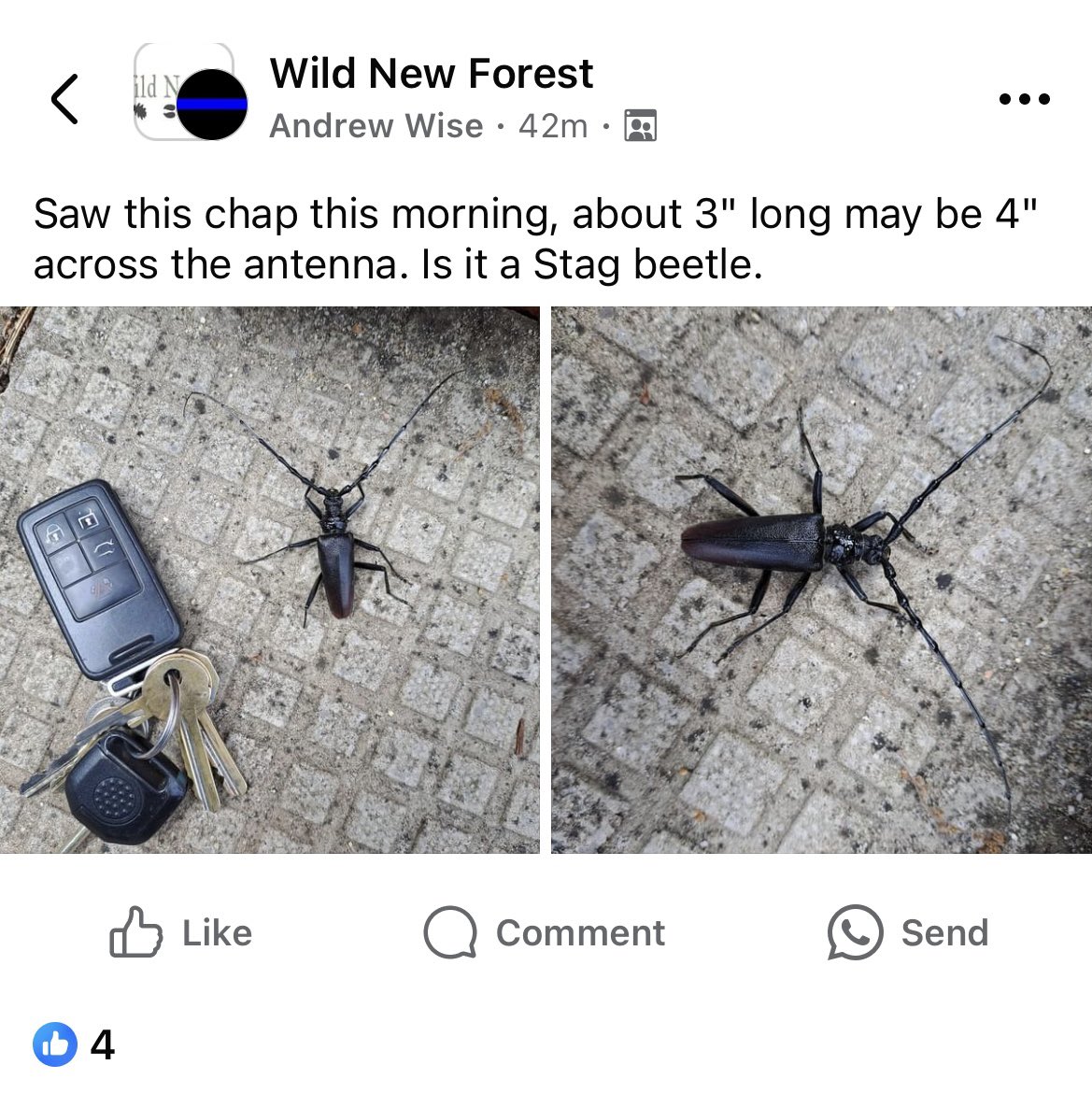
An amazing wildlife sighting from the New Forest - the Great Capricorn Beetle Cerambyx cerdo.
The last native records are sub-fossil specimens dating to 4k years ago and is ocassionally imported - but could a population have established itself in the ancient oaks of the NF?
@PeteMRCooper Just back from Germany, in the central region they are loosing mature large oaks to a combination or Jewel beetle and Capricon beetle, they are very concerned. It's the big old open grown that are dying, so think veterans and ancient trees here.
This is becoming my banker Wolf site, I'm fairly certain that this is a rendezvous site, the site has been badly affected by new boar fencing to try to stop ASF, so unlike last year the pack were dispersed and I think only 3 yearlings. I had to whistle this one to stop it
@woodlandbirder Thanks Richard, I used the example as its one I'm aware of but don't always think that it's widely recognised that a relatively low density of stems per ha can produce a closed canopy
@woodlandbirder I'd just like to add the there is some interesting work by Keith Kirby that argues very well for closed canopy forest as a large part of the system and interestingly he pointed out about the Oaks at Knepps is that at the current densities they will close canopy. It doesn't take
@HerbertNickel @woodlandbirder dynamic events that stop linear succession. Once this occurs other trees, inc oak are released, oak has the ability to nearly die then fully respond, epicormic growth shows us this. I could go on but I think all will he lost on you so I'll leave it at that
@HerbertNickel @woodlandbirder quite capable of growing in a beech stand, infact beech is used to grow fine quality cherry. Add in drought, heatwaves, climatic changes and beech quickly declines, Germany research shows that many of the stag head beech about today relate to the drought of 1976. These are the
@HerbertNickel @woodlandbirder Returning from Germany, enjoyed seeing forests where the trees have reached maximum growth height, many if not most of the oaks crowns were well above the beech. Beech is one of the least palatable species, oak one of the most, perhap your referring to high browsing pressure
@MichaelMacLeod1@andyheald Thanks Michael, do you think that's the full list?
Interesting read and gives a snapshot from one area, there are probably a number of other issues involved, I recall a visit when working for Westonbirt 20 years ago when issues of air pollution and compaction were the main issue