Four presidents. One persistent enemy. On today’s episode of The Iran Breakdown, @brett_mcgurk, author of Brink, joins @mdubowitz to explain what Washington got right and wrong on Iran, and whether America is winning. https://t.co/DrnSviWn9g
Washington should make Turkish entrenchment a central issue in its efforts to broker a security agreement between Syria and Israel, ensuring that any understanding addresses Israeli security concerns and prevents Syrian territory from becoming a source of confrontation between Ankara and Jerusalem, explains @AhmadA_Sharawi:
https://t.co/WmaewqGXjg
Eastern Libya’s parliament called a proposed maritime deal with Turkey “built on illegality” earlier this year. On October 20, it unanimously approved the agreement.
@SinanCiddi writes that the pact violates Greece’s internationally recognized maritime rights. https://t.co/vL6MAPmxPc
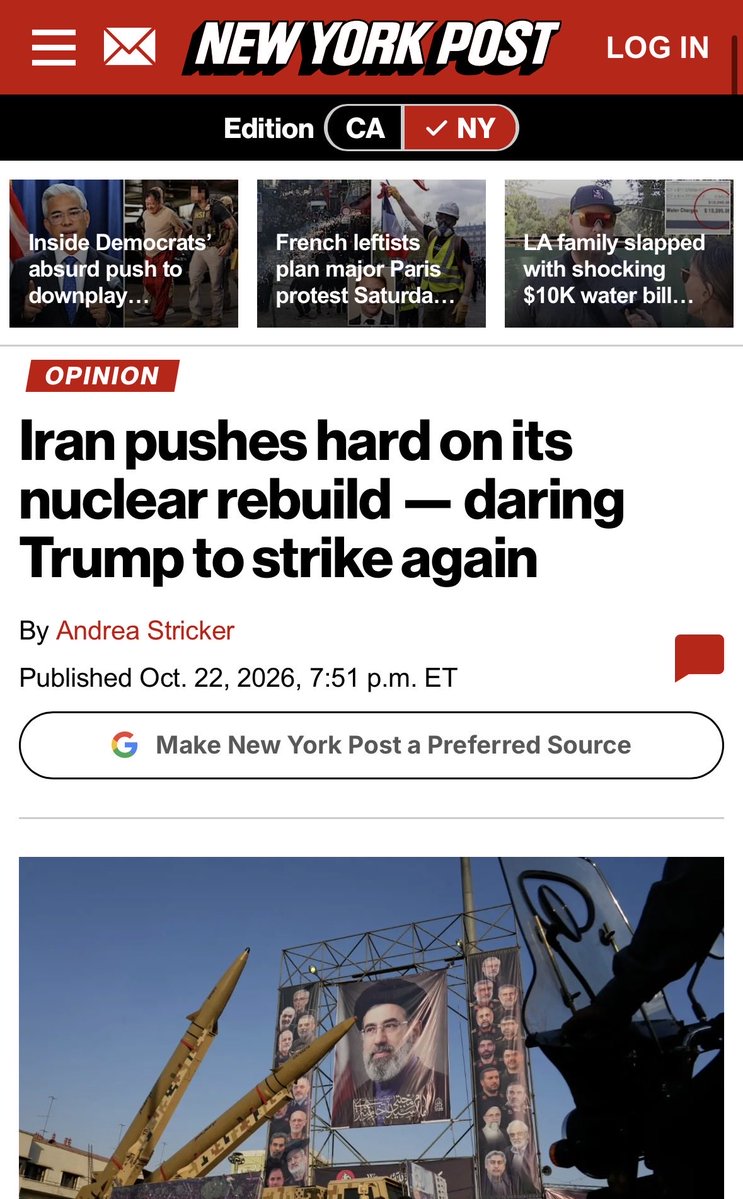
The regime’s unbending pursuit of nuclear weapons and its refusal to make peace remind us why it’s so dangerous — and why a new, limited round of military strikes may be necessary.
My latest for @nypost 🔗
Mines in the Strait of Hormuz, Houthis using AI to design missiles, air defense shortfalls, and Saudi military failures. On today’s FDD Morning Brief, @JSchanzer and @RyanBrobst_ break down the military state of play in the Middle East. https://t.co/SewzUPgjPf
After nearly three years of staying out of the wars in the Middle East, Egypt may finally be ready to engage, providing Saudi Arabia with “all necessary and possible” support to defend itself against Houthi attacks, write @BridgetKToomey and @themariamwahba.
https://t.co/tm6t03LqdP
As Iranian attacks in the Persian Gulf return to wartime highs, GCC officials urged Moscow to press Iran to halt its attacks.
@BridgetKToomey and @KKorkiya write that mediation offers the Kremlin an opportunity to expand its regional influence. https://t.co/Khjkhhsj0J
Chinese IP theft costs the U.S. an estimated $225 billion to $600 billion annually, with up to 80% of economic espionage cases attributed to China, @SusanSoh827 and @afixler write: https://t.co/N4uLIemn2q
The Maritime agreement between Libya and Turkey has been declared null and void by Greece, rejected by Egypt, condemned by the EU and Israel
It also defies existing international law under UNCLOS
I break it down for @i24NEWS_FR & @FDD
https://t.co/9f4IJTaAjh
The U.S. should not waver on its support for the trilateral framework for negotiations launched by the United States with Lebanon and Israel, which aims to replace international peacekeepers with Lebanon’s own army and security forces, as a means of moving forward. — @BenCohenOpinion
https://t.co/ywXhDbU5H5
Washington should create incentives for U.S.-aligned operators to buy ships out of Iran’s black market and put them to legitimate use in the Strait of Hormuz.
Read more from @miadmaleki: https://t.co/xNfEVYf4Qd
Washington should press Damascus to reject a permanent Turkish military presence. While Ankara will retain significant influence in Syria given its geographic proximity and close ties to the rulers in Syria, cooperation does not require a substantial Turkish troop presence, writes @AhmadA_Sharawi: https://t.co/kvvSlQ64Ys
New @FDD memo: foreign money is flowing into American K-12 classrooms with almost no disclosure requirements. Colleges report foreign gifts over $250K — K-12 schools don’t, except Georgia. So we built this dataset ourselves — filing 260+ public records requests, plus 1,200+ more with our partner @open_the_books
🧵
https://t.co/pED6ZYVTAu
The Trump administration’s call for UN reform and efficiency as a prerequisite for receiving U.S. funding has prompted the world body to carry out a 15 percent budget cut.
@DavidSamuelMay & @BenCohenOpinion discuss:
https://t.co/9qCtDdDQ1y
The U.S. should steady its relationship with Ethiopia and continue to treat the TPLF as an illegitimate, anti-democratic force. It should address the Eritrea-Ethiopia conflict by imposing visa restrictions on Eritrean military leadership for crossing Ethiopia’s border, write @EFittundBrown & Grant Wishard:
https://t.co/kqv4NzsJh1
Encryption isn’t enough to protect data wherever it goes
Once data is in use, encryption falls short. A tested approach that replaces sensitive values with realistic substitutes could make stolen information far less useful to hackers
@_GeorgiannaShea in @CyberScoopNews: https://t.co/GRXBUlc5qo
The Egypt-Turkey rapprochement happened because Sisi and Erdogan understood they needed each other in places like Libya and Sudan. Yet these issues will be what drives a wedge between them. You can only set aside ideological differences for so long.
We designated Confucius Institutes as foreign missions.
Why are 🇹🇷 state-run religious and educational institutions in the U.S. still getting the presumption of charity?
My first for "The Patient Revolution" on Erdogan’s “pious generation” going global
https://t.co/WqGWCkZHox