Most agents have a private key sitting in a .env file.
One leaked log and it's gone.
We built Agent Wallet so the key lives inside an AWS Nitro Enclave.
It signs from inside. Nothing pulls it out, not even us.
You can export whenever.
View Documentation → https://t.co/0IW0IEo0jY
Watch an AI agent pay for its own API call.
• No top-up
• No approval request
• No human in the loop
2.8 seconds later. Back to work.
This is what actually autonomous looks like.
Set it up for free ↓
https://t.co/p4R7d0F8nB
In the attention economy, the winners captured human eyeballs 👀
Agents don't have eyeballs. They have tasks.
They don't respond to ads. They don't develop brand loyalty.
They have cost functions and objectives.
The value in the agent economy doesn't sit at the interface layer. It sits where the transactions happen.
That's the layer we're building 🏙️
@0xJeff One edge case as you add providers: tools that accept different tokens or chains. A single-asset wallet bounces on whatever you're not holding. Multi-asset balances avoid it.
The financial system was designed around one assumption: a human is always in the loop.
Not to authorize every transaction or approve every payment, but simply to exist as an accountable party.
AI agents are the first buyers, sellers, and intermediaries who do not meet that assumption.
The rails need rebuilding, not patching
Every payment protocol before x402 added a layer on top of the web.
x402 puts payment inside the request itself.
→ A server returns a 402 with the payment details.
→ The agent pays on-chain.
→ It retries with proof in the header.
→ The server verifies and returns the resource.
No SDK. No API key. No checkout flow. No redirect.
Any server that supports x402 is now a storefront your agent can buy from.
@catena_labs Congrats on the round. Agents safely using money splits two ways: bank custody with governance, or non-custodial with hardware-isolated keys. Operators will pick based on their threat model.
@nickprince We love no API keys. The worst hour of any agent project is signing up for 5 accounts, juggling 5 secrets, and finding which one is throttling you this week
@CoinbaseDev@Jnix2007 Spend caps are the natural pair to scoped signing. Per-tx, per-day, per-token limits enforced by the smart account itself. Scoped signer stops the wrong action. Spend caps bound the right action when instructions go sideways.
@jerallaire Pay-per-request only works if the agent can pay on whatever chain the merchant takes. ERC-3009 makes the payer gasless. Most x402 deployments still pin you to one chain and one stablecoin. That's where the wallet has to do the work.
@brian_armstrong The wallet on the agent's side is where it breaks. ERC-3009 makes the payer gasless. The harder part is letting that wallet pick the chain from what the merchant accepts, not the other way around.
The most important thing in any payment network was never the currency. It was the infrastructure that moved it.
That was true for Visa in 1958. True for SWIFT in 1973. The token is easy to copy. The rails take years to build and decades to earn trust.
Stablecoins are the money layer of the agentic economy. But what's actually scarce isn't a stable token, there are dozens.
What's scarce is the infrastructure that moves value between agents, APIs, and services without human intervention.
Own the rails, not just the token.
@circle The access vs control framing resonates with us as progressive architecture. Layer in session keys and spend caps when agent autonomy needs them. Balance ends up being the primary control.
@base This makes us wonder whether the next wave comes from new agents on the same merchants, or new merchants opening up to agent traffic for the first time 👀
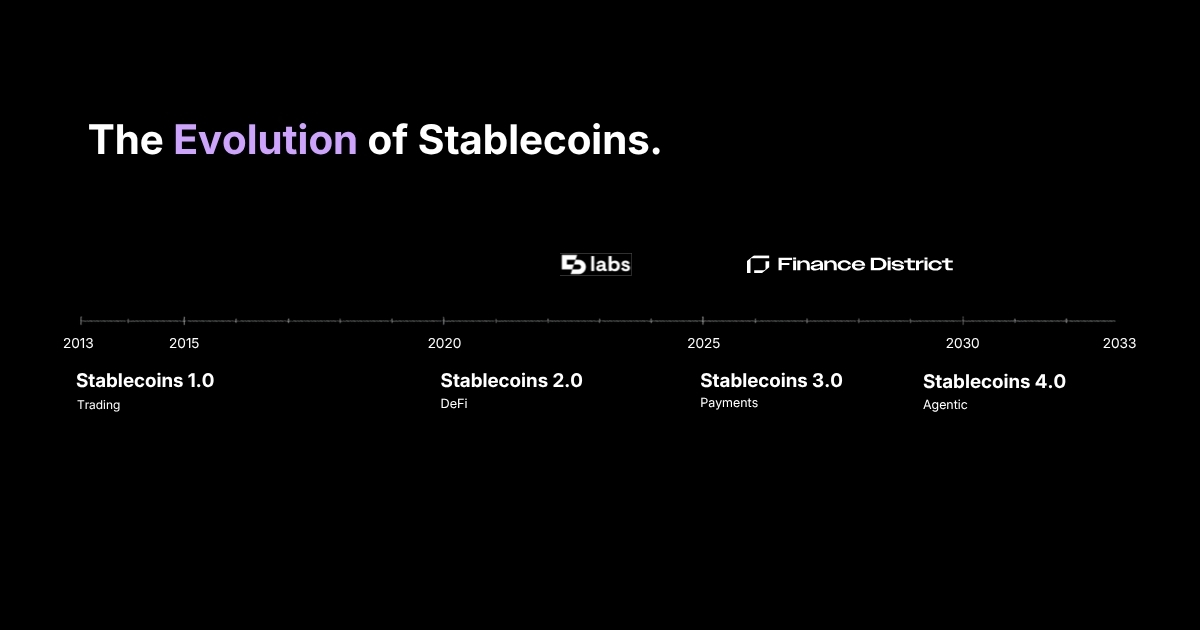
Stablecoins have had four distinct eras.
1.0 — Trading. Getting in and out of crypto without touching a bank. The original use case, dating back to 2013.
2.0 — DeFi. Liquidity, lending, yield. The protocol era that made stablecoins load-bearing infrastructure for decentralised finance.
3.0 — Payments. Cross-border transfers, merchant settlements, payroll. What most people today think stablecoins are for.
4.0 — Agentic. Agents don't use payment links. They don't have billing accounts. They hold stablecoins, pay in seconds, and settle without human approval.
The builders who design for 4.0 now, while most of the market is still building for 3.0, are the ones who will own the infrastructure when agents become the dominant economic actor.
Most of what's being built today will need to be rebuilt.
The ones who build for 4.0 first won't have to.