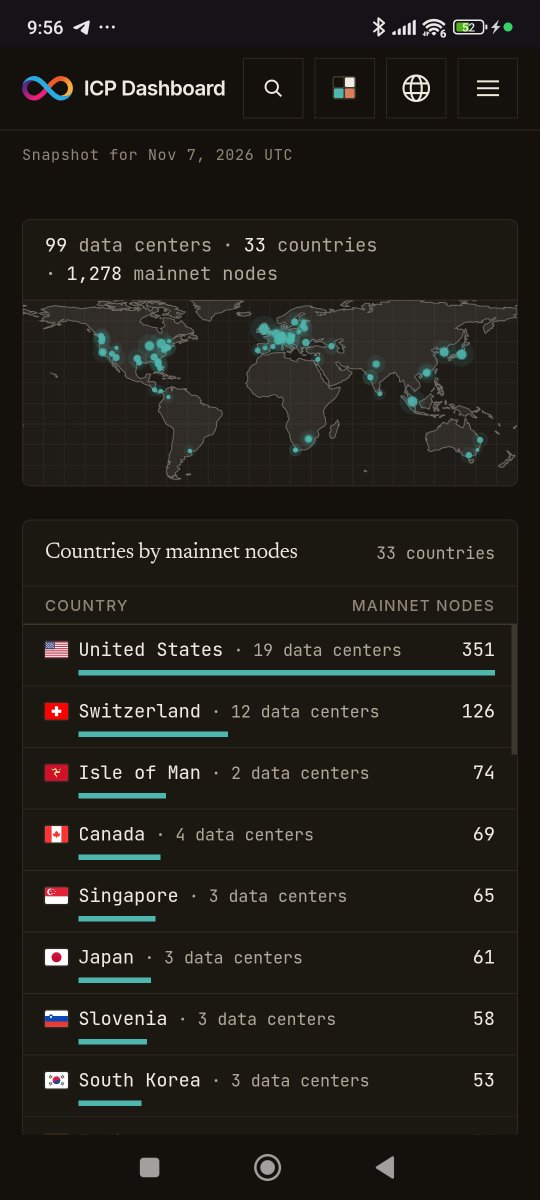
You're not actually ready for what's coming. Many of you are still joking with $ICP.
There are around 99 $ICP data centers serving the mainnet across the globe 🌎, spread across 33 countries, with the United States leading with 19 data centers.
Over 1,200 mainnet node machines are waiting for deployment, while 600+ are already deployed across subnets.
And this is just the mainnet side. We haven't even started talking about the Cloud Engines side.
As I said, you're not ready. $ICP will shock a lot of people. 🚀
GPT-6 Cyber "available to select Daybreak Red customers"
General problem: if a customer can security audit open source software before you, that you develop or rely on, they can become your attacker.
Solution: move the world to tamperproof backend code hosted by a network/ICP.
What I’m calling out is the narrative that $NEAR has anything to do with AI. The marketing doesn't survive contact with its own docs.
For example:
⚠️The blog says ChatGPT/Claude/Gemini access is "zero visibility to providers"
The docs say those models are "proxied to their providers" and "the TEE privacy and verifiability guarantees do not extend to the upstream provider."
⚠️The landing page says "100% requests attested"
15 of 51 models are in TEEs. OpenAI alone has more entries in the "private AI" catalog than NEAR entire TEE fleet.
⚠️"user-owned AI" one private company, one gateway, one billing system. The chain's only job is routing your staking rewards to that company.
⚠️"our stack" Phala dstack, open source, Apache 2.0. their own docs says the SDK was "built by Phala Network."
None of this is any kind of Web3 AI. It's an OpenAI API compatible reseller running on Intel/NVIDIA enclaves, with a token stapled to the invoice.
Let me ask you straight: does the average crypto user think NEAR built Web3 AI?
Because that's who this is for. Not you, you know the difference between an enclave and a blockchain.
It's for the holder who bought the "NEAR is the AI chain" story and doesn't realize the chain's entire job is to move staking rewards from their wallet to Jasnah Inc.
"only the foundation is allowed to work on products" Sure, thats why Anthropic have own ICP connector and Claude Code works on it directly: Internet Identity login, canister discovery, onchain calls etc..
Nobody's gated behind @caffeineai that's one door, Anthropic connector is another, icp-cli with own agent skills is a third.
Now do the same exercise for https://t.co/djglO5xTBL.
Name one door into it that isn't Jasnah Inc.
Gateway? Jasnah.
Direct endpoints? Jasnah.
Private Chat? Jasnah.
The "decentralized" GPU marketplace? Jasnah
When real medicine is on the shelf, pointing at the snake oil matters even more. And this one's easy, the docs admit what it is while marketing and social narrative claim the opposite.
Same bottle, two labels. Marketing wrote "cure" because marketing can. The docs wrote "snake oil" because the docs have to. Guess which one the holders read.
Have you tried the Internet Computer connector in Claude yet?
Search "Internet Computer" in Claude's connectors, connect it once, and start prompting.
Build on the Internet Computer directly from @claudeai.
Now on Caffeine you can choose where your app is deployed.
Either on the IC Mainnet, European Cloud, or Encrypted Cloud.
Another great example of Internet Computer tech in action.
A blockchain going head to head with AWS and Google Cloud is a big claim! ☁️
Here's how $ICP from @dfinity really stacks up for developers, from costs to tooling.
Full breakdown ⬇️
https://t.co/SWOc6vhAaC
🚨WOW: $ICP processed an astonishing 349,500 TIMES more transactions per validator than Ethereum over the past 24 hours, showing it's INCREDIBLE blockchain efficiency!
According to @chainspect_app, $ICP averaged 699,000 transactions per validator in 24 hours, compared with just TWO for Ethereum!
And it's not just ICP making waves!
$XLM ranked 6th and $HBAR 10th across blockchains tracked.
The infrastructure behind crypto is evolving FAST!
Another banger @BobbyO_
And the solution is..... that there is no solution. Typical. This industry is done. The "fake it till you make it" narrative is going to be destroyed by AI.
AI is exposing vulnerabilities back and forth. Where are the solutions?
$ICP has delivered a solution. Who else did?
I think you are missing the point of what $ICP is actually solving.
Let's look at some major hacks:
Bybit: Had exactly what you prescribe:
an air-gapped multisig cold wallet with hardware signers.
Still lost $1.5B. The compromised laptop wasn't even Bybit's. A Safe Wallet dev was hacked, attackers obtained AWS credentials and replaced the JavaScript in Safe AWS S3 bucket. The signers approved what the screen showed them. The screen lied. The malicious JavaScript was removed two minutes later.
Binance: DevOps laptop -> service container -> the signing system signed whatever it was told. No private key was leaked.
Bangladesh Bank: Custom malware inside SWIFT Alliance Access, manipulating the Oracle DB to conceal fraudulent transfers.
Capital One: A misconfigured WAF on AWS.
See the pattern?
The pattern isn't "humans". It's one human reaching one mutable server that sits between the signer and the chain. #InternetComputer removes that server.
An attacker compromises a mutable component of the infra and changes what the system does. That infra is the attack surface, not the person signing.
That's the attack surface $ICP is designed to eliminate:
✅Frontends served directly from canisters, with responses certified by the subnet and verifiable by the client. No S3 bucket where attackers can silently replace JavaScript.
✅No traditional service containers, SSH access or admin controlled databases. Canister state changes are executed through subnet consensus.
✅No single administrator holding the upgrade keys on a laptop. Canisters can be governed by a DAO, with upgrades requiring a vote.
✅No complete signing key sitting in one place. Threshold crypto distributes key shares across nodes, while properly implemented consent messages let users verify what they're signing.
✅ No API keys or cloud credentials. Canister calls are authenticated by the protocol, nothing for a compromised laptop to hand over.
✅ Verifiable deployed code. Wasm hash is onchain, reproducible builds let anyone check it matches source.
✅ Public controllers. Anyone can see who can upgrade a canister, one key, DAO, or nobody.
✅ Withdrawal policy enforced by consensus. Limits and approvals live in the canister, not in a backend someone can reach.
✅ Upgrades go through a visible voting window. A malicious change is a public proposal, not a silent push.
✅ Certified data reads. Balances and transaction lists are verifiable as coming from the subnet, not a tampered node.
✅ No runtime supply chain. Dependencies compile into the WASM, nothing fetched at execution time.
✅ No passwords or seed phrases to phish. Internet Identity uses passkeys, with a separate principal per app.
✅ No key server. vetKeys derive encryption keys onchain via threshold crypto.
Your three "someone still has to" points: code bugs, key custody and user signing and those are real risks, and they apply everywhere. ICP has never claimed otherwise.
What $ICP solves is that the infra layer exploited in hacks like Bybit, Binance, Bangladesh Bank etc.. can be fundamentally redesigned to eliminate entire classes of attack.
#InternetComputer isn't trying to make traditional infra more secure. It's eliminating entire attack surfaces by making that infra unnecessary.
That's why I'm genuinely optimistic about ICP future.
The tech addresses real problems, and its potential extends far beyond what we've seen in crypto.
I like the direction @dominic_w is taking on X lately, focusing on practical problems and what $ICP can do to solve them.
🔴 While on the surface this take makes sense
"Tons of hacks happening. Dfinity should do more marketing."
Global transitions to new tech infrastructure would need to be handled with the largest players (sovereign countries, hyperscalers/BigTech) IF you want to do this efficiently
If you sell an entire country
Alllll the institutions in that country will likely follow suit as solutions are rolled out
If you sell the Tech companies
Allllll their users (which is everyone) will follow suit with their new built-in, secure solutions
(These two groups cover most of the world)
Dfinity would be wasted time targeting individual companies like Mercado Bitcoin or this French bank
That time would be better spent talking to sovereign countries. And getting in alignment with BigTech via putting all the necessary tooling in place to make this plug and play. That is minimally a 100-1000x bigger opportunity than individual companies.
There are levels to everything
They are targeting the entities at the top
Also none of us have any clue what they are and aren't doing privately
The majority of the ecosystem was claiming Utopia was dead. RIGHT BEFORE cloud engines got introduced and Pakistan + the UNDP started adopting the technology.
$ICP ☁️♾️
Dfinity should start compiling a list of all these vulnerable companies and reach out to as many of them as possible.
Educate them about the security risks and present the solutions that $ICP has already built to help address these vulnerabilities.
There is no point waiting for them to discover ICP when we can take the technology directly to them. 👌🚀
No direct swap? OISY can suggest a route.
OISY only offers swaps it can check before you approve them. When there's no direct swap like that for your pair, it can now suggest two, through one token in between.
Say you hold USDC on Base and want NVDA on Robinhood Chain. OISY suggests swapping to USDG first, then USDG to NVDA. It sets up the first swap for you, and you review each one yourself.
@G4mblerICP[email protected] (you need to describe the purpose of the engine).
MULTI/DEX is being integrated with chain key for real, but passing security reviews critical. There's never been an open source order book exchange before. It's tamperproof, but gaming algos a risk
@markus_AI_ UX will continue to improve as moves to prod, but that's not where there hard work is.
The real challenge is making the backend backend algos impossible to game, etc. One of the reasons it's the 1st open source order book exchange.
funny, on a podcast the other day I talked about AI/agent worms being able to run on things like security cameras and freezers, swap their models and API keys so they can't be blocked, and move between hacked devices... "that sounds like sci-fi"
https://t.co/TCAQcWCKEG