How would an LLM "thought" actually look, and what properties should it have? 🧠
LLMs shouldn't reason purely in text. That's why the AI field is moving toward continuous thought representations (vectors instead of words). But nobody had answered the more fundamental question: what should a thought look like? What properties must it have for an LLM to actually "think" properly?
I went and answered that in our new paper. This might be very influential for the future of LLM reasoning.
I propose 4 fundamental properties every thought representation must satisfy:
🎯 Causality: The thought must actually drive the answer, not just tag along for the ride.
🗜️ Minimality: It should compress the problem down to only what matters.
🔍 Separability: It must distinguish one question from another within the same topic.
⚖️ Stability: It must stay consistent with how uncertain the model is.
These aren't just theoretical ideas. They give us concrete, measurable targets for building LLMs that actually think better.
To see where we stand today, we audited 5 open-weight LLMs across 23 reasoning tasks, testing 4 different continuous thought representation methods from the literature.
Here is what we found:
❌ None of them satisfy all 4 properties simultaneously.
🤯 Every single method fails at Separability.
Meaning the LLM's internal "thought" cannot distinguish two different questions from the same domain. In plain terms: if you ask an LLM two different questions about your project, its thoughts for both look almost identical. It doesn't actually know which problem it's solving!
🏗️ The failure is structural.
We see it across different sizes, dense models, RL-trained models, and reasoning-distilled models alike. Throwing more compute, bigger models, or more training at it won't fix it.
⚡ The biggest surprise:
Simply using the input text embedding as the "thought" is competitive with, and often beats, the expensive iterative thinking methods on almost every metric. This strongly hints that current methods don't add information beyond what's there in the input to begin with.
This gives researchers the first principled framework for what a proper LLM thought should look like, and tells us exactly what to fix and optimize for to get there.
Dive into the research below 👇
📄 Paper: https://t.co/LYAu988wAt
🌐 Website: https://t.co/QO79RtKG3q
Do LLMs actually think in silence? We formalized four axioms, Causality, Minimality, Separability, and Stability, to audit latent thought representations. Most model representations encode nothing beyond the input embedding itself. Great work led by @fahdseddik.
Do LLMs actually think in silence?
A new paper formalizes four axioms — Causality, Minimality, Separability, and Stability — to audit latent thought representations. No open-weight LLM satisfies all four. Most representations encode nothing beyond the input embedding itself.
🌟 Exciting News! 🌟
#SEMLA2025 promises to be an inspiring event featuring a stellar lineup of 🎤 renowned experts.
🚀 Secure your spot now at a special discounted rate 👉 https://t.co/iEcNnl8tvC
🌐 https://t.co/9lB6XATWLq
🗓️ June 17th to June 19th
📍 Polytechnique Montréal
Videos of #ICSE2025 keynote presentations are now on our YouTube Channel! https://t.co/0dmTB59VcD Other session videos will follow in the coming weeks, as we receive requests.
🙏 Finally, a huge THANK YOU to all our organizers, authors, reviewers, volunteers, sponsors & participants. Your dedication and passion made #icse2025 truly outstanding!
Let’s keep building the future of software engineering—together.
See you in Rio🇧🇷 for #icse2026!
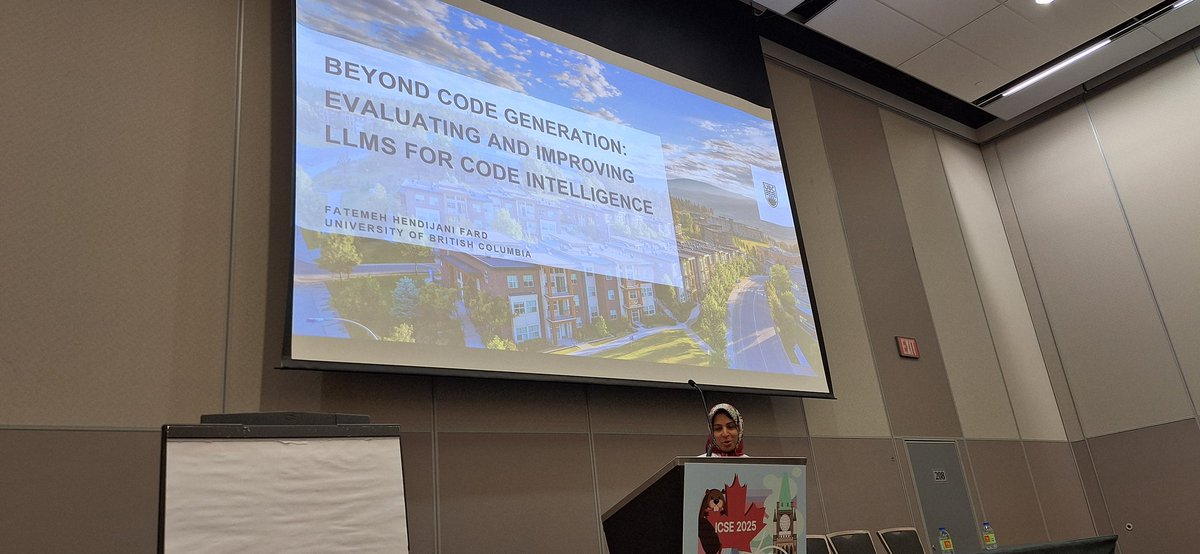
@FH_Fard is giving a tutorial on "Beyond Code Generation: Evaluating and Improving LLMs for Code Intelligence" at @ConfForge. If you are at @ICSEconf, please join us :)
☕ Join us for Wednesday’s Women Café @ #icse2025 — an informal networking session to connect with colleagues and share ideas on how professional societies can continue to promote and strengthen DEI initiatives.
🗓️ Apr 30, 2025
🔗 https://t.co/fcFG1rJ8LW
#WomenInTech#DEI #SIGSOFT
📣 All tracks now open for #ICSME2025 paper submissions!
From research to tools to industry experiences — there’s a place for your work.
We'll be highlighting each track in the coming weeks. Stay tuned! 🔗 https://t.co/hIfSAOmVF9
#CallForPapers#SoftwareEngineering#SEresearch
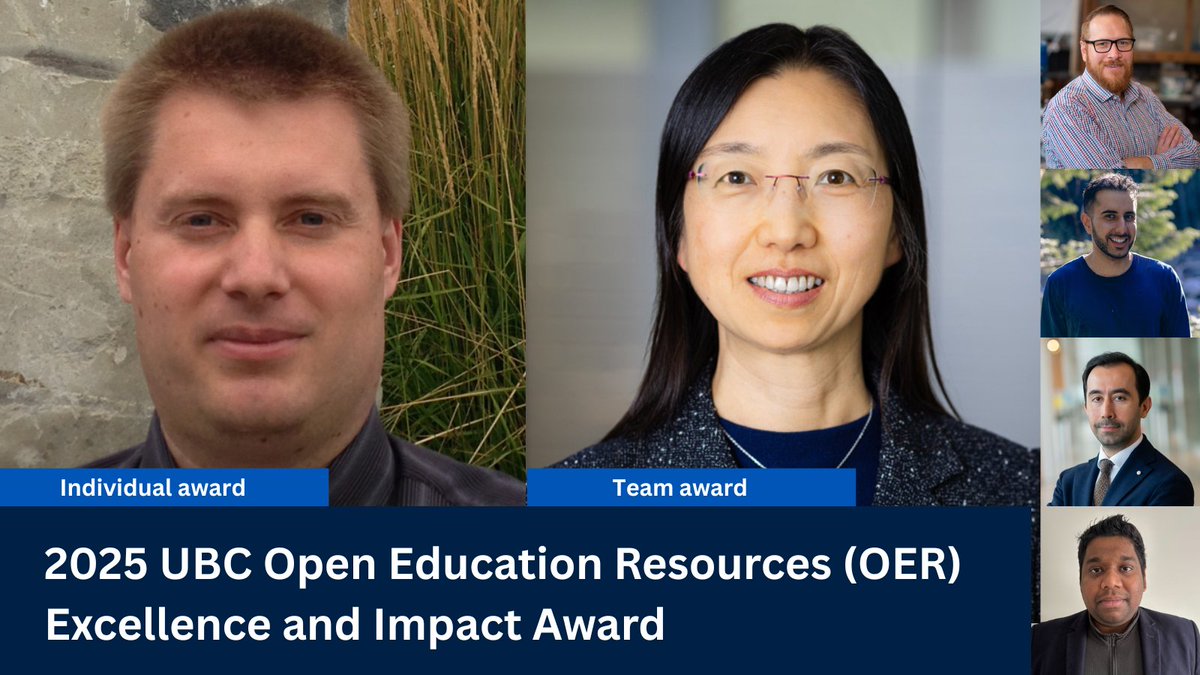
Congratulations to Dr. Ramon Lawrence and Dr. Claire (Yu) Yan and her team, recipients of the 2025 Open Education Excellence and Impact Awards for the Okanagan campus.
Learn more about award and recipients' efforts to support open education: https://t.co/wunVfwvJLe
Our paper "Unveiling Ruby: Insights from Stack Overflow and Developer Survey" got accepted at @ConfEASE 2025. Pre-print available: https://t.co/LLWnLmJimr.
Co-authored with @Gerope90.
🚀 Mark your calendars! The IEEE CASCON 2025 call for contributions and proposals is now open. We look forward to your submissions 💫
More details: https://t.co/DsxGLhwdM9 #CASCON2025#CallForPapers
🚨 Great news! Our special issue “Emerging Concerns in Technical Debt Management” has been accepted at EMSE! 🎉
📅 Submission deadline: June 9
📝 Guest Editors: Giammaria Giordano, @zadiacodabux, Marcus Ciolkowski, Florian Deissenboeck, and @mtbaldassarre
We developed a taxonomy of 35 topics in 6 categories for Ruby developers' issues and discussions from Stack Overflow, followed by a survey. Interestingly, showing misalignment between SO and survey data, reflecting the need to develop metrics to capture difficulty levels.