How would an LLM "thought" actually look, and what properties should it have? 🧠
LLMs shouldn't reason purely in text. That's why the AI field is moving toward continuous thought representations (vectors instead of words). But nobody had answered the more fundamental question: what should a thought look like? What properties must it have for an LLM to actually "think" properly?
I went and answered that in our new paper. This might be very influential for the future of LLM reasoning.
I propose 4 fundamental properties every thought representation must satisfy:
🎯 Causality: The thought must actually drive the answer, not just tag along for the ride.
🗜️ Minimality: It should compress the problem down to only what matters.
🔍 Separability: It must distinguish one question from another within the same topic.
⚖️ Stability: It must stay consistent with how uncertain the model is.
These aren't just theoretical ideas. They give us concrete, measurable targets for building LLMs that actually think better.
To see where we stand today, we audited 5 open-weight LLMs across 23 reasoning tasks, testing 4 different continuous thought representation methods from the literature.
Here is what we found:
❌ None of them satisfy all 4 properties simultaneously.
🤯 Every single method fails at Separability.
Meaning the LLM's internal "thought" cannot distinguish two different questions from the same domain. In plain terms: if you ask an LLM two different questions about your project, its thoughts for both look almost identical. It doesn't actually know which problem it's solving!
🏗️ The failure is structural.
We see it across different sizes, dense models, RL-trained models, and reasoning-distilled models alike. Throwing more compute, bigger models, or more training at it won't fix it.
⚡ The biggest surprise:
Simply using the input text embedding as the "thought" is competitive with, and often beats, the expensive iterative thinking methods on almost every metric. This strongly hints that current methods don't add information beyond what's there in the input to begin with.
This gives researchers the first principled framework for what a proper LLM thought should look like, and tells us exactly what to fix and optimize for to get there.
Dive into the research below 👇
📄 Paper: https://t.co/LYAu988wAt
🌐 Website: https://t.co/QO79RtKG3q
I rebuilt the git history of every SKILL.md in GitSkills, dated 2.1M+ skill adoptions, and linked each copy to the repository it came from. The result is the first dated copy network of agent skills. You can explore it NOW yourself:
🌐 𝗜𝗻𝘁𝗲𝗿𝗮𝗰𝘁𝗶𝘃𝗲 𝘃𝗶𝗲𝘄𝗲𝗿: https://t.co/QXKkodBSqd
A skill is a folder of instructions and scripts (SKILL.md) that coding agents like Claude Code, Codex and Cursor follow with your permissions. There is no registry, no versioning and no update channel.
Many findings, but here are three of them:
1. A small set of repositories supplies almost every copy, and GitHub stars do not tell you which ones.
2. Copies rarely follow their source. Only about one copy in five picks up a later edit, and a fix at the source mostly never arrives.
3. Network position beats popularity for audits. Reviewing the 100 repositories a copy model ranks highest prevents 14.9% of later high-risk adoptions, against 0.5% for the 100 most starred.
Skills are becoming dependencies. They should ship like dependencies, as versioned references rather than copies.
📄𝗣𝗮𝗽𝗲𝗿: https://t.co/AzoN9fgLmI
🌐𝗜𝗻𝘁𝗲𝗿𝗮𝗰𝘁𝗶𝘃𝗲 𝘃𝗶𝗲𝘄𝗲𝗿: https://t.co/QXKkodBSqd
🤗𝗗𝗮𝘁𝗮𝘀𝗲𝘁: https://t.co/LCilN2Jeig
#SoftwareEngineering #AIAgents #SoftwareSupplyChain #OpenData
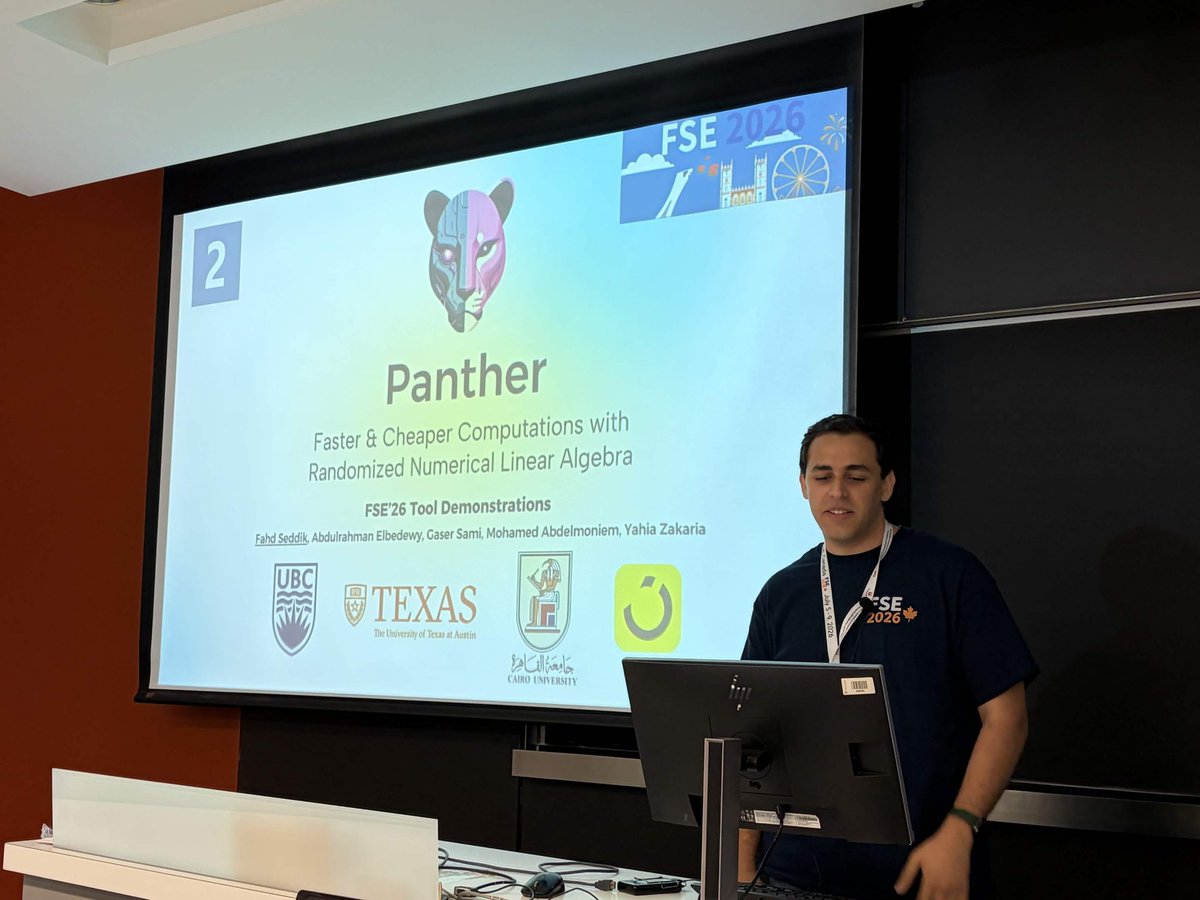
Panther has made it to #Montreal 🇨🇦 at #FSE26 ! 👇
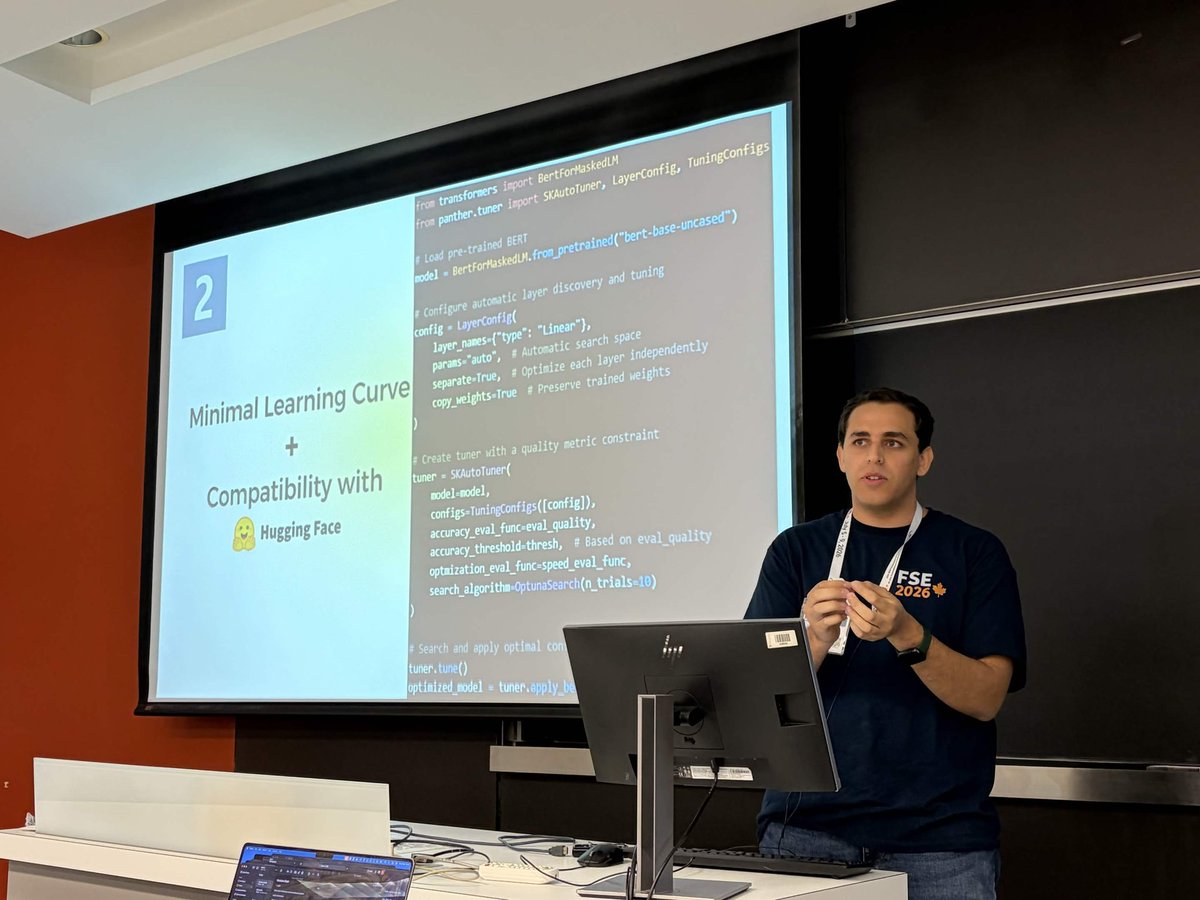
You can now optimize your models beyond just quantization, both speedup and compression together! Directly integrating and beating PyTorch implementation with 3x-50x🔥 speedups with better scaling as problem size increases. Most importantly, controllable accuracy-speed/compression tradeoff with our easy-to-use AutoTuner!
Check it out! We're open for contributors!
🌐Docs: https://t.co/Qjnsvx1f59
▶️Demo: https://t.co/HaYqvYPCeZ
📃Paper: https://t.co/HdIb1q3Q0u
A year after my bachelor graduation, I'm super glad to have published this work at The ACM International Conference on the Foundations of Software Engineering (FSE) 2026.
#ArtificialIntelligence #MachineLearning #DeepLearning #LLMs
The University of British Columbia has introduced an axiomatic evaluation framework for latent thoughts in Large Language Models.
Imagine a mind auditor evaluating a suspect's internal reasoning process against strict rules ensuring their inner logic directly guides their answers and keeps different problems distinct rather than just checking if their final answer happens to match the truth.
By formalizing four functional axioms including Causality, Minimality, Separability, and Stability, the framework reveals that current iterative thinking methods structurally fail at Separability, meaning an LLM's internal thought vector looks nearly identical for two different questions in the same domain. Surprisingly, using standard input text embeddings often beats these expensive iterative reasoning methods, proving that current vectors fail to add new information beyond the initial input.
@fahdseddik@FH_Fard
https://t.co/pEuRrHrVGK
@HuggingPapers the honest answer is that most current models are just manipulating word embeddings in clever ways, rather than actually thinking or representing abstract concepts. this paper's axioms highlight the gap between what we think our models can do and what they're actually capabl
Do LLMs actually think in silence? We formalized four axioms, Causality, Minimality, Separability, and Stability, to audit latent thought representations. Most model representations encode nothing beyond the input embedding itself. Great work led by @fahdseddik.
Do LLMs actually think in silence?
A new paper formalizes four axioms — Causality, Minimality, Separability, and Stability — to audit latent thought representations. No open-weight LLM satisfies all four. Most representations encode nothing beyond the input embedding itself.
How would an LLM "thought" actually look, and what properties should it have? 🧠
LLMs shouldn't reason purely in text. That's why the AI field is moving toward continuous thought representations (vectors instead of words). But nobody had answered the more fundamental question: what should a thought look like? What properties must it have for an LLM to actually "think" properly?
I went and answered that in our new paper. This might be very influential for the future of LLM reasoning.
I propose 4 fundamental properties every thought representation must satisfy:
🎯 Causality: The thought must actually drive the answer, not just tag along for the ride.
🗜️ Minimality: It should compress the problem down to only what matters.
🔍 Separability: It must distinguish one question from another within the same topic.
⚖️ Stability: It must stay consistent with how uncertain the model is.
These aren't just theoretical ideas. They give us concrete, measurable targets for building LLMs that actually think better.
To see where we stand today, we audited 5 open-weight LLMs across 23 reasoning tasks, testing 4 different continuous thought representation methods from the literature.
Here is what we found:
❌ None of them satisfy all 4 properties simultaneously.
🤯 Every single method fails at Separability.
Meaning the LLM's internal "thought" cannot distinguish two different questions from the same domain. In plain terms: if you ask an LLM two different questions about your project, its thoughts for both look almost identical. It doesn't actually know which problem it's solving!
🏗️ The failure is structural.
We see it across different sizes, dense models, RL-trained models, and reasoning-distilled models alike. Throwing more compute, bigger models, or more training at it won't fix it.
⚡ The biggest surprise:
Simply using the input text embedding as the "thought" is competitive with, and often beats, the expensive iterative thinking methods on almost every metric. This strongly hints that current methods don't add information beyond what's there in the input to begin with.
This gives researchers the first principled framework for what a proper LLM thought should look like, and tells us exactly what to fix and optimize for to get there.
Dive into the research below 👇
📄 Paper: https://t.co/LYAu988wAt
🌐 Website: https://t.co/QO79RtKG3q
5/
Things such as this shift in perception could change how we evaluate software quality moving forward. Instead of asking whether a human or a machine wrote it, our focus might narrow entirely to how well the logic operates and whether it accurately solves the problem at hand.
1/ Five years ago, introducing a synthetically generated piece of code as part of a research dataset often invited deep scrutiny. The term synthetic carried a specific, almost critical weight. It implied something artificial or distinctly lacking in human intuition.
#AI#Agentic
4/
We could be looking at a shift where AI generation is simply viewed as another layer of abstraction. Just as developers long ago stopped worrying about the machine code their compilers generated, we might be learning to accept AI output as the new default text of our trade.
6/ The logic is straightforward. Aiming for a perfect standard might only get you 90 percent of the way there, but aiming for a flawed 80 percent standard guarantees you will never surpass it.
#GenAI#MachineLearnint#ArtificialIntelligence#LLMs#AgenticAI
1/ In current AI literature, there is a fascinating tension. We try to mimic human cognition, but then we spend an immense amount of resources trying to fix the model's outputs.🧵👇
5/ Instead of aiming to mimic humans, things such as setting a target beyond our own capabilities could be the future of development. We should consider striving for a higher, more absolute target.