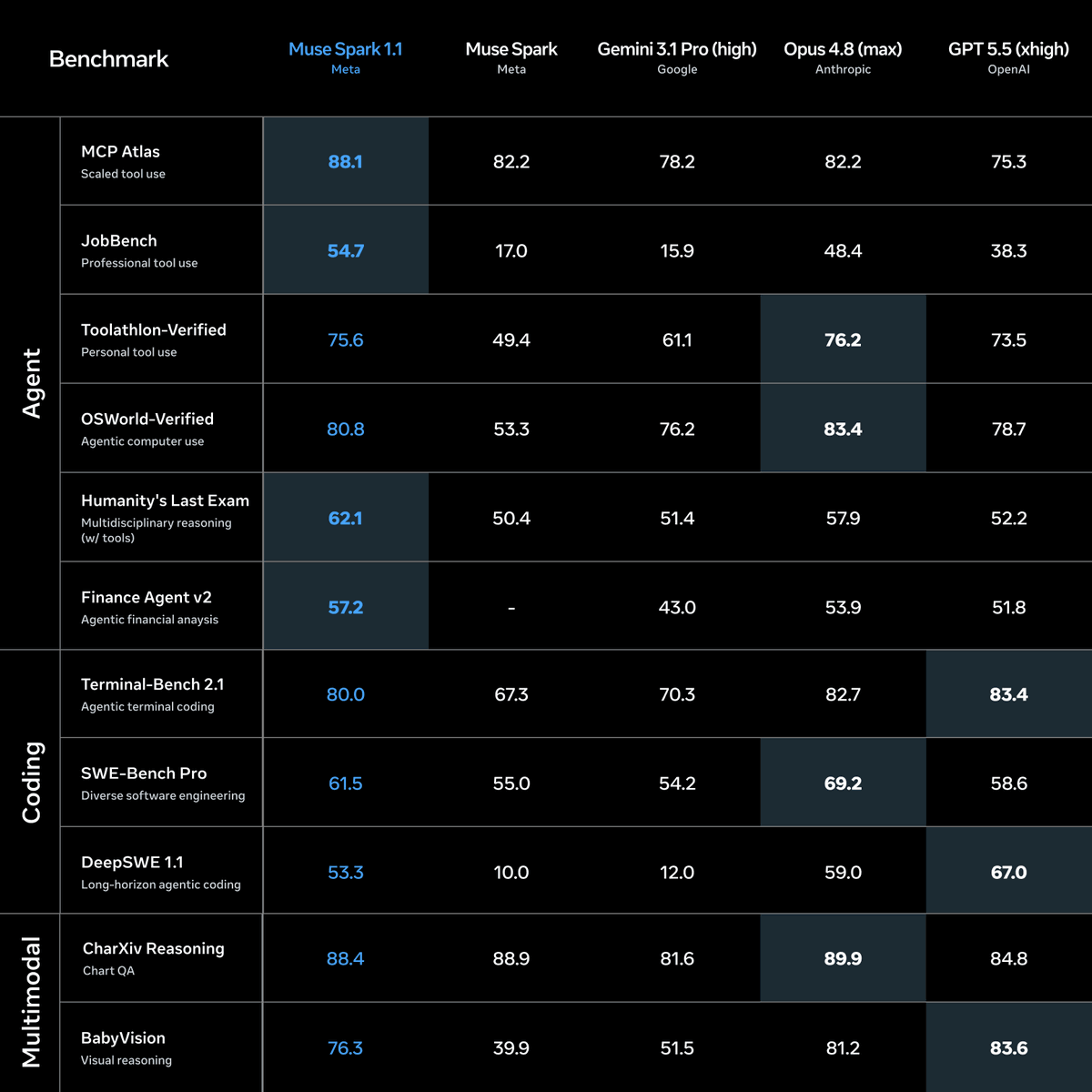
(1) Today we're releasing Muse Spark 1.1 -- a strong agentic and coding model at a very low price. It's available through our new Meta Model API and in Meta AI.
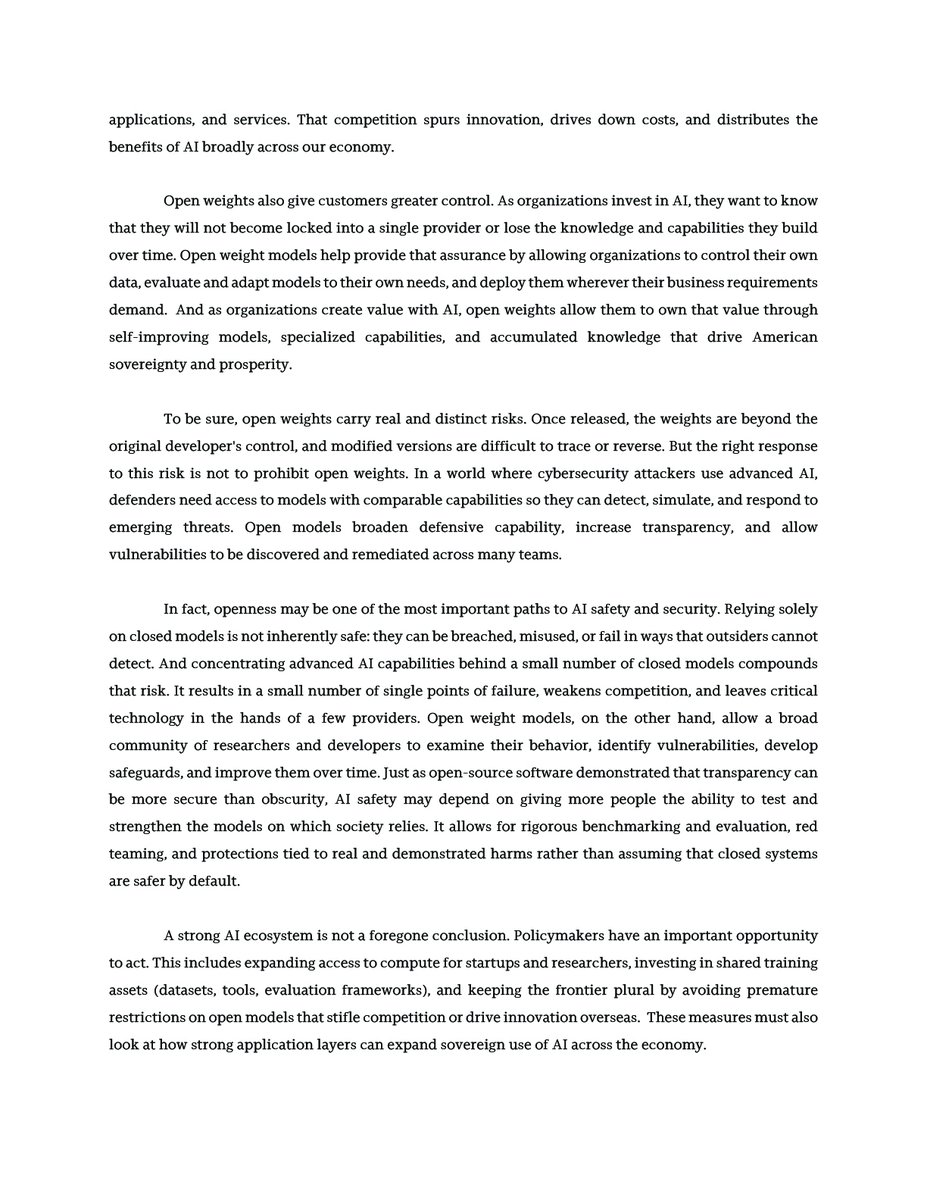
Open-weight models are essential to a healthy AI ecosystem. Together with others across our industry, we are outlining a path for open-weight models to strengthen American competitiveness and expand economic opportunity, while protecting national security. https://t.co/Tr0sAzAxTD
BREAKING: Muse Spark 1.1 takes 1st on our new Video to Website leaderboard with an Elo of 1250.
Video inputs capture richer context than static images - including interactions, transitions, and responsive behavior - challenging models to reproduce the full experience.
Only six labs currently support native video input, with @Meta debuting 14 Elo points ahead of @Kimi_Moonshot and 32 ahead of @GoogleDeepMind.
Video input is quickly becoming one of our users’ most requested capabilities.
Note: OpenAI & Anthropic currently do not yet support native video input in the API.
Congratulations to the @AIatMeta team!
Developer choice is core to what we're building.
We’re excited to share that Muse Spark 1.1 is now available on @OpenRouter for US-based developers.
Get started today 👉 https://t.co/DTyYKrTgNK
Meta made a “minor” release to Muse Spark, there’s nothing minor about it. Lots to parse here:
- This model is so fucking cheap I almost don’t believe it. In practice we see it’s 1/10 the cost of both Fable and GPT 5.5. If you thought OS models would compete away margins, just wait till you see this. It’s somehow cheaper to use MS 1.1 than host your own OS model…
- Coding improvements are significant. This was a real shortcoming in 1.0. But 1.1 sees a ~50% improvement in VibeCodeBench and ~10% improvement in SWE Bench. Not quite SOTA, but at this cost/latency it is still incredibly compelling.
- Speaking of latency, wow this model is fast. Across our benchmarks, we find it to be 1/4 the latency of Opus 4.8 and 1/2 the latency of GPT 5.5. I would expect Meta to have incredible web infra, but really don’t know what witchcraft they’re pulling to host the model for such fast inference at high rate limits.
- There is a public API. This is the first time Meta has released a model through a hosted API. I’m expecting lots of AI natives to hot-swap and rapidly test this model as a replacement. We’ll soon see if it's performant enough for those production uses.
- Speaking of AI natives, it’s been a wild week for Harvey’s legal benchmark. Grok 4.5 held the SOTA position for ~24 hours at 12% before MS 1.1 unseated it with a big jump up to ~20%. I suspect many internal evals will see surprising results like this. Glad to collab with @harvey@gabepereyra@nikogrupen@ItsJulioPereyra on this eval.
- Intelligence is more jagged than ever, even within individual domains like legal and coding. Every application and user benefits from staying dynamic. There an edge in picking the right model/system for each task.
Meta just released Muse Spark 1.1 and is the new SOTA on MedScribe and TaxEval, taking the top spot from Fable 5 while being 10x cheaper and twice as fast. Meta currently holds the top 2 spots on TaxEval
It is also the new #1 on Harvey's Legal Agent Bench, dethroning Grok 4.5 less than 24 hours after it took the top spot.
(3) The Meta Model API allows developers to build using Muse Spark for the first time. Our focus is on delivering strong agentic and multimodal models at very low cost. More to come soon.
(1) Today we're releasing Muse Spark 1.1 -- a strong agentic and coding model at a very low price. It's available through our new Meta Model API and in Meta AI.
(2) Muse Spark 1.1 is strongest at agentic performance, tool use, and computer use. It does well on long-running tasks with 1M token context window, can delegate execution to sub-agents running in parallel, and is trained to use computer interfaces on desktop, mobile, or browser.