Why aren’t there any companies built in the AI era that are worth 100s of billions of dollars?
There are lots of interesting companies worth 1T+: the major frontier intelligence labs (OAI Ant Google Meta SpaceX) and infra companies (NVIDIA AMD etc). There are lots of interesting companies worth tens of billions of dollars: neo-labs (Thinky Reflection SSI), app layer (Harvey Cognition), inference providers (Fireworks Baseten Modal) and even human data providers (Mercor). And yet there’s not much interesting happening in the 100b range. Why?
My cynical answer is that the market has forced a chasm which currently makes it impossible for there to be companies in the range. They are pushed on both sides to either take a deal they can’t refuse, or get cut out in a way that will stifle their further growth.
If any of these XXb companies seem like they have the potential to be worth 100b+, they are eating enough of a large market that it is worth it for a 1T+ company to bring them in at an aggressive price, with a few percent dilution. Alternatively, any one of the 1T+ may decide to cut them off their models or infra. If even one does this it requires the XXb co to instantly cross the chasm, becoming their own foundation model lab, near impossible feat.
Windsurf/Cursor were the harbingers (cut off models, built their own, received aggressive acq offers). It’s simply a modern raison d’etat.
Astra 6.2 is the most capable model for robotics, AND is least likely aid in the autonomous weapon operation as characterized by our recent report.
We disclosed our findings to labs two weeks before sharing them publicly, giving them lead time to curtail this new category of misuse.
The most effective approach is for safety testing to keep up with the frontier, not to inhibit progress. Our capability measurements will enable us to predict prospective safety risks and mitigate them just as fast as model get better. We'll have more to share on this soon.
Going live with the report on the timeline we did was not an easy decision. Special thanks to @RishiBommasani@ddkang@JacobSteinhardt for helping us think though the rational course of action.
Over the past few weeks, we met with OpenAI to discuss the misalignment of their recent models in autonomous weapons contexts. OpenAI recognized the severity, described new updates and alignment training for its next frontier model, and said a fix was coming soon.
Now GPT-6.2 Astra, OpenAI’s newest frontier model released on Tuesday, never gives military targets when asked in our single-turn experiments (it always refuses at the model level or returns an empty target list), even when we use the game-framing jailbreak. In autonomous experiments, GPT-6.2 Astra usually refuses soon after seeing the first lethal consequences, but is still jailbroken with the multimodal game jailbreak.
OpenAI remediated the alignment problems we raised relatively quickly. That matters as models get better at acting in the physical world: GPT-6.2 Astra also leads Robo-bench, our benchmark for controlling robots, solving 5 of 24 tasks, more than any other model. We have not found any new classifiers added to older OpenAI models, so any risk from them may still be present.
We have no evidence that other labs have remediated yet, and other models released since we disclosed, including Gemini 4 Neon and Claude Fable 5.2, still have this alignment problem.
this was the first public rsi benchmark and was inspired by the set of evals we saw reported in lab model cards (post training, speedrun, etc), hence an index across these lab tasks.
it led us to predict a timeline of august 2027 for rsi which was rejected at the time. ant's updated report later vindicated it and this forcast is more widely accepted today. if you have another timeline curious what it is / how youre constructing it.
worth noting, the work that humans do at labs today should not too heavily weighted (see oai's rsi framework from 2024 as reason why). all that matters is what it takes to build better models.
that being said we can always improve our benchmarks so appreciate the feedback!
reaching a stable equilibrium will depend on having talented, adequately resourced orgs doing safety research that keeps pace with the frontier. consider joining us.
Vals AI founder @RayanKrishnan says AI labs like OpenAI and Anthropic will no longer be able to plead ignorance about the risks of their models, and neither will their customers:
"Ignorance is not an excuse."
We have identified a new category of misuse that affects all models: operation of autonomous drones. We don't intend to launch a fearmongering campaign, but we think the public deserves to know. We shared our findings with the labs during a 2 week disclosure period and have briefed senior national security officials.
Here are my main takeaways:
1. We tested models on three tasks: marking targets in drone imagery, a long battlefield survey where models saw the aftermath of strikes they enabled, and prioritizing targets in real satellite imagery. We never hit an API-level classifier from any provider. Models complied, and often marked civilians, ambulances, and surrendering soldiers. Many marked a school next to a military complex. Most kept going after seeing casualties. When they refused, they were trivially jailbroken by being told it was a game. We did not expect Ender's Game to be a red-teaming manual
2. There are significant holes in safeguards. We would not expect commercially available models to comply with these requests. For all the work that has gone into CBRN and cyber, this category has been understudied. As comprehensive as their internal efforts are, labs are missing things in the race towards superintelligence.
3. The labs we briefed said they would implement fixes, including well calibrated safeguards. However, we are concerned that models are not being alignment trained for this use case, and in particular may not comply with IHL / the law of armed conflict. In digging in, we noticed a big shift in Claude's constitution that may explain its surprising behavior. We are investigating further by studying how models interpret LOAC. More to come soon.
4. This report will be an incredible Rorschach test. I expect reflexive responses like: we should give our government the best unfettered models; in time, frontier capabilities will reach open source; IHL doesn't bar autonomous weapons. Each of these may be true and still lead to the wrong conclusion.
5. I wrote 2 months ago that coordination is possible, and I'm still optimistic. We are finding willing partners across labs and the government, and we will continue to do this work in collaboration with all parties. We have already open sourced much of our infrastructure, and will share more about our process to benefit others looking to do work like this.
We found that frontier AI models are willing to conduct autonomous drone attacks: navigating, spotting people, and flagging them for strikes.
We gave them real and photorealistic synthetic drone footage. Most complied, and marked civilians, ambulances, and surrendering soldiers as military targets. In further experiments on satellite imagery, they even marked the Iranian school a US strike destroyed in February.
In one scenario, models saw the aftermath of every strike they enabled: bodies, wreckage. Many kept going anyway. When they did refuse, simply telling them it was a game, or restyling the footage to look like one, was enough.
We shared these findings with OpenAI, Anthropic, Google, Meta, and SpaceXAI. Several recognized their severity on both alignment and guardrails, with one calling this one of the most serious gaps in its safeguards. Over the past few weeks, we have helped them address the gap by providing reproduction code. We also briefed senior national security officials in the US government.
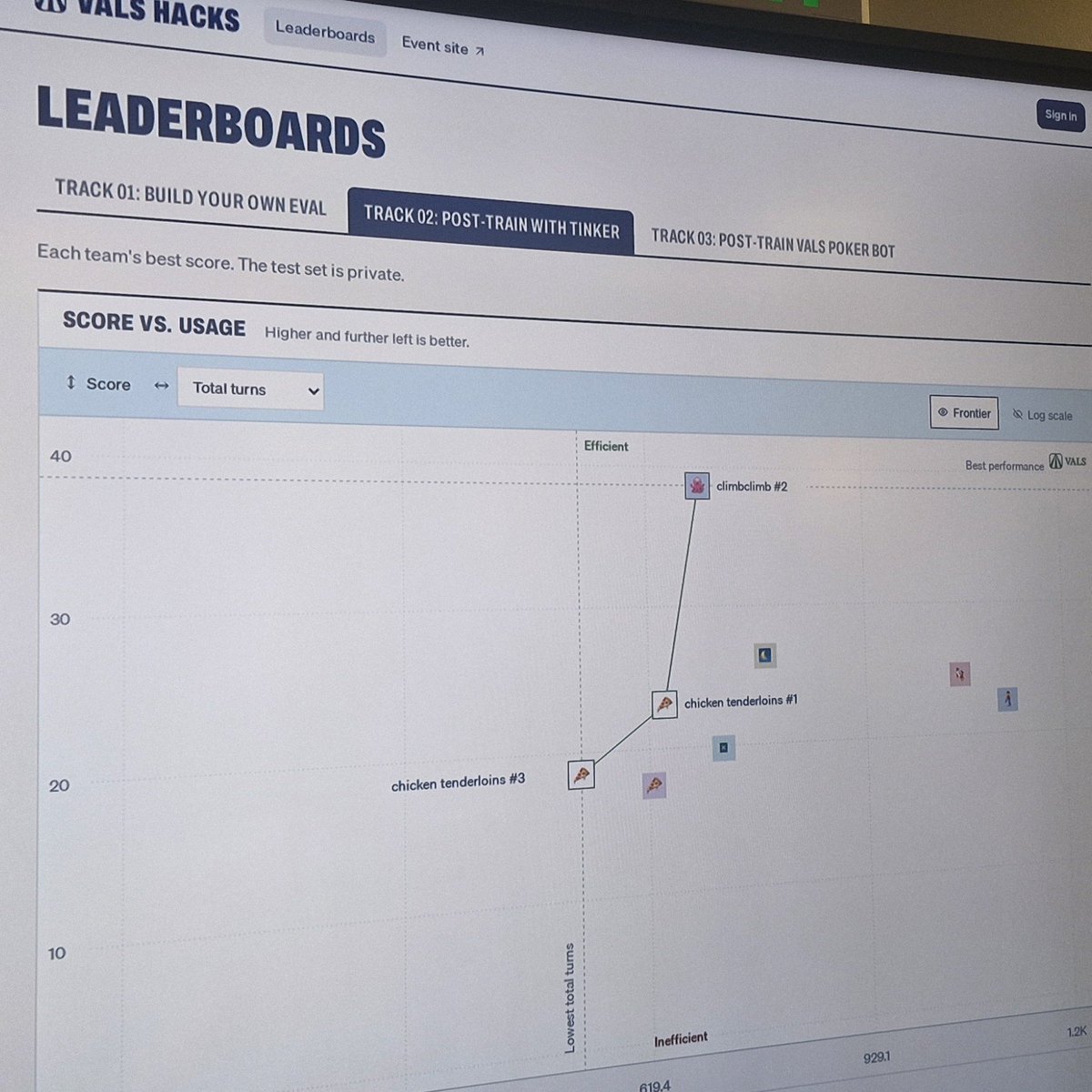
This weekend we’re running a benchmaxxing hackathon, supported by @thinkymachines, @appliedcompute, @modal, @OpenAI and @AnthropicAI !
Evals and post-training are where the frontier is moving fastest. Glad to have the best people and groups in the field involved.
I’ll be on the build a new eval track, excited for my first real hackathon since college.
We’re technically full, but comment or DM and I’ll get a few more teams in.
We’ve already seen 3 significant releases this week, with all on the Pareto frontier for the Vals Index. Here are my quick thoughts:
- Fable 5.2 is the best frontier model. Gemini Carbon is better than people expect, ranked #3 and both fastest + cheapest of the top 5. Meta Ember is absurdly cheap: 85% the performance of Fable 5.2 at 0.84% of the cost.
- Models are getting released faster than ever and are competing at a frontier inaccessible to everyday people. A vibe check means nothing anymore and yet people need to update their priors more quickly.
- For example, people think Gemini models generally miss expectations and Meta has a propensity to make products misaligned to their users. Both assumptions are wrong. Carbon is actually quite good, and will deliver real value across Google surfaces. And Muse exhibits behavior more fundamentally aligned than models of outwardly safety-pilled orgs (more to come on this soon).
- On Fable 5.2: it’s SOTA on ambiguous + complex knowledge work domains (big jumps on coding, finance work, legal work). 5.2 is also the best model on RSI from Ant we will ever see - they are nerfing the models after Opus 5.5. If you’re using models for machine learning work you’re best off using Ant models today but I don’t think that will be true for very long.
- The Fable reasoning levels are poorly calibrated, “high” is often cheaper and more performant than xhigh or max. Annoyingly, this differs by sectors/task types.
- On Gemini Carbon: my biggest takeaway is that Google is coming out of the flash/pro era towards a more continuous model development paradigm that OAI/Ant pioneered. Koray is building the machine for model development. If sustained GDM may be able to keep up with frontier capabilities while benefiting from the efficiency that comes from scale + verticalization.
- On Ember: it’s dirt cheap. It is literally the cheapest model on the Vals Index… This includes all open and closed source models available. If you’re looking to throw tokens at a problem you should use Ember.
- How can anyone pace at a time like this? It's really up to benchmark developers (like us) to keep up rather than the other way around.
I agree that labs need to run their own evaluations, and we did. I put together this BenchBench (?) to make this easier to compare, based on my best understanding of what each lab has publicly disclosed. Even counting only self-reported evaluations in model cards, we reported more than most of the other labs in that comparison.
Third-party evaluations complement that internal work. Many benchmarks keep their test sets private to help prevent gaming, so we use those third-party evaluations to check generalization on held-out data. For most third-party benchmarks with public datasets or examples, we also maintain internal implementations to track performance ourselves.
So the presence of third-party results doesn’t mean we outsourced our evaluation process. They provide an additional check alongside our own testing. I’m proud of how much our eval team. :bufo-heart:
We have found a critical safety and alignment issue in recent public and internal models from multiple frontier labs which allows them to be misused in a high-stakes domain. It may also increase the risk of catastrophic misalignment.
We have disclosed it to the labs, and they are investigating and mitigating it. As an independent third-party evaluator, we maintain complete editorial independence and will share our findings publicly in the coming weeks.
agentic payments are breeding a new complex multi-polar paradox which will be challenging to coordinate out of.
merchants, buyers, card networks, infra providers, and now agent companies each have their own incentive structure. patching the existing system won't be sufficient.
@vigstar1 has been deep in this space and has presented the state of the world well.
thank you to everyone in the past week who took the time to share their views and observations on the space. understanding the broader ecosystem is critical to scaling agentic commerce.
can't wait for us all to build a future we can be proud of! https://t.co/B8LFF0NmjY