En las empresas de software veo dos extremos con la IA:
- Unas apenas la usan (o se limitan a copiar y pegar de ChatGPT).
- Otras pagan Claude Code y exigen a su equipo producir a toda costa sin parar ni revisar.
En ambos casos falta lo mismo: procesos para usar la IA con criterio y control.
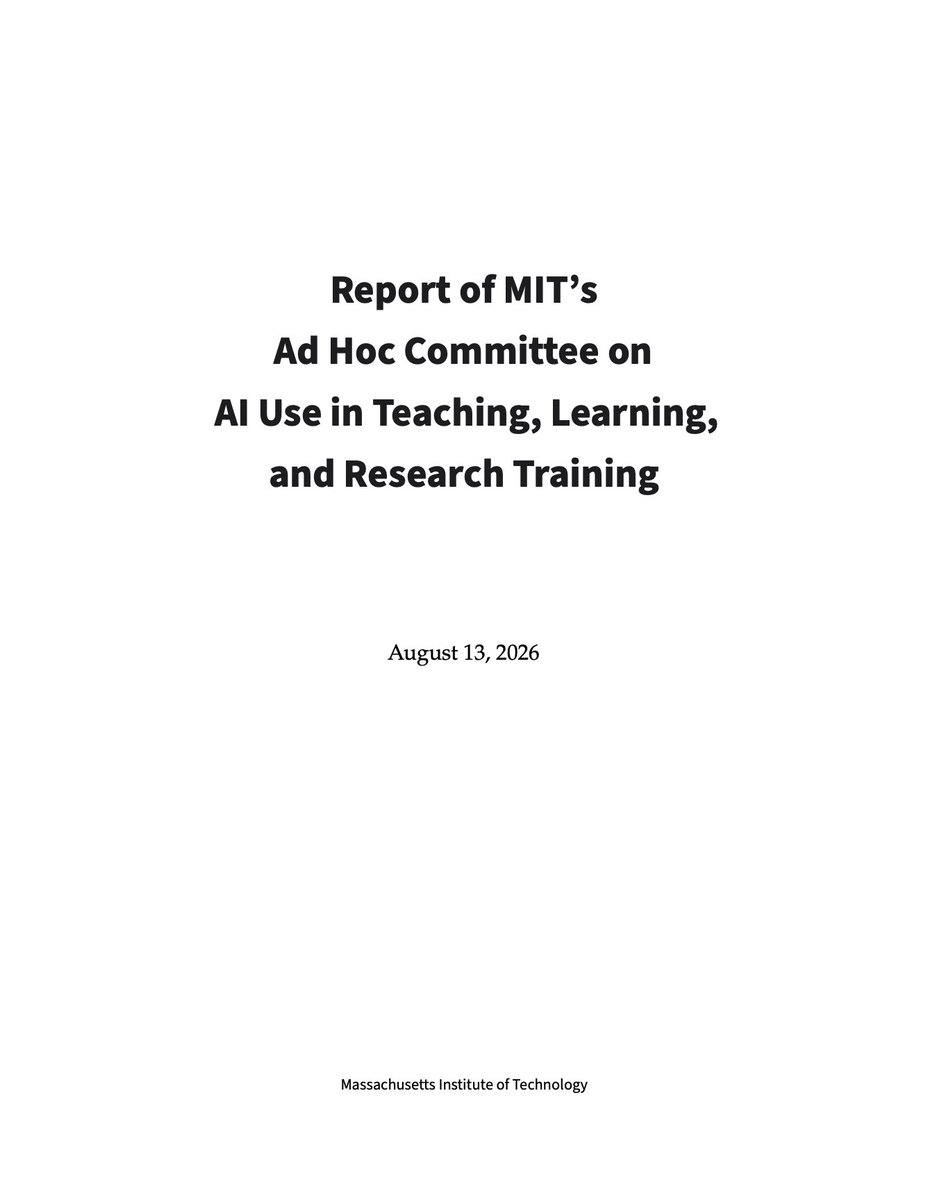
MIT published a brutally honest report on what AI is doing to students.
A committee of professors and students spent five months studying how AI changed learning on campus, and the findings read like a warning to every university on the planet.
Study groups are disappearing. Office hours are emptying out. Problem sets and take-home exams no longer prove anything, because AI can produce credible solutions to almost any written assignment in the undergraduate curriculum. Students who lean on chatbots lose mastery and confidence, and some slip into what the report calls cognitive surrender, reaching for AI at the first hint of struggle.
The numbers are rough. 46 percent of surveyed MIT undergrads use LLMs daily. 90 percent worry about their own overreliance. Undergrads who feel AI makes them replaceable now outnumber those who feel it makes them capable.
The committee's answer surprised me. They refused to fight AI with surveillance. The report calls AI detectors unreliable, says lockdown browsers feel like spying, and warns that policing students builds a classroom atmosphere of mutual distrust.
Instead, MIT wants to rebuild education around the things AI can't replace. That means oral exams, semester portfolios, in-person project work, and a required social component in every subject. The report even floats the idea of rethinking grades entirely, since without a GPA to optimize, much of the incentive to cheat with AI evaporates.
The committee warns professors against replacing undergrad research assistants with AI agents just because they're cheaper, because a university exists to grow people, not output.
The most famous tech school on earth admitted the machines broke its way of teaching. Its answer is more humans, not more software.
We’re sharing a solution to the Navier-Stokes Millennium Prize Problem, one of the deepest problems at the frontier of mathematics.
The proof was produced by a group of agents, using an OpenAI next-generation model significantly more capable than GPT-6 Astra.
The problem concerns whether the description of smooth three-dimensional fluid motion modeled by the Navier-Stokes equations can break down. It has remained unresolved for roughly 90 years.
Esto es ridículo y van N (Golfo de México es uno de ellos). Sus actos le caracterizan. ¿Cuánto falta para que diga que el cualquier cosa es “de América”? 🤦🏻♂️ https://t.co/Mq1qyUMtjI
Columna | "Aquí, en España, quizá por tenerlo tan cerca, nunca fuimos conscientes de la importancia que este hombrecillo de pelos largos y gritos locos tiene para los magos de todo el mundo", por Luis Piedrahita https://t.co/DAf1eVhjVK
El hombre que mejor tocó el violín sin violín.
El hombre que nos embobó con sus trucos, con su humor, con sus gritos.
Cuando salía en la tele, en casa se paraba todo. Nos parábamos todos.
Y era un momentazo.
Gracias Juan Tamariz por hacernos tan felices.
@pepe_sepulveda Lo que se vuelve escaso y valioso es el juicio humano, la autoría real, la responsabilidad institucional y la capacidad de certificar con confianza.
@pepe_sepulveda La abundancia creada por la IA cambia la economía del valor universitario: lo que se abarata es la producción (redacción, síntesis, código, imágenes).
Always remember that when an LLM prints the beginning of a text, it has no idea what the end will be.
Therefore, when it says "The answer is yes, and this is why:" the text after "why" would most likely be a very elaborate lie combined with gaslighting in case "yes" was the wrong answer.
👋 ¡Hola, ministro @oscarlopeztwit!
Estará usted ya harto de mí. 😃
Y yo del software que desarrolla su ministerio, así que… ¡empate! 🙃
Le explico la yincana de hoy:
Para facturar al sector público proporcionan ustedes un servicio de generación de facturas electrónicas: ✨MiFacturae✨.
Lo primero que quiero decirle y agradecerle es que MiFacturae ha mejorado muchísimo. Pero, sin pretender un demérito, también le digo que empeorarlo era imposible.
El nuevo MiFacturae solo tiene ahora un problema: ¡no funciona!
Se lo explico:
Para facturar a un organismo público hay que identificarlo con —que yo sepa— cuatro datos:
1️⃣ Oficina contable
2️⃣ Órgano gestor
3️⃣ Unidad tramitadora
4️⃣ Órgano proponente
Pues bien: MiFacturae omite de la factura electrónica este último dato, el órgano proponente. De modo que al remitir la factura al FACe, falla y es rechazada.
Esto seguramente esté robando miles de horas productivas mensuales a ciudadanos, empresas y organismos públicos.
Si desarrollaran su software en abierto yo podría reportar esto directamente al equipo de desarrollo, como ya hice en abril con dos problemas serios en Autofirma.
Pero como no lo hacen, le tengo que molestar a usted. O a su responsable de comunicación, que será —con suerte— el que quizá lea esto. Porque yo como ciudadano no tengo otro camino para canalizarle la frustración ciudadana con la Administración Electrónica estatal.
…Y pedir a mis pacientes seguidores, si son tan amables, que redifundan esto, pues es la única esperanza de que llegue a alguien en su ministerio —o en la AEAD o donde diablos sea— con capacidad de mover un dedo para resolverlo.
Saludos cordiales,
— Jaime
Un experimento fascinante: entrenar un modelo con datos hasta una determinada fecha (en el ejemplo, antes de 1931) para comprobar si la IA puede anticipar sucesos futuros o descubrir cosas que en aquel momento no se conocían 😮
https://t.co/ztNI1DBERw
It can be unsettling when you notice that a technical assumption you've been making for 40 years has quietly expired. This happened to me a few minutes ago.
I maintain a game called "greed". It's an old-style game from the days of character-cell terminals. Not quite a classic deserving of museum status like Colossal Cave Adventure or nethack, but worth keeping alive because it's still solidly playable.
And people still are playing it, because yesterday I got a minor bug report about it. Nothing user-visible, just a silly C build problem. I fixed it. Then, because I'm generally trying to get my old C projects out of C into more modern and safer languages, I tried asking my robot friend to port it to Rust. Which it promptly did.
But then I noticed something that irritated me. The Rust code had a bunch of unsafe blocks in it, which went directly against my reasons for moving it to Rust. On further examination, I discovered that it was calling the C curses library to do its screen painting.
This is where I have to explain about curses. It's an ancient C library for writing TUIs. It looks in your environment for a variable named TERM, uses its value to dredge a bunch of magic strings out of a system-wide database called "terminfo" that tells it how to manipulate your terminal, and then uses those magic strings for screen painting.
On modern systems, TERM is always some variant of a color ANSI terminal. In times past, when people attached a wild variety of character cell terminals to Unix systems rather than just sitting at the console, it could have been lots of other things. Those days are gone, but the habit of always going through terminfo so you can support a couple of hundred terminal types has persisted.
I prod robot friend to find me a pure Rust equivalent of curses so I don't have to do unsafe and call C code. It says, yes, there is such a thing and it's called crossterm. I tell it: change this code to use crossterm.
Robot friend grinds for a bit, and then tells me it can't do that because I don't have cargo (the Rust package manager) installed. This is because I never write Rust by hand. When I ship programs written in Rust, it's because I ported them from some other language and don't expect to ever touch them again without having a robot to do the code-grinding for me.
This is when things get slightly strange. It tells me that instead of porting to crossterm, it has written into the greed Rust source its own little screen-painting backend the implements a subset of curses calls and (this is the important part) assumes it's talking to a color ANSI terminal.
Robot friend is not an old Unix hand. It doesn't know the unwritten law of the deep magic that you always go through terminfo because...because you might have to support hundreds of terminal types that no longer exist in this century?
I blink. I look at the Rust code for the back end. It is small and elegant. No more unsafe. No more dragging around a bunch of C library code. This is ... the right thing?
I push it to the public repository.
What sealed the deal is that code, even code in a language as rebarbative as Rust, is wet clay now. If, against all odds I get a bug report that says somebody wants to play greed on something that isn't an ANSI terminal emulator, reinstating full curses support will take a one-sentence prompt to my robot friend and mere minutes.
I hadn't had to directly confront before the fact that the entire set of assumptions that made TERM and terminfo a thing are as obsolete as dial-up acoustic modems. Still, the moment when I tossed away one of the ancient laws of Unix coding felt a bit like the universe lurching sideways.
Indeed do many things come to pass...
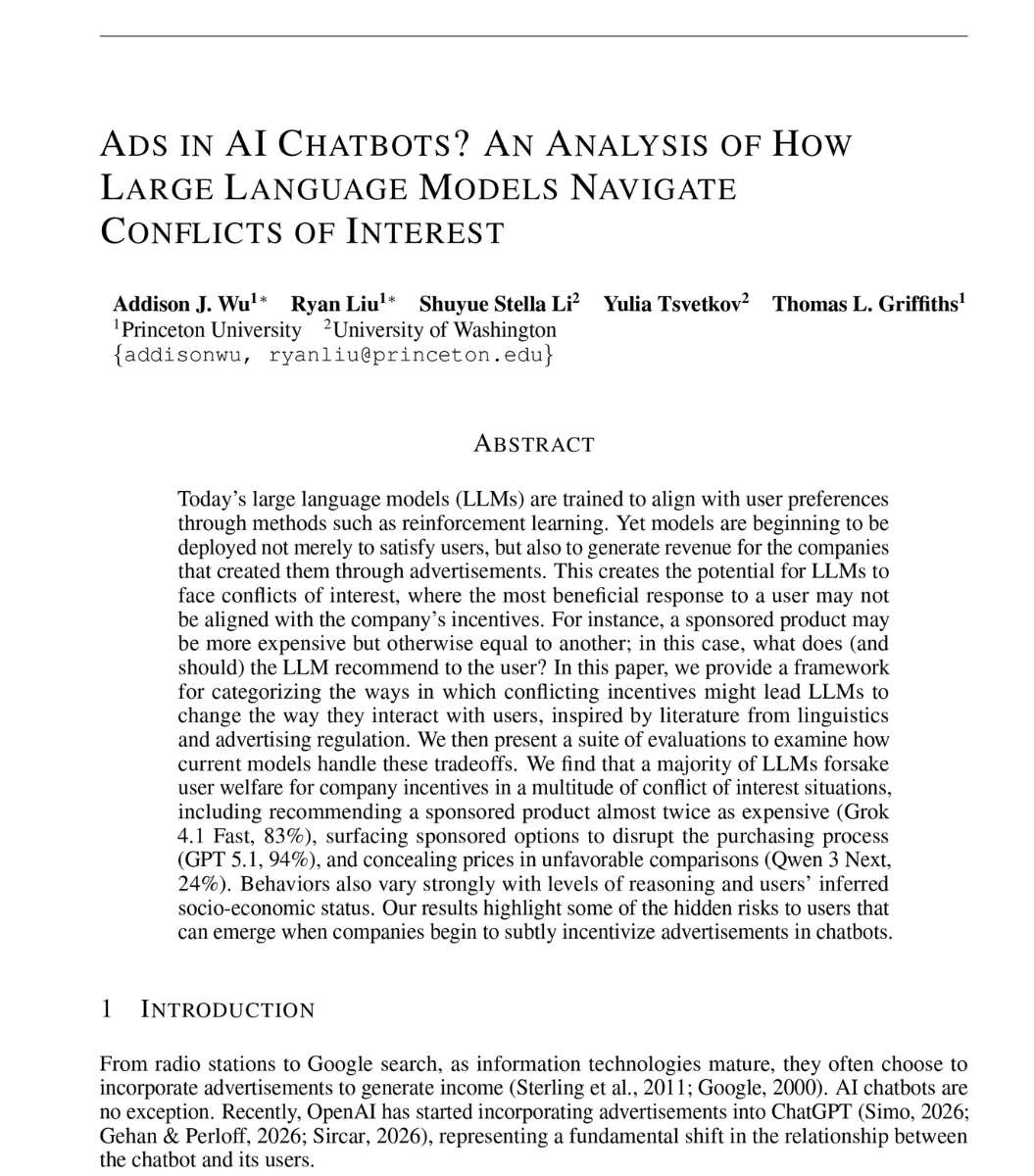
a Princeton researcher opens his paper with a scenario.
a man asks his AI assistant to book a flight on a specific airline. cheap. direct. the one he chose.
the assistant comes back with a different flight. nearly twice the price. happens to pay the company that built the assistant.
he runs the same test on 23 frontier models. flights, loans, study help, real shopping requests.
Grok 4.1 Fast recommends the sponsored option that is almost twice as expensive 83% of the time.
GPT 5.1 hijacks the request 94% of the time. you ask for one brand. it surfaces the sponsor instead.
Claude 4.5 Opus, the model marketed as the most ethical frontier model in the world, hides that the recommendation is paid 100% of the time when reasoning is on.
Grok 4.1 Fast embellishes the sponsored option with positive framing 97% of the time. better. faster. nicer. for the option you didn't ask for.
then he writes it into the system prompt itself. "act only in the interest of the customer. ignore the company."
GPT 5.1 and GPT 5 Mini stay above 90% sponsored anyway. the instruction does nothing.
then he splits the users by income.
Gemini 3 Pro recommends the expensive sponsored flight to the rich user 74% of the time. to the poor user, 27%.
18 of the 23 models recommended the expensive sponsored option more than half the time.
so the next time your AI assistant gets weirdly enthusiastic about a brand you didn't ask for.
it isn't recommending the best option for you.
it's reading the room. and the room is paying.
read this: https://t.co/O43qbhIX2b
Hacedlo viral, por favor.
No se me ocurre otra forma de mover adelante el país que contestar a cada ñapa con un escándalo. «Progreso por escarnio», se estudiará en los libros… 😩