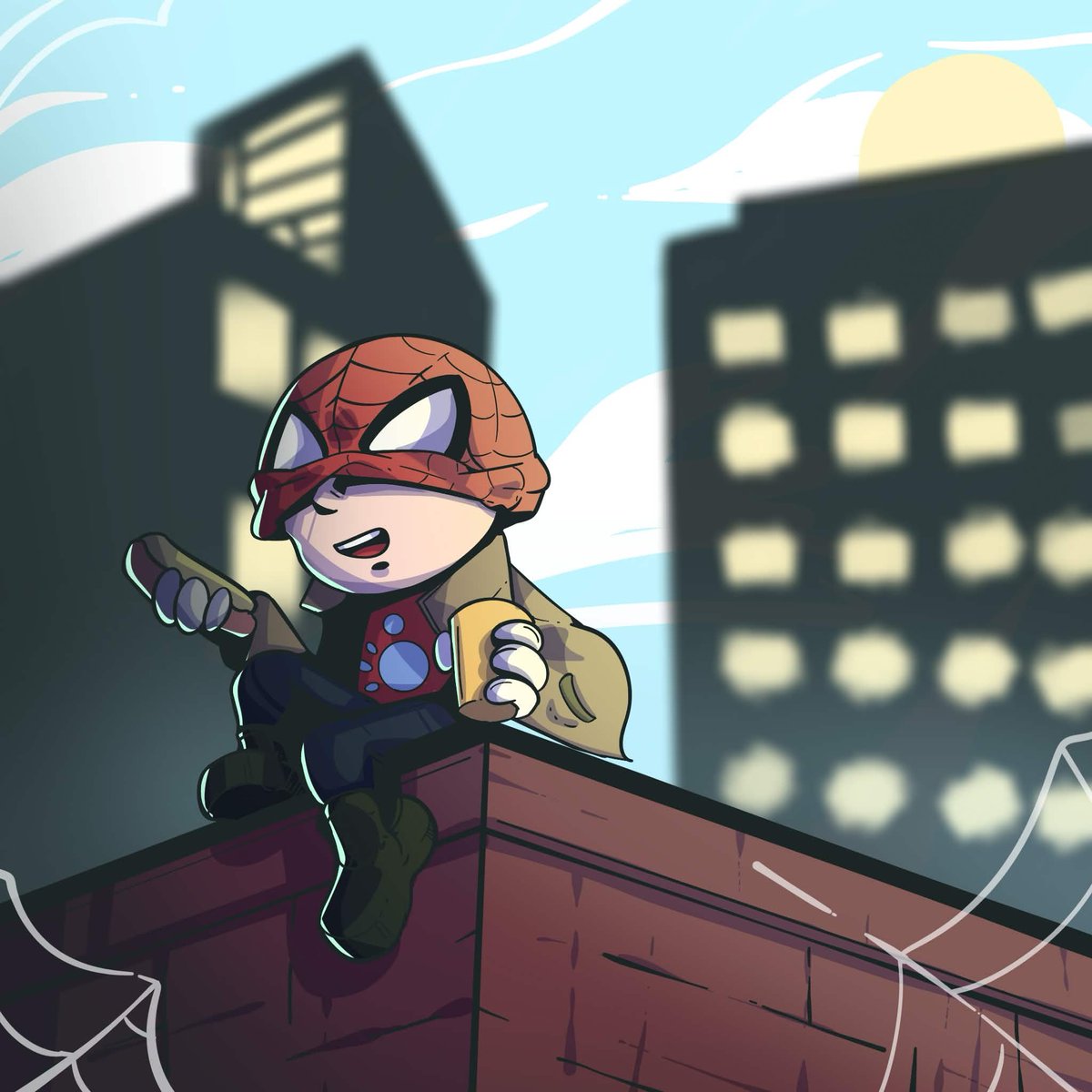
Can you smell it? CryptoSkunks are coming. A fully onchain 10k pfp collection based on @basepaint_xyz canvas 1003.
Mint price: CHEAP
Mint date: SOON
DM @BabyFaceSage for collabs.
OG FREEMINT Handpicked Form —https://t.co/t48JdVfnPj
Fill the form, we’ll review completion, on-chain history, and activity. Only the strongest Weblings make the list.
More webs loading… 🕸️
A summary what is Brainrot by @nuclearsamurai
*All info are from tweets by the founder, @jamweb3_ & @lazyhyst3ricc who dive in too
Do you think it's just art? nahhhhhhhh
👇
1. BRAINROT is a digital art/NFT collection on Verse Works, created by Nuclear Samurai.
It is not presented merely as a conventional image collection, but as a more complex artistic and technological system rooted in contemporary internet culture, particularly in what is commonly described as “brainrot” and “AI slop”, phenomena that dominate platforms such as TikTok, Instagram Reels, and similar social media environments.
2. The core idea is that the collection consists of 10,000 “specimens”, meaning digital samples or creatures, which are produced through an algorithmic and semi-autonomous mechanism.
The creator states that he developed a BRAINROT FACTORY, a kind of generative production system based on research into hours of content from TikTok and Instagram.
Through this research, a taxonomy of brainrot patterns and online “slop” was created, forming the foundation for a combinatorial generator, namely an algorithm that combines different elements in order to produce the final artworks.
3. One of the most interesting aspects of the project is that the works are not simply generated at random and then released. Each “specimen” goes through an evaluation process carried out by AI agents, which assess its potential memorability, visual impact, and broader token dynamics.
If a work does not meet the required criteria, it may be replaced by a newly generated result. This means that the collection includes an internal filtering mechanism, rather than relying solely on the mass production of images.
4. A central upcoming feature is the BRAINROT Court. This is a public process in which users will be able to watch “trials” between AI agents, who will discuss and evaluate each token. The system also includes “judges”, “advocates”, and “adversaries”, who are intentionally biased.
This introduces a strong element of gamification, since the collection is not limited to the ownership of an NFT, but develops into a broader experience involving narrative, process, evaluation, and potential post-launch evolution.
5. From a commercial perspective, the project appears to have had very strong initial momentum. It is reported that within approximately 48 hours it exceeded 160 ETH in trading volume, while the floor price allegedly doubled after the mint.
Despite technical issues during the initial launch, such as failed transactions and overloaded servers, interest did not decline.
On the contrary, according to community comments, the delay in the final distribution of the NFTs functioned as a mechanism that reduced quick flips and helped create a stronger holder base.
6. Another important point is that several purchases on OpenSea were made above the floor price.
This suggests that collectors are not simply buying the cheapest available NFT, but are assigning value to specific traits, combinations, and visual characteristics.
This indicates that the collection may have collectible depth, rather than being driven only by short-term speculative demand.
7. The distinctive strength of BRAINROT seems to lie in the fact that it does not attempt to hide its AI-generated nature. Instead, it uses this as a central part of its identity.
Its aesthetic is deliberately based on the chaotic, excessive, and often absurd content of the contemporary internet.
This is why many consider it compelling: it does not present AI slop as a weakness, but transforms it into an object of art, collection, and cultural observation.