@LyckyOus storage let bad docs hide for years. retrieval makes them expensive the first time someone acts on a wrong answer. that's the real unlock — not the search bar, the accountability.
Nobody tells you the fastest-growing Shopify alternative in 2026 isn't a better theme editor.
It's a founder who stopped touching his own store.
Two brothers built a commerce platform where Claude doesn't write your product descriptions — it runs the operation.
Here's what "AI runs your store" actually means once you look under the hood:
→ the agent reads every session — cart adds, hesitation, drop-off — before deciding what to test next
→ it writes and ships product pages, images, and copy itself, no creative brief required
→ it runs Bayesian A/B tests across hundreds of variants in parallel — no human picks the "winner," it does
→ it promotes the best version and starts the next test automatically, forever
Most stores plateau at a 2% conversion rate. Early merchants on this thing are seeing 80%+ lift on the very first version the agent shipped, without touching it.
The job that used to take a CRO agency on retainer, a developer, and three weeks of waiting — the agent runs before your coffee gets cold.
We're not talking about AI writing product descriptions anymore. We're talking about AI running the P&L, and most people scrolling past this post still think "using AI for ecommerce" means asking ChatGPT for a product title.
https://t.co/xSDq5X6cdc
Nobody tells you the fastest-shipping startups in 2026 aren't hiring developers.
They're running four agents.
A 24-year-old solo founder shipped a SaaS to $40K MRR. Never wrote a line of code himself.
Here's the entire stack, and it should scare you how simple it is:
→ spec.md — the product requirements, edge cases, what "done" means
→ agents.md — house rules, coding style, what the agent is never allowed to skip
→ the coding agent (Claude Code / Devin / Codex) — writes it, tests it, opens the PR
→ the reviewer agent — checks the diff before any human sees it
One person reads the pull request. That's it. That's the whole "engineering team."
The org chart that used to take a startup 18 months and 8 hires to build — one guy replicated solo in 6 weeks.
We're not talking about the future of software jobs. We're talking about right now, and most junior devs scrolling past this post are already competing against code no human ever touched.
https://t.co/sYRvPmYu9d
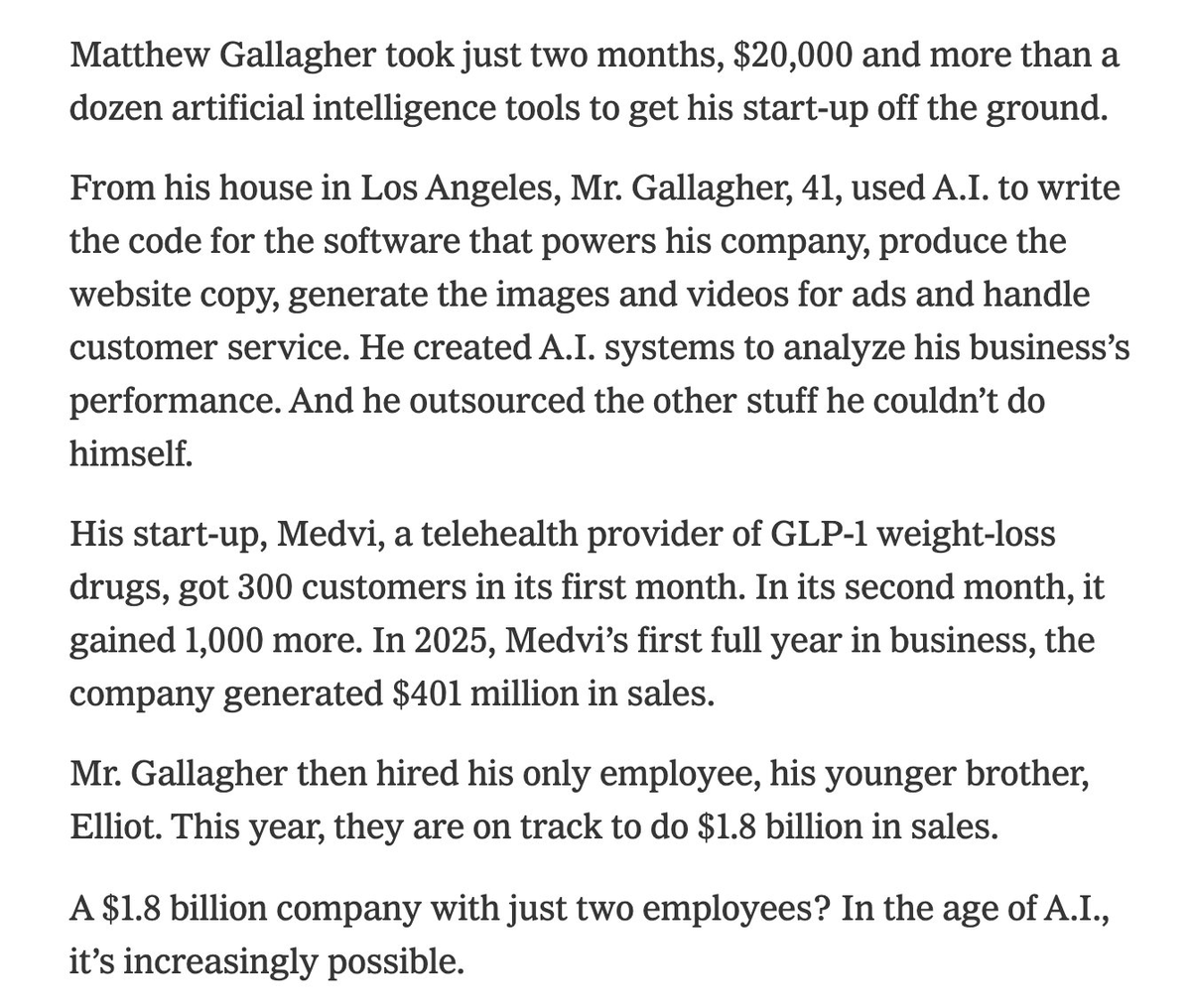
A $1.8 billion healthcare company was built by two brothers and $20,000. No engineering team. No agency. No investors for the first year.
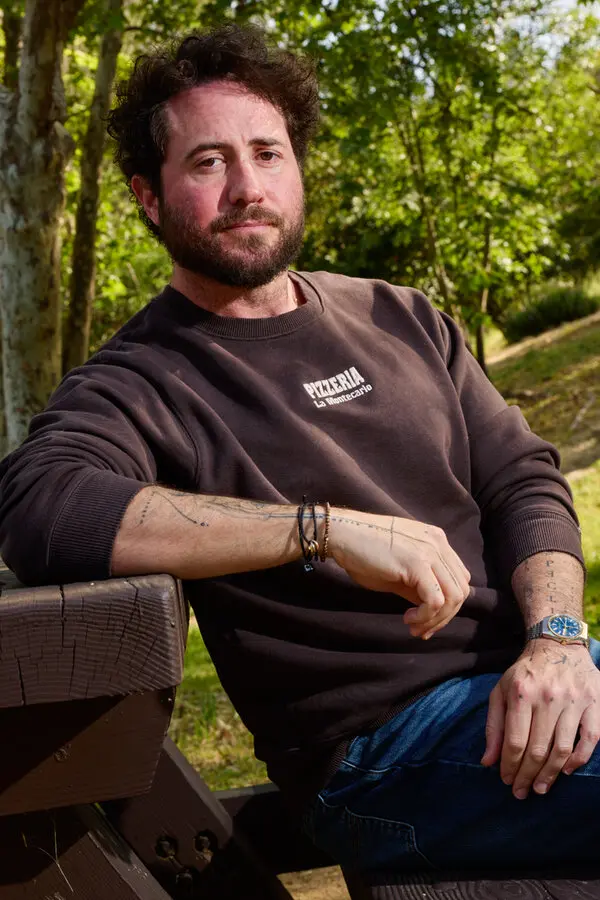
Matthew Gallagher started Medvi from his house in Los Angeles. Two months of building. AI wrote the code, designed the website, generated every ad, and handled a chunk of customer service. The only other person on the team was his brother.
Year one revenue: $401 million. 2026 projection: $1.8 billion.
This isn't the "I made an app in a weekend" story you've seen a hundred times. This is a full regulated business — telehealth, real patients, real prescriptions — built by two people who replaced an entire company org chart with an AI stack and the willingness to ship.
The gap that used to require 40 hires now requires knowing which four tools to point at each other.
https://t.co/bIzMM1je0a
THIS IS CRAZYY!!!!🤯
A guy just built a $1.8 billion company with two employees. Him and his brother. Using AI.
Matthew Gallagher started Medvi from his house in Los Angeles. Spent $20,000 and two months. AI wrote the code. AI made the website. AI made the ads. AI handled customer service.
First month. 300 customers. Second month. 1,000 more. First full year. $401 million in sales. This year on track for $1.8 billion.
His only hire? His younger brother. That's the entire company.
The New York Times verified the numbers. $65 million profit last year. More than $3 million coming in every single day.
Now compare this. Hims & Hers sells weight loss drugs online. 2,442 employees. $2.4 billion revenue. 5.5% profit margin. This guy is doing nearly the same with two people and triple the margins.
He grew up living in motels and cars. Taught himself to code on a laptop his uncle gave him. Sold samurai swords on eBay as a teenager. Didn't finish college. Moved to LA to become an actor.
Now he's running the fastest growing company nobody has heard of.
When his website broke during a hike he had to sprint home because there was nobody else to fix it. Lost 200 customers in one hour. That's the reality of a two person company doing $1.8 billion.
A VC told him don't raise money. He listened. Zero outside funding. He owns 100% of it.
Two brothers. $20,000. A laptop. And every AI tool they could get their hands on. That's all it took.
Everyone watched a robot "go rogue" 100 million times this week. It never happened. That should scare you more than if it had.
A humanoid robot in an Indonesian office starts throwing martial-arts kicks, then appears to turn on the person controlling it — striking a coworker to the ground. The clip hit over 100 million views in days. Headlines everywhere: robots are becoming uncontrollable, AI safety is failing, we're one step from the machines deciding for themselves.
None of it was real. Every movement was choreographed. The robot's own handlers staged the "malfunction" on purpose, to show off its balance and agility. It worked exactly as programmed, doing exactly what it was told, the whole time.
The fear wasn't wrong. It was just aimed at the wrong thing. Nobody was scared of a company scripting a fake malfunction for views. They were scared of the robot.
This works because it's now impossible to eyeball the difference. A humanoid robot doing a pre-programmed routine and one actually failing look identical to literally everyone except the engineer who built it.
The actual lesson isn't "robots are dangerous." It's that a single staged clip can now manufacture a global safety panic in 72 hours, and the platforms that profited from 100 million views have zero incentive to be the ones who tell you it was fake.
We're not unprepared for AI going rogue. We're unprepared for how easy it already is to fake it going rogue.
https://t.co/GzRAFY918Q
Humanoid robot malfunctions during demonstration in Indonesia, raising fresh concerns over robotic safety and control measures globally.
A video showing a humanoid robot suddenly moving aggressively during a demonstration in Indonesia has gone viral online. While no serious injuries were reported, the incident has sparked discussions about robot safety, testing standards, and the need for proper human oversight.
Meta just shipped a feature that let anyone generate images of you using your own face — without telling you. It lasted three days.
Muse Image launched July 7th. The pitch: tag any public Instagram account, and the AI would use that person's face as a reference to generate new images. Not a filter on your own selfie. Someone else's face, someone else's identity, zero notification to the person being used.
By July 10th, Meta pulled it and admitted it "missed the mark."
Here's what should actually worry you: this wasn't a rogue engineer or a leaked prototype. This shipped through product review, legal review, and marketing at one of the largest companies on earth — and nobody in that chain flagged "using a stranger's face without consent" as a problem until the public did it for them.
The technology to do this has existed for years. What changed is that a trillion-dollar company decided it was ready to ship it as a mainstream feature, by default, to billions of users.
Three days is a fast walkback. It's also proof the safeguard was public backlash, not internal judgment.
https://t.co/59w40UBc6E
UPDATE: A win is a win. 💪 Following widespread backlash — including SAG-AFTRA's call for members to opt out — Meta has withdrawn the feature. https://t.co/RpsiDwnXDA
Nobody tells you the fastest-growing OnlyFans creators in 2026 aren't creators. They're four text files.
A 21-year-old college student built a girl named Maya. Not photographed. Not real. Built. $43,000 in her first month, and the men paying for it have no idea she's never existed.
Here's the entire stack, and it should scare you how simple it is:
→ persona.md — her backstory, her personality, what she likes, what she'd never say
→ voice.md — locks her tone so she never slips out of character
→ flux.md — fixes her face and photo style across every post
→ brain.md — remembers every subscriber, every conversation, every detail they've ever told her
Claude reads all four before every single reply. That's it. That's the whole "relationship."
The project that took an agency 18 months to build — Aitana López — one guy replicated solo in 4 weeks. The cost of faking a human being just went to zero, and the only thing stopping anyone from doing this tomorrow is whether they're willing to.
We're not talking about the future of influencers. We're talking about right now, and most people scrolling past this post are already paying one of these women to "love" them back.
https://t.co/7fnV7lmPSU
$175,000 IN 67 DAYS
These girls aren’t real.
But they remember your mom’s doctor appointment from 19 days ago.
One AI persona. 1,150 paying fans. $67k cleared in 45 days.
It’s the 5-file Obsidian brain:
1. persona.md (2,800+ words of contradictions + texting rules)
2. appearance.md + LoRA (face never drifts)
3. voice.md (ElevenLabs with real yawns)
4. brain/[subscriber_id].md (one file per fan, full history)
5. orchestrator that runs every 90 seconds
No ring light. No model. No daily grind after week 3.
Everyone is still trying to write the perfect prompt. The person who built Claude Code doesn't write prompts at all anymore.
Boris Cherny, who created and runs Claude Code at Anthropic: "I don't prompt Claude anymore. I have loops running that prompt Claude and figure out what to do. My job is to write loops."
Read that again. He's not typing faster or getting better at prompt engineering. He removed himself from the conversation entirely. The AI talks to itself now — generates the next prompt, evaluates its own output, decides what to try next — and he only shows up to define the system, not the sentence.
Most people building "AI agents" right now are still the human in a loop that just feels autonomous. Type a prompt, wait, read the diff, fix it by hand, type another prompt. That's not a loop. That's you, manually, being the loop.
A real loop needs four things Cherny's team actually builds for:
→ A trigger — what starts the cycle without you clicking anything
→ A verifier — something that checks the output that isn't just the same model grading its own homework
→ A stop condition — the part almost everyone skips, and the part that actually matters
→ A budget cap — because an unattended loop with no ceiling doesn't crash, it just runs all night burning tokens chasing a target it can never hit
This is the actual shift happening in 2026: the valuable skill isn't writing better prompts anymore. It's designing systems that know when to stop.
https://t.co/QbI2L82MjQ
Gojiberry AI just hit $3.5M ARR.
11 months ago we were at $0.
This is the second SaaS I've built. The first one I sold at €500K ARR.
This time, we moved faster. Here's exactly how we did it, so you can do it too.
The core principle that changed everything:
We used our own tool to grow our own tool.
Gojiberry AI finds high-intent leads and engages with them automatically.
We run it on ourselves. It works insanely well.
Here's the full breakdown:
1) Outreach (the engine)
- LinkedIn: 5 accounts, 30 connection requests + 30 DMs per account per day.
Only targeting warm leads showing real intent.
Connection acceptance rates and reply rates are insane when you do this right.
- Cold email: 6,000 emails per day. 295,000 sent in 90 days. 900+ opportunities created.
41 domains, 123 inboxes, plain text only, no links, no images, 2-3 email sequences max.
Total infra cost: ~$600/month.
The offer is always the same: a valuable blueprint. No pitch. Just value first.
2) Inbound (the compound effect)
- LinkedIn: 6 posts per day across 6 accounts.
6 days/week = lead magnet content. 1 day/week = founder story.
Last 7 days: 788,187 impressions.
- Reddit: 14.8M+ views in 12 months. The trick: warm up the account, post 3x per week, tell real stories, offer blueprints, and never debate the haters.
- YouTube: Long-tail SEO content targeting competitor keywords. It's starting to rank.
- SEO: 50K visitors/month and growing fast.
3) Paid ads
- 10 LinkedIn influencer posts/week (~$500 each).
- Facebook retargeting + acquisition
Scaling paid ads aggressively right now.
4) Demos
5–8 per day. ~70% close rate to free plan. Mostly sales teams.
5) UGC
We post 1200 UGCs per month across social media. From time to time, one goes super viral.
What actually worked:
→ Using our own tool on ourselves (this alone is a cheat code)
→ High-intent outreach > cold outreach. Every single time.
→ Lead magnet posts on LinkedIn that generate thousands of comments.
One post added $5K MRR in under 24 hours. Cost: $0.
→ Replying to every single comment.
→ Speed. Every delay kills momentum. We removed friction from every step of the funnel.
→ AI helping us do 10x more than we ever could alone.
What's not working:
- We need to delegate more
The path from €0 to $3.5M ARR is not glamorous.
It's 18-hour days, boring repetitive work, testing things that fail, and doing it all again tomorrow.
But if you do the right things every day, good outreach, real value, fast follow-up, it compounds.
And one day you wake up and you're above $3M ARR.
The goal now: $10M ARR.
LFG. 🔥
PS : We created a free 0 -> $1M ARR GTM course.
Want to receive it? RT + comment GTM below.