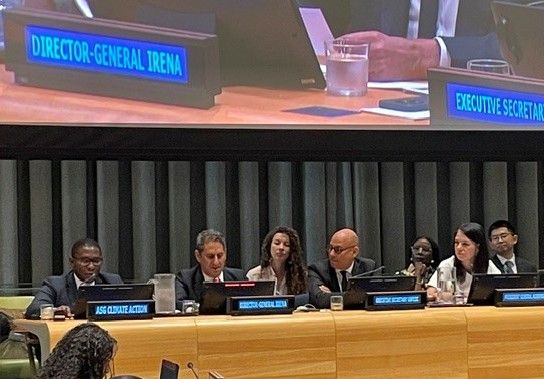
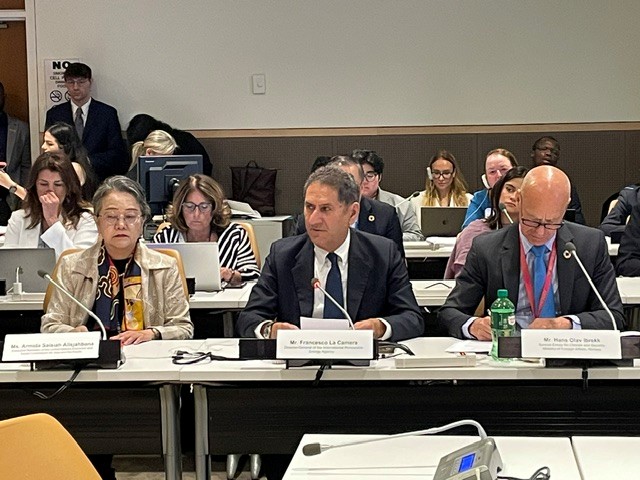
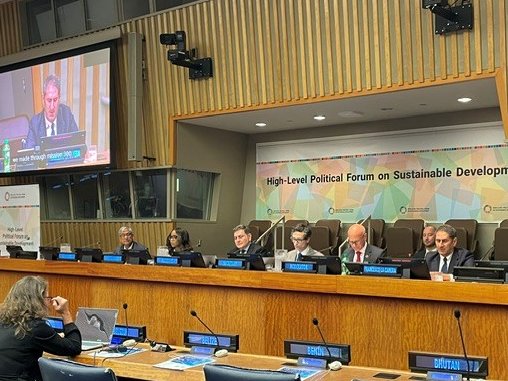
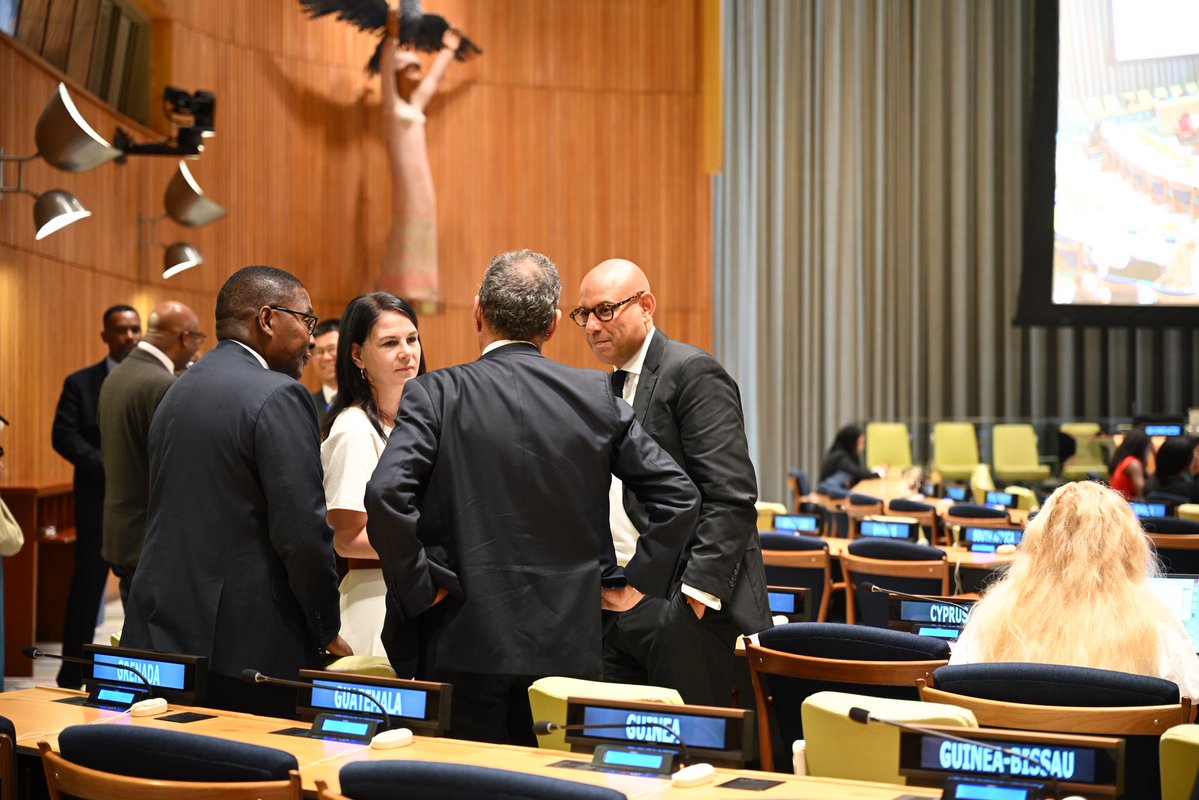
“The answers are all there. But the matching is missing.” Today I convened an Interactive Dialogue on the Global Energy Transition. UNFCCC’s @simonstiell was direct: finance is essential to building resilience. IRENA’s @flacamera put it simply: geology no longer decides who has power. And ASG @SelwinHart reminded us that this revolution is “unstoppable and irreversible. Now we need to deliver, for everyone, including Africa. #UNGA80
Honoured to provide the global state of the energy transition to the @UN General Assembly. The renewable energy story has no winners or losers - only opportunities. @IRENA continues supporting countries in building energy futures defined by resilience and competitiveness. #UNGA80
Many pathways. One global energy transition.
Follow us on #TransitionPathways & find out how renewables are emerging as a common solution to the world's most pressing challenges — from energy security and resilience to competitiveness and sustainable development.
🌏 The global #energytransition doesn't follow a single path. Every country is shaping its own #TransitionPathways, which contribute to global progress. Watch 👇
#DYK? Annual renewable capacity additions have increased notably over the past 25 years, reaching an unprecedented peak of 693 GW in 2025. This positive trend in installed capacity confirms that renewable deployment continues to outpace fossil-fuel growth → https://t.co/3JIwsxtpDf
Delighted to share @IRENA’s latest Renewable Energy Statistics 2026. Renewable electricity generation grew by 9.8% in 2024 — the fasted recorded growth ever.
Renewables accounted for 31.7% of the electricity generation globally in 2024, find out more➡️ https://t.co/uYI1OpePgW
It is always a joy and privilege to meet @UN SG @AntonioGuterres. I thanked him for his tireless call to accelerate the shift towards renewables. We discussed priorities of the energy transition, from #SDG7 progress and electrification to high-level collaboration ahead of #COP31.
A pleasure meeting @flacamera, Director-General of @IRENA, at the #HLPF2026.
We discussed the importance of accelerating the energy transition through stronger regional cooperation & partnerships, and explored opportunities for collaboration between @UNESCWA & @IRENA.
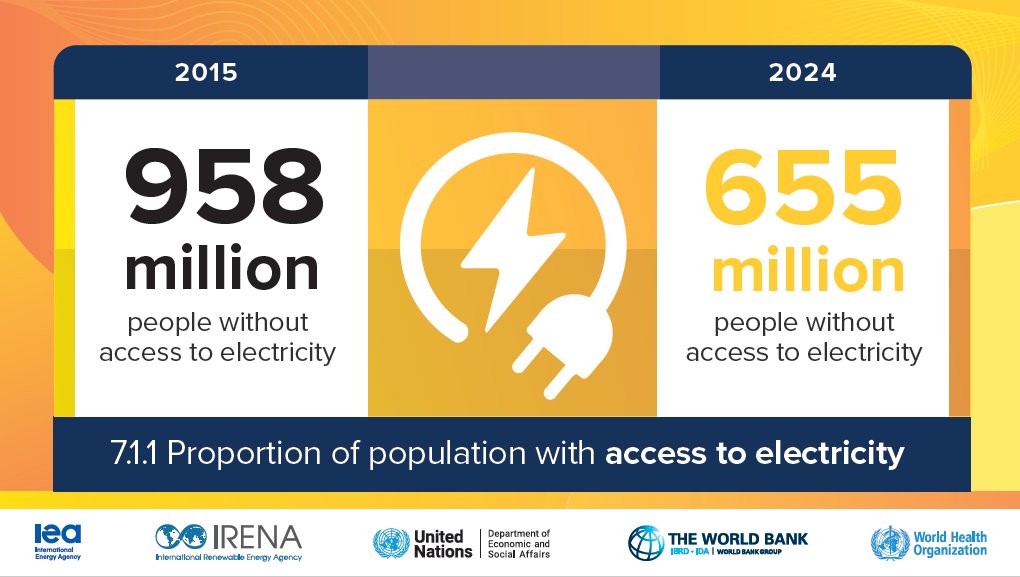
📈The latest #SDG7 data are in!
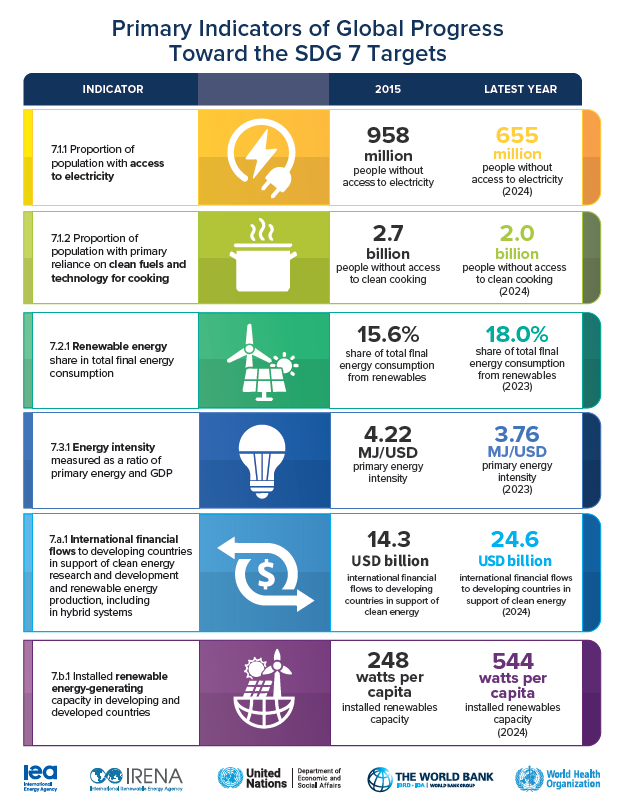
In 2024, 92% of the world had access to electricity 💡& 75% to clean cooking. Renewables continued their strong expansion but financing constraints hamper equitable progress.
Read more: https://t.co/v5zW7LihLq
Progress on sustainable energy goals 2030 tell two stories:
1 - extraordinary progress on renewables
2 - alarming gap on energy access with 655 million people still without electricity
At the #HLPF this week presenting our new #SDG7 tracking report ➡️https://t.co/ktRvguBFzD
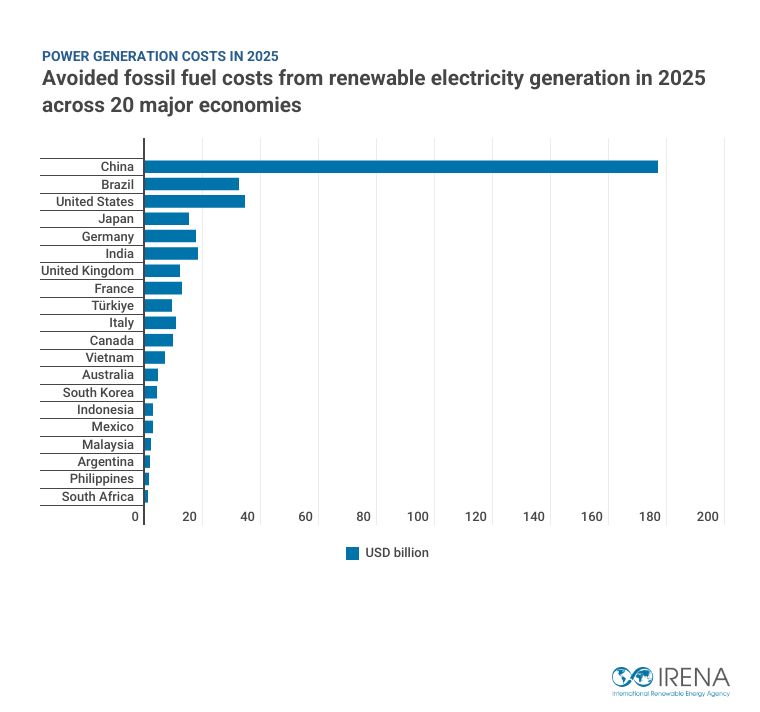
The value of #renewables extends well beyond costs. Existing renewable power also provides a crucial financial buffer in times of fossil fuel crisis. Across 20 major economies, accounting for 4/5 of the world’s generation, renewable power in 2025 avoided an estimated USD 377 billion in fossil-fuel purchases. The geographic distribution of economic benefits mirrors the concentration of renewables, check out @IRENA’s new report on Renewable Power Generation Costs ➡️ https://t.co/r5NosvXz1M
@KI_Agent $480 Billion Fossil-Fuel Costs Avoided by Renewable Energy Boom in 2025. New IRENA cost report confirms renewables not only cheapest new power but also prime geopolitical shock absorber to enhance energy security and economic stability.
https://t.co/lCwkrMHSUN
The cost advantage of #renewables over fossil fuels continued to widen. In 2025, more than 90% of new renewable power added globally was already cheaper than the lowest-cost fossil-fuel alternatives. Conversely, for new gas-fired generation the combined-cycle costs rose in several markets as turbine demand exceeded manufacturing capacity. Find more data in @IRENA’s latest Renewable Power Generation Costs report → https://t.co/SazVofaxSL
UN - renewables are the cheapest new power. They are also a prime geopolitical shock absorber, enhancing energy security and economic stability.
A new report by International Renewable Energy Agency (IRENA) estimates that more than 90% of the utility-scale renewable capacity added in 2025 was cheaper than the lowest-cost new fossil alternative.
In total, installed renewables helped avoid an estimated USD 480 billion in fossil-fuel costs in 2025, turning renewables into a geopolitical shock absorber against fossil-volatile systems in energy crisis.
As United Nations Secretary-General António Guterres said: “The good news is – unlike every past energy crisis – we now have a clear way out. A clean way out. Renewables are the cheapest, fastest and most scalable source of new electricity in most of the world.”
Full report here: https://t.co/SPmcNpX9A3
Since 2010, the cost of solar PV has fallen by 89%, onshore wind by 71% & offshore wind by 63%. Renewables are now the cheapest source of new electricity in most markets.
New @IRENA report confirms the cost advantage of renewables over fossil fuels➡️ https://t.co/JMp0176pJW
OUT NOW! New report confirms the cost advantage of #renewables over fossil fuels. Renewables remained the cheapest source of new #electricity in most markets in 2025 while costs of fossil-generation continued to rise.
In addition to technology, financing remains a key driver of generation #costs. Increasingly, it matters more where a project is built than what is built: national conditions explain around 2.3 times as much variation in financing costs as technology, finds @IRENA’s new 'Renewable Power Generation Costs in 2025' report 👉 https://t.co/SazVofaxSL
Savings generated by renewables are growing, providing a built-in hedge against future fossil fuel shocks.
This energy crisis has shown again: expanding renewables is a strategic investment in resilience & competitiveness ➡️ https://t.co/emggLyGq9t
The business case of #renewables goes far beyond delivering low-cost electricity. How are renewables protecting economies from volatile fossil-fuel prices? Stay tuned for @IRENA's new 'Renewable Power Generation Costs in 2025' report!
As energy demand grows & fossil fuel markets remain volatile, #electrification is poised to lead the next phase of the #energytransition. 🎧 In the latest episode of 'All Things Renewable', @IRENA's expert explains why the "35 by 35" target matters not only for climate goals, but also for strengthening #energysecurity, reducing fossil fuel dependence & building more resilient energy systems. Tune in ▶️ https://t.co/3GhImTXfbz
Electrification is rising across both G20 & non-G20 economies. By 2035, #electrification would reach 37% in G20 countries & 28% in non-G20 economies under @IRENA’s roadmap, highlighting the need for tailored pathways and investment across sectors & regions. More 👉 https://t.co/3TNVyNkhIC
@turkiyecop31